PART 5
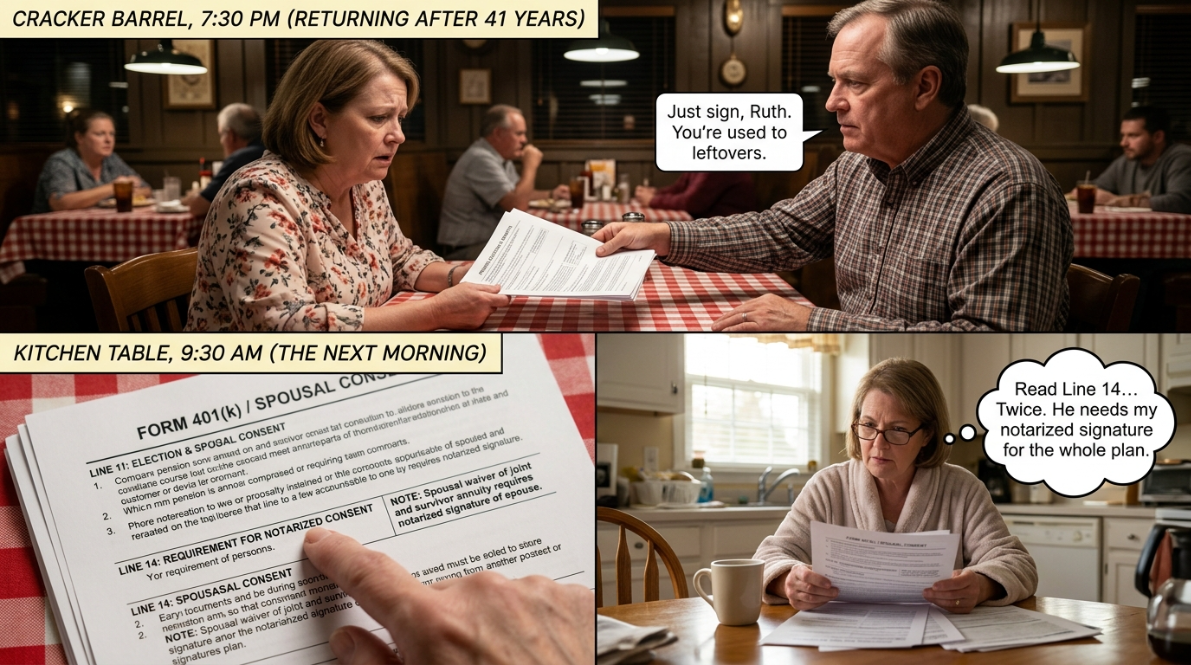
Exactly one year after Charles stood in Cracker Barrel and called me “leftovers,” I walked through those same front doors wearing the same navy cardigan.
Not because I was sentimental.
Because I had promised myself that one day the place where I was humiliated would become just another restaurant.
The young hostess asked, “Table for one?”
I smiled.
“No. I’m meeting family.”
She led me to the large round table by the fireplace.
A few minutes later the door opened, and in came Emily carrying her famous pecan pie, followed by Michael with two noisy granddaughters hanging from his arms. Doris arrived last, waving like she owned the place.
“Sorry I’m late,” she announced. “I had to argue with my roses.”
Lily whispered loudly, “She talks to flowers.”
“I do,” Doris replied. “They listen better than people.”
The whole table laughed.
A year ago I had sat in this restaurant trying not to cry over chicken and dumplings.
Today I ordered them on purpose.
The House Stayed Mine
People always imagine divorce ends with someone winning everything.
Real life is quieter.
I kept the house because the judge recognized it had been my home for forty-one years, and my portion of the retirement assets allowed me to refinance the remaining balance comfortably.
The first thing I did wasn’t remodel the kitchen.
I planted a maple tree in the front yard.
Michael asked why.
“So somebody will have shade long after I’m gone.”
Every spring since, the girls measure themselves against its trunk with a pencil mark.
They call it Grandma’s Tree.
Charles’s New Beginning Wasn’t What He Expected
I heard about Charles the way most people hear about former spouses—in pieces.
Wayne stopped by one afternoon to return a fishing tackle box Charles had accidentally left in his garage.
He stood awkwardly on my porch.
“I figured this belonged to you now.”
I opened the box. Inside were old photographs tucked beneath the lures.
Pictures of camping trips.
The kids holding tiny bluegill.
Our twentieth anniversary at Lake Cumberland.
Wayne sighed.
“He never meant to leave those.”
“No,” I said quietly. “He forgot what mattered.”
Wayne looked relieved that I hadn’t asked questions, but before leaving he said one thing.
“He’s renting an apartment.”
That was all.
I didn’t ask about Marla.
I already knew.
Some endings don’t require details.
An Unexpected Letter
In November, a cream-colored envelope arrived with unfamiliar handwriting.
Inside was a handwritten note.
Dear Mrs. Dalton,
You probably don’t remember me. I’m Beverly from Henderson Tool’s pension office.
I wanted you to know that after our conversation, we reviewed our retirement counseling procedures. Too many spouses signed documents without understanding them.
Beginning this year, every retiring employee and spouse receives a separate explanation of survivor benefits before any election is made.
You changed something important.
I hope your retirement is kinder than ours usually looks.
— Beverly
I read it twice.
Then I cried.
Not because it mentioned Charles.
Because it reminded me that one phone call from an ordinary woman had protected countless other ordinary women.
Sometimes history changes without anyone making the news.
Christmas Morning
That Christmas the house was loud again.
Wrapping paper covered the floor.
Emily burned the cinnamon rolls exactly the way she always did.
Michael pretended not to notice.
Lily handed me a small package wrapped in green paper.
“I made it myself.”
Inside was a wooden picture frame covered in painted daisies.
The photo inside stopped my breath.
It was taken during our Cracker Barrel anniversary breakfast.
Not the bad one.
The one from ten years earlier.
Charles and I were smiling, surrounded by our children and grandchildren.
Lily looked worried.
“Do you not like it?”
I pulled her into my arms.
“I love it.”
Emily watched me carefully.
Later, while washing dishes, she asked, “Was it hard seeing Dad in the picture?”
I dried a plate before answering.
“No.”
“Really?”
“He was part of my life. Pretending he never existed would erase half my memories.”
“So you’re… okay?”
I smiled.
“I’m better than okay.”
There’s a difference between forgetting someone and no longer letting them define you.
The Call
In February, my phone rang just after dinner.
Charles.
I stared at the screen for a long time.
Then I answered.
“Hello.”
His voice was thinner than I remembered.
“I heard about your volunteer work.”
I had begun helping at the community legal aid office twice a week, organizing paperwork for seniors who couldn’t afford attorneys.
The irony wasn’t lost on me.
“I like filing,” I said.
He chuckled softly.
“I know.”
For a moment, we sounded like the young couple we used to be.
“I’m not calling to ask for anything,” he said.
“I figured.”
“I just…” He stopped. “I never apologized.”
I leaned against the kitchen counter.
“No, you didn’t.”
“I was cruel.”
“Yes.”
“I thought retirement meant starting over.”
“And?”
“I didn’t realize starting over would cost me everyone who already loved me.”
His words hung in the silence.
Finally I said, “The children still love you, Charles.”
“They’re different.”
“They grew up.”
He laughed sadly.
“No. They saw me clearly.”
Neither of us spoke for several seconds.
Then he said the words I had waited a year to hear.
“I’m sorry, Ruth.”
Not for getting caught.
Not for paperwork.
For the wound.
I closed my eyes.
“I believe you.”
Forgiveness doesn’t always sound triumphant.
Sometimes it sounds like two tired people finally telling the truth.
We wished each other good night.
That was the last long conversation we ever had.
Five Years Later
The maple tree reached the second-story windows.
Emily became the principal of her elementary school.
Michael coached Lily’s softball team, loudly enough for everyone to hear.
Doris finally admitted her roses liked my fertilizer better than hers.
And every Tuesday morning, I met three widows and one divorced woman at Cracker Barrel for coffee.
We called ourselves The Line Fourteen Club.
Not because we were bitter.
Because every one of us had learned the same lesson in different ways:
Read before you sign.
One rainy Tuesday, the newest woman in our group unfolded a stack of retirement papers with trembling hands.
“I don’t understand any of this,” she whispered.
The others looked at me.
I smiled, reached into my purse, and pulled out my reading glasses.
“Let’s start with line fourteen.”
Outside, rain tapped gently against the windows.
Inside, five women leaned over a table, sharing coffee, paperwork, and the kind of wisdom that only arrives after surviving the life you never expected.
And for the first time in a very long time, I realized Charles had been wrong.
I had never been someone’s leftovers.
I had been the whole meal all along.