PART 4
The first thing I said was, “There has to be some mistake.”
Margaret didn’t answer immediately. She had the patience of someone who had spent forty years watching people discover the truth one document at a time.
She slid the statement closer.
At the top, beneath Henderson Tool’s logo, was Charles’s full name.
Deferred Executive Retention Account
Vested Balance: $286,417.83
I read the number three times.
My hands didn’t shake because of the money.
They shook because I had balanced our household budget for forty-one years and had never seen that account.
Not once.
“I opened every bank statement,” I whispered.
Margaret nodded.
“This wasn’t a bank account. It’s an employer-sponsored deferred compensation plan.”
“So the statements went to work?”
“Most likely.”
I leaned back in my chair.
Charles hadn’t forgotten to tell me.
He had arranged for me never to know.
On the drive home, I didn’t turn on the radio.
I drove past the elementary school where Emily learned to ride her bike, past the Little League field where Michael broke his wrist sliding into second, past the church where Charles and I renewed our vows on our twenty-fifth anniversary.
The town looked exactly the same.
It was my marriage that had become unrecognizable.
When I pulled into the driveway, Doris was trimming her roses.
She lowered the shears.
“Well?”
I smiled weakly.
“You ever find something in your attic that should’ve been in your living room?”
She frowned.
“Can’t say I have.”
“I think I just did.”
She didn’t ask another question.
Good neighbors know when silence is the better gift.
Two days later, Charles’s attorney requested mediation.
Margaret looked delighted.
“Why are you smiling?” I asked.
“Because people usually request mediation when they’re hoping to avoid explaining something to a judge.”
She tapped the deferred account.
“I think Mr. Dalton would prefer this conversation happen in a conference room.”
The mediation took place in a beige office building that smelled faintly of coffee and copier toner.
Charles sat across from me wearing a navy suit I had helped pick out for Michael’s wedding.
Marla wasn’t there.
That surprised me.
His attorney, Richard Ellis, spoke first.
“We’re hoping to reach an amicable settlement.”
Margaret smiled politely.
“So are we.”
Richard slid a proposal across the table.
House to Ruth.
Savings split equally.
Charles keeps pension.
Clean. Simple.
Margaret didn’t even touch the paper.
Instead she opened her leather briefcase and removed one document.
She placed it gently in the center of the table.
The deferred compensation statement.
Charles’s face lost all color.
Richard looked confused.
“What is this?”
Margaret answered calmly.
“It appears to be an omitted marital asset.”
Richard slowly turned toward his client.
“Charles?”
Charles swallowed.
“I… forgot.”
Margaret actually laughed.
Not loudly.
Just enough.
“You forgot a quarter of a million dollars?”
Richard removed his glasses.
“Charles… is this accurate?”
Nobody spoke.
The silence said yes.
Mediation ended thirty minutes later.
Not because we had settled.
Because Richard insisted on a private conversation with his client.
As Margaret and I walked toward the elevator, she whispered, “That’s the shortest mediation I’ve ever attended.”
I asked, “Is this good?”
She pressed the elevator button.
“It’s honest.”
Sometimes honesty is expensive.
That evening my phone rang.
It was Charles.
I almost didn’t answer.
“Hello?”
His voice sounded older.
“Ruth… it wasn’t what you think.”
I closed my eyes.
“What do I think?”
“That I was hiding money.”
“Were you?”
He hesitated.
“I was going to tell you.”
“When?”
Another silence.
“After retirement.”
“After I signed?”
He didn’t answer.
I looked out my kitchen window at the bird feeder Charles had built fifteen years earlier.
Two cardinals landed together.
Funny how nature keeps pairing things after people stop.
“You know what hurts?” I asked.
“The affair?”
“No.”
He sounded surprised.
“It’s that you built an entire future where I disappeared.”
His breathing caught.
“The cabin. The lump sum. The hidden account. You planned every chapter except the one where I remained a person.”
He whispered my name.
But I had already said everything I needed to say.
I hung up.
A week later, something unexpected happened.
Marla knocked on my front door.
Alone.
I considered pretending not to be home.
Instead I opened it.
She looked nothing like the confident woman in my living room.
Her mascara had run.
“Can I have five minutes?”
I folded my arms.
“You have exactly five.”
She nodded gratefully.
“I left Charles.”
I stared.
“I’m not here for sympathy.”
“Then why?”
She reached into her purse and handed me an envelope.
Inside were printed emails.
Retirement projections.
Messages between Charles and a financial advisor.
One sentence had been highlighted.
Once Ruth signs the waiver, I’ll transfer the lump sum and close everything before filing.
My stomach turned.
Marla spoke quietly.
“I didn’t know about the hidden account.”
“You knew about the cabin.”
“Yes.”
“You knew he was married.”
Her eyes filled.
“Yes.”
“I’m not innocent.”
For the first time, she wasn’t trying to defend herself.
“I thought he was leaving an unhappy marriage. That’s what he told me.”
She laughed bitterly.
“Then I watched him lie to everyone else.”
I looked down at the emails.
“Why give these to me?”
“Because one day he’ll tell people I ruined his life.”
She shook her head.
“He did that himself.”
When she stood to leave, I stopped her.
“Marla.”
She turned.
“I do forgive you.”
Her eyes widened.
“But forgiveness doesn’t mean we become friends.”
She nodded once.
“I know.”
Then she walked away.
And somehow that closed a door I hadn’t realized was still open.
The divorce hearing arrived in October.
Forty-one years of marriage fit inside ninety-two minutes.
The judge had kind eyes and absolutely no patience.
When Charles testified that omitting the deferred account had been an oversight, Margaret quietly introduced three years of employer statements mailed directly to his office.
Then she introduced the emails.
The judge removed his reading glasses.
“Mr. Dalton,” he said, “this court has seen forgetfulness.”
He held up the highlighted email.
“This appears considerably more organized.”
Charles lowered his head.
By the end of the hearing, the ruling was clear.
The marital home would be sold only if I chose.
I chose to keep it.
His pension would be divided according to the law.
The deferred compensation account would also be divided.
And because of the intentional nondisclosure, Charles was ordered to pay a substantial portion of my legal fees.
Outside the courthouse, reporters weren’t waiting.
There was no applause.
Just ordinary people walking to lunch.
Life rarely celebrates justice with music.
It simply lets you breathe again.
Winter arrived early that year.
Emily helped me repaint the living room.
Michael installed brighter porch lights.
My granddaughters filled the refrigerator with crooked drawings labeled Grandma’s House.
One Saturday, we were baking cinnamon rolls when the youngest, Lily, asked, “Grandma?”
“Yes?”
“Are you poor now?”
Emily looked horrified.
“Lily!”
I laughed.
“It’s okay.”
I knelt beside her.
“No, sweetheart.”
“Are you rich?”
I thought about the question.
About pensions.
Receipts.
Lawyers.
Heartbreak.
And forty-one years.
I smiled.
“I’m something better.”
“What?”
“I’m free.”
She accepted that answer without needing it explained.
Children often understand freedom better than adults do.
That night, after everyone went home, I found the blue pension folder in my desk drawer.
I opened it one last time.
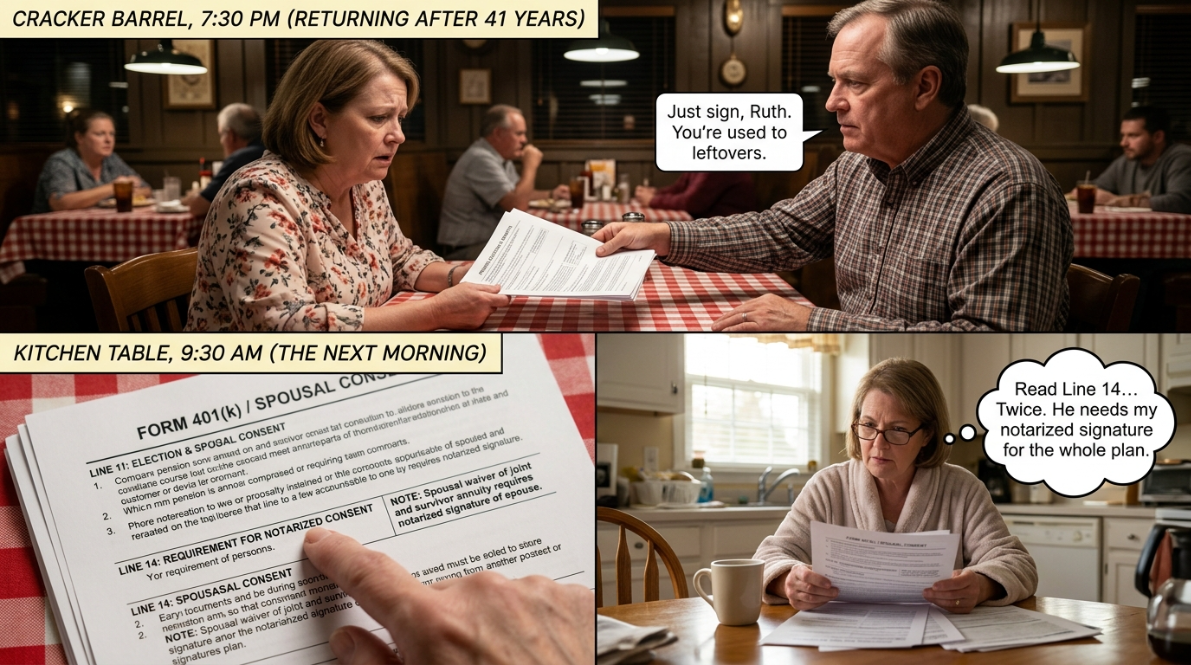
Line fourteen was still highlighted.
The signature space beneath my name was perfectly blank.
I took a black pen.
Not to sign.
To write three words across the bottom of the page.
Consent respectfully declined.
Then I closed the folder forever.