PART 3
He dropped my car keys onto the table with a sharp clatter.
For the first time since Cracker Barrel, Charles looked uncertain.
He wasn’t worried about losing me.
He was worried about losing the money.
He spent the next hour pacing the kitchen.
Every few minutes he tried a different version of the same argument.
“You’ll still get half.”
“This is just paperwork.”
“Why make things ugly?”
Finally he stopped beside the refrigerator.
“You’re punishing me.”
I looked up from buttering toast.
“No, Charles.”
“What then?”
“I’m reading before I sign.”
That answer irritated him more than yelling ever could.
He grabbed his jacket, muttered something about unreasonable women, and slammed the front door hard enough to rattle the picture of our grandchildren hanging in the hallway.
The silence afterward felt enormous.
I finished my toast.
Then I called my daughter.
Emily answered on the second ring.
“Mom?”
The moment I heard her voice, my own nearly disappeared.
“Can you come over?”
She didn’t ask why.
“I’ll be there in twenty.”
Emily arrived carrying two coffees and the expression every daughter wears when she already knows something is wrong.
She sat across from me at the kitchen table—the same chair where she’d done algebra homework twenty-five years earlier.
“What happened?”
I handed her my phone.
She read Marla’s text once.
Then again.
Her jaw tightened.
“He told her you’d sign because you had nowhere else to go?”
I nodded.
Emily set the phone down very carefully.
“That woman texted you?”
“By accident.”
She leaned back and covered her face with one hand.
“I swear Dad has lost his mind.”
I expected her to defend him a little. Children often do.
Instead she reached across the table and squeezed my hand.
“Don’t sign anything.”
“I wasn’t planning to.”
“Good.”
Then she asked the question I had been avoiding.
“Mom… do you want a divorce?”
The word hung between us.
Forty-one years of marriage makes a terrible sound when reduced to two syllables.
“I don’t know,” I whispered.
“I know one thing.”
“What?”
“You need your own lawyer.”
By noon, Emily had found one.
Her name was Margaret Bell, sixty-eight years old, silver hair, sensible shoes, and a reputation for terrifying arrogant husbands.
Her office occupied the second floor above an old pharmacy downtown.
When Margaret walked into the conference room, she didn’t waste time pretending everything would be fine.
“Mrs. Dalton,” she said, opening the pension packet, “has anyone explained what this document actually does?”
“Yes.”
“Did your husband?”
“No. Beverly from payroll.”
Margaret smiled.
“I already like Beverly.”
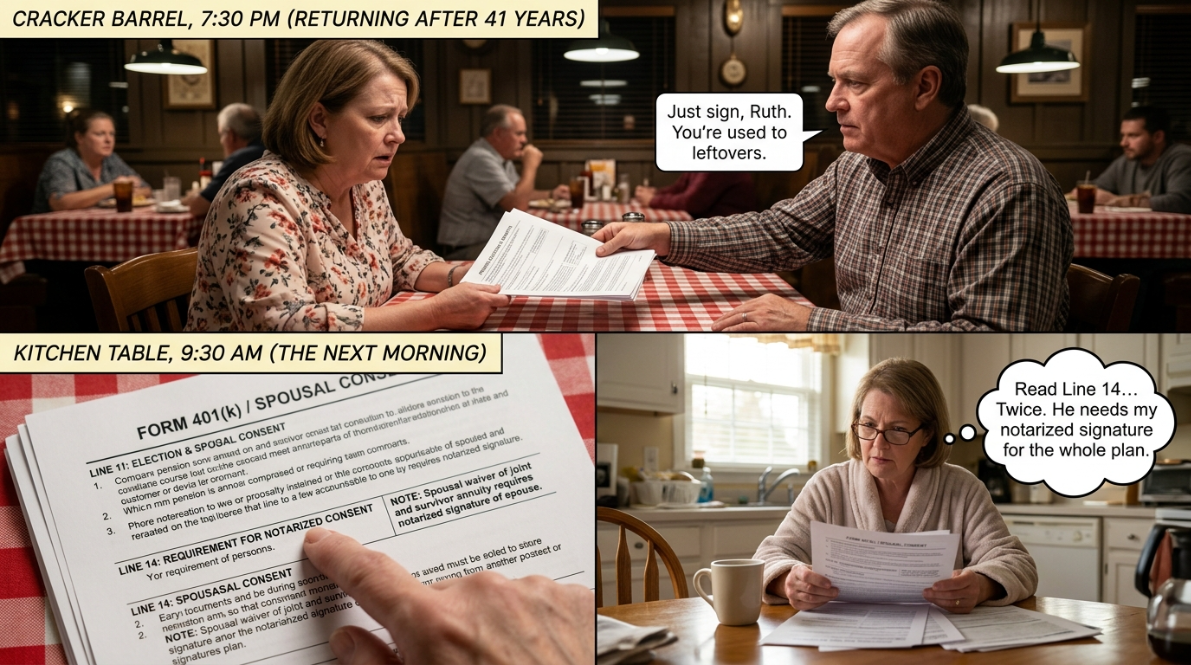
She adjusted her glasses and pointed to line fourteen.
“Your husband wants a lump-sum distribution because it’s immediate. But under the current plan, you’re automatically entitled to survivor protections unless you voluntarily waive them before a notary.”
“So if I refuse?”
“He cannot elect this option while you’re married.”
“Can he force me?”
“No.”
“Can he divorce me?”
“Yes.”
The room became quiet.
Margaret folded her hands.
“But divorce doesn’t erase forty-one years of marital property. It simply changes how it’s divided.”
I felt my shoulders lower for the first time in days.
Charles had spoken as though my signature were inevitable.
Margaret spoke as though it were entirely mine.
There was a difference.
When I returned home, Charles wasn’t alone.
Marla sat in my living room.
She was prettier than I expected.
Not glamorous.
Just younger.
Smooth skin. Bright pink sweater. Teeth so perfectly white they almost glowed.
She stood as I entered.
“Ruth,” she began, “I think we should talk woman to woman.”
I almost laughed.
After forty-one years of washing Charles’s uniforms, raising his children, clipping coupons, sitting through chemotherapy with his mother, and balancing every family budget—
Now she wanted to meet me as a woman.
I set my purse down.
“No.”
She blinked.
“I just wanted—”
“No.”
Charles stepped forward.
“Don’t be rude.”
I turned to him.
“You brought your girlfriend into my house.”
“Our house.”
“Yes,” I said evenly. “The house where your wife still lives.”
Marla picked up her handbag.
“I’ll wait in the car.”
She left without another word.
Charles rounded on me the moment the door closed.
“You embarrassed her.”
“No,” I replied. “You embarrassed yourself.”
His face reddened.
“You’re acting vindictive.”
“Did she pick the cabin?”
He froze.
I watched realization spread across his face.
“The text,” he whispered.
“Yes.”
“You went through my phone?”
“She sent it to mine.”
For one glorious moment, Charles had absolutely nothing to say.
That evening my son Michael came over.
Unlike Emily, Michael looked exhausted.
He loved his father.
He loved me.
And suddenly those loyalties had become opposing teams.
He sat on the porch swing beside me.
“Dad says you’re refusing to cooperate.”
I smiled sadly.
“Is that what he called it?”
Michael rubbed his forehead.
“He says you’re trying to trap his pension.”
I handed him the pension booklet Margaret had highlighted.
“Read page twelve.”
He did.
Halfway through, his eyebrows lifted.
“He needs your consent?”
“Yes.”
“He didn’t tell me that.”
“I know.”
Michael closed the booklet.
“You know what makes me angry?”
“What?”
“He asked me to convince you.”
There it was.
Charles hadn’t come himself.
He had sent our son.
Michael looked out across the yard where his daughters used to catch fireflies.
“I told him no.”
Tears filled my eyes before I could stop them.
He noticed and smiled.
“You’re my mother first.”
Three days later Charles officially moved out.
Not dramatically.
He packed golf clubs, fishing rods, three boxes of clothes, and the leather recliner.
He left the wedding china.
Funny what people decide is valuable.
As he loaded the truck, our next-door neighbor Doris pretended to water flowers for forty-seven straight minutes.
Neighborhoods are like that.
Nobody watches.
Everybody knows.
Before driving away, Charles walked onto the porch.
“We don’t have to make this expensive.”
I folded another towel into the laundry basket.
“That depends.”
“On what?”
“Whether you keep treating me like paperwork.”
He sighed.
“I’ll have my attorney contact yours.”
I nodded.
He waited, almost expecting me to cry.
Instead I asked, “Did you remember your blood pressure medicine?”
He looked confused.
“It’s in the bathroom cabinet.”
For one second, I saw the man I had married instead of the stranger leaving.
He quietly went back inside, retrieved the bottle, and drove away.
Life became strangely peaceful.
Not happy.
Peaceful.
I painted the guest room pale blue.
I donated three garbage bags of Charles’s old magazines.
I learned the television remote actually had subtitles.
Then one afternoon Margaret called.
Her voice sounded unusually cheerful.
“Ruth, I received your husband’s financial disclosure.”
“And?”
“You’re going to want to come in.”
She spread twelve pages across her conference table.
“Your husband reported his pension.”
I nodded.
“He reported Social Security estimates.”
Another nod.
“Would you like to guess what he forgot?”
I looked at the papers.
“I don’t know.”
Margaret turned one page toward me.
Deferred Executive Retention Account.
Balance: $286,400.
I stared.
“What is that?”
Margaret smiled very slowly.
“A retirement account Henderson gave certain long-term supervisors.”
“I’ve never heard of it.”
“I don’t think that was an accident.”
My stomach tightened.
“He hid it?”
“He omitted it.”
“Is there a difference?”
Margaret closed the folder.
“In my profession, judges tend to have opinions about that.”
For the first time since Cracker Barrel, I wasn’t thinking about revenge.
I was thinking about truth.
Charles had called me leftovers.
But he’d forgotten something important.
I was the one who had always kept the receipts.