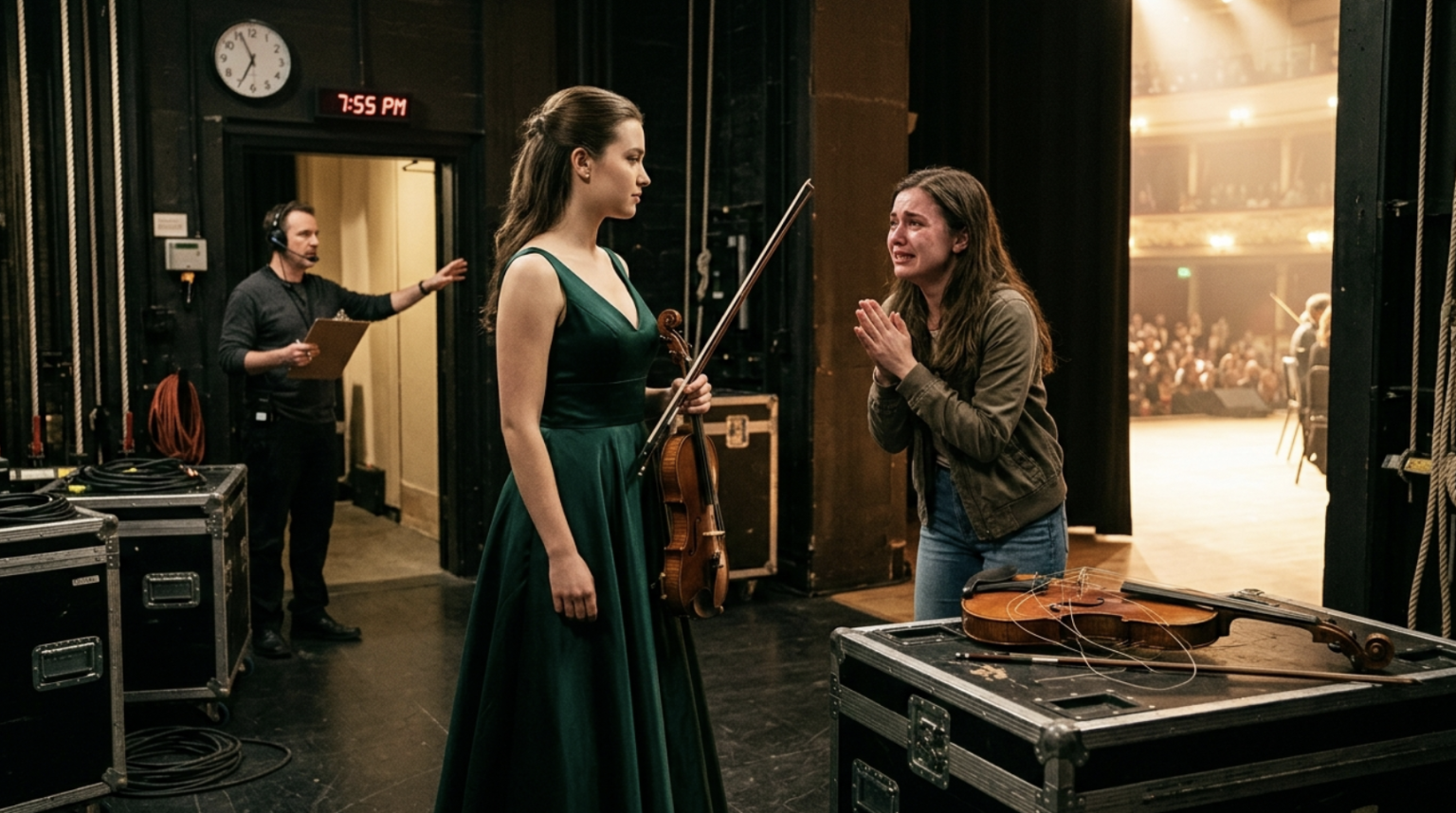
My Sister Broke My $80,000 Grandfather’s Violin 20 Minutes Before My Biggest Performance—Then She Begged Me to Save Her Future
PART 10
She hugged her violin case.
I watched her walk back toward her mother.
And I realized that Grandpa’s greatest legacy had never been the instrument he left me.
It was the belief that music could help someone become stronger, kinder, and more courageous.
That was something Vanessa could never break.
When Evelyn finally called to say the violin was ready for its final assessment, I drove to her workshop immediately.
I had imagined that moment hundreds of times.
Sometimes, in my dreams, the violin looked exactly as it had before.
Sometimes, I imagined it restored with no visible signs of damage.
But when Evelyn opened the case, I understood that restoration wasn’t the same as erasing history.
The violin had been carefully repaired.
The structure was stable, and the damaged areas had been treated with extraordinary care. The restoration was documented, and the instrument’s original materials had been preserved wherever possible.
But a few subtle signs remained.
Tiny traces of its history.
Proof that it had been broken.
Proof that someone had taken great care to bring it back.
I reached toward it, then stopped.
“May I?”
Evelyn smiled.
“Of course.”
I lifted the violin from its case.
It felt familiar in my hands.
I placed it beneath my chin and drew the bow across the strings.
A clear note filled the workshop.
My eyes closed.
For a moment, I was four years old again, sitting beside Grandpa in his armchair.
I could almost hear him correcting my posture.
“Relax your shoulder, Claire.”
I laughed through my tears.
Evelyn stood quietly nearby.
I played a simple scale.
Then another.
The violin responded beautifully, though its voice was not exactly the same as I remembered.
Some things had changed.
But the instrument was alive again.
I lowered the bow.
“Thank you,” I whispered.
Evelyn shook her head.
“Your grandfather trusted me with something precious. I’m glad I could help.”
I carefully placed the violin back in its case.
Then I noticed a small envelope resting beneath the protective lining.
I looked at Evelyn.
“What’s this?”
She seemed surprised.
“I didn’t put that there.”
I opened it.
Inside was a short note in Grandpa’s handwriting, along with a photograph of him standing outside the same music school where Evelyn had once worked.
I recognized the note immediately.
He had written it years before his death, perhaps intending to give it to me when I was older.
Claire,
If this instrument ever returns to your hands after a difficult time, remember that restoration is not the same as pretending nothing happened.
The cracks may leave marks. The work may take longer than you expect. And the instrument may never be exactly as it was.
That does not mean the effort was wasted.
Some things become more meaningful because someone cared enough to repair them.
But remember this, too: not everything that breaks must be returned to its former place in your life.
Learn the difference.
With love, Grandpa.
I read the final sentence several times.
Not everything that breaks must be returned to its former place.
I thought about Vanessa.
I thought about my family.
I thought about the years I had spent trying to preserve relationships by ignoring the damage they caused.
I had believed that healing meant returning to the way things used to be.
Now I understood that healing could mean building something different.
The violin could be restored because the damage could be treated and the instrument could safely function again.
My relationship with Vanessa was more complicated.
It would require honesty, time, and consistent change.
And even if we eventually became close again, we would never be the same sisters we had been before that night.
Perhaps that was all right.
Perhaps the goal wasn’t to return to the past.
Perhaps the goal was to build something better.
A year after the concert, I received an invitation to perform with the New York Metropolitan Youth Orchestra again.
This time, I would be featured in a special program honoring young musicians who had demonstrated exceptional dedication to their craft.
I accepted.
The evening before the performance, I sat at my kitchen table with Grandpa’s violin in its case beside me.
My phone rang.
It was Vanessa.
“Are you busy?” she asked.
“A little. I’m preparing for tomorrow.”
“Oh. Right. Your concert.”
She sounded nervous.
“I wanted to ask you something.”
“Go ahead.”
“Would it be all right if I came?”
I was silent for a moment.
She continued quickly.
“I know you might not want me there. I understand that. But I wanted to ask instead of assuming you would be okay with it.”
I leaned back in my chair.
That small difference mattered.
“You can come,” I said. “But I want to be clear about something.”
“Okay.”
“This is my performance. I don’t want to spend the evening worrying about whether you’re upset with me or whether I need to make you feel included.”
“I understand.”
“And I don’t want you to borrow anything without asking.”
She gave a small, embarrassed laugh.
“Fair enough.”
I smiled despite myself.
“Vanessa, I’m serious.”
“I know. I’m sorry.”
We talked for a few minutes about ordinary things.
She told me she had found a position with a small communications firm and was trying to rebuild her professional reputation through consistent work rather than impressive appearances.
She had started saving money and was learning to live within her budget.
She also admitted that she was still working on her tendency to become defensive when she felt embarrassed.
“I’m not suddenly a different person,” she said. “I still get angry sometimes. But I’m trying to stop myself before I do something I regret.”
“That’s a good place to start.”
After we hung up, I sat quietly for a while.
I didn’t know whether our relationship would ever become close again.
But I could see that something had changed.
Vanessa had asked.
And I had been free to answer.
For the first time, our relationship contained a boundary that neither of us was expected to pretend didn’t exist.
It was a small thing.
But it was real.
The following evening, the concert hall was filled with people.
The orchestra performed several pieces before my turn.
When the announcer introduced me, I walked onto the stage carrying Grandpa’s violin.
The audience applauded.
I stood beneath the lights and looked toward the front row.
My father was there.
My mother sat beside him.
Vanessa was seated several rows behind them.
She wasn’t wearing an extravagant outfit.
She wasn’t trying to attract attention.
She simply sat with her hands folded in her lap, watching me.
For a moment, our eyes met.
She gave me a small nod.
I returned it.
Then I turned toward the conductor.
I lifted my violin.
And I began to play.
The instrument’s voice rose into the hall.
Every note carried the memory of the night it had been broken.
But it also carried the memory of the hands that had restored it.
The patience of Evelyn Hart.
The encouragement of Maestro Cole.
The work of the musicians who had helped me prepare.
The little girl who had once struggled to hold a bow.
And the grandfather who had taught me that music was not something an instrument owned.
It was something a person learned to give.
When I reached the final passage, I felt a familiar warmth in my chest.
I wasn’t thinking about revenge.
I wasn’t thinking about Vanessa’s mistakes.
I wasn’t even thinking about whether the audience would applaud.
I was thinking about Grandpa.
I was thinking about how much he had loved music.
And I was grateful that I had been able to carry that love forward.
The final note faded.
For one quiet moment, the hall was still.
Then the audience rose to its feet.
I bowed.
The applause washed over me.
And for the first time, I felt that the story of the broken violin had finally become something more than a story about what my sister had done.
It had become a story about what I had chosen to do afterward.
After the performance, my family waited near the backstage entrance.
My father hugged me first.
“You were wonderful.”
“Thank you, Dad.”
He looked at the violin case.
“I’m glad it’s back.”
“Me too.”
My mother approached next.
She seemed uncertain.
“I enjoyed the performance,” she said.
“Thank you.”
She hesitated.
“Claire, I’ve been thinking about what happened last year.”
I waited.
“I should have stopped Vanessa. I should have understood how much the violin meant to you instead of worrying about what other people would think.”
Her eyes filled.
“I was wrong.”
I felt my throat tighten.
For years, I had imagined hearing those words from her.
I had imagined that they would erase every painful memory.
They didn’t.
But they made room for something new.
“Thank you for saying that, Mom.”
She reached for my hand.
“I’m sorry.”
I squeezed her fingers.
“I appreciate the apology.”
I didn’t promise that everything was fine.
I didn’t tell her I had forgotten.
But I allowed her to stand beside me without pretending the past had never happened.
Then Vanessa approached.
She looked at the violin case.
“Is it really restored?”
I nodded.
“Evelyn did an incredible job.”
Vanessa’s eyes glistened.
“I’ve thought about that night a lot.”
She looked at me.
“I know I can’t undo what I did. And I know that paying for the damage doesn’t make it disappear.”
She took a breath.
“I want you to know that I’m proud of you. Not because you performed after what happened. Not because you won the fellowship. I’m proud of you because you kept doing what you loved, even when I tried to hurt you.”
I looked at her for a long moment.
“Thank you.”
She swallowed.
“I don’t expect you to forgive me completely just because I’m saying this.”
“Good.”
A faint smile crossed her face.
“Good?”
“Because trust takes time.”
She nodded.
“I know.”
We stood quietly for a moment.
Then she asked, “Would you ever let me listen to you practice again?”
I considered the question.
“When I’m ready.”
She nodded.
“Okay.”
And that was how we left things.
Not with a dramatic embrace.
Not with a promise that we would never argue again.
Just two sisters standing in a quiet corridor, finally beginning to understand that love without respect was not enough.
Several months later, I organized a small concert for the children at the community music program.
The event took place in a modest auditorium with folding chairs, homemade decorations, and a piano that had seen better days.
Parents filled the room.
Children fidgeted nervously with their instruments.
Mia, the little girl whose violin had been damaged, stood near the front wearing a blue dress.
Her instrument had been repaired.
She had worked hard for months, and she was about to perform her first solo.
Before she went onstage, she approached me.
“Miss Claire?”
“Yes?”
“What if I make a mistake?”
I smiled.
“You probably will.”
Her eyes widened.
“Really?”
“Of course. Everyone makes mistakes.”
“But what if everyone hears?”
“Then everyone will hear that you’re brave enough to keep going.”
She looked down at her violin.
“What if I forget what comes next?”
“Take a breath. Find your place. Begin again.”
She thought about that.
Then she nodded.
When her name was called, she walked onto the stage.
Her first few notes were hesitant.
Halfway through the piece, she missed a note and stopped.
I saw panic flash across her face.
The audience remained silent.
Mia looked toward me.
I smiled and nodded.
Take a breath.
Find your place.
Begin again.
She lifted her bow.
And she continued.
When she finished, the audience applauded warmly.
Mia ran offstage, laughing and crying at the same time.
“I made a mistake!”
“You did.”
“But I finished!”
“You did.”
She hugged me.
I held her for a moment, and I felt something settle peacefully inside me.
Grandpa had taught me how to play the violin.
But he had also taught me how to keep going when life became painful.
And now, in a small auditorium filled with children and proud parents, I was passing that lesson on.
Not through a perfect performance.
Not through an expensive instrument.
But through a simple reminder that a mistake, a disappointment, or even a broken thing did not have to become the end of someone’s story.
That night, after the children had gone home and the chairs had been stacked, I returned to my apartment.
I placed Grandpa’s violin on its stand beside the window.
The evening light touched the polished wood.
THE BEST PART IS NEXT 👇

Related Posts

My Family Wanted Me to Plead Guilty for My Sister’s Crime—But I Had Been Waiting Four Years to Reveal the Truth ro By ro

My Husband Cheated and Humiliated Me for Three Years—Until He Discovered Who His Wife Really Was