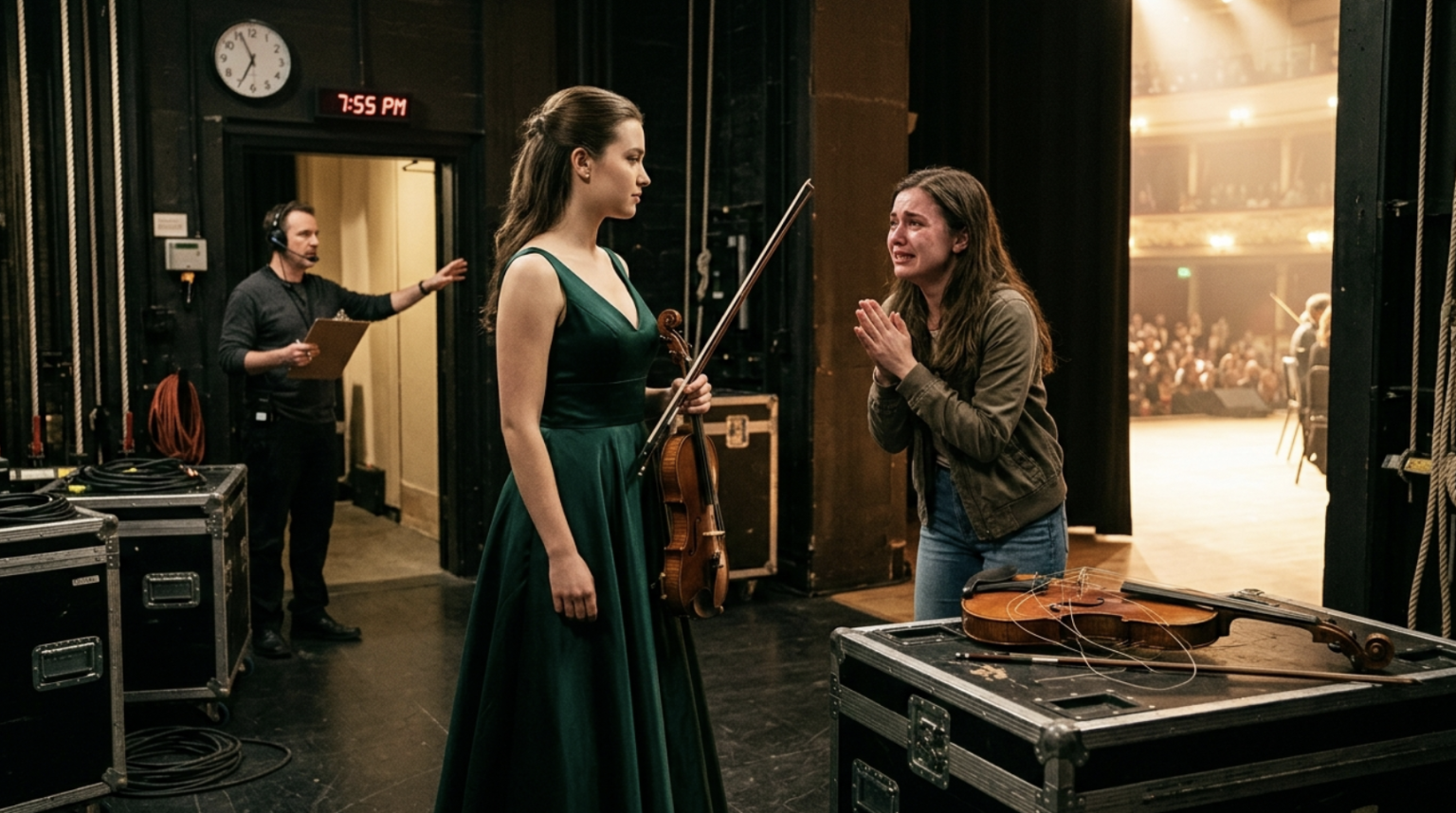
My Sister Broke My $80,000 Grandfather’s Violin 20 Minutes Before My Biggest Performance—Then She Begged Me to Save Her Future
PART 9
Another part remembered the girl who had once sat beside me on the living-room floor while Grandpa taught us both to recognize musical notes.
Vanessa had been only seven then.
She used to clap whenever I played a scale correctly, and she once made me a paper medal that said BEST VIOLINIST IN THE WORLD.
I had kept it for years.
Our relationship hadn’t always been cruel.
Somewhere along the way, something had changed.
Perhaps my parents’ constant comparisons had made her feel entitled to more attention. Perhaps she had learned that getting what she wanted was easier than learning to accept disappointment. Perhaps there were reasons I would never fully understand.
But understanding why someone hurt you didn’t mean you had to pretend the hurt never happened.
I replied.
We can talk tomorrow. Somewhere public.
We met at a small café near the park.
Vanessa arrived early.
She wasn’t wearing designer clothes or expensive jewelry. Her hair was tied back, and she looked tired.
For several minutes, we sat without speaking.
Finally, she looked up.
“I owe you an apology.”
I waited.
She took a shaky breath.
“I know I said I was sorry before, but I wasn’t really apologizing. I was angry that you wouldn’t help me. I was upset about what happened at the reception. I was thinking about myself.”
She stared at her hands.
“I didn’t think about Grandpa. I didn’t think about how much that violin meant to you. I just wanted to hurt you because you said no.”
The words were painful to hear.
But they were also the first honest words she had spoken about the incident.
“Why?” I asked.
She looked up.
“What?”
“Why did you want to hurt me?”
She swallowed.
“Because you always seem to get what you want.”
I stared at her.
“Vanessa, you broke my violin because you thought I had something you deserved.”
She shook her head.
“I know how it sounds.”
“No. I don’t think you do.”
I leaned forward.
“You thought my success meant I had an easier life. You thought my dress was something you could take because you liked it. You thought Grandpa’s violin was just an expensive object. And when I refused to give you what you wanted, you decided to destroy it.”
Tears slipped down her cheeks.
“I know.”
“Do you?”
She nodded.
“I’ve been thinking about it every day.”
She told me that the incident had forced her to confront several things she had avoided for years.
She had spent too much money trying to appear successful. She had exaggerated her professional connections and made promises she couldn’t always keep. She had become so accustomed to receiving help from our parents that she rarely considered how her behavior affected other people.
The reception incident hadn’t destroyed her career, but it had embarrassed her and damaged the trust of people she hoped to work with.
She had been asked to provide clarification about her claims and had lost an opportunity to assist with a project.
She had also begun speaking with a counselor to understand why she reacted so aggressively when people refused her.
“I thought you were always judging me,” she said. “Whenever you succeeded at something, I felt as if I was falling behind.”
I listened.
“I know that isn’t your fault. But I acted as though it was.”
She wiped her eyes.
“I don’t expect you to forgive me today. I don’t expect you to lend me anything or pretend we’re close. I just want you to know that I understand what I did.”
I studied her face.
For once, she wasn’t asking me to fix the situation.
She wasn’t demanding that I reassure her.
She wasn’t telling me how much worse her life had become because of my refusal to protect her.
She was acknowledging what she had done.
“Thank you for telling me,” I said.
She looked up hopefully.
“Does that mean we’re okay?”
I shook my head gently.
“Not yet.”
Her face fell.
“But it means we can begin somewhere,” I continued. “If you want to rebuild our relationship, you’ll have to show me that you can respect my boundaries. Not just today. Not just when you’re afraid of losing something. Consistently.”
She nodded slowly.
“I understand.”
“And Vanessa?”
“Yes?”
“I need you to pay for the damage you caused, according to the restoration costs and the proper legal and insurance process. I’m not going to pretend it didn’t happen.”
She looked down.
“I understand.”
“I don’t want revenge. I want accountability.”
She took a breath.
“I’ll cooperate with the process. I’ll do what I’m legally responsible for.”
For the first time in months, I believed she might mean it.
It wasn’t a magical reconciliation.
We didn’t hug across the table and suddenly become best friends.
I didn’t tell her everything was forgiven.
But when we stood to leave, I felt lighter.
I had said what needed to be said.
And I had allowed her the opportunity to become someone better without making myself responsible for whether she succeeded.
That was enough for one afternoon.
The restoration took eleven months.
Evelyn worked slowly, documenting every stage and explaining each decision before proceeding.
Some pieces could be stabilized and rejoined. Others required more complicated treatment. The neck had sustained serious damage, and the instrument’s structure needed careful attention to avoid placing further stress on the surviving wood.
The final restoration was not inexpensive.
The insurance process took time, and the question of responsibility required documentation and professional advice. Vanessa cooperated with the process, and the matter was resolved through the appropriate channels.
I refused to let the financial question become a substitute for the emotional one.
Money could help pay for restoration.
It couldn’t purchase trust.
During those eleven months, I continued my fellowship.
I attended master classes, performed in smaller concerts, and studied with musicians whose recordings I had admired since childhood.
I also began teaching young students at a community music program on weekends.
At first, I did it because I needed extra income.
But I soon discovered that I loved teaching.
I loved watching a child struggle with a difficult passage and then finally produce a clear note.
I loved seeing the way a student who was afraid to perform slowly learned to trust their own hands.
And I loved telling them the same thing Grandpa had once told me.
“You don’t have to be perfect to make something beautiful.”
One Saturday afternoon, a little girl named Mia arrived at class carrying a violin case that was far too large for her.
She was eight years old, with untidy braids and an expression of absolute determination.
“Miss Claire,” she asked, “what happens if my violin breaks?”
I knelt beside her.
“Why do you ask?”
She opened her case and showed me a small crack near the edge.
“My brother dropped it. My mom says we might not be able to afford another one.”
I examined the instrument.
The damage appeared manageable, though I would need to have it assessed before promising anything.
“Let’s have someone look at it,” I told her. “We may be able to repair it.”
She bit her lip.
“But what if we can’t?”
I thought of Grandpa’s violin.
Then I smiled.
“Then we’ll find a way for you to keep playing.”
Her eyes widened.
“Really?”
“Really. Because the most important part of playing isn’t the instrument you own. It’s what you learn to do with it.”
PART 10 IS NEXT 👇

Related Posts

My Family Wanted Me to Plead Guilty for My Sister’s Crime—But I Had Been Waiting Four Years to Reveal the Truth ro By ro

My Husband Cheated and Humiliated Me for Three Years—Until He Discovered Who His Wife Really Was