PART 4
For a long moment, I couldn’t understand what I was looking at.
Three words.
Keep her confused.
The handwriting was familiar.
Too familiar.
I had seen it on grocery lists.
Birthday cards.
Notes left on the refrigerator.
The little reminders my husband used to write before going to work.
I looked at the detective.
“That’s his handwriting.”
The detective didn’t react.
“You’re certain?”
“Yes.”
He turned the photograph around and placed it beside another document.
A prescription record.
Then another.
Then another.
“This is what we’ve been able to establish so far,” he said.
I looked down.
My husband’s name appeared repeatedly.
Different dates.
Different pharmacies.
Different medications.
Some were legitimate.
Others weren’t.
But the most disturbing part wasn’t the medications.
It was the pattern.
Every time I had complained about feeling dizzy, exhausted, confused, or unusually sleepy, a prescription had been filled somewhere.
Not in my name.
In his.
And several of the medications were sedating.
I felt cold despite the hospital room being warm.
“How long?”
“We’re still determining that.”
“No.”
I looked directly at him.
“How long has this been happening?”
The detective hesitated.
“At least several months.”
Several months.
I closed my eyes.
Suddenly, memories came crashing back.
The afternoon I forgot my daughter’s school pickup.
The night I couldn’t remember whether I had locked the front door.
The morning I woke up with a headache and couldn’t remember falling asleep.
The time I found myself crying in the kitchen and couldn’t explain why.
My husband had always been there.
Always ready with an explanation.
“You’re exhausted.”
“You’re overwhelmed.”
“You need help.”
“You’ve been acting strange.”
“You should see someone.”
And because he said those things so gently, I believed him.
I believed the man who was poisoning my confidence.
I believed the person who was supposed to protect me.
I believed him because I loved him.
The detective spoke quietly.
“Mrs. Hale, there’s more.”
I looked at him.
“What?”
“We found a notebook.”
“Where?”
“In your husband’s desk.”
My stomach tightened.
“What kind of notebook?”
“Financial records. Medication records. Notes about your behavior.”
My hands went numb.
“My behavior?”
The detective nodded.
“He documented things he called your ‘episodes.’”
He opened a folder.
There were pages.
Dates.
Times.
Descriptions.
August 2 — emotional.
August 8 — forgot appointment.
August 15 — cried for no reason.
August 21 — accused Mom of interfering.
August 27 — slept unusually long.
I stared at the page.
The dates matched the days I remembered feeling sick.
Then I saw something written in the margin.
Need to increase confusion before evaluation.
My breath caught.
“Evaluation?”
The detective nodded.
“There’s a psychiatric appointment scheduled for you next week.”
I looked at him.
“I never made one.”
“We know.”
“Who did?”
“Your husband.”
The room seemed to become smaller.
He had been preparing something.
Not just hiding what he had done.
Building a story.
A story where I was unstable.
A story where I was an unreliable mother.
A story where everyone would believe him when he said he needed to take control.
I whispered,
“He was going to take my children.”
The detective didn’t answer.
He didn’t need to.
That night, I didn’t sleep.
I sat beside my son’s hospital crib until sunrise.
My daughter slept curled beneath a blanket in the chair.
Every few minutes, I looked at her.
She had saved her brother.
A seven-year-old child had noticed what three adults had failed—or refused—to see.
I reached over and touched her hair.
She stirred.
“Mommy?”
“I’m here.”
“Is the baby okay?”
“He’s getting better.”
She smiled sleepily.
“Good.”
Then she closed her eyes again.
I looked at my son.
His tiny chest rose and fell.
I whispered,
“I promise you both something.”
My voice broke.
“I will never ignore my instincts again.”
The next morning, my husband came to the hospital.
He looked exhausted.
He had apparently spent the night being questioned.
He stood at the doorway.
“Can I see him?”
I didn’t answer.
He looked at our son.
“Please.”
I stepped between him and the crib.
“You don’t get to hold him.”
His eyes filled with tears.
“I’m his father.”
“And I’m his mother.”
“I made a mistake.”
“A mistake is giving someone the wrong bottle.”
He swallowed.
“You don’t understand.”
“No.”
I looked at him.
“I understand now.”
He lowered his head.
“My mother told me it would help.”
“You knew.”
“I knew she was giving him something.”
“You knew.”
“I didn’t know how dangerous it was.”
“You didn’t ask.”
He looked at me.
“You never asked.”
His silence told me everything.
I stepped closer.
“You didn’t want to know.”
He began crying.
“I was scared.”
“Of what?”
“That you’d leave.”
I stared at him.
“So you tried to make me believe I was losing my mind?”
“I never wanted it to go this far.”
“You wrote ‘keep her confused.’”
His face went white.
The detective had not told him we had found the note.
I watched the realization spread across his face.
He understood.
He had lost.
Not because I had fought him.
But because he had underestimated the one person he never thought would speak.
Our daughter.
By noon, investigators searched our house.
I didn’t go with them.
I didn’t need to.
They found enough.
The purple bottle.
The medication records.
The notebook.
Several discarded syringes.
And a hidden folder containing financial documents.
That folder revealed the final piece of the plan.
My husband had been preparing to petition for full custody.
He had already contacted an attorney.
He had already collected statements from his mother describing me as emotionally unstable.
He had even drafted a letter claiming I was suffering from severe postpartum anxiety and was becoming dangerous around the children.
My hands shook as I read it.
Not because it was true.
Because it was so carefully constructed.
He hadn’t lost control.
He had been planning.
And my mother-in-law had helped him.
There were messages between them.
One said:
She trusts you. Keep giving her the pills.
Another:
If she gets worse, the doctor will believe us.
Another:
Once the baby is old enough, we can make the case stronger.
I stopped reading.
I couldn’t breathe.
My daughter was sitting beside me.
I closed the folder.
She didn’t need to see it.
Not yet.
There were some things a child should never have to carry.
The investigation moved quickly after that.
My husband was arrested.
My mother-in-law was arrested later that day.
The charges were serious.
Medication tampering.
Endangering a child.
Conspiracy.
And additional charges related to what investigators believed had been done to me.
But the legal process would take months.
Maybe longer.
For the first time, I didn’t care about revenge.
I cared about healing.
My son remained in the hospital for several more days.
His fever eventually came down.
His feeding improved.
The doctors monitored him carefully.
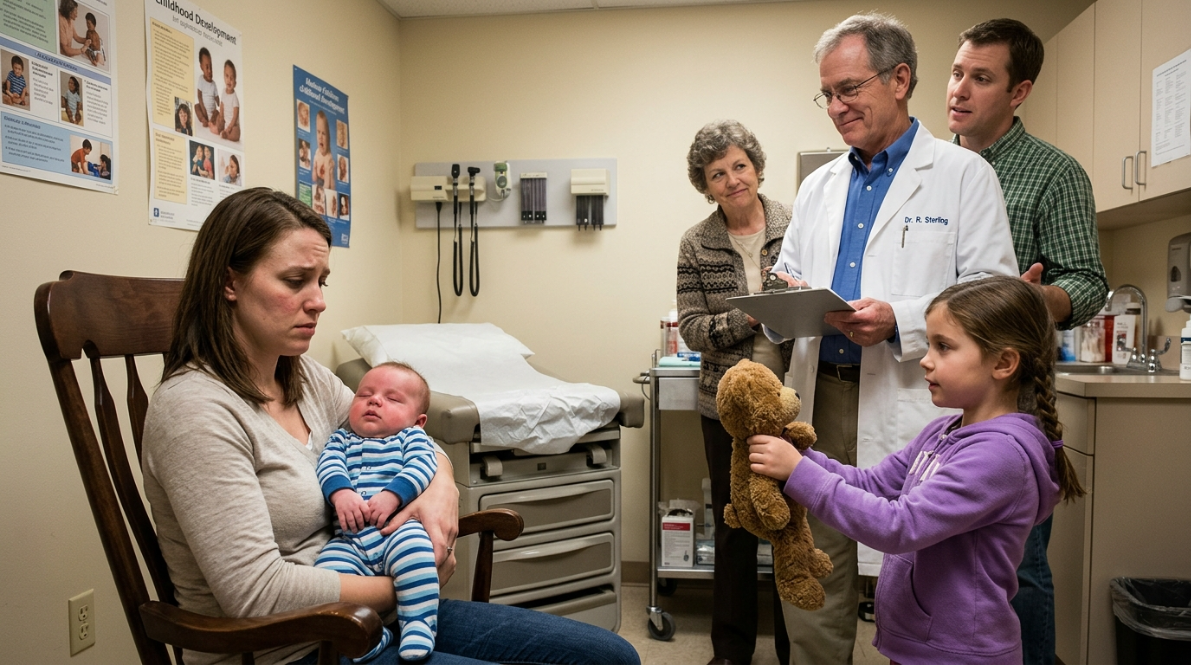
One afternoon, Dr. Sterling came into the room.
He smiled.
“He’s doing beautifully.”
I nearly cried.
“Really?”
“Really.”
He checked the baby’s chart.
“His numbers look much better.”
I looked at my son.
“He saved himself.”
Dr. Sterling shook his head.
“No.”
He looked toward my daughter.
“She did.”
My daughter smiled shyly.
Dr. Sterling crouched beside her.
“You know something?”
“What?”
“Doctors don’t always find the answer first.”
She hugged her teddy bear.
“Mommy said I should tell the truth.”
Dr. Sterling smiled.
“Your mother taught you well.”
I looked away because my eyes were filling again.
Three months later, the court hearing began.
I expected to be terrified.
Instead, I felt strangely calm.
My husband sat at the other side of the courtroom.
He looked older.
Smaller.
Nothing like the confident man who had once told me I was imagining everything.
My mother-in-law sat beside her attorney.
She wouldn’t look at me.
The evidence was presented.
Pharmacy records.
Hospital records.
Video footage.
Handwriting analysis.
Messages.
The notebook.
The medication bottles.
And finally, my daughter’s statement.
Because she was young, she didn’t testify in the same way an adult witness would.
A child specialist spoke with her privately.
The evidence she had preserved was presented through proper legal channels.
The paper where she had written the dates became one of the most important pieces of evidence in the case.
The video was even more devastating.
My husband standing beside the crib.
2:13 a.m.
Holding the syringe.
Looking toward the camera.
And whispering:
“She’ll never know.”
When the recording ended, there was silence in the courtroom.
My husband lowered his head.
I never looked at him.
I looked at my daughter.
She was sitting beside me.
Holding her teddy bear.
The same teddy bear that had carried the prescription bottle into the hospital.
I squeezed her hand.
Months passed.
The court eventually ruled that my husband and mother-in-law were responsible for what happened.
My husband lost custody.
My mother-in-law was prohibited from contacting the children.
The criminal case continued separately.
I didn’t celebrate.
There was nothing to celebrate.
My son had been harmed.
My daughter had been forced to become brave too early.
And I had spent months questioning my own mind.
But slowly, life began to return.
We moved.
Not far.
Just far enough.
I wanted a house where every room didn’t carry a memory.
I wanted a kitchen where I could stand without remembering arguments.
A bedroom where I could sleep without wondering whether someone had entered while I was unconscious.
A front door I could lock without wondering who might be standing behind it.
The first night in our new home, my daughter walked into the baby’s room.
She placed her teddy bear on the shelf.
Then she looked at me.
“Mommy?”
“Yes?”
“Can we keep the bear here?”
“Of course.”
“Because he helped.”
I smiled.
“He did.”
She climbed onto the chair.
“Can I tell you something?”
“Anything.”
“I don’t hate Daddy.”
I sat beside her.
“You don’t have to.”
She looked surprised.
“But he hurt the baby.”
“Yes.”
“And he hurt you.”
“Yes.”
“Then why don’t I hate him?”
“Because you’re allowed to feel whatever you feel.”
She leaned against me.
“Can people do bad things and still love you?”
I thought about that for a long time.
“Yes,” I finally said.
“But love doesn’t make harmful choices okay.”
She nodded slowly.
“Then I love Daddy, but I don’t want him here.”
I kissed her forehead.
“That is okay.”
A year later, my son took his first steps.
He was standing in the living room, holding onto the edge of the sofa.
My daughter was sitting on the floor with the teddy bear beside her.
“Come on!” she shouted.
“Come to Mommy!”
My son let go.
One step.
Then another.
Then another.
He fell onto his bottom.
My daughter screamed with excitement.
“He did it!”
I laughed.
I was crying too.
I picked him up.
He wrapped his tiny arms around my neck.
And for the first time in a long time, I didn’t think about hospitals.
Or prescriptions.
Or courtrooms.
Or lies.
I thought about the future.
Two years after the hospital incident, my daughter brought home a school assignment.
The teacher had asked the children to write about someone who had taught them an important lesson.
She handed me the paper.
At the top, in large uneven letters, she had written:
MY MOM
I smiled.
“Why me?”
She shrugged.
“Because you taught me that being scared doesn’t mean you should stay quiet.”
I read the rest.
It said:
My mom taught me that sometimes grown-ups can be wrong.
She taught me that you should ask questions.
She taught me that if something feels wrong, you should tell someone.
And she taught me that telling the truth can help people.
At the bottom, she had drawn three people.
Me.
Her.
And her little brother.
There was a fourth figure crossed out in black crayon.
I didn’t ask who it was.
I already knew.
I hugged her.
“You’re an incredible girl.”
She smiled.
“I learned from you.”
I shook my head.
“No.”
I looked at the teddy bear on the shelf.
“I learned from you too.”
Years later, my son would not remember the hospital.
He would not remember the fever.
He would not remember the machines.
He would not remember the woman who had nearly taken away his chance to grow up healthy.
But my daughter remembered.
And I remembered.
Not because I wanted to live in the past.
Because remembering taught us what silence could cost.
My son grew into a healthy, energetic boy.
My daughter became fiercely protective of him.
She was the first person he ran to when he scraped his knee.
The first person he called when he lost a tooth.
The first person he wanted beside him on the first day of school.
And whenever he asked why she was so protective, she would grin and say,
“Because I’m your big sister.”
She never told him the whole story.
I didn’t either.
Not yet.
Some truths belong to adulthood.
But I made sure he knew one thing.
His sister had loved him before he was old enough to understand what love meant.
My husband eventually sent me a letter.
I didn’t open it for several days.
When I finally did, it was only one page.
He apologized.
He said he had been afraid.
He said his mother convinced him that I was unstable.
He said he regretted everything.
He said he wanted forgiveness.
I read the letter twice.
Then I folded it.
I didn’t write back.
Not because I hated him.
Because forgiveness and reconciliation were not the same thing.
I could forgive someone in my heart someday.
But I didn’t have to give them access to my life again.
That was a lesson I had learned the hard way.
One spring morning, several years after everything happened, my daughter and I were cleaning out a closet.
She found the old teddy bear.
The denim overalls were faded.
One button was missing.
She held it up.
“Remember this?”
I smiled.
“How could I forget?”
She laughed.
“It’s ugly now.”
“It was always ugly.”
She gasped dramatically.
“Mom!”
We both laughed.
Then she became quiet.
“You know what?”
“What?”
“If I hadn’t taken the medicine bottle…”
She didn’t finish.
I knelt beside her.
“Don’t think about what might have happened.”
“But—”
“You did what you knew was right.”
She looked at me.
“You believed me.”
“I should have believed you sooner.”
She shook her head.
“You were trying.”
I hugged her.
For a moment, neither of us spoke.
Then she whispered,
“Mommy?”
“Yes?”
“I’m glad you listened eventually.”
I closed my eyes.
“So am I.”
That night, I tucked my children into bed.
My son was already asleep.
My daughter was still awake.
“Mommy?”
“Yes?”
“Are you scared anymore?”
I sat beside her.
“Sometimes.”
“Even now?”
“Sometimes.”
She thought about that.
“Then what do you do?”
I smiled.
“I listen to myself.”
She nodded.
“Good.”
She pulled the blanket to her chin.
“Because you’re usually right.”
I laughed softly.
“Usually?”
She grinned.
“Sometimes you’re wrong.”
“That’s true.”
She closed her eyes.
I kissed her forehead.
Then I walked into the hallway.
For a moment, I stood completely still.
The house was quiet.
Peaceful.
Safe.
I could hear my son’s soft breathing through the open door.
I could hear my daughter’s gentle snoring.
And for the first time, silence didn’t frighten me.
It comforted me.
I had once believed that trusting someone meant never questioning them.
I had learned that real trust was different.
Real trust didn’t demand silence.
It didn’t punish questions.
It didn’t make you feel crazy for noticing something wrong.
And love was not supposed to require you to ignore your instincts.
My daughter had taught me that with a teddy bear, a shaking voice, and a bottle she refused to throw away.
She had been seven years old.
But that night, she had been brave enough to say what everyone else was afraid to hear.
“Grandma gave the baby the wrong medicine.”
Those words saved my son’s life.
They saved my sanity.
And, in a strange way, they saved me from spending the rest of my life believing the lie that I was the problem.
I walked into my son’s room one last time.
He was sleeping peacefully.
I touched his forehead.
Cool.
Normal.
Safe.
I smiled.
Then I looked toward the doorway where my daughter stood holding the old teddy bear.
She smiled at me.
And I finally understood something I would carry for the rest of my life:
Sometimes the person everyone dismisses as too young, too emotional, too frightened, or too inexperienced is the only person brave enough to tell the truth.
And sometimes the smallest voice in the room is the one that saves everyone.
I turned off the light.
“Goodnight,” I whispered.
My daughter whispered back,
“Goodnight, Mommy.”
I closed the door.
And this time, when I walked away, I wasn’t afraid of what might be happening behind it.
I knew my children were safe.
And I knew something else, too.
No one would ever convince me to stop listening to my own voice again.
THE END
Continue Reading