PART 3
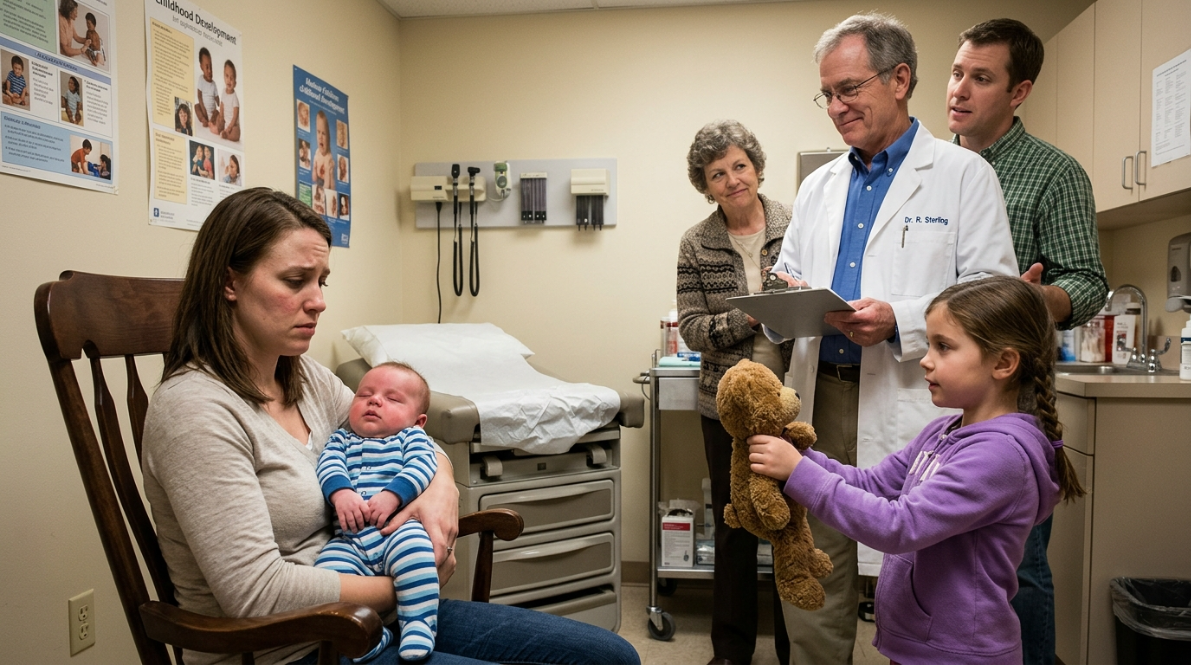
She hugged the teddy bear tighter.
Advertisement
“I didn’t.”
My husband looked at me.
“She’s confused because she’s scared.”
I stared at him.
Advertisement
That sentence.
Again.
Always the same sentence.
She’s confused.
You’re anxious.
You’re imagining things.
You’re overreacting.
For months, every time something felt wrong, I had been told the problem was not what was happening around me.
The problem was me.
But my seven-year-old daughter was standing in a hospital examination room holding the evidence.
And suddenly I remembered something I had dismissed as a mother’s exhaustion.
The first night my son became sick, my husband had told me, “Go to sleep. Mom knows what she’s doing.”
The second night, he had told me, “You need to stop checking on him every ten minutes.”
The third night, when I woke up and asked why the baby’s breathing sounded strange, my mother-in-law had smiled and said, “He finally slept. Don’t ruin it.”
I had believed them.
Because I had wanted to believe them.
I had wanted my husband to be the man I married.
Dr. Sterling looked at the nurse.
“Let’s get the baby into a monitored bed. Now.”
The nurse gently took my son from my arms.
I followed.
My husband tried to come with us.
Dr. Sterling stepped in front of him.
“Sir, I need you to stay here.”
My husband frowned.
“Why?”
“Because I need to understand exactly what your child has been given.”
“My mother already explained—”
“I didn’t ask your mother.”
The room became very quiet.
Dr. Sterling looked at me.
“Do you have the names of all medications your son has been prescribed?”
“Yes.”
“Any over-the-counter medicine?”
“None.”
“Supplements?”
“No.”
“Anything your mother-in-law might have given him?”
I swallowed.
“I don’t know.”
That was the most frightening sentence I had ever spoken.
I didn’t know.
I had trusted the people inside my own home.
I had slept while someone else held my baby.
I had believed that when my husband said, “Everything is fine,” everything was fine.
Dr. Sterling’s expression hardened.
“We’re going to find out.”
The next twenty minutes moved like a nightmare.
Nurses connected monitors.
Blood was drawn.
A pediatrician was called.
Another doctor came in and asked questions.
How much medicine had my son been prescribed?
When was the last confirmed dose?
When did his fever begin?
When did he become unusually sleepy?
Had he vomited?
Had his breathing changed?
Had he stopped feeding normally?
I answered every question I could.
Then they asked my husband.
And that’s when I noticed something.
His answers were different from mine.
Not slightly different.
Completely different.
“He had his medicine every four hours,” he said.
I looked at him.
“That isn’t true.”
He ignored me.
“He was eating normally.”
“No,” I said. “He barely finished two bottles yesterday.”
“He slept normally.”
“He slept almost all day.”
“He was just tired.”
Dr. Sterling looked between us.
“When did he last receive the prescribed medication?”
My husband opened his mouth.
Nothing came out.
My mother-in-law answered for him.
“Last night.”
“What time?”
She hesitated.
“Around midnight.”
My daughter suddenly spoke from the corner.
“No.”
Everyone turned.
She was sitting beside the nurse, her teddy bear resting on her lap.
“Grandma gave him the purple medicine at midnight.”
My mother-in-law’s face changed.
Just for a moment.
But I saw it.
Fear.
Real fear.
Then she recovered.
“She is confused about the color.”
My daughter shook her head.
“No, I’m not.”
She reached into the teddy bear’s denim overalls and pulled out a folded piece of paper.
“I wrote it down.”
My heart stopped.
“Where did you get that?”
My daughter unfolded the paper carefully.
“I wrote the nights because you always say I should write things down when something important happens.”
The paper was covered in crooked handwriting.
Three dates.
Three times.
And beside each one:
Grandma medicine.
My husband stared at it.
“You’ve been keeping notes?”
My daughter nodded.
“Mommy said if I ever get scared and can’t find her, I should write down what happened.”
I looked at my daughter.
I had said that.
Months ago.
After she had gotten lost for ten minutes at a crowded fair.
I had never imagined those words would matter like this.
Dr. Sterling took the paper.
He read it silently.
Then he looked at the nurse.
“Can we document this as part of the history?”
“Yes.”
My mother-in-law stood abruptly.
“This is absurd.”
Dr. Sterling turned toward her.
“Please sit down.”
“I have done nothing wrong.”
“I didn’t accuse you of anything.”
“You’re treating me like a criminal.”
“No,” Dr. Sterling said calmly.
“I’m treating a very sick infant.”
That silenced her.
The lab results began coming back.
The room changed with every result.
The doctors didn’t tell us everything immediately, but I could see it in their faces.
Something wasn’t right.
My son’s condition wasn’t consistent with the medication schedule my husband and mother-in-law had described.
There was evidence that he had been exposed to another substance.
A sedating medication.
The same type of medicine my daughter had described.
My knees almost gave out.
I grabbed the edge of the counter.
“So that’s why he was sleeping?”
Dr. Sterling nodded slowly.
“It may explain some of what you’ve been seeing.”
“And the fever?”
“We’re still investigating the cause of the fever. But the medication exposure is concerning enough that we need to understand exactly how it happened.”
My husband immediately stepped forward.
“My mother wouldn’t hurt him.”
Dr. Sterling looked at him.
“Then we’ll establish what happened.”
“She was trying to help.”
“Giving an infant someone else’s medication is not helping.”
My mother-in-law began crying.
Not quietly.
Loudly.
She covered her face with both hands.
“I would never hurt my grandson.”
I watched her.
Part of me wanted to believe her.
That was the worst part.
Even after everything, some part of me still wanted there to be another explanation.
Maybe she had made a terrible mistake.
Maybe she thought the medicine was safe.
Maybe she didn’t understand the consequences.
Maybe my husband truly didn’t know.
Maybe my daughter had misunderstood.
Maybe—
Then I remembered the prescription bottle.
Nearly full.
Days of supposed doses missing.
The trash.
The purple bottle.
Three nights.
And my husband’s words.
Go back to bed.
My chest tightened.
“Where is the purple bottle?” I asked.
My mother-in-law stopped crying.
“What?”
“The medicine your granddaughter described.”
“I don’t know.”
“You keep it by your bed.”
“So?”
“Where is it now?”
She looked toward my husband.
That tiny movement told me more than any answer could have.
My husband noticed it too.
“Mom?”
She said nothing.
Dr. Sterling turned to the nurse.
“Security should be notified.”
My husband immediately protested.
“Wait. Security? That’s unnecessary.”
Dr. Sterling looked at him.
“An infant has been given medication that was not prescribed to him. We have a witness who says she saw it happen. We have a medication bottle that was apparently not being administered as claimed. And now the medication allegedly used cannot be accounted for.”
My husband became pale.
“This is a family matter.”
“No,” Dr. Sterling said.
“This is a medical matter.”
A hospital security officer arrived.
Then another person came with him.
A woman in a dark blazer introduced herself as the hospital’s patient safety investigator.
She asked everyone to remain in the room.
My mother-in-law kept saying she needed to call her attorney.
My husband kept insisting this had gone too far.
I said nothing.
I was watching my son.
He was lying beneath a warm blanket, surrounded by monitors.
His tiny chest rose and fell.
Every breath felt like a question.
Would he be okay?
Would I ever forgive myself?
Could I forgive the people who had done this?
And then something unexpected happened.
The nurse came over and touched my shoulder.
“Your daughter wants to tell you something.”
I looked toward her.
My daughter was crying.
Not loudly.
Just tears running down her cheeks.
I knelt beside her.
“What is it, sweetheart?”
She whispered,
“Mommy, I tried to tell you.”
My heart broke.
“Tell me what?”
“The first time.”
“What first time?”
“When Grandma changed the medicine.”
I froze.
“You tried to tell me?”
She nodded.
“I told you he didn’t get the medicine.”
“When?”
She looked down.
“The morning after.”
I remembered.
A strange conversation suddenly came rushing back.
My daughter had been sitting at the breakfast table eating cereal.
She had looked at me and said, “Mommy, Grandma doesn’t give the baby the medicine you put by the sink.”
I had been exhausted.
I had been holding the baby.
My mother-in-law had laughed from across the kitchen.
“She means she doesn’t like the taste.”
And my husband had said,
“See? This is exactly what I mean. Everyone is feeding your anxiety.”
I had let the conversation disappear.
My daughter looked at me.
“I told you.”
I closed my eyes.
“I know.”
“No, Mommy.”
She grabbed my hand.
“You didn’t know.”
Then she pointed toward her teddy bear.
“I kept watching because I knew you would need me to remember.”
I pulled her into my arms.
“I am sorry.”
She cried against my shoulder.
“I was scared.”
“I know.”
“I thought Grandma was making him sick.”
I couldn’t breathe.
I held her tighter.
“You did the right thing.”
She whispered,
“I didn’t know if Daddy was bad.”
That question destroyed something inside me.
Because I didn’t know either.
Later that afternoon, the police arrived.
Not because anyone had been arrested.
Not yet.
They wanted statements.
My husband asked to speak to them privately.
I objected.
The investigator agreed that my daughter should not be questioned repeatedly without appropriate safeguards.
They took my statement first.
I told them everything.
Every strange fever.
Every bottle.
Every argument.
Every time I had been told I was overreacting.
Every time my husband had insisted his mother knew better.
Then they asked me a question I wasn’t prepared for.
“Has your husband ever prevented you from giving your child medication yourself?”
I thought.
“Yes.”
“When?”
“Several times.”
“Why?”
“He said I was too nervous.”
“Did you ever see him give the baby medicine?”
“Yes.”
“How often?”
“Almost every night my mother-in-law was here.”
The officer wrote something down.
“Did you see what was inside the syringe?”
“No.”
That answer hurt.
Because I realized how easy it had been.
They had never needed to hide anything complicated.
They had simply convinced me that checking was evidence of distrust.
My husband entered the room.
His face was pale.
“Can we talk?”
I looked at him.
“For what?”
“I need you to understand.”
“Understand what?”
“That my mother didn’t mean to hurt him.”
I stared at him.
“And you?”
He looked away.
“I didn’t know exactly what she was giving him.”
“Exactly?”
He swallowed.
“I knew she gave him something to help him sleep.”
The room seemed to tilt.
I stared at him.
“You knew?”
“I didn’t know it was dangerous.”
“You knew she was giving him medication that wasn’t prescribed.”
“She said it was safe.”
“And you let her?”
“She raised me!”
My voice shook.
“She raised you. She didn’t raise our son.”
He started crying.
“I was exhausted too.”
“So was I.”
“I couldn’t stand watching you panic every night.”
“So you decided to let your mother drug our baby?”
“I didn’t think—”
“No.”
I stopped him.
“You didn’t.”
He covered his face.
“I thought it would help.”
I looked through the glass toward my son.
“He was eight weeks old.”
My husband’s shoulders collapsed.
“I know.”
“You held him.”
He didn’t answer.
“You held our baby while your mother put that medicine into his mouth.”
His silence was enough.
I stepped back.
“Don’t touch me.”
He looked at me.
“I love you.”
I almost laughed.
Not because it was funny.
Because the words sounded completely meaningless.
“You loved me while you convinced me I was crazy.”
“That wasn’t what I meant.”
“You loved me while I sat awake listening to my baby’s breathing.”
“I was trying to help.”
“You loved me while you watched someone give our son medicine that wasn’t prescribed.”
He began sobbing.
I turned away.
“I don’t know who you are.”
That evening, a doctor came to speak with me privately.
My son was stable.
That word became the most beautiful word in the English language.
Stable.
Not safe yet.
Not completely recovered.
But stable.
The doctor explained that the sedating medication had likely contributed to his unusual sleepiness and poor feeding. His fever still required monitoring, and they were continuing tests to determine whether there was another infection or underlying cause.
But he was responding.
He was fighting.
My baby was fighting.
I sat beside his bed and touched his tiny fingers.
“I’m here,” I whispered.
His fingers curled weakly around mine.
I cried for the first time that day.
Not from fear.
From relief.
Then the door opened.
A detective stepped inside.
“Mrs. Hale?”
I looked up.
“Yes?”
“We found the purple bottle.”
My stomach dropped.
“Where?”
“In your mother-in-law’s overnight bag.”
I stared at him.
“She said she didn’t have it.”
“She also told us she had never given your son anything that wasn’t prescribed.”
I looked toward my baby’s crib.
“What happens now?”
“That depends on the investigation.”
He paused.
“There is something else.”
“What?”
“We found several prescription labels in the bag.”
My heart began pounding.
“Labels?”
“Different names.”
He handed me a photograph.
I looked at it.
Several bottles.
Several names.
One belonged to my mother-in-law.
Another belonged to my husband.
And one—
I stopped breathing.
The third prescription had my name on it.
But I had never filled it.
I looked at the detective.
“Why would my name be on a medication I never received?”
“We’re trying to determine that.”
My hands began shaking.
“What medication was it?”
He looked at the photograph.
“A sedative.”
I stared at him.
Then I remembered something.
Three weeks earlier, my husband had told me he’d picked up a prescription for me because I had been having trouble sleeping.
I had never taken it.
I had assumed he had forgotten to bring it home.
But now I understood.
He hadn’t forgotten.
He had taken it home.
And someone had been using it.
I looked toward the hallway where my husband had disappeared.
The man I had married had been telling everyone I was unstable.
He had been telling my mother-in-law I was imagining things.
He had been telling doctors I was overly anxious.
And now my name was on a sedative bottle found inside his mother’s bag.
The detective’s voice softened.
“Mrs. Hale, did your husband ever tell you that you were becoming forgetful?”
I nodded.
“He said it constantly.”
“Did he ever tell you that you were imagining conversations?”
“Yes.”
“Did he ever tell you that you were emotionally unstable?”
“Yes.”
The detective exchanged a glance with his partner.
Then he asked:
“Did you ever wake up feeling unusually confused after taking something you thought was a normal painkiller or vitamin?”
I stared at him.
Suddenly, several mornings came back.
Headaches.
Dizziness.
A strange heaviness.
My husband telling me,
“You didn’t sleep last night.”
My mother-in-law telling me,
“You’re becoming forgetful.”
My husband telling me,
“Maybe you should see someone.”
I had believed them.
I had believed everyone except myself.
The detective slowly closed his notebook.
“We may need to expand this investigation.”
I looked at my sleeping son.
Then at my daughter, who was curled up in a chair nearby, exhausted from the longest day of her life.
And finally, toward the closed door.
Something inside me became very still.
For months, I had been trying to prove that I wasn’t crazy.
Now I had a different problem.
I had to find out exactly what they had been trying to make me believe.
And why.
Because whatever they had done to my baby was only the beginning.
And the next morning, while my son was still in the hospital, the detective brought me a piece of evidence that changed everything.
It was a video.
A security recording from my own house.
And in the video, my husband was standing beside my son’s crib at 2:13 in the morning.
He was holding a syringe.
But my mother-in-law wasn’t with him.
He was alone.
And before he gave the baby anything, he turned toward the hallway camera and whispered:
“She’ll never know.”
I watched the screen.
Then I looked at the detective.
“What was inside that syringe?”
He didn’t answer immediately.
Instead, he placed another photograph on the table.
A photograph of the medication bottle.
And beneath it was a handwritten note.
Three words.
Keep her confused.