PART 4
For most of Daniel’s life, I had known when he was hiding something.
At seven, he hid a broken lamp behind the sofa.
At thirteen, he hid a report card beneath his mattress.
At seventeen, he tried hiding the fact that he had backed Arthur’s car into our mailbox.
He always became unusually helpful.
That week, he sent me three messages asking whether I needed groceries.
The third one arrived Tuesday morning.
Need anything from Costco?
I stared at it.
Then typed:
No. But I would like to know about your business loan.
The little dots appeared.
Disappeared.
Appeared again.
Finally:
Rebecca told you.
Yes.
Can we talk tonight?
Yes.
He arrived at seven carrying nothing.
No flowers.
No groceries.
No attempt to soften the conversation.
That gave me hope.
We sat on the balcony.
The Arizona evening was cool, and below us people moved between restaurants and shops.
Daniel rubbed his hands together.
“I should have told you.”
“Yes.”
“I was going to.”
“When?”
He looked at me.
“I don’t know.”
“Then you weren’t going to.”
He sighed.
“Probably not.”
I appreciated the answer.
“What business?”
He leaned back.
“Consulting.”
“You already consult.”
“For someone else.”
He explained.
For nearly fifteen years, Daniel had worked for a healthcare technology firm. He earned well, traveled occasionally, complained about management, and stayed because stability seemed sensible with two children and a mortgage.
Two years earlier, a colleague named Marcus had approached him about starting a small consulting company specializing in software transitions for medical offices.
Daniel invested savings.
Then more savings.
Then he personally guaranteed a modest business line of credit.
The company was not failing.
But it was not yet successful enough to repay everything.
“How much?”
He told me.
Sixty-two thousand dollars remained on the business loan.
I sat quietly.
“And Rebecca knows?”
“Yes.”
“The children’s education money?”
“We haven’t touched it.”
“But you were considering it.”
“To refinance the house.”
“To repay me.”
He nodded.
“Absolutely not.”
His expression tightened.
“Mom—”
“No.”
“The loan is due.”
“Then we change the agreement.”
“You need the money.”
“I need enough money for my life. I do not need your children’s college savings.”
“They’re my children.”
“And my grandchildren.”
He looked frustrated.
“You can’t keep rescuing us.”
The words stopped me.
Because he was right.
I had spent years helping until help became expectation.
Now I was about to solve another problem simply because I could.
I folded my hands.
“What do you suggest?”
He blinked.
“What?”
“You said I shouldn’t rescue you. Fine. What do you suggest?”
Daniel stared out over the balcony.
“I could sell my share of the business.”
“Do you want to?”
“No.”
“Then that seems foolish.”
“We could sell the house.”
I had expected that.
“How would the children feel?”
“They’d adjust.”
“That wasn’t my question.”
He looked down.
“They love the house.”
“Do you?”
“Yes.”
“So does Rebecca?”
“Yes.”
“Then what else?”
He thought.
“We could repay part of your loan now and the rest over time.”
“How much now?”
“Twenty thousand without hurting anything important.”
“And the rest?”
“Monthly payments.”
I nodded.
“That sounds reasonable.”
His head lifted.
“You’d agree to that?”
“Maybe.”
“Maybe?”
“I want terms.”
He almost smiled.
“Peter has infected you.”
“Peter was right.”
“He’ll enjoy hearing that.”
“He already knows.”
Daniel laughed.
It was the first easy sound between us in days.
Then he became serious.
“Mom, there’s something I need you to understand.”
“What?”
“When I asked you to move in after Dad died, I wasn’t thinking about childcare.”
“I know.”
“I wasn’t thinking about money.”
“I know that too.”
“I was scared.”
I looked at him.
He swallowed.
“When Dad died, you sounded empty on the phone.”
I remembered those weeks only in fragments.
Condolence cards.
Casseroles.
Arthur’s coat hanging by the door.
Waking at three in the morning and reaching toward a side of the bed that would never be warm again.
Daniel continued.
“I thought if you stayed in Chicago, something in you would disappear.”
“It nearly did.”
“So when you moved here and started cooking and driving the kids around and making friends…”
He smiled slightly.
“You became Mom again.”
A sharp tenderness rose inside me.
“But somewhere along the way,” he said, “I started treating that version of you like she existed for us.”
I said nothing.
“I thought needing you was the same as loving you.”
“That is an important difference.”
“I know.”
“No. You know now.”
He nodded.
“Now.”
I looked at my son.
The boy who used to climb into our bed during thunderstorms.
The man who held my hand at Arthur’s funeral.
The father who worked too much and worried too quietly.
He had hurt me.
And he loved me.
Both could be true.
“I heard something years ago,” I said.
“What?”
“Your father told a friend that marriage was mostly learning to update your information.”
Daniel laughed.
“That sounds like Dad.”
“He said people get into trouble because they keep loving the person their spouse used to be instead of noticing who they are becoming.”
I looked toward the apartment.
“I think families do that too.”
“You changed.”
“Yes.”
“So did we.”
“Yes.”
He took a breath.
“Will you ever live with us again?”
“No.”
The answer came easily.
His expression fell.
I reached across the table and touched his hand.
“That isn’t a punishment.”
“I know.”
“I need my own home.”
He nodded.
“And I think you need yours.”
We sat there quietly.
Then he smiled.
“Are you buying the townhouse?”
“I’m thinking about it.”
“You’ve been thinking about it for a week.”
“At seventy-three, that counts as impulse buying.”
Three days later, I made an offer.
Not because Daniel wanted me to.
Not because Rebecca encouraged me.
Not because Linda declared the patio “criminally perfect.”
I made the offer because I stood alone in the empty living room, sunlight crossing the floor, and could imagine my life there without needing anyone else to approve it.
The seller accepted.
I used savings for the down payment.
Daniel and Rebecca paid twenty thousand dollars toward the family loan.
Peter drew up a new agreement for the remaining sixty-five thousand.
Reasonable interest.
Monthly payments.
No surprises.
No children’s education money.
No emergency refinancing.
Everyone signed.
This time, we all read every page.
Rebecca tapped the final paragraph.
“Primary residence clause.”
“I noticed.”
“We’re not forgetting that one again.”
“No.”
Peter, who joined by video call, said, “I’m deeply moved that after forty years of professional service, my legacy is convincing one family to read contracts.”
“You dreamed too small,” I told him.
Moving into Saguaro Ridge felt different from moving out of Daniel’s house.
The first move had been about leaving.
The second was about arriving.
Linda helped choose curtains.
I chose pale ones that let the morning sun through.
Jack assembled another bookshelf, this time without pretending he had read the directions.
Emily selected a bright yellow cushion for the patio.
Rebecca brought a housewarming gift.
A coffee maker.
Not Italian.
Not expensive.
A simple black machine with one button.
“I thought you should have one that belongs to this house,” she said.
I looked at her.
“That may be the most thoughtful insult to Italian engineering I’ve ever received.”
She laughed.
Daniel carried boxes from the garage.
At one point, I heard him call from the hallway.
“Mom, where do you want Dad?”
I knew exactly what he meant.
Arthur’s photograph.
“Living room.”
Daniel placed it on the mantel.
He adjusted it twice.
Then stepped back.
“Here?”
“Perfect.”
That evening, all four of them stayed for dinner.
I ordered pizza.
Rebecca stared at the boxes piled in my kitchen.
“You’re not cooking?”
“No.”
“You always cook on moving day.”
“I changed my mind.”
She grinned.
“I’m starting to enjoy that sentence.”
We ate from paper plates on the patio.
Nothing remarkable happened.
And that was remarkable.
No speeches.
No dramatic promises.
Jack talked about science class.
Emily demonstrated a dance she had learned at school.
Daniel complained about an accountant.
Rebecca told Linda a story that made her laugh so loudly the neighbor’s dog barked.
I looked around the table and realized I was not outside my family.
I had simply changed my address within it.
The months that followed were not perfectly smooth.
Real change rarely is.
The first time Rebecca called and said, “Can you pick up Emily?” I automatically said yes.
Then remembered I had pottery class.
I nearly canceled.
Instead I said, “I can’t today.”
There was a pause.
Then Rebecca replied, “Okay. I’ll arrange something.”
No disappointment.
No pressure.
I spent the afternoon creating a bowl so crooked Linda called it “an architectural warning.”
I displayed it proudly.
Daniel struggled too.
He occasionally arrived without calling.
The third time, I made him stand on the patio while I finished a phone conversation.
“You’re serious about this boundaries thing,” he said afterward.
“Very.”
“Dad would have laughed.”
“Your father respected locked doors.”
“He also picked locks.”
“Only once.”
“Twice.”
We both smiled.
The business improved.
Not dramatically.
Gradually.
Marcus and Daniel landed two long-term clients.
Then another.
Daniel stopped asking whether I needed anything from Costco every three days.
He began calling to ask ordinary questions.
Had I watched the baseball game?
Did I remember the name of his fifth-grade teacher?
Would I like to come for dinner Sunday?
Come for dinner.
Not cook dinner.
The distinction pleased me more than it should have.
Rebecca changed in quieter ways.
One afternoon, about four months after I moved, she visited alone.
We sat on the patio drinking iced tea.
She looked tired.
“Can I ask you something?”
“Of course.”
“How did you know when you were doing too much for everyone?”
I smiled.
“I didn’t.”
She frowned.
“I thought you might have wisdom.”
“I have age. People confuse the two.”
She laughed.
Then became thoughtful.
“I signed up for a photography class.”
“That’s wonderful.”
“It’s Thursday nights.”
“So?”
“Thursday was always one of the nights you watched the kids.”
I heard what she was not saying.
Without me living there, she and Daniel had been forced to rebuild the structure of their family.
They had hired a college student two afternoons a week.
Daniel rearranged his work schedule.
Jack was old enough to do more for himself.
Some evenings were more difficult.
But something important had happened.
Their household no longer depended on one person silently absorbing every inconvenience.
“What does Daniel think?” I asked.
“He said we’ll figure it out.”
“Good.”
She smiled.
“You know what’s strange?”
“What?”
“I used to think asking you for help was proof we were close.”
“And now?”
“Now I think being able to hear no without taking it personally is proof we’re close.”
I raised my glass.
“That is actual wisdom.”
“I’m writing down the date.”
By spring, our family had found a new rhythm.
Wednesday afternoons belonged to the grandchildren.
Not because anyone scheduled me.
Because I chose them.
Jack sometimes came over and did homework at my dining table.
Emily brought craft supplies and covered my patio with paper, ribbon, glitter, and objects whose purpose remained mysterious.
When they left, I missed them.
That was the difference.
Missing someone after choosing time with them felt very different from resenting time you never chose.
One Wednesday, Emily asked a question while painting a wooden birdhouse.
“Grandma?”
“Yes?”
“Are you still mad about Hawaii?”
Children rarely approach difficult subjects with warning.
I put down my paintbrush.
“I was hurt about Hawaii.”
“That’s what Mom said.”
“What else did she say?”
“That grown-ups made a bad decision.”
I smiled slightly.
“That sounds accurate.”
“Do you forgive them?”
I looked at my granddaughter.
Forgiveness.
Adults make the word complicated.
We imagine it as a door that is either open or shut.
But mine had been more like sunrise.
Slow.
Uneven.
Light reaching one corner before another.
“Yes,” I said.
“Completely?”
I laughed.
“Where did you learn to ask questions like that?”
“Mom.”
“That also sounds accurate.”
I considered my answer.
“I forgive them. But forgiveness doesn’t mean pretending nothing happened.”
“What does it mean?”
“It means you stop wanting the past to become different.”
Emily frowned.
“The past can’t become different.”
“Exactly.”
Satisfied, she returned to the birdhouse.
I sat there thinking that perhaps eight-year-olds should be assigned to simplify most human problems.
In May, Daniel invited me to lunch.
Just the two of us.
We went to a Mexican restaurant Arthur had loved during visits to Arizona.
Halfway through lunch, Daniel slid an envelope across the table.
“What’s this?”
“Open it.”
Inside was a check.
Ten thousand dollars.
I looked at him.
“This is more than the monthly payment.”
“We had a good quarter.”
“You need reserves.”
“We have reserves.”
“Your business loan?”
“Down to thirty-eight.”
I was impressed.
“That’s excellent.”
He smiled.
“I wanted to pay extra on yours.”
I looked at the check.
Then at him.
“Why?”
“To finish what we owe.”
“No rush.”
“I know.”
That was the answer I wanted.
Not fear.
Not guilt.
Responsibility.
I placed the check in my handbag.
“Thank you.”
He lifted his glass.
“You’re welcome.”
Then he hesitated.
“Mom?”
“Yes?”
“I found something when we cleaned the garage.”
He pulled out his phone.
On the screen was a photograph.
An old cardboard box.
Across the side, in Arthur’s handwriting:
MAGGIE — THINGS SHE WILL INSIST ARE IMPORTANT.
I laughed so suddenly that people turned toward us.
“What was inside?”
“Receipts.”
“Of course.”
“From 1989.”
“Your father had no respect for historical records.”
“There was something else.”
Daniel swiped to another photograph.
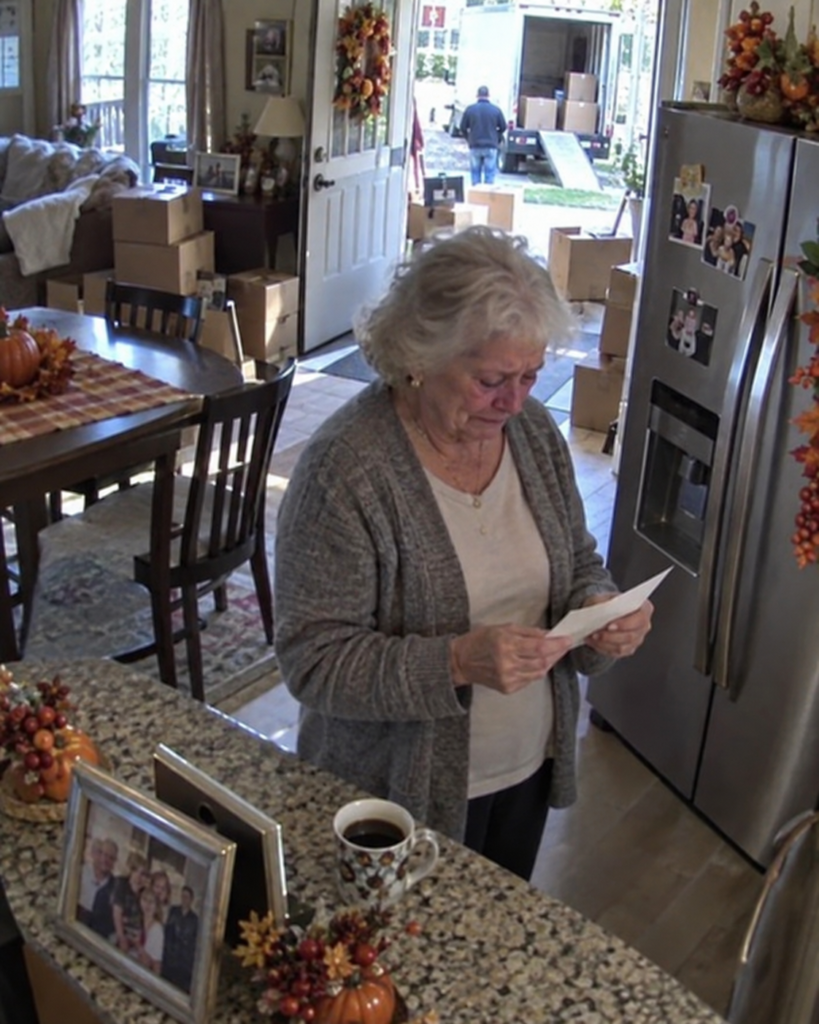
It showed a folded piece of notebook paper.
“What is that?”
“I brought the original.”
He reached into his pocket and gave it to me.
The paper was yellowed.
Arthur’s handwriting covered one side.
Maggie,
If you are reading this, you are probably trying to decide whether to throw something away.
Throw it away.
Except this note.
Keep this because I know you.
You spend your whole life making places feel like home for other people.
Remember to keep one place for yourself.
Love,
A.
I stopped breathing for a moment.
Daniel watched me quietly.
My eyes blurred.
This grief was different from the grief after Arthur died.
That grief had felt like falling through a floor.
This was softer.
A door opening unexpectedly onto a room I thought I would never see again.
“He wrote this?”
“Apparently.”
“I never saw it.”
“He probably forgot he wrote it.”
“That also sounds like him.”
Daniel smiled.
I folded the note carefully.
“He would have liked your place.”
“I think so.”
“He would have made fun of the community yoga.”
“He made fun of everything involving flexibility.”
We laughed.
I took Arthur’s note home and placed it beside his photograph.
Not inside the blue folder.
Some things should not be filed.
That summer, I flew to Chicago for the first time since moving west.
Alone.
Daniel offered to come.
I said no.
He did not argue.
I walked through Oak Park and passed the building where Arthur and I had lived.
Someone had planted red flowers near the entrance.
I drank coffee at our old café.
Visited two friends.
Walked farther than Daniel probably would have liked.
Took a nap when I was tired.
And realized that was the whole point.
I could rest because I chose to rest.
Not because someone had decided I was too old to go.
When I returned to Arizona, Jack and Emily met me at the airport with Rebecca.
Emily waved a sign.
WELCOME HOME GRANDMA.
The same words that had hung over my bedroom door four years earlier.
But this time they meant something different.
Home was not their house.
Home was not my townhouse.
Home was not Illinois.
Home was being welcomed without being owned.
That Thanksgiving, one year after Hawaii, we gathered at my place.
It was too small for seven people once Linda joined us.
Perfect.
Daniel brought mashed potatoes.
Rebecca made sweet potatoes.
They were terrible.
We ate them anyway.
Jack set the table.
Emily made place cards.
Mine said:
GRANDMA
OWNER OF THIS HOUSE
I laughed until I nearly cried.
“Who told you to write that?”
“No one.”
Rebecca looked suspiciously innocent.
Daniel carved the turkey.
Before dinner, he raised his glass.
“I’m not making a speech.”
“That sounds like the beginning of a speech,” Jack said.
“It’s not.”
We waited.
Daniel looked at me.
“Last Thanksgiving, we made a decision for someone else because we told ourselves we knew what was best.”
The room became quiet.
He continued.
“We were wrong.”
I watched his face.
There was no performance in it.
No self-punishment.
Only understanding.
“This year,” he said, “I’m thankful Mom taught us that loving somebody means leaving room for their choices.”
Rebecca raised her glass.
“To Maggie.”
Linda raised hers.
“To boundaries.”
Jack looked confused.
“To turkey.”
Emily shouted, “To Hawaii!”
Everyone laughed.
Even me.
Especially me.
After dinner, the children went inside to choose a movie.
Rebecca followed with plates.
Daniel remained on the patio beside me.
“You know,” he said, “we could actually go to Hawaii together someday.”
I looked at him.
“Are you inviting me?”
“Yes.”
“Or telling me?”
He smiled.
“Inviting.”
“Then I’ll think about it.”
He shook his head.
“You enjoy saying that now.”
“I do.”
We stood beside each other as the sun disappeared behind the desert mountains.
My life had not become smaller at seventy-three.
It had become mine again.
I had lost an old arrangement.
I had gained a home.
My son had lost the version of his mother who was always available.
He had discovered the woman underneath.
Rebecca and I had lost the easy assumptions that once existed between us.
What grew in their place was slower, more deliberate, and far more honest.
And the grandchildren?
They still ran through my hallway.
They still raided my kitchen.
They still left shoes where shoes had no business being.
Only now, after they went home, the house became quiet.
Not the terrible silence of that Thanksgiving morning.
A peaceful silence.
The kind that belongs to a life with doors you can open willingly and close without guilt.
Later that night, after everyone left, I found a container in the refrigerator.
Rebecca had labeled it:
SOUP.
Underneath, she had added:
Only if you actually want it.
I stood alone in my kitchen laughing.
Then I took a marker and wrote beneath her message:
I’ll decide tomorrow.
I placed the container back on the shelf.
On the refrigerator door, held beneath a little blue sea-turtle magnet, was Arthur’s note.
Remember to keep one place for yourself.
I had.
And somehow, by finally creating a place that belonged to me, I had not lost my family.
I had found a healthier way back to them.
THE END