PART 2
A man climbed out of the moving truck and walked toward me carrying a clipboard.
“Margaret Sullivan?”
“That’s me.”
“I’m Luis.”
He glanced at the large two-story house behind me.
“Where are we going?”
I handed him a sheet of paper.
It listed the address of a furnished short-term apartment in Old Town Scottsdale.
I had rented it the previous afternoon for one month.
One month.
That was all the future I had been prepared to decide.
Luis studied the list of furniture I had written.
“You’ve marked specific items?”
“I have receipts for all of them.”
He smiled politely.
“Then you’re more organized than most people we move.”
“My husband used to say organization was my favorite form of entertainment.”
Luis laughed.
For the first time in twenty-four hours, the sound of another person laughing near me felt strangely comforting.
I walked him through the house.
“The blue sofa. Both armchairs. The television in the family room. The dining table and six chairs.”
Luis glanced toward the kitchen.
“The refrigerator?”
I hesitated.
It was mine.
I had paid nearly four thousand dollars for it because Rebecca had wanted the model with two freezer drawers and an interior water dispenser.
But there were groceries inside.
Food for the children when they came home.
“Leave it.”
Luis looked at my list.
“You have it marked.”
“I changed my mind.”
The washer and dryer stayed too.
So did the guest beds.
I realized, as we walked from room to room, that ownership and belonging were not always the same thing.
I had paid for the beds.
But Emily had slept in the guest room during thunderstorms.
Jack sometimes sprawled across one on Sunday afternoons reading comic books.
Taking everything simply because I could would not make me freer.
It would only make the house emptier.
In the end, I took the furniture from my bedroom, the antique sideboard that had belonged to Arthur’s mother, two lamps, my desk, one sofa, one armchair, a small television, several boxes of kitchenware I had brought from Illinois, my grandmother’s dishes, and the Italian coffee maker.
I stood in front of that machine longer than I should have.
Then I put a red sticker on it.
Luis raised an eyebrow.
“That one matters?”
“More than it should.”
By ten thirty, the truck was full.
The house looked different, but not stripped.
There were empty spaces.
That was all.
Spaces.
I walked through each room once more.
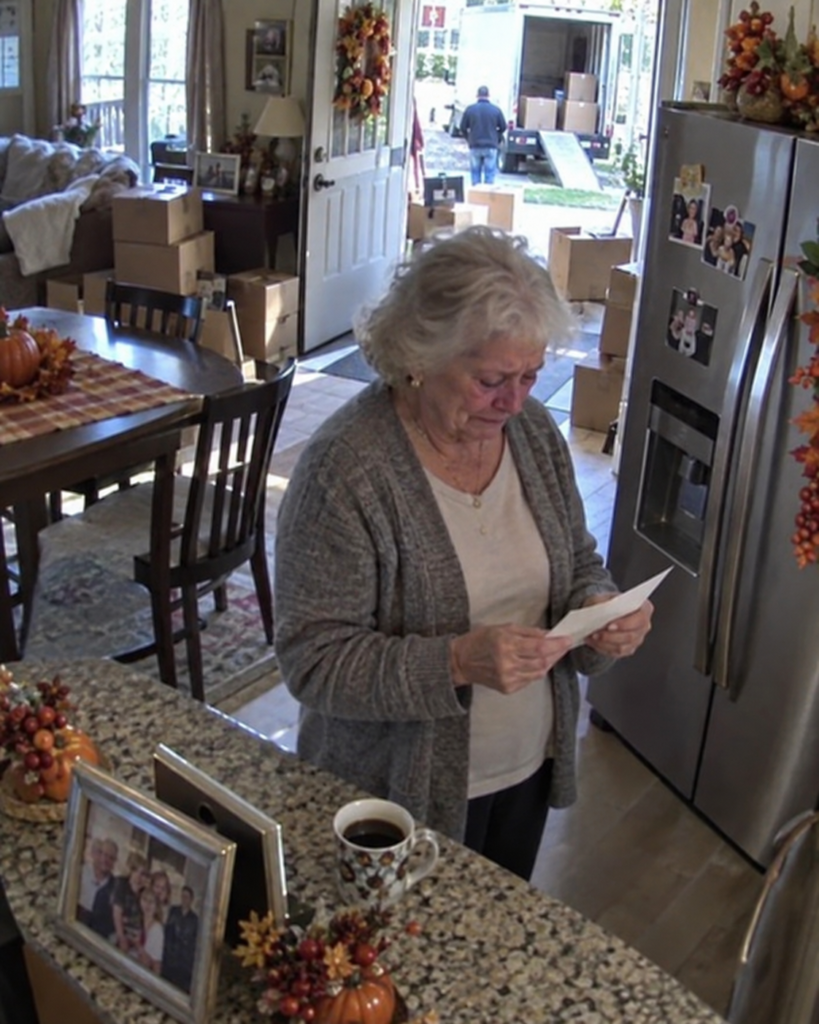
Daniel’s framed family photograph remained on the mantel.
The children’s school pictures stayed on the staircase wall.
Rebecca’s cookbooks sat neatly beside the stove.
Nothing had been damaged.
Nothing had been hidden.
Nothing had been done in anger.
I placed my house key on the dining counter beside Rebecca’s note.
Underneath it, I left another page.
Daniel,
I am safe.
I have moved into a temporary apartment and will contact you after you return.
I have taken only property that belongs to me and have receipts for everything removed.
I love you and the children.
But I will no longer live in a home where decisions about my life are made without me.
We will talk when you are home.
Mom
I read it three times.
Then I added one sentence.
Please do not tell the children I left because of them. I did not.
That mattered more than anything else.
I locked the front door from the inside, walked out through the garage, pressed the button, and stepped beneath the lowering door.
Four years of my life disappeared behind beige metal panels.
I followed the moving truck in a rental car.
Halfway to the apartment, my phone rang.
For one wild moment, I thought Daniel had somehow discovered what I had done.
But the screen showed another name.
Linda Herrera.
I nearly laughed.
Linda had been my closest friend since I moved to Arizona. We met at a community art class where neither of us had shown any talent whatsoever.
I answered.
“Happy day after Thanksgiving.”
“That depends,” Linda said. “Did you survive yesterday with Rebecca’s sweet potatoes?”
“There were no sweet potatoes.”
“What happened?”
I drove silently for several seconds.
Then I told her.
Not everything.
Just enough.
When I finished, Linda said nothing.
That was one of the reasons I loved her.
She knew silence could be more respectful than instant advice.
Finally she asked, “Where are you now?”
“Following a moving truck.”
“A moving truck?”
“I moved out.”
Another pause.
“Maggie.”
“Yes?”
“Where are you sleeping tonight?”
“An apartment in Old Town.”
“Do you want company?”
I looked ahead at the truck carrying pieces of my old life toward a place I had never seen in person.
“Yes,” I said.
“I think I do.”
The apartment was smaller than it had looked online.
Of course it was.
Real estate photographs have the same relationship to reality that family Christmas letters do.
Everything appears brighter, wider, happier.
Still, the place had large windows, a small balcony, and a view of palm trees across the courtyard.
Luis and his crew carried in my furniture while I directed traffic.
The blue armchair went near the window.
Arthur’s mother’s sideboard fit against the dining wall.
My desk went into the second bedroom.
The coffee maker occupied the most important position in the kitchen.
Linda arrived at noon carrying sandwiches, two iced teas, and an orchid.
“What is that for?” I asked.
“People bring plants when someone starts a new chapter.”
“I’m renting for thirty days.”
“Then it’s a short chapter.”
She walked into the living room and surveyed the boxes.
“So.”
“So.”
“Are you terrified?”
“Yes.”
“Regret it?”
I considered the question.
“No.”
Linda nodded.
“Good. Then eat your sandwich.”
That afternoon we unpacked dishes while I told her the full story.
I told her about Hawaii.
I told her about the note.
And finally, I told her what I had heard Rebecca say six months earlier.
It’s not really her we need. It’s her money.
Linda stopped unwrapping a glass.
“You never told me that.”
“I was embarrassed.”
“Why?”
“Because I had spent three years telling everyone how wonderful it was living with family.”
“It can have been wonderful and still become something else.”
I sat down.
That sentence settled somewhere deep inside me.
For months I had been rewriting my own memories.
If Rebecca was ungrateful now, perhaps she had always been ungrateful.
If Daniel ignored me now, perhaps he had never loved me properly.
But that wasn’t true.
When Arthur died, Daniel had flown to Chicago the same night.
He slept in a chair beside my bed because I had been afraid of waking alone.
He handled funeral arrangements when I could barely remember my own telephone number.
Rebecca had packed my kitchen when I moved.
The grandchildren had taped a sign above my new Arizona bedroom.
WELCOME HOME GRANDMA.
Those things had happened too.
Maybe the most painful truth was that love could be genuine and still become careless.
That night, after Linda left, I sat alone on the balcony.
The city below glowed in warm pools of light.
Music drifted faintly from a restaurant.
Someone laughed in the courtyard.
I expected loneliness.
Instead, I felt tired.
Wonderfully, peacefully tired.
No lunches to pack.
No laundry waiting.
No one asking what was for dinner.
At ten fifteen, I made tea and opened my laptop.
There was an email from Daniel.
The subject line read:
YOU’RE NOT ANSWERING.
My heart jumped.
I opened it.
Mom,
We’ve called several times. I wanted to make sure you were okay. I know you’re probably angry, but please don’t turn this into something bigger than it is.
The kids are having a great time.
We’ll talk when we get back.
Love,
Daniel
I stared at the second paragraph.
Please don’t turn this into something bigger than it is.
For years, I had used almost the same sentence on myself.
Don’t make trouble.
Don’t take it personally.
They’re busy.
Families make compromises.
I closed the laptop.
I did not reply.
The next morning, I woke at six out of habit.
My body waited for footsteps overhead.
There were none.
I waited for the sound of a bedroom door opening.
Nothing.
Then I remembered.
I was alone.
And for the first time in decades, I could choose what happened next.
I walked to a café three blocks away.
I ate eggs outside beneath a striped umbrella.
After breakfast, I wandered through an art market and bought a ridiculous turquoise scarf.
At eleven, Linda called.
“Are you busy?”
“I’m buying things I don’t need.”
“Excellent. You’re recovering beautifully.”
We had lunch.
Afterward, she drove me to a neighborhood in north Scottsdale I had passed hundreds of times but never entered.
A low stone sign read:
SAGUARO RIDGE — ACTIVE ADULT COMMUNITY.
I frowned.
“What are we doing here?”
“Looking.”
“At what?”
“Options.”
“I don’t need to be put somewhere.”
Linda stopped the car.
“No one is putting you anywhere.”
Her voice was gentle.
“That is the point.”
We toured a two-bedroom townhouse with white walls, a shaded patio, and a small den.
The agent talked about walking clubs, book groups, yoga, woodworking, day trips, a community garden.
I barely listened.
I was looking at the kitchen.
Not because it was impressive.
Because it was mine to imagine.
My coffee cup by that window.
Arthur’s photograph on that shelf.
Dinner for one if I wanted it.
Dinner for twelve if I invited people.
No one needing permission from anyone else.
“What do you think?” the agent asked.
“I think I’m not ready.”
“Of course.”
She handed me a brochure.
“Keep it anyway.”
I tucked it into my handbag.
Two days later, Daniel called again.
This time, I answered.
“Mom.”
His relief was immediate.
“Where have you been? We were worried.”
“I’m fine.”
“Did you get my email?”
“I did.”
A pause.
“Are you angry?”
“I’m thinking.”
“About Thanksgiving?”
“About the last four years.”
Silence came through the phone.
In the distance, I heard children laughing and waves breaking.
“Mom, Hawaii was Rebecca’s idea. We found a last-minute package and—”
“You don’t need to blame your wife.”
“I’m not.”
“Yes, you are.”
Another pause.
Then Daniel lowered his voice.
“We honestly thought the flight would be hard on you.”
“Did you ask me?”
“No.”
“Did you think about asking me?”
He didn’t answer.
I looked around the apartment.
My boxes were still stacked against the wall.
“Daniel, the problem isn’t Hawaii.”
“Then what is?”
“You stopped seeing me as a person who makes choices.”
“That’s not fair.”
“It may not feel fair.”
“You live with us because we care about you.”
“I moved in because you asked me to.”
“We all agreed it made sense.”
“It did make sense. Then.”
His voice became more strained.
“Why are you talking like you’re leaving?”
I took a breath.
“Because I already did.”
For several seconds, I heard nothing.
Then: “What?”
“I moved out Friday.”
“Moved where?”
“A temporary apartment.”
“You moved out while we were away?”
“Yes.”
“Mom, you can’t just—”
He stopped himself.
I waited.
When he spoke again, his voice was quieter.
“What did you take?”
“Things that belong to me.”
“What does that mean?”
“The blue sofa. My bedroom furniture. The sideboard. My dishes. Some other things.”
“The coffee maker?”
Despite myself, I smiled.
“Yes.”
“Oh, for God’s sake.”
“It was mine.”
“You gave it to Rebecca.”
“I bought it for the household.”
“That’s basically the same thing.”
“No, Daniel. That sentence explains more than you realize.”
He exhaled.
“Can we talk when we get home?”
“Yes.”
“Will you come back to the house?”
“To talk. Yes.”
“To live.”
“I don’t know.”
That frightened him.
I could hear it.
And I understood why.
My leaving did not simply create an emotional problem.
It created practical ones.
Who would pick up Jack on Tuesdays?
Who would stay with Emily when school closed?
Who would cook three nights a week?
Who would buy groceries when Rebecca forgot?
Who would sit with the children so Daniel and Rebecca could go to dinner?
I wondered whether he was thinking about losing his mother or losing the life his mother had made easier.
Perhaps both.
That was the hardest possibility of all.
People were rarely only one thing.
“Mom?”
“Yes?”
“There’s something we need to talk about when I get home.”
“What?”
“The house.”
My fingers tightened around the phone.
“What about it?”
“Just… the money you gave us when we bought it.”
“What about the money?”
He hesitated.
“Rebecca and I don’t remember it the same way you do.”
My stomach turned cold.
“How do you think I remember it?”
“As a loan.”
“It was a loan.”
Daniel was quiet.
“Rebecca thought it was a gift.”
I closed my eyes.
Eighty-five thousand dollars.
The amount I had transferred after selling my Oak Park apartment.
Daniel had said they would repay me when their finances improved.
At least, that was what I remembered.
“Daniel, you told me—”
“I know what I said.”
“Then what are we discussing?”
“There was paperwork.”
“What paperwork?”
“I don’t want to do this on the phone.”
The apartment suddenly felt too quiet.
“Daniel.”
“We’ll talk Sunday.”
“Were there documents I signed?”
“Yes.”
I stood.
“What documents?”
“I need to look at them.”
He sounded genuinely uncertain now.
That frightened me more than defensiveness would have.
After we hung up, I sat at my desk and opened the blue folder.
Receipts.
Bank statements.
Furniture invoices.
Moving documents.
But nothing concerning the eighty-five thousand dollars.
I remembered the bank transfer.
I remembered Daniel sitting across from me at the old apartment.
I remembered Arthur’s accountant, a man named Peter Cohen, telling me not to mix family and money without putting things in writing.
Had I listened?
At seventy-three, there is a particular kind of panic that comes when you cannot immediately find a document you remember existing.
You question the paper.
Then you question the drawer.
Then, eventually, you question yourself.
I spent three hours searching.
Nothing.
Finally, I called Peter.
He had retired two years earlier, but I still had his number.
“Maggie Sullivan,” he said when he answered. “Well, there’s a voice I haven’t heard lately.”
“Peter, do you remember when I moved to Arizona?”
“Of course.”
“Do you remember the money I gave Daniel for the house?”
Silence.
Then his tone changed.
“Yes.”
“Was it a gift?”
“No.”
Relief went through me so quickly I nearly laughed.
“You’re certain?”
“I’m an accountant, Maggie. Certainty is the only interesting thing about me.”
I sat down.
“Do you have anything in writing?”
“I might.”
“Might?”
“I closed the office. Most records were digitized.”
My pulse began pounding.
“Peter, Daniel says there was paperwork.”
“There was.”
“What kind?”
“I don’t want to answer from memory.”
I stared out the window at palm trees moving softly in the evening wind.
“When can you check?”
“Now.”
I heard a chair scrape.
Then footsteps.
A door opening.
Keys.
Peter had always been like that.
If something could be answered, he saw no reason to leave it unanswered.
He returned several minutes later.
“I have the file.”
My mouth went dry.
“And?”
“Interesting.”
I almost laughed from nerves.
“Peter, at my age, interesting is not a reassuring word.”
“Your eighty-five thousand dollars was documented as a family loan.”
I closed my eyes.
“Thank God.”
“But there’s more.”
I opened them again.
“What?”
“You didn’t loan it only to Daniel.”
“What do you mean?”
“The agreement lists Daniel and Rebecca jointly.”
“That makes sense.”
“Yes. But there’s an addendum.”
I frowned.
“What addendum?”
“You signed it three months later.”
“I don’t remember that.”
“I can send it to you.”
“What does it say?”
Peter took a breath.
“It changes when repayment is due.”
My hand tightened around the phone.
“To when?”
“When the property is sold, refinanced…”
He paused.
“Or when you cease using the residence as your primary home.”
For several seconds, the words made no sense.
Then they did.
“When I move out.”
“Yes.”
I stared at the boxes around my little apartment.
The turquoise scarf lay across the back of my chair.
My moving receipt sat on the desk.
I had thought I was simply reclaiming my independence.
But without remembering it, four years earlier, I had signed a piece of paper that made my decision mean something else too.
“When I moved out Friday,” I whispered, “the loan became due.”
Peter was quiet.
“Yes, Maggie.”
My chest tightened.
Not with triumph.
With dread.
Daniel and Rebecca had a mortgage.
School expenses.
Cars.
A life built around the assumption that I would remain inside that house.
“Send me everything,” I said.
“I will.”
“And Peter?”
“Yes?”
“Don’t contact Daniel.”
“I wouldn’t without your permission.”
After we hung up, I remained at the desk.
Five minutes later, the documents arrived.
I opened the agreement.
There was my signature.
There was Daniel’s.
There was Rebecca’s.
And beneath the addendum was something I had completely forgotten.
A handwritten sentence beside Rebecca’s initials:
Loan repayment will protect Maggie’s future housing needs if she ever chooses to live independently again.
I read it twice.
Rebecca had initialed it.
Daniel had initialed it.
So had I.
They had known.
At least once, they had known.
The question was not whether the loan existed.
The question was how all three of us had managed to live for four years as though my independence never would.
I closed the document and stared into the darkening room.
Daniel had said we needed to talk about the house.
Now I knew why.
But one question remained.
If Rebecca had once signed a promise meant to protect my independence, when had she started believing my independence no longer mattered?