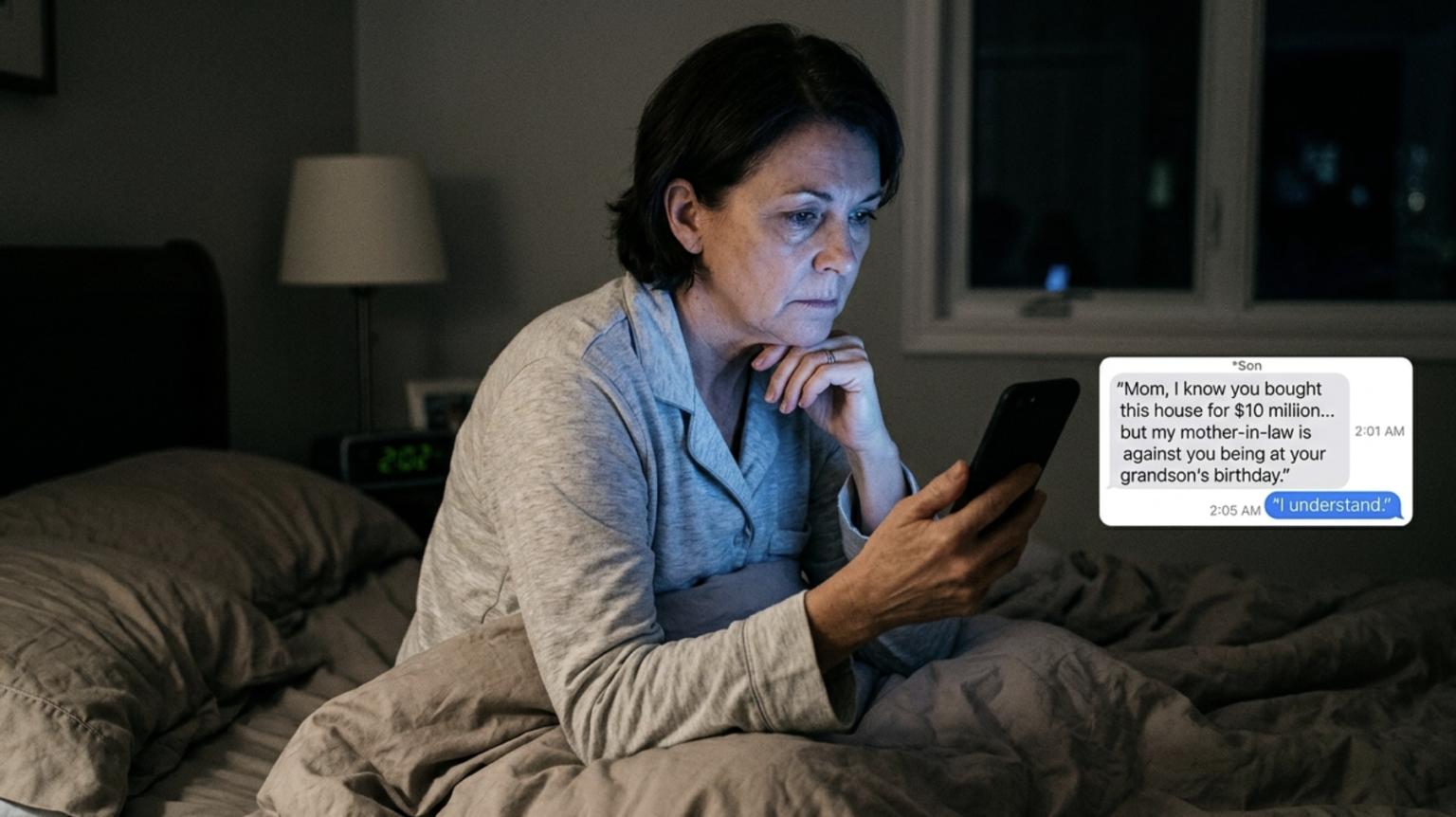
My Son Banned Me From My Grandson’s Birthday—So I Took Back the $10 Million House
PART 3
PART 4
The first thing Richard found was not a missing payment.
It was a pattern.
Three days later, I sat across from him in his conference room while six years of financial records covered the table between us.
Bank statements.
Wire transfers.
Property expenses.
Legal invoices.
Contractor payments.
Private school tuition.
Country club memberships.
Even the monthly household accounts I had never bothered to inspect because I had trusted my son.
Richard removed his glasses and looked at me.
“Victoria, I need you to understand something before I show you this.”
I nodded.
“This is no longer a family disagreement.”
“I know.”
“No,” he said quietly. “I don’t think you do.”
He turned his laptop toward me.
“There are transfers from the property operating account to a private company.”
I leaned forward.
“What company?”
Richard clicked.
A name appeared on the screen.
Kensington Advisory Group LLC.
I frowned.
“I’ve never heard of it.”
“Neither had I.”
“When was it created?”
“Four years ago.”
“By whom?”
Richard hesitated.
Then he opened the corporate filing.
“Your daughter-in-law’s father.”
My stomach tightened.
“Beatrice’s husband?”
“His name is attached to the company. But that’s not the interesting part.”
Richard clicked again.
The ownership structure appeared.
My name was nowhere.
William’s name was nowhere.
Audrey’s name was nowhere.
But there was another entity.
A holding company registered in Nevada.
Richard zoomed in.
“Look at the managing member.”
I stared.
Then I stopped breathing.
Beatrice Kensington.
For several seconds, neither of us spoke.
I remembered every dinner.
Every conversation.
Every time Beatrice had asked questions about the house.
How much the property cost.
How much maintenance was.
Whether the neighborhood association had restrictions.
Whether I intended to keep the property “in the family.”
At the time, I thought she was simply being curious.
Now I understood.
She had been studying an asset.
Not loving a home.
Studying an asset.
“How much?” I asked.
Richard looked uncomfortable.
“How much what?”
“How much money went there?”
He slid a spreadsheet toward me.
I looked down.
The total made my vision blur.
$486,700.
Nearly half a million dollars.
Transferred from accounts connected to the house.
I shook my head.
“That can’t be right.”
“It gets worse.”
He opened another file.
“Some of those payments were disguised as consulting fees.”
“For what?”
“Property management.”
I stared at him.
“Beatrice never managed this property.”
“Exactly.”
He clicked again.
“Then there are payments for family events, travel, private dining, and something called strategic household planning.”
I almost laughed.
“What does that even mean?”
Richard didn’t smile.
“It means someone was taking money and creating descriptions vague enough to discourage questions.”
I sat back.
The room suddenly felt too warm.
“Does William know?”
“I don’t know.”
I stared at the spreadsheet.
There was one question I couldn’t stop thinking about.
“Richard… did William ever sign anything authorizing these transfers?”
Richard’s expression changed.
“That’s what we’re trying to determine.”
He opened another folder.
“Because there’s a second issue.”
“What?”
“There are electronic signatures on several documents.”
“Whose?”
“William’s.”
My chest tightened.
“Forgery?”
“We don’t know yet.”
“Then find out.”
“I will.”
I stood.
Richard looked up.
“Where are you going?”
“To see my son.”
“Victoria—”
“I am not going there to fight.”
“Then why?”
I picked up my purse.
“To ask him one question.”
“What question?”
I looked directly at him.
“Whether he knew.”
William opened the door that evening.
The moment he saw me, his expression collapsed.
“Mom.”
“Can I come in?”
He stepped aside.
The house was unusually quiet.
No Beatrice.
No Audrey.
No staff moving around.
Just William standing in the enormous foyer I had once been proud to give him.
He looked exhausted.
“I’ve been calling you.”
“I know.”
“You haven’t answered.”
“I needed space.”
He nodded.
Then he noticed the envelope in my hand.
“What is that?”
“Financial records.”
His face changed.
“What records?”
“Your property accounts.”
He stared at me.
“What about them?”
I placed the envelope on the table.
“Did you authorize payments to Kensington Advisory Group?”
He didn’t answer.
“William.”
“I don’t know.”
“That’s not an answer.”
“I said I don’t know.”
I watched his face carefully.
There was fear there.
But not the kind I expected.
It wasn’t the fear of someone caught stealing.
It was the fear of someone realizing they had been used.
“What did you sign four years ago?”
He looked away.
“I signed a lot of things.”
“Think.”
He ran a hand through his hair.
“Mom, after the business failed, Beatrice said I needed help organizing the finances.”
“Beatrice?”
“Yes.”
“Why?”
“She said you were controlling everything.”
I felt something inside me crack.
“Controlling?”
“She said I was too dependent on you.”
I stared at him.
“And you believed her?”
“I was embarrassed!”
His voice suddenly rose.
“I was thirty-seven years old, Mom. I had failed. You had rescued me. You owned the house. You controlled the accounts. Every time I looked at you, I felt like a child.”
I absorbed his words.
Then I asked quietly:
“So you let her convince you that protecting you was the same as controlling you?”
He looked down.
“I was wrong.”
“Yes.”
He swallowed.
“But I never wanted you out of the family.”
“Yet you asked me to stay away from Noah’s birthday.”
“I was afraid.”
“Of whom?”
He didn’t answer.
“William.”
He finally looked at me.
“Beatrice.”
The room went silent.
“She has been telling me for years that you would eventually take everything back,” he said. “That you would use the house to control us.”
“And what did you think?”
“I didn’t know what to think.”
“Then why didn’t you ask me?”
His eyes filled with tears.
“Because I was ashamed.”
That answer hurt more than anger would have.
I walked toward him.
For a moment, I wanted to hug him.
But I stopped.
Not because I didn’t love him.
Because love without boundaries had already brought us here.
“I can forgive you for being afraid,” I said.
He nodded.
“But I cannot forgive you for using that fear to hurt me.”
He wiped his face.
“I know.”
“Do you?”
“Yes.”
I pointed toward the envelope.
“Then read those documents.”
He opened it.
As he turned the pages, his expression slowly changed.
Page after page.
Transfer after transfer.
His hands began trembling.
“This isn’t possible.”
“It is.”
“I never approved this.”
“Your signature appears on several documents.”
He stared at the signatures.
“That isn’t my handwriting.”
“Richard believes they may have been electronically authorized.”
William’s face went pale.
“Mom…”
“What?”
“I remember something.”
I waited.
“Four years ago, Audrey asked me to sign a stack of documents.”
“What kind?”
“She said they were related to household expenses.”
“And you signed them?”
“I thought they were.”
“Did you read them?”
“No.”
I closed my eyes.
“William.”
“I know.”
“You didn’t just trust your wife.”
He looked at me.
“You trusted someone who had already convinced you that you couldn’t trust your own mother.”
He lowered his head.
Then I heard footsteps behind us.
Audrey.
She had come home.
She stopped when she saw me.
Her eyes immediately went to the papers on the table.
Then to William.
Then back to me.
“What are you doing here?”
I answered calmly.
“Finding out where my money went.”
Her face drained of color.
“What money?”
“The $486,700 transferred through Kensington Advisory Group.”
She froze.
William turned toward her.
“Audrey.”
She didn’t answer.
“Did you know about this?”
Silence.
“Audrey,” he repeated.
She slowly placed her handbag on the table.
“I can explain.”
That sentence was all I needed.
I looked at William.
Then at Audrey.
“Go ahead.”
She opened her mouth.
Nothing came out.
Then she whispered:
“Your mother doesn’t understand how complicated everything became.”
I almost smiled.
“No, Audrey.”
I picked up the envelope.
“I understand perfectly.”
Her eyes narrowed.
“You think you know everything.”
“I know enough.”
“No, you don’t.”
Her voice suddenly became sharp.
“You think you can buy a house and own everyone’s lives?”
William stared at her.
“Audrey, stop.”
She ignored him.
“She has always held that house over us!”
I looked at her quietly.
“Then why did you secretly move nearly half a million dollars through a company controlled by your mother?”
Audrey went completely still.
William turned toward her.
“Your mother?”
She didn’t respond.
“Beatrice owns that company?”
Still nothing.
“Answer me!”
“Yes!”
Her shout echoed through the foyer.
“Yes!”
She began crying.
“You don’t understand!”
“Then explain it,” William said.
Audrey covered her face.
“Mom said she was protecting us.”
“From me?”
“She said eventually Victoria would take the house away.”
William stared at her.
“So you stole from the house to protect us from the woman who owned it?”
“It wasn’t stealing!”
“Then what was it?”
Audrey couldn’t answer.
I walked toward the door.
William grabbed my arm.
“Mom, please don’t leave.”
I gently removed his hand.
“I’m not leaving because I’m angry.”
“Then why?”
“Because you need to decide what kind of man you want to be.”
He stared at me.
“You have thirty days.”
“Mom—”
“Use them wisely.”
I stepped outside.
But before I reached my car, my phone rang.
Richard.
I answered.
“Richard?”
His voice was unusually serious.
“Victoria, I need you to come back.”
“Why?”
“We found the largest transfer.”
“How much?”
He paused.
“Eight hundred and twenty thousand dollars.”
I stopped walking.
“What?”
“And Victoria…”
“Yes?”
“It wasn’t transferred to Beatrice’s company.”
“Then where?”
His voice dropped.
“It went to an account connected to a law firm.”
“What law firm?”
“The same firm currently preparing a challenge against your ownership of the mansion.”
My heart stopped.
“They were already preparing to sue me?”
“Yes.”
“When?”
Richard took a breath.
“Two months ago.”
I looked back at the mansion.
The lights glowed warmly through the windows.
The home I had built.
The home I had protected.
The home where my grandson slept.
And suddenly, I understood the birthday invitation.
It wasn’t a birthday party.
It was the final step in a plan that had been unfolding for months.
They hadn’t wanted me absent for one afternoon.
They wanted me absent from my own life.
I tightened my grip around my phone.
“Richard.”
“Yes?”
“Find every person involved.”
“I will.”
“And don’t stop at the money.”
“What do you mean?”
I looked toward the upstairs window.
A small shadow moved behind the curtain.
Noah.
My grandson.
“I want to know exactly what they planned to do after they took the house.”
Richard was silent.
Then he said:
“Victoria… I think you should sit down before I tell you.”
I felt a coldness settle over me.
“What did you find?”
Richard answered slowly.
“They weren’t planning to keep the house.”
I frowned.
“What?”
“They were planning to sell it.”
My entire body went still.
“To whom?”
Richard’s next words changed everything.
“To a developer.”
And the developer had already paid someone inside my family for access to the property.
PART 5
The developer’s name was Blackwell Pacific Holdings.
I knew the company.
Everyone in San Francisco’s real-estate world knew the company.
They specialized in buying old luxury properties, obtaining development approvals, demolishing the structures, and replacing them with enormous high-end projects.
Richard had barely finished saying the name when I understood why the mansion suddenly mattered so much.
It wasn’t just a ten-million-dollar house anymore.
The property sat on nearly two acres in one of the city’s most valuable neighborhoods.
A developer could potentially turn it into something worth several times what I had paid.
But that still didn’t explain one thing.
“Who inside my family was paid?” I asked.
Richard didn’t answer immediately.
“Victoria, I need you to see this yourself.”
He sent me a document.
It was a transaction summary.
A payment of $250,000.
Recipient:
A.K. Consulting Services.
I stared at the initials.
“A.K.”
Richard nodded.
“Audrey Kensington.”
My heart sank.
Then another document appeared.
A second payment.
$300,000.
Same account.
Then another.
$270,000.
Total:
$820,000.
I sat completely still.
“They paid Audrey.”
“According to the records, yes.”
“For what?”
“Access to the property. Development information. Financial records. And preliminary cooperation regarding a future sale.”
I closed my eyes.
There it was.
The truth.
Audrey hadn’t simply wanted me out.
She had been preparing to sell the house.
And William…
I couldn’t stop thinking about him.
Had he known?
Had he signed those documents?
Had he agreed to it?
Or had he simply been so frightened of losing his wife that he stopped asking questions?
“Richard,” I said quietly, “I want one more thing.”
“What?”
“Don’t contact the police yet.”
He looked at me carefully.
“Why?”
“Because I want to give William one chance to tell me the truth himself.”
Richard nodded.
“But if he lies?”
“Then I’ll know exactly what I’m dealing with.”
That night, I returned to the mansion.
William was sitting alone in the living room.
He looked like he hadn’t slept.
When he saw me, he stood.
“Mom.”
I didn’t sit down.
“Did you know about the developer?”
His face went blank.
“What developer?”
“Blackwell Pacific.”
The color disappeared from his face.
I knew immediately.
“You knew.”
He lowered himself slowly back into the chair.
“Mom, please.”
“Did you know?”
“Yes.”
The word came out barely louder than a whisper.
I felt as if someone had struck me.
“How long?”
“About three months.”
I stared at him.
“Three months.”
He nodded.
“Why?”
“I didn’t want it to happen.”
“But you knew.”
“Yes.”
“And you said nothing.”
“I was trying to stop it.”
“How?”
He looked down.
“I thought if I could get Audrey to back out, everything would end.”
“Did you?”
“No.”
“Why not?”
“Because she had already accepted the money.”
I swallowed.
“Why did she want to sell the house?”
“She said the property was too valuable to keep sitting there.”
“And you agreed?”
“No.”
“Then why did you allow this to continue?”
His eyes filled with tears.
“Because I was scared.”
I laughed bitterly.
“You’re always scared.”
He flinched.
“I know.”
“You were scared of losing your wife.”
“Yes.”
“You were scared of losing your lifestyle.”
“Yes.”
“You were scared of admitting that you had made a terrible mistake.”
He nodded.
“But you weren’t scared of losing me.”
He looked up.
“That isn’t true.”
“Then prove it.”
He couldn’t.
I turned toward the window.
Outside, the garden lights illuminated the wet stone path.
“Do you know what hurts most?”
William said nothing.
“I could have forgiven the money.”
He looked at me.
“I could have forgiven your wife’s greed.”
I continued.
“I could even have forgiven you for being weak.”
My voice cracked.
“But you let them convince you that I was the enemy.”
“Mom…”
“I was never trying to own your life.”
I turned back toward him.
“I was trying to give you one.”
He began crying.
Not quietly.
Not politely.
The way adults cry when they finally realize the damage cannot be undone with a simple apology.
“I am sorry,” he whispered.
I believed him.
But forgiveness and trust were no longer the same thing.
I walked toward the door.
“Mom.”
I stopped.
“Is there anything I can do?”
I looked at him.
“Yes.”
“What?”
“Tell the truth.”
He nodded.
“To everyone?”
“To everyone.”
The next morning, Richard filed the necessary legal notices.
The developer’s offer was frozen.
The unauthorized transfer records were preserved.
The trust remained intact.
And then William did something I never expected.
He went directly to the developer’s attorney.
He brought every document.
Every message.
Every payment record.
Every conversation he had saved.
He admitted that he had known about the planned sale.
He admitted that he had failed to tell me.
And he admitted that he had allowed Audrey and Beatrice to use his fear against his own mother.
The developer withdrew immediately.
They had no interest in becoming part of a criminal investigation.
By noon, the entire scheme had collapsed.
But Beatrice refused to accept defeat.
She arrived at my office that afternoon.
She didn’t come alone.
She brought Audrey.
For the first time since I had known her, Beatrice looked frightened.
“You’ve destroyed my daughter’s marriage,” she said.
I looked at her calmly.
“No.”
“You’ve humiliated us.”
“No.”
“You’ve taken the house away from them.”
“No.”
Her eyes narrowed.
“You think you’re innocent?”
“I know exactly what I did.”
“You controlled William financially.”
“I supported him.”
“You made him dependent on you.”
“I rescued him when his business failed.”
“You held the property over his head.”
“I never charged him rent.”
She had no answer.
I stood.
“Beatrice, you have mistaken generosity for weakness for a very long time.”
Her face tightened.
“You don’t understand what family means.”
I looked directly at her.
“No.”
Then I shook my head.
“I understand it better than you ever will.”
Audrey suddenly began crying.
“Victoria, please.”
I looked at her.
“You knew what you were doing.”
“I was trying to protect my family.”
“No.”
I pointed toward the documents.
“You were trying to protect a lifestyle.”
She covered her face.
“You’re right.”
Beatrice turned sharply.
“Audrey!”
But Audrey finally stopped listening to her mother.
“I was wrong,” she whispered.
Beatrice stared at her daughter in disbelief.
“I thought if we sold the house, we’d never have to worry about money again.”
She looked at me.
“I thought your mother-in-law would finally have no control over us.”
I corrected her gently.
“I’m not your mother-in-law anymore.”
Audrey froze.
“What?”
“I am William’s mother.”
I picked up the trust documents.
“But I’m no longer going to be financially responsible for either of you.”
Her eyes filled with tears.
I handed her a copy of the thirty-day notice.
“You have thirty days to find another home.”
Beatrice looked furious.
“You can’t throw my daughter out.”
“I am not throwing her out.”
I looked at Audrey.
“I’m giving her the same opportunity I once gave my son.”
“To build a life without depending on someone else’s money.”
Thirty days later, the mansion was quiet.
William and Audrey had moved into a modest rental across town.
It wasn’t luxurious.
There was no marble foyer.
No private gate.
No enormous garden.
No staff.
But it was theirs.
Audrey had started working again.
William had gone back to building his company from the ground up.
Beatrice moved out of state after discovering that the accounts she had expected to rely on were no longer available.
The legal investigation continued.
Some money was recovered.
Some wasn’t.
But I stopped caring about the number.
Because something more important had already happened.
William had finally grown up.
Not because I punished him.
Because I stopped protecting him from the consequences of his choices.
Three months later, I received a letter.
It was from Noah.
The envelope was covered with crooked blue handwriting.
FOR GRANDMA VICKY.
I opened it.
Inside was a drawing.
A house.
A garden.
Three people standing outside.
Me.
William.
And Noah.
Underneath, he had written:
“Grandma, I know the house was yours. But I hope someday we can have another birthday together somewhere, even if it’s not the big house.”
I pressed the letter against my chest.
For the first time in months, I cried.
Not because I had lost something.
Because I finally realized what I had saved.
Six months later, I sold the mansion.
Not to a developer.
Not to an investor.
I sold it to a foundation.
The property was converted into a residential scholarship center for young adults aging out of foster care.
When Richard asked why I had chosen that, I smiled.
“Because I know what it feels like to build a future for someone and wonder whether they’ll appreciate it.”
He smiled.
“And?”
“And because those kids deserve a home where nobody can tell them they don’t belong.”
The mansion became something beautiful.
Not a symbol of wealth.
Not a weapon in a family argument.
A home.
A second chance.
Exactly what I had wanted it to be all along.
A year after the night William sent me that message, I stood outside a small restaurant in San Francisco.
It wasn’t expensive.
There were no crystal chandeliers.
No private dining room.
Just warm lights, wooden tables, and the smell of fresh bread.
Noah ran toward me the moment he saw me.
“Grandma!”
I opened my arms.
He crashed into me.
I hugged him tightly.
Then I looked up.
William stood behind him.
His clothes were simpler now.
His face looked older.
But somehow, he looked happier.
Audrey stood beside him.
She approached me slowly.
“I brought something.”
She handed me a small box.
Inside was a photograph.
It was from Noah’s birthday.
The birthday I hadn’t been allowed to attend.
But someone had taken a picture of Noah holding a cupcake.
On the back, Audrey had written:
“You should have been there.”
I looked at her.
She started crying.
“I am sorry.”
I nodded.
“I know.”
William stepped closer.
“Mom?”
“Yes?”
“I don’t expect you to trust me yet.”
I looked at him.
“But I hope someday you will.”
I smiled faintly.
“Trust isn’t something you ask for, William.”
He nodded.
“You earn it.”
“I know.”
“And you have a lot of earning to do.”
He smiled.
“I’ll spend the rest of my life trying.”
Noah tugged at my hand.
“Grandma, come on! They saved your seat.”
I looked inside the restaurant.
There was a chair waiting beside him.
Not at the head of the table.
Not in a place of honor.
Just beside my grandson.
And somehow, it was the most valuable seat I had ever been given.
I sat down.
William sat across from me.
Audrey sat beside him.
Noah leaned against my arm.
For a moment, nobody spoke.
Then Noah smiled.
“Grandma?”
“Yes?”
“Can we have my birthday here next year too?”
I laughed.
“Of course.”
William looked at me.
And for the first time in years, there was no fear in his eyes.
Only gratitude.
I realized something that evening.
The mansion had never been the thing I was fighting for.
Neither was the money.
Neither was the property.
I had spent years believing that protecting my family meant giving them everything.
The truth was much harder.
Sometimes protecting the people you love means allowing them to lose what they were never entitled to keep.
Sometimes the strongest thing a mother can say is no.
And sometimes the best revenge isn’t watching the people who hurt you fall.
It’s watching yourself rise without them.
I had been rejected from a mansion I built.
I had been treated like a stranger by people I considered family.
They tried to remove me from my grandson’s life.
They tried to take my property.
They tried to sell the home I had sacrificed everything to protect.
But in the end, they taught me the one lesson I had been too afraid to learn:
Love should never require you to disappear.
I didn’t lose my family that night.
I lost the illusion that I had to keep buying their love.
And once I stopped paying for it…
I finally discovered which people loved me for free.
Noah squeezed my hand.
“Grandma, you’re quiet.”
I looked at him.
“I was just thinking.”
“About what?”
I smiled.
“About how sometimes the best endings don’t look like the endings we planned.”
He frowned.
“What does that mean?”
I kissed his forehead.
“It means we get to write a better story.”
And this time, when I looked around the table, I knew exactly where I belonged.
Not because I owned the house.
Not because I had money.
Not because anyone needed what I could provide.
But because I was finally surrounded by people who wanted me.
And that was worth more than ten million dollars ever could be.