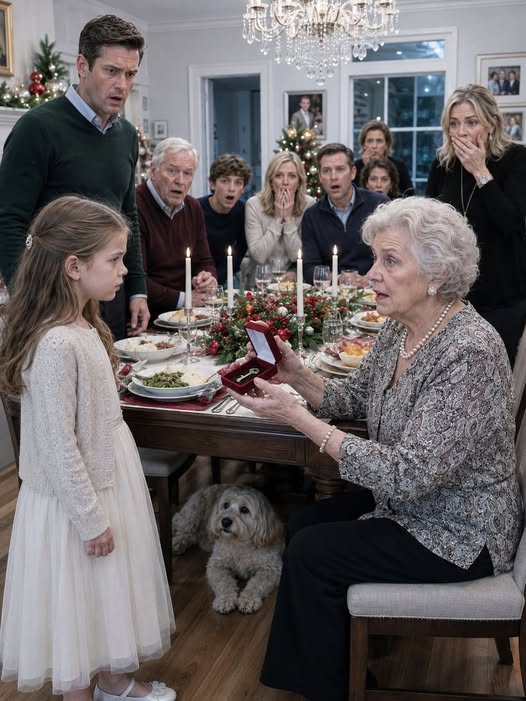
The Candle Labeled “To Brandon’s Girl”
Chapter 1 — Gene’s Golden Rule
There is a particular quality of silence that falls over a room where everyone is holding their breath, and Gene’s dining room had it that Christmas morning before a single unkind thing had even been said out loud.
My mother-in-law’s house in Tacoma was, as always, breathtaking.
Pine garlands hung heavy over the wide mahogany doorway.
Cinnamon rolls cooled under foil on the sideboard.
The chandelier threw sharp bright light across antique silver napkin rings she had arranged with the precision of a woman who measures such things.
Outside, a small flag ticked against the porch rail in the freezing wind.
Everything was perfect, and perfection, in Gene’s house, was not warmth.
It was control.
Everyone who came through that door understood the golden rule without anyone ever having to say it: you smiled, you stayed exquisitely polite, and you never, ever challenged Gene when she decided that some member of the family needed to be quietly put back in their place.
I had watched her do it to others over the years — a daughter-in-law seated at the wrong end of the table, a cousin whose gift was pointedly modest, a hundred small corrections delivered with a smile so that no one could ever accuse her of anything.
It was an art form, her cruelty.
It never left fingerprints.
And that Christmas morning, I understood, watching her arrange the last napkin ring, that she had chosen this year’s target, and that the target was my seven-year-old daughter.
I had come, over two years of marriage, to understand Gene the way you come to understand weather in a place you’ve moved to — not by any one storm but by the accumulation of them.
She had raised Brandon and his brother inside this same system of smiles and corrections and withheld approval, and I could see its marks on both of them, could see how Brandon’s brother had solved the problem by becoming exactly what his mother wanted, agreeable and hollow, and how Brandon had solved it by leaving, by building a life three hundred miles away in Spokane and coming back only for the holidays, keeping his mother at the length of a long drive.
Gene ran her family the way some people run a business, on incentives and consequences, on the careful distribution of favor.
Love, in her house, was never simply given; it was awarded, an
It was a masterpiece of plausible deniability.
If I had ever said, Gene, why won’t you call Holly your granddaughter, she would have widened her eyes and touched her chest and said she had no idea what I meant, that she adored Holly, that I was being terribly sensitive on a holiday, and every other adult in the room would have shifted uncomfortably and privately agreed that I was making a scene.
That was the trap, and she’d built it beautifully.
You cannot fight an insult that is never quite spoken.
You can only absorb it, and watch your child absorb it, and count the ways a seven-year-old is being taught, in a house full of relatives, that she is a guest in her own family.
And children hear it.
That is the thing adults forget, or choose to forget, because forgetting is more comfortable.
Adults believe that because a cruelty is subtle, a child will miss it, and the truth is the opposite: children are exquisite instruments for detecting exactly this kind of thing, because their whole survival once depended on reading whether the big people wanted them or not.
Holly did not have the words for what Gene was doing, but she had the whole of it, absorbed straight through the skin.
She knew that the other children were grandchildren and she was something else.
She knew that when Gene’s voice went sweet, something unkind was coming, the way you know a smell means the milk has turned.
She had learned to go still and small in that house, to fold her hands, to make herself a quiet as-little-trouble-as-possible version of herself, and I had watched her do it and hated it, because the Holly who existed in her own home — loud, silly, bossy with her stuffed animals, fully and gloriously herself — went into hiding the moment we crossed Gene’s threshold, and a careful, watchful, diminished child came out in her place.
That is what Gene’s unspeakable insults actually cost.
Not a candle’s worth of hurt feelings.
The slow teaching of a bright seven-year-old that some rooms are not safe to be herself in, that her belonging is a thing to be anxiously monitored, that love comes with terms and conditions she must read carefully and never violate.
You cannot sue a woman for that.
You cannot even name it out loud without sounding unhinged.
But it is real, and it is a kind of theft, and my daughter had been robbed of three years of Christmases by it before Brandon finally found the one thing that could make it stop.
Chapter 3 — The Father He Chose to Be
Holly is my daughter from my first marriage, and if you want to understand this story, you have to understand that Brandon has never once, in any word or act, treated that as a technicality.
He is the one who packs her school lunches, every morning, and knows without asking that the crusts come off and the apple gets sliced because she won’t bite into a whole one.
He knows which floppy-eared stuffed rabbit has to be positioned facing her bedroom door before she’ll sleep, and that if it faces the wrong way she’ll pad down the hall at midnight to fix it.
He can tell the difference — instantly, across a crowded room — between Holly’s real laugh, the loud helpless one that takes her whole body, and the small careful chuckle she puts on around adults who make her uneasy.
He learned her.
That is the thing about Brandon that made me fall in love with him and marry him: he did not accept my daughter as a condition of having me.
He chose her, separately, fully, as her own person.
The morning of that Christmas, before we walked up Gene’s front steps, he’d noticed a scuff on Holly’s right shoe, and he had knelt down in the snow in his good trousers and wiped it clean with his thumb, and I heard him say to her, very quietly, “My sweet girl deserves at least one holiday where she feels completely chosen.” He said it like a wish.
He’d been saying that wish, in one form or another, for three years.
The Candle Labeled “To Brandon’s Girl”
And for three years Gene had spent every holiday making sure it did not come true.
I should tell you how Brandon and Holly began, because it matters.
When Brandon and I started seeing each other, Holly was four, and I did the thing every single mother does, which is to hold the two halves of my life carefully apart, braced for the moment the man decided a child was more than he’d signed up for.
That moment never came.
What came instead was Brandon, on our fourth or fifth time out, cutting the evening short because he’d found a used copy of a picture book Holly loved and wanted to drop it by before her bedtime — not to impress me, I wasn’t even going to be there for the handoff, but because he’d been thinking about her.
What came was a man who learned her allergies before he learned my middle name, who asked me, seriously, months in, whether he was allowed to love her or whether that was a line I needed him to hold, because he didn’t want to overstep but the truth was he already did.
I had spent Holly’s whole life afraid that the fact of her would cost me love.
Brandon made the fact of her the center of it.
When we married, he did not “become a stepfather,” a word he has never once used; he simply became her dad, the way you become anything real, by doing the ten thousand small unglamorous things nobody sees.
So understand that when Gene called my daughter Brandon’s girl as an insult, she was, without meaning to, naming the one thing Brandon was proudest of in his entire life.
She thought she was drawing a line to exclude Holly.
She had no idea she was describing the thing my husband would have tattooed over his heart.
Brandon’s girl.
Yes.
Exactly.
The Candle Labeled “To Brandon’s Girl”
That was the whole point of him.
Chapter 4 — Three Years of Small Cuts
None of it was ever one big thing.
That is what made it so hard to name, and so hard to fight, and so effective.
It was three years of small cuts, each one shallow enough to seem like nothing, each one placed with care.
There was the family portrait, two summers back, that hung in Gene’s hallway — the professional one, everyone in coordinated blue — from which Holly had simply, somehow, been cropped, so that she stood at the very edge, half of her shoulder showing, easy to mistake for a stranger who’d wandered into the shot.
There were the holidays where the cousins ate at the big table and Holly was placed at “the kids’ table,” except the kids’ table was Holly, alone, because the cousins were teenagers who ate with the adults.
The Candle Labeled “To Brandon’s Girl”
There were the birthday cards that came for every grandchild and skipped my daughter, and the toys bought for the cousins “because I was at the store anyway” that never once included her.
Each of these, alone, could be explained.
An oversight.
A coincidence.
A busy grandmother with a lot of grandchildren.
The Candle Labeled “To Brandon’s Girl”
But I was not the only one feeding it, and I have had to make my peace with that too.
The whole extended family fed it.
The aunts who saw Holly cropped to the edge of the portrait and said nothing.
The uncles who noticed her alone at the kids’ table and looked away.
The cousins old enough to know better who took their iPads and their envelopes of cash and did not once ask why the little girl in the gold dress got a candle.
They were not cruel people, most of them.
They were ordinary people, doing the ordinary thing that keeps cruelty running in families everywhere, which is to see it clearly and decide it is not their business, to prize the smooth surface of a holiday over the child being quietly bled beneath it.
I understood them, because I had been them — I had swallowed it too, for three years, for the same reasons.
It is so much easier to tell yourself you are keeping the peace than to admit you are simply keeping your own comfort.
And the terrible genius of a woman like Gene is that she does not need accomplices, only bystanders.
She does not need the whole family to hurt Holly.
She only needs them to watch her do it and pass the cinnamon rolls.
Every silent adult at that table was a brick in the wall Gene had built around my daughter, and the hardest thing I have had to forgive — harder, in some ways, than forgiving Gene, who at least was honest in her cruelty — is all the good, kind, comfortable people who watched a child be made small year after year and decided that the seating chart was more important than her heart.
Chapter 5 — Christmas Morning
At eight forty-seven on Christmas morning, Gene began handing out the gifts, and she did it the way she did everything, with a slow ceremonial importance, as though she were bestowing rather than giving.
The Candle Labeled “To Brandon’s Girl”
She called the grandchildren up one at a time.
The oldest cousin tore into a box and pulled out a gleaming new tablet and shrieked, and a younger one opened an identical one, and the teenagers slid thick folded stacks of cash out of their holiday cards and grinned.
The room filled with the good noise of Christmas — torn paper, happy shouting, the adults marveling at how the kids had grown.
Holly sat beside me in the gold dress Brandon had steamed that morning, her Mary Janes tucked neatly under her chair, her hands folded in her lap, watching the other children the way a child watches a party she has not quite been invited to, hoping.
I want you to understand that she was not greedy.
Holly has never once judged love by a price tag; she would have been happy with a coloring book, with a candy cane, with nothing at all but her name said warmly.
She was not waiting for an iPad.
She was waiting, the way children wait, simply to be included in the circle of the morning.
And then Gene turned to her, and her smile flickered for just a fraction of a second into something colder, and she said, “Oh — look.
It’s little Holly.” And she reached behind her chair.
I have to tell you about that word, little, because Gene used it like a scalpel and almost no one ever noticed. Little Holly. It sounds tender.
It sounds like the kind of thing a doting grandmother says.
But Gene never once called any of the other grandchildren little anything; they got their full names, said with pride. Little was reserved for Holly, and it did a very specific job: it made her small, and it made her generic, one interchangeable small thing rather than a particular beloved person.
Everything Gene said about my daughter did that job.
And in the half-second before she reached behind that chair, I saw her enjoy it — saw the flicker of real pleasure cross her face, quickly hidden, the pleasure of a person about to do a cruel thing she has been looking forward to.
I have thought a great deal since about what makes a person like that, what hollow place a woman has to be carrying to look at a seven-year-old and feel, not love, not even indifference, but the specific appetite to diminish her.
I don’t fully understand it.
I don’t think I want to.
But I saw it on Gene’s face for half a second on Christmas morning, and I have never again been able to pretend, the way I had pretended for three years, that any of it was accidental.
She reached behind the chair, and she brought out the bag, and she was smiling the whole time, and the smile was the worst part.
Chapter 6 — The Candle and the Tag
What she pulled out was a thin drugstore gift bag, the kind you grab at a register at the last second, with a crooked red bow stuck to the handle.
“This is for you, sweetheart,” Gene said, and there was something almost triumphant under the sweetness.
“I didn’t want you to feel totally left out today.”
Holly took the bag with both hands, because she is a polite child, because we raised her to be careful and gracious with adults, and she drew out the thin white tissue paper slowly, the way you’d unwrap something you wanted to make last.
At the bottom of the bag was a four-dollar vanilla candle.
And I felt the whole room register it — the cheapness of it, sitting there next to the iPads and the cash — but the candle was not the thing that stopped my heart.
Tied around the glass jar with a bit of string was a small handwritten cardboard tag, and I watched Holly’s eyes find the words on it and try to read them, and I read them at the same moment she did. To Brandon’s Girl. Not To Holly. Not even To my granddaughter. Gene had sat down, at some point before this morning, and taken a pen, and written those three words onto a tag with her own hand, and tied it to a four-dollar candle, and put it in a drugstore bag, so that a seven-year-old would open it in front of the whole family and understand exactly where she stood.
The dining room went silent.
A fork stopped halfway to my brother-in-law’s mouth.
A teenage cousin found something fascinating in the carpet.
The dog backed away from the table.
Beside me, Brandon crushed his coffee cup in his fist so hard the coffee ran over his knuckles, and I don’t think he felt it.
And Gene kept her small tight smile fixed exactly where it was, already certain that no one in that room would have the nerve to say a word.
That smile is the thing I keep returning to.
Because it told me she knew — that this was not carelessness, not a grandmother stretched thin who’d grabbed the wrong gift, but a decision, made and executed and now being enjoyed.
You do not write three words on a tag by accident.
You do not tie that tag to a candle by accident.
Somewhere in the days before Christmas, Gene had sat at a desk with a pen and thought about my daughter, specifically, and chosen those words, specifically, and pictured this exact moment — the child opening the bag in front of everyone, the dawning of the small hurt, the whole family watching and saying nothing.
She had planned Holly’s humiliation with more care than she’d spent on any of the actual gifts, and now she sat with her hands folded and her smile in place, waiting to see whether we would swallow it like we always had.
And I understood, in that suspended silent moment with the coffee running over Brandon’s knuckles, the full shape of what she was counting on.
She was counting on our love for Holly to keep us quiet — because to object was to make the moment bigger, to force Holly to stand in an even brighter spotlight of not-belonging, to turn her daughter’s small private wound into a family war fought over her head.
Our love for Holly had always been Gene’s best weapon against us.
Every year, we protected Holly from the scene by absorbing the insult, and every year, absorbing the insult was itself the injury.
It was a perfect trap, sprung the same way every holiday.
What Gene did not know — what she was about to learn — was that this year, for the first time, the trap had a way out, and it was sitting in a velvet box in a seven-year-old’s overnight bag.
Chapter 7 — I Prepared for It
“Brandon,” I whispered, turning my head a few degrees toward my husband.
He did not look at his mother.
He kept his eyes on Holly, who was staring at the tag in her lap with a small crease between her brows, trying to work out what she had done to earn it.
“I told her,” Brandon said, very low, “to give my mother the little red box if this exact thing happened again.” I turned to him, sure I’d misheard.
“What little red box?” “The velvet one,” he said.
“It’s in the side pocket of Holly’s overnight bag.” I stared at his profile — the jaw set like poured concrete, the eyes never leaving our daughter — and I felt the ground of the morning shift under me, because I had been married to this man for two years and I had not known there was a plan.
“Brandon,” I whispered.
“Did you plan this?
Did you plan this whole thing?” And he finally turned and looked at me, and his face was not the face of a man springing a trap.
It was the face of a man who had hoped, right up until eight forty-seven that morning, that he would not have to.
“No,” he said.
“I didn’t plan it, honey.
I prepared for it.” And in those two words was three years of watching, the same three years I had spent watching, except that where I had kept a silent tally and swallowed it, Brandon had done something else.
He had decided, quietly, at some point I never saw, that his daughter wa
He had built her a door of her own.
He just hadn’t told me, because — I understood this later — he hadn’t wanted me to have to carry it either.
Chapter 8 — Am I Really Just Dad’s Girl?
At nine twelve that night I went to check on Holly and found her sitting cross-legged on the edge of the guest bed, still in the wrinkled gold dress, the cheap candle balanced in her lap.
She was not crying.
She was looking at the tag, at those three handwritten words, with the deep still concentration children use when they are trying to decode something the adult world has handed them without explanation.
I sat down beside her on the mattress, and before I could find the right words — there are never right words, for this — she asked me the question I had been dreading since the moment the tag came out of the bag.
“Mom,” she said, not looking up.
“Am I really just Dad’s girl?” And every cruelty of the last three years was in that small sentence, all of it, distilled down into a seven-year-old’s quiet attempt to understand her own place in the world.
I have to tell you that in that moment I wanted to lie down on the floor of Gene’s guest room and howl.
Not cry — howl, the way you want to when someone hurts your child in a place you cannot reach and cannot fix.
Because Holly was not asking me a question about a candle.
She was asking me a question about herself, about her own reality, and the question was: is the bad thing they keep telling me true? Every subtle exclusion of three years had finally accumulated into a seven-year-old sitting on a bed genuinely unsure whether she was a real daughter or a kind of provisional one, a placeholder, a girl who belonged to her stepfather in some lesser conditional way that the grown-ups all seemed to understand and she was only now catching up to.
And the unbearable thing, the thing that made me want to howl, was that she asked it so calmly.
She was not being dramatic.
She was not fishing for reassurance.
She was a small scientist examining the data of her own life and reaching a frightening hypothesis, and she wanted to know if it was correct, and she trusted me to tell her the truth even if the truth was that she was, in fact, less.
That a child of mine had gathered enough evidence over three years to seriously entertain that hypothesis is the single greatest failure of my life as her mother, and I will carry it.
I should have burned Gene’s whole careful machine to the ground the first Christmas.
I didn’t, because I was afraid of being the dramatic one, and my fear had cost my daughter three years and brought her to this — sitting in a wrinkled gold dress asking whether she was really anybody’s.
I opened my mouth to answer, but Brandon stepped into the room behind me.
Before I could answer, Brandon came into the room behind me.
He crossed the floor and went down on his knees in front of her, so that his eyes were below hers, looking up, and he took both her small hands into his big ones.
“You are my daughter,” he said, and his voice was low and steady and left no crack for doubt to get through.
“You are my daughter.
No tag, written by anyone, in any house, ever gets to decide that.
Do you hear me?” She looked at him for a long moment, weighing it, the way she weighs everything.
And then Brandon reached over to her pink overnight bag by the closet, and drew out a small red velvet box, and set it gently into her open palms.
Chapter 9 — Will You Still Be My Dad?
“If Grandma ever tries to make you feel invisible again,” Brandon said, “or like you don’t belong, or like you’re less than the other kids — you get to decide whether she gets this box.
Not me.
Not your mom.
You.”
Holly turned the little box over in her hands, feeling its weight, not yet opening it.
“Is Grandma going to be mad at us?” she asked.
“She probably will be,” Brandon said.
He did not soften it; he has never lied to her, even to make a moment easier.
“She’s probably going to be very mad.” Holly was quiet for a second, and then she asked the question that undid me, the one I will hear in my head for the rest of my life, asked in the smallest voice she had.
“Will you still be my dad?
If she gets mad?” And I watched my husband’s face come apart for a single instant — not because he had to think about the answer, but because it broke something in him that a seven-year-old had been made to wonder, had been taught by three years of a woman’s careful cruelty that a father’s love might be the kind of thing that could be revoked if a grandmother disapproved.
He got hold of himself.
He looked her dead in the eyes.
“I will always be your dad,” he said.
“Always.
No matter who gets mad, no matter what happens in this house or any other house, for the rest of my life and yours.
That is the one thing in this whole world that cannot change.” Holly looked at him.
And then she nodded, once, and closed her fingers around the red box, and tucked it away — and I understood that my daughter had
Chapter 10 — What Brandon Had Done
I lay awake a long time that night, turning over what my husband had done, and the more I turned it the more remarkable it seemed to me.
He had not stormed downstairs on Christmas morning and torn into his mother.
He had not made the speech I would have made, the one that feels so good for eleven seconds and changes nothing, the one that would have let Gene cast herself as the wounded party and me as the hysteric who ruined the holiday.
He had done something harder and far more radical.
He had taken the power that the adults in that house had been hoarding for three years — the power to decide whether Holly’s mistreatment would be tolerated or answered — and he had placed it, deliberately, into the hands of the one person who had never once been allowed to hold any: Holly herself.
He was not asking a seven-year-old to fight his battle.
The battle was his; he had already fought it, already drawn the line, already done the grown-up thing that stood behind the box.
What he was giving her was something subtler and, I think, more precious.
He was giving a child who had been made to feel powerless the actual experience of power — the dignity of choosing, of being the one who decides, of learning in her own small body that she was not a leaf the adults blew around a room but a person with a hand on the door.
Whatever was in that box, the gift was not the box
The gift was that Holly got to be the one who opened it, or didn’t.
After three years of being handed cheap candles and printed place cards that told her where she stood, my daughter finally held something that let her stand somewhere of her own choosing.
Chapter 11 — GUEST
The next morning was Gene’s annual Boxing Day brunch, and she had reset the long table with the same meticulous care she brought to everything — white porcelain squared to the table edge, silver napkin rings, and at every place a handwritten card telling each of us exactly where Gene had decided we belonged.
Place cards are a hospitable-looking thing.
That is what makes them such a perfect instrument for a woman like Gene.
They read as graciousness, as attention to detail, as a hostess who has thought of everyone — and underneath the graciousness they are pure control, a way of assigning every person their exact position in the room and daring anyone to move.
I found my card.
I found Brandon’s.
I found the cards for the aunts and the uncles and the teenage cousins, every one of them with a name printed in Gene’s careful hand.
And then I found the card beside Holly’s plate, and I stopped breathing, because it did not have her name on it.
It had one word, printed in capital letters, the same hand that had written To Brandon’s Girl the morning before.
It read: GUEST.
Two labels, then, in less than twenty-four hours.
Two deliberate little knives, each one delivering the message Gene would never say aloud, each one placed where a child would have to find it herself.
And this second one told me something the first hadn’t, which was that Gene had not learned a thing.
The candle, on Christmas morning, she might have half-talked herself into believing was defensible — a cheap gift, an oversight, nothing anyone could really prove.
But the place card was different.
The place card came the morning after, after a whole day of the family’s stiff silence, after she had surely felt, even through her armor, that this year something had landed wrong.
A person with any capacity for self-correction, feeling that, would have course-corrected — would have made the Boxing Day brunch the place where she quietly overcompensated, seated Holly in a place of honor, called her by her name for once.
Gene did the opposite.
She sat down with her pen, the morning after humiliating a seven-year-old, and she looked at the stack of place cards, and she made the deliberate choice to do it again, worse, in writing, in capital letters.
GUEST.
She had a whole night to reconsider and she used it to escalate.
That was the moment, I think, that any lingering hope in Brandon died for good — not the candle, but this, the proof in his mother’s own hand that she was not going to stop, that there was no version of enough humiliation that would satisfy her, that she would keep doing this to Holly every holiday for the rest of her life if we let her.
You can forgive a person one cruelty as a bad moment.
Two identical cruelties, a day apart, with a night to think in between, is not a bad moment.
It is a character.
It is who someone has decided to be.
And once you know who a person has decided to be, continuing to hand them your child is not grace.
It is negligence.
I felt the old fury rise in me, the reflex to leap up and tear the card in half and finally, finally say the thing out loud — and beside me I felt Brandon go still in the exact same way, both of us on the edge of the same explosion.
But neither of us moved.
Because we were both, at the same moment, looking at Holly.
Chapter 12 — She Reached Into Her Purse
She had already seen it.
Of course she had; children always see the thing you hope they’ll miss.
She was looking at the card that reduced her to a single cold word, and her face did not crumple, and she did not cry, and she did not turn to me with the wet pleading look that would have broken my heart and started the war on her behalf.
Instead, my seven-year-old daughter reached into the small beaded purse Brandon had bought her for the trip.
I watched her hand disappear into it.
And when it came back out, her small fingers were wrapped around the red velvet box.
I want to describe what happened in the room in that instant, though almost nothing happened that anyone could have photographed — only that the entire center of gravity of that house shifted, silently, from the head of the table to a child in a wrinkled gold dress, and Gene did not feel it yet, and everyone else was about to.
Holly pushed back her chair.
She stood up straight, her posture composed in a way I had never quite seen in her, and she stepped out from the table with the box held in both hands in front of her, and she began to walk the length of that long dining room toward her step-grandmother.
Every aunt and uncle and cousin fell silent and watched her go.
No one interrupted.
No one reached out to stop her or smooth it over or turn it back into a nice brunch.
They watched a small girl cross a big room, and I think some of them understood, before Gene did, that they were watching something arrive that had been three years coming.
I have replayed that walk more times than I can count, those few seconds of my daughter crossing Gene’s dining room, because it was the bravest thing I have ever watched a person do and she was seven years old.
Understand what it cost her.
This was a child who had been taught, carefully, over three years, that this room was dangerous to her — that in this house she was a guest, a visitor, Brandon’s girl, that her belonging was conditional and could be revoked, that the adults here would not protect her and might, at any moment, produce a new small humiliation with her name almost on it.
Every instinct three years of that builds into a child says: stay small, stay quiet, don’t draw the eye, don’t give them a reason.
And she overrode every one of those instincts and stood up and walked, alone, the length of the room, straight toward the source of all of it.
She did not do it in anger; there was no tantrum in it, no tears, none of the messy human things that would have let the adults dismiss her.
She did it with a composure that frightened me a little, if I’m honest — a stillness that seemed too large for her small body — and I realized, watching her go, that Brandon’s gift the night before had already worked its true purpose.
He had not just given her a box.
He had given her the thing under the box, the thing she’d been starved of for three years: the knowledge that she had a choice, that she was not powerless, that something in this room bent to her will and not the other way around.
And a child who knows that, even a small one,
Chapter 13 — Dad Told Me to Give You This
Holly stopped beside Gene’s chair.
She was so small that standing, her head barely cleared the table, and she looked up at the woman who had spent three years teaching her she didn’t belong, and when she spoke, her voice carried clear to the far end of the room.
“Grandma,” she said.
“Dad told me to give this to you if you ever ignored me again.” And she held the red box out, in both hands, without a tremor.
Gene looked down at the box, and then at Holly, and her polished smile tightened at the corners, and she reached, out of three years of practiced habit, for the weapon that had always worked before — contempt disguised as reason.
“Well,” she said, with a soft little laugh meant to make Holly small again.
“Isn’t that just wildly dramatic of you.” And that was when Brandon stood up.
He did not rush.
He walked the length of the room, unhurried, and took his place directly behind our daughter — close enough that she could feel him there at her back, not close enough to take the box from her hands or say her words for her.
He let it stay hers.
Gene looked up at her son, and I watched her expect the thing she had always gotten from him: the apology, the smoothing-over, the Mom, she’s just tired, let’s not make a thing of it. Brandon gave her none of it.
He looked at his mother across the daughter she had labeled a guest, and he said, in a voice with no anger in it and no give either, “Open it, Mom.”
Chapter 14 — The Scream
Gene took the box.
She lifted the lid with the last of her composure still on her face, already assembling, I could see it, the little speech she meant to deliver — something about oversensitive children and modern parenting and people who can’t take a harmless joke.
She never gave the speech.
Her eyes reached the inside of the box, and the color went out of her face all at once, and she made a sound I had never heard a person make at a brunch table — a high, cracked, involuntary cry that jerked half the room upright in their chairs and sent a cousin’s water glass over onto the linen.
Her manicured hands began to shake against the velvet.
Everyone leaned to see what could possibly be inside a small box that would do that to unshakeable Gene, and what they saw made no sense to them, because what was inside the box was nothing.
A single brass house key.
A folded white index card.
That was all.
An ordinary key, the kind that hangs on a hook in any kitchen in the country, worth nothing, explaining nothing — and Gene was staring at it as though it were the most terrible thing she had ever been handed.
No one had made a speech.
No one had raised a voice.
Brandon stood silent behind his daughter.
Holly stood silent beside the chair.
And Gene, who had run this family through fear and smiles for longer than I had been in it, sat frozen with a four-cent key in her shaking hands and understood something the rest of the room did not yet understand, and was, for the first time in the years I had known her, plainly and completely afraid.
I looked around the table in that suspended moment, and I watched comprehension move across the faces of the relatives one by one, at different speeds, like a light coming on in a row of windows.
They did not know what the key opened or what the card said; they would not know the specifics until later, when the story traveled the family the way stories do.
But they knew enough.
They knew that unshakeable Gene was shaking.
They knew that the little girl they had watched be diminished for three years had walked across the room and handed her step-grandmother something that had drained the blood from her face.
And I saw, on more than one of those faces, a thing I had not expected and have not entirely forgiven and have not entirely blamed them for either: relief.
Relief that someone had finally done it
Relief that the machine they had all been feeding, the one that ran on everyone’s polite silence, had finally been switched off by a hand braver than any of theirs.
They had all known, for years, that what Gene did to Holly was wrong.
Not one of them had lifted a finger.
And now a seven-year-old had done what a roomful of adults had been too comfortable to do, and I watched some of them realize it, and have the grace, at least, to look ashamed.
Gene lifted the folded white card out of the box with hands that would not hold steady.
Chapter 15 — What the Card Said
The key was her own.
That was the first blow, the one only Gene understood in that first instant: the brass key in the box was the spare key to our house in Spokane — the one Brandon had given her years ago, in better faith, back when he still hoped — being handed back to her now in a velvet box by the very child she had spent those years pushing to the edge of the family.
Given back.
Returned.
Which meant it opened nothing anymore.
With shaking hands — hands nowhere near as steady as they’d been when they printed GUEST on a place card an hour before — Gene unfolded the white index card.
She unfolded it once, and then again, and the whole room held its breath, and she read it.
It was, in Brandon’s plain handwriting, a notice.
It informed her that the locks on our home had been changed.
That her key was revoked, permanently, which was why it now sat useless in her hand.