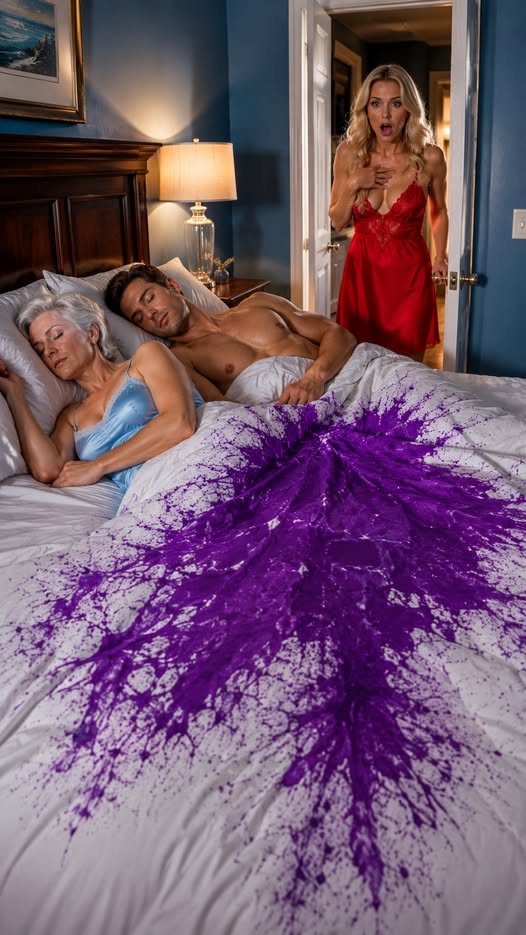
On our wedding night, I had to give up my bed to my mother-in-law after everyone insisted she was “too drunk” to stay anywhere else. The following morning, I spotted something clinging to the bedsheet, and when I finally understood what I was looking at, I was left completely speechless.
Chapter 1: The Honeymoon Suite Sabotage
The tulle of my bridal gown felt like a lead weight by the time midnight finally chimed. All I craved on that inaugural night of my marriage was the quiet sanctuary of our bedroom, the reassuring presence of my new husband, Julian, and a few hours of absolute silence after an excruciatingly long day of forced smiles and camera flashes. I sat on the edge of the mattress, systematically pulling thirty metal bobby pins from my aching scalp.
Before I had even managed to wipe the foundation from my cheeks, the bedroom door flew open. It didn’t just swing; it struck the wall with a dull thud. My mother-in-law, Victoria, staggered over the threshold, a white goose-down pillow clutched to her chest like a shield.
She reeked of cheap gin and stale champagne. Her gait was exaggeratedly clumsy, a pantomime of a woman who had enjoyed the open bar a fraction too much. Yet, as she caught herself on the doorframe, I noticed her eyes. They were obsidian-dark, perfectly focused, and scanning the room with the sharp, predatory calculation of a hawk. They were utterly devoid of the hazy, unfocused glaze that her supposed intoxication should have guaranteed.
“Elena, darling,” she slurred, dragging out the syllables of my name as if tasting something rotten. “The music downstairs is simply pounding in my skull. Let me just rest my eyes in here tonight. Just for a tiny fraction of a moment.”
I remained frozen, a damp makeup wipe suspended halfway to my face. I swiveled my gaze toward Julian, fully expecting him to gently but firmly guide his mother out. Surely, he would explain that a couple’s wedding night was unequivocally the most inappropriate moment for a mother-in-law to commandeer their marital bed.
Instead, Julian’s shoulders slumped. A muscle in his jaw twitched before he offered me that familiar, gut-wrenching look of quiet apology—the exact same expression he wore whenever Victoria demanded he cancel our dinner dates to fix a non-existent leak at her house.
“Mom’s just had a bit too much to drink, honey,” Julian murmured, his gaze dropping to the hardwood floor. “Let her stay a little while. I don’t want her tripping on the stairs.”
A cold ember of disbelief flared in my chest. I was only twenty-six, and I had officially held the title of ‘wife’ for less than six hours. I desperately wanted to avoid becoming the cautionary tale whispered about at family reunions—the hysterical bride who screamed at her mother-in-law before the reception tent was even dismantled. Biting the inside of my cheek hard enough to taste copper, I swallowed my pride, grabbed a spare blanket, and silently exiled myself to the downstairs parlor to sleep on a stiff, leather Chesterfield sofa.
Before I crossed the threshold into the hallway, I paused and cast a glance over my shoulder. Victoria wasn’t looking at me. She was watching Julian. Her gaze was locked onto him with a ferocious, suffocating intensity that completely betrayed her drunken charade. She isn’t looking at a son, I thought, a shiver tracing its way down my spine. She’s looking at a possession. It was the look of a miser fiercely guarding her gold, utterly repulsed by the idea of sharing a single coin.
The leather sofa offered no comfort, and my mind refused to shut down. I tossed and turned, phantom sounds of the sprawling, empty house amplifying my anxiety. By the time the first pale ribbons of dawn began to bleed through the parlor windows, physical exhaustion had finally overridden my racing thoughts, granting me an hour of fitful, dreamless sleep.
Shortly before six in the morning, I abandoned the attempt. I folded the blanket and crept upstairs, intending to wake Julian so we could see off my parents before their early flight back to Chicago.
Our bedroom door stood slightly ajar, exactly how I had left it. But the moment my fingers pushed the wooden frame wider, the breath vanished from my lungs.
Julian was lying flat on his back, his face turned toward the window. Victoria was curled beside him beneath the heavy duvet I had surrendered hours prior. She was entirely too close, her head resting practically on his shoulder, an intimate tableau that made my stomach perform a slow, sickening roll.
I crept closer, my stockinged feet making no sound on the thick Persian rug. My brain frantically scrambled for a rational, innocent justification. She rolled over in her sleep. It’s just a cramped bed.
Then, my eyes darted downward.
Against the pristine, snow-white expanse of the Egyptian cotton fitted sheet, situated right near the center of the mattress between them, was a stark, reddish-brown smear.
Without thinking, driven by a morbid, trancelike curiosity, I reached out. I pressed my index finger against the edge of the stain. The center was dried and flaking, but the thicker edge remained distinctly tacky, clinging slightly to my skin. I brought my finger toward my face. It possessed a heavy, metallic tang. It smelled absolutely nothing like the gin that had been so prominent on Victoria’s breath the night before.
It smelled like rust. It smelled like blood.
Before I could even begin to process the horrific implications, the mound of blankets suddenly shifted.
Chapter 2: The Silent House & The Locked Door
“Oh! Are you awake already?”
Victoria’s voice sliced through the quiet room, startling me so badly I nearly stumbled backward. She jerked the duvet up to her chin, concealing her shoulders, before flashing me a brilliantly wide, toothy smile. There was something deeply unnatural about her demeanor. Her hair was perfectly in place. Her eyes were bright and alert. For a woman who had supposedly consumed enough liquor to disable a sailor, there was no redness in her eyes, no puffiness in her cheeks, no croak in her voice.
“Heavens, I was so fatigued last night, I simply died the moment my head hit the pillow! Slept like an absolute rock,” she chirped, the cheerfulness in her tone sounding remarkably rehearsed.
I didn’t answer her. I pivoted my attention to Julian, praying he would sit up, rub his eyes, and offer me a lifeline of logic to pull me from this escalating nightmare.
His eyes remained squeezed shut. Yet, beneath the quilt, his chest rose and fell in short, erratic bursts. The rigid line of his posture, the tight clenching of his hands by his sides—it was painstakingly obvious he was wide awake.
He didn’t utter a single syllable. He didn’t even dare to turn his head in my direction.
That silence was infinitely worse than any lie he could have fabricated. It cemented a heavy, leaden realization in my gut: whatever twisted event had transpired during the inaugural hours of our marriage was a dark, venomous secret neither of them intended to share with me.
I turned on my heel and walked out, scrubbing my blood-stained fingertip raw against my sweatpants.
By the time the sun had fully risen, the house was a theater of the absurd. Victoria hummed merrily in the kitchen, brewing chamomile tea as if the morning was entirely unremarkable. Julian avoided my gaze, hiding behind his laptop, citing urgent architectural blueprints he had to review.
Later that evening, craving a moment of solitude, I slipped into the basement laundry room. The air was thick with the harsh, stinging chemical odor of industrial bleach. I peered into the large stainless-steel sink. The white sheets from our marital bed were submerged in a frothy, chlorinated bath, the reddish-brown evidence currently being systematically eaten away by the chemicals.
Seeing them there, soaking in silence, caused the vague uneasiness I had lugged around all day to calcify into a hardened, inescapable dread.
That was the exact moment my marriage ceased to feel like the sunrise of a beautiful new chapter. It began to feel like a trap.
Three agonizingly tense days passed. We walked around the sprawling Victorian house on Elm Street like ghosts haunting the same corridors, careful not to collide. Julian grew increasingly pale, flinching whenever a door slammed.
On the fourth night, a sharp, scraping noise from the upper floor jolted me awake. The illuminated dial of the bedside clock read 3:14 AM. Julian was asleep, his back turned to me, his breathing heavy and exhausted.
I slipped from the bed, grabbing a heavy brass candlestick from the dresser as a makeshift weapon, and followed the sound. The noise had emanated from the attic—a space that had been strictly padlocked since the day I moved my boxes into the house.
I crept up the narrow, groaning wooden stairs. My heart hammered violently against my ribs as I reached the landing. The padlock, which had always hung heavy and secure on the hasp, was gone. The heavy oak door stood a few inches ajar, spilling a slice of pale, yellow lamplight onto the dusty floorboards.
I pushed the door open with the base of the candlestick and stepped inside.
The candlestick nearly slipped from my clammy grip.
The walls of the cramped, windowless room were plastered with hundreds of photographs. They covered the faded wallpaper like a patchwork quilt of obsession, chronicling Julian’s existence from a swaddled infant to his college graduation. But it wasn’t the sheer volume that made my breath catch in my throat; it was the composition.
Victoria was anchored beside him in almost every single frame. Her arm wrapped around his neck, her cheek pressed against his, her hands gripping his shoulders. Meanwhile, the peripheral figures—childhood friends, little league coaches, teenage peers—had been physically mutilated. Their faces were either burned away by cigarette embers or aggressively blacked out with thick permanent marker.
It was a shrine dedicated not to a son’s life, but to a mother’s absolute, unchallenged monopoly over it.
Resting on a small, battered writing desk in the corner was a leather-bound diary, its pages swollen and yellowed with age. Curiosity, dark and compelling, violently shoved my hesitation aside. I approached the desk and flipped the heavy cover open.
The handwriting inside was frantic, characterized by aggressive, jagged loops that dug deeply into the paper. One specific, undated entry halfway through the journal hooked my attention, refusing to let go.
“After the ice road accident, it was finally only you and me. Your weak father died, coughing up his life in that ditch. But before the end, he blamed me. He knew. He always knew.”
A wave of nausea washed over me. I turned the page, my hands trembling so violently the paper rattled.
The next passage was written in a thicker, darker ink, as if she had pressed the pen down until the nib nearly snapped.
“From that glorious day onward, I swore a blood oath. I will never let anyone steal you from me. You are mine. You were carved from my flesh.”
I turned another page. Then another. The same terrifying mantra was vomited across the pages, repeating in varying degrees of manic intensity, sometimes furiously crossed out, only to be rewritten larger and bolder.
“She cannot take him. Nobody will ever take him.”
I dropped the diary. As it hit the desk, a loose piece of cardstock fluttered to the floor, landing face-up near the toe of my slipper.
It was a 5×7 print of one of our engagement photos. Julian looked handsome, smiling brightly into the lens, entirely untouched.
My own face, however, had been subjected to a psychotic frenzy. It had been violently, repeatedly gouged with a razor blade or a pin, the glossy paper shredded and torn until my features were reduced to a terrifying, unrecognizable void of white pulp.
The noise from earlier hadn’t been an accident. She had wanted me to find this.
Chapter 3: The Confession of Blood
I didn’t wait for morning. I grabbed the shredded photograph and the leather diary, marched straight down the two flights of stairs, and threw open our bedroom door. I slammed the heavy journal down onto Julian’s chest.
He jolted awake with a panicked gasp, his eyes wide and uncomprehending in the dim moonlight filtering through the blinds.
“Read it,” I commanded, my voice trembling with a terrifying mixture of rage and profound fear.
Julian scrambled to sit up. He stared at the worn leather cover for a long, agonizing minute. He didn’t open it. He didn’t need to. The blood drained from his face, leaving his skin the color of old parchment. He buried his face in his shaking hands, a ragged, pathetic sob tearing its way out of his throat.
“Julian,” I pushed, refusing to let him hide. “She confesses to your father’s death in this book. She admits he knew she caused the accident. Why wasn’t I told? Why was I brought into this house blind?”
He lowered his hands. The man looking back at me wasn’t the confident architect I had married; he was a terrified, shattered ten-year-old boy.
“When I was ten,” he rasped, his voice barely a whisper, “my dad’s car skidded off the mountain pass. The police found evidence that the brake lines had been tampered with. They suspected her. The whole town suspected her. But the local sheriff was her cousin, and the physical evidence magically vanished from the precinct. They ruled it a tragic malfunction.”
I stared at him, my mind reeling, trying to process the magnitude of the lie our relationship was built upon. “You never breathed a word of this to me. Three years, Julian. Three years.”
He wouldn’t look me in the eye. “She lost her mind after he died, Elena. She isolated us. If I tried to leave, she would stop eating. If I made friends, she would sabotage them. I stayed because I honestly believed her mind was broken by grief, and that if I abandoned her, she would die.”
His gaze slowly drifted toward the shredded photograph I still clutched in my fist. His expression darkened, the shadows in the room seemingly clinging to his features.
“It wasn’t just isolation,” he confessed, the words spilling out like poison being drained from a wound. “There has always been a cycle. Anyone who ever managed to break through her walls and get close to me… they eventually vanished. High school friends suddenly moved away without saying goodbye. Two of my college girlfriends transferred schools in the middle of the night and blocked my number. I thought it was bad luck. But deep down… I always knew it was her.”
My stomach tightened into a painful knot as the horrifying mosaic finally assembled itself in my mind. The shrine upstairs. The mutilated faces. My own obliterated image. What I had foolishly dismissed as the pathetic jealousy of an overbearing mother was, in reality, the calculated, predatory behavior of a serial destroyer.
“Julian,” I whispered, stepping closer to the bed, forcing him to look at me. “The reddish-brown mark on our bedsheet the morning after the wedding… I touched it. It smelled like copper. What exactly did she do in this room?”
Julian’s entire body began to violently shudder. He swallowed hard, his Adam’s apple bobbing in his throat, his eyes filled with a desperate, trapped-animal terror.
“After you went downstairs,” he began, his voice cracking, “her drunken act vanished in a second. She sat on the edge of the mattress. Her eyes were dead, Elena. Just… empty. She demanded I sign over the deed to the Elm Street house to her immediately. She claimed that now I was married, she needed legal security so you couldn’t ‘throw her into the streets’.”
I covered my mouth with my hand.
“When I refused, and told her she was acting crazy… she reached into her purse.” Julian choked on a sob, squeezing his eyes shut against the memory. “She pulled out my dad’s old bone-handled hunting knife.”
My blood ran ice cold. “A knife?”
“She didn’t aim it at me,” he wept, tears finally slipping down his cheeks. “She rolled up her silk sleeve, looked me dead in the eye, and slashed the blade horizontally across her own forearm. Deep.”
“Oh my god…”
“She smeared her own blood directly onto the sheets,” he continued, the horror of the memory entirely paralyzing him. “She held the bloody knife out to me and smiled. She said if I didn’t promise to divorce you within six months, she would call 911, hand me the knife, and tell the police her new daughter-in-law convinced her son to butcher her in her sleep. She said no jury would believe a newlywed over a bleeding, elderly widow.”
The silence in the bedroom was deafening. The stain wasn’t an act of incestuous betrayal. It was a literal blood oath, a psychological hostage situation forced upon a traumatized victim by a textbook sociopath.
“She bandaged her arm in the bathroom,” Julian whispered. “Then she laid down next to me, pulled up the covers, and told me that if I made a sound when you came up, she would rip her stitches open and start screaming.”
A bizarre clarity suddenly washed over me. The initial shock evaporated, replaced instantly by an absolute, scorching, protective rage.
“Get up,” I ordered, my voice hard as granite.
“Elena, what—”
“I said get up, Julian! We cannot spend another hour in this slaughterhouse. She isn’t going to stop at blackmail or cutting herself. The moment the six months are up, if I am still here, she is going to murder me. She is going to kill one of us.”
Julian stared at the leather diary on the bedspread. Decades of suppressed terror, of being gaslit and abused, seemed to finally crack against the undeniable reality of his wife’s scratched-out face. The little boy vanished, replaced by a man backed into a corner.
He threw off the covers and planted his feet firmly on the floor.
“You’re right,” he said, his voice dropping to a decisive, steady baritone. “We end this. Tonight.”
Chapter 4: The Staircase Confrontation
We moved through the upper hallway with the panicked precision of soldiers behind enemy lines. We packed only the absolute essentials—passports, birth certificates, Julian’s laptop, and a few changes of clothes—shoving them forcefully into a single canvas duffel bag. Our plan was simple: slip out down the back stairs, bypass the main floor entirely, exit through the side garage door, and drive directly to the state police headquarters in the city. We would drop the diary and the cold-case files right onto the captain’s desk.
Julian zipped the duffel bag, giving me a silent nod. I gripped my heavy brass candlestick in my right hand, just in case.
We reached the top of the grand, sweeping mahogany staircase that overlooked the foyer. The house was submerged in absolute darkness, the only sound the violent, synchronized thudding of our own heartbeats.
We took the first step down.
Clack.
A sudden, sharp noise echoed from below. The massive crystal chandelier suspended above the foyer flared to life, flooding the entryway with blinding, artificial daylight.
Standing at the very bottom of the stairs, perfectly centered on the Italian marble floor, was Victoria.
She had shed the fragile-old-woman costume entirely. She wasn’t wearing a nightgown. She was fully dressed in a heavy, dark wool trench coat, her silver hair immaculately pinned back. Her expression was completely devoid of humanity—it was a mask of cold, calculating granite.
In her gloved right hand, she casually gripped the heavy, solid brass fireplace poker. Its sharp, wrought-iron tip glinted wickedly beneath the chandelier’s light.
“Where exactly do you think you’re scurrying off to with my son, Elena?” she asked. Her voice was terrifyingly smooth, lacking any trace of anger or panic. It was the voice of an exterminator addressing a pest.
Julian reacted instantly. He stepped down to the next tread, placing his body squarely in front of mine, using his broad shoulders to physically shield me from her line of sight.
“We’re leaving, Mom,” Julian stated, his voice resonating with an authority I had never heard from him before. “And we’re taking Dad’s old journals to the authorities.”
The calm demeanor Victoria wore shattered like cheap glass. Pure, unbridled malice flooded her features, twisting her face into a snarl. Her eyes narrowed into dark, hateful slits as her leather-clad fingers tightened their death grip on the brass iron.
“You ungrateful, foolish little boy,” she spat, taking her first slow, deliberate step up the carpeted stairs. The heavy poker scraped softly against the wooden banister. “I eliminated your weak father because he had secretly bought plane tickets to take you away to Europe. I ruined the reputations and lives of every pathetic little tramp who ever dared to look at you.”
She took another step. The distance between us was closing rapidly.
“I built your entire world, Julian!” she screamed, the sound echoing harshly off the high ceilings. “Do you honestly believe I’m going to stand by and let this mediocre, nobody of a girl walk out that front door with the only thing on this earth that belongs to me?”
“You will not touch her,” Julian roared, bracing his legs on the stairs, preparing for the impact.
Victoria let out a wild, high-pitched laugh that sounded like tearing metal. “I created you! Every drop of blood in your veins is mine! If I cannot have you… no one will!”
With terrifying, unnatural speed, she lunged up the final three steps, raising the heavy brass poker high above her head, aiming a lethal, crushing blow directly toward Julian’s skull.
Chapter 5: The Fall and The Future
Julian didn’t flinch. He didn’t retreat up the stairs. As Victoria swung the heavy iron downward with murderous force, he stepped directly into her reach, throwing his arms upward to intercept the strike.
He caught her wrists mid-air. The brutal force of her momentum sent them both crashing violently against the carved wooden banister. The wood groaned under their combined weight.
“Elena, call 911! Now!” Julian screamed, his face red with exertion as he desperately wrestled his mother’s gloved hands away from the weapon.
I dropped the candlestick, yanked my cell phone from my pocket, and dialed the emergency digits with trembling, slippery fingers. I sprinted down the remaining stairs, desperate to get behind her and find an opening to help him.
“Dispatcher! I need police and an ambulance at 412 Elm Street immediately!” I shouted into the receiver, my voice raw. “There is an armed intruder! She’s trying to kill my husband, and she just confessed to a homicide!”
Hearing me on the phone pushed Victoria over the edge of sanity. She shrieked—a guttural, animalistic sound—and abandoned her grip on the poker, using all her frantic, adrenaline-fueled strength to shove Julian directly in the chest.
Caught off guard by the sudden shift in tactics, Julian lost his footing on the slick edge of the carpeted stair. He tumbled backward, his arms flailing, but his fingers remained tangled in the heavy wool of Victoria’s coat.
He went down hard, tumbling down the final flight of stairs, dragging his mother down into the abyss with him.
The heavy brass poker slipped from her grasp and clattered loudly across the hardwood floor, spinning to a halt near my feet.
A sickening, wet crack echoed through the massive foyer, followed instantly by absolute, suffocating silence.
When the dust literally settled at the bottom of the staircase, Julian groaned. He rolled onto his side, pushing himself up against the floral wallpaper, clutching his bruised shoulder, but miraculously intact.
Victoria lay flat on her back near the heavy oak front door. She wasn’t moving.
During the chaotic fall, the back of her skull had struck the sharp, unyielding marble corner of the antique entryway console table. A dark, crimson pool was already beginning to seep into the grout of the Italian tile beneath her. Her sharp, terrifyingly calculating eyes were wide open, staring blankly up at the crystal chandelier above. The fierce, possessive fire that had burned in them for decades was completely extinguished. She was entirely motionless.
Outside, the distant, frantic wail of police sirens began to cut through the quiet, pre-dawn air, growing louder and more urgent with every passing second.
Julian sat on the cold floor, his chest heaving, staring at his mother’s lifeless form. I dropped the phone, rushed down the remaining steps, and fell to my knees beside him. I wrapped my arms tightly around his trembling torso, pulling his head firmly into my shoulder, shielding his eyes from the gruesome consequence of his freedom.
“It’s over, Julian,” I wept, burying my face in his hair as the flashing red and blue lights began to dance violently through the front windows. “It’s finally over.”
Three months later, the vibrant spring sun shone warm and brilliantly through the floor-to-ceiling windows of our new, modern apartment in the heart of the city—miles and lifetimes away from the quiet, suffocating horrors of Elm Street.
The subsequent police investigation had been incredibly swift and horrifyingly thorough. Crime scene investigators had uncovered a hidden floor safe beneath the floorboards in Victoria’s attic shrine. Inside, they found the original, unaltered medical examiner reports from Julian’s father’s suspicious death, alongside a cache of trophies—driver’s licenses and jewelry—connecting her definitively to the sudden, unexplained disappearances of the two high school girlfriends years prior.
Victoria’s decades of meticulous, hidden madness had finally been exhumed and exposed to the harsh light of day, permanently closing cold cases that had cast a long, dark shadow over the small town for over fifteen years.
I stood in our bright, airy kitchen, the scent of fresh, dark-roast coffee filling the space. I poured two steaming mugs and watched my husband through the glass of the balcony door.
Julian was sitting at a glass drafting table in the pure sunlight, sketching out the preliminary blueprints for his newly established architecture firm. For the first time since the day I had met him, the constant, invisible tension that had permanently hiked his shoulders toward his ears had completely vanished. The hollow, haunted shadow that had always lurked just behind his eyes had been replaced by a quiet, steady, enduring peace.
He paused his sketching, looked up, and caught my eye through the glass. He set his pencil down and offered me a genuine, radiant smile—a smile unburdened by guilt or fear.
Our marriage certainly hadn’t commenced inside the pages of a fairy tale. It had been baptized in a nightmare born of maniacal control, spilled blood, and deeply buried secrets. But as I slid the glass door open, stepped out onto the warm balcony, and handed him his mug, wrapping my fingers tightly through his free hand, I felt an overwhelming sense of triumph.
We had survived the fire together. We hadn’t just saved his life from a matriarch’s crimson cage—we had finally laid the foundation for a home that belonged entirely, and beautifully, to us.