What Happens When a SpaceX Rocket Crashes Into the Moon?
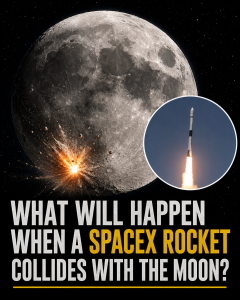
The Moon has been struck by objects for billions of years. Asteroids and meteoroids have carved countless craters into its surface, while in more recent decades human-made spacecraft and probes have added a few impacts of their own.
Now another unusual collision is expected: a discarded section of a SpaceX Falcon 9 rocket is on course to hit the Moon.
According to NASA’s Center for Near-Earth Object Studies (CNEOS), the Falcon 9 upper stage is expected to strike the lunar surface on August 5. The object comes from a rocket launched in January 2025 as part of a US-Japanese mission carrying lunar landers and scientific equipment toward the Moon.
Independent astronomers studying publicly available tracking data first identified the rocket stage’s accidental collision course. NASA later confirmed the trajectory.
NASA has emphasized that the object poses no threat to Earth. Instead, scientists plan to continue tracking it and study the impact site afterward, turning an accidental crash into an opportunity for lunar research.
A Huge Piece of Space Hardware
Falcon 9 rockets are partly reusable, with their first stages designed to return to Earth for future missions. However, upper stages can sometimes remain in space after completing their work.
The section heading toward the Moon is substantial. It has a mass of at least 4,000 kilograms (about 8,800 pounds) and is roughly comparable in size to a five-storey building.
It is expected to be travelling at approximately 2.43 kilometres per second — around 5,400mph — when it reaches the lunar surface.
Astronomer Bill Gray predicts the rocket stage will strike near the Einstein crater. The collision could leave behind a new crater measuring more than 17 metres (56 feet) across.
A Powerful Lunar Impact
Astronomers expect the crash to produce a dramatic burst of lunar material.
Dr Matt Bothwell, a public astronomer at the University of Cambridge, explained that the impact could throw a massive plume of dust high above the Moon’s surface, potentially reaching tens of kilometres into space before spreading outward and eventually falling back.
Conditions on the Moon make such an impact very different from one on Earth.
The Moon has virtually no atmosphere to slow the incoming rocket stage, and its gravity is much weaker than Earth’s. As a result, the object should reach the surface at extremely high speed, potentially sending an estimated million kilograms of debris and lunar material upward.
The event is unlikely to be clearly visible to the naked eye from Earth. However, astronomers using powerful telescopes may have a chance to detect a brief flash produced by the collision.
Scientists See a Rare Opportunity
For researchers, the impact is more than a spectacle.
Large telescopes in the Americas are expected to observe the event, while spacecraft including NASA’s Lunar Reconnaissance Orbiter and South Korea’s Danuri lunar probe could help examine the aftermath.
Amateur astronomers may also contribute observations through citizen-science projects.
Scientists hope to measure how much lunar material is thrown into space, how high the debris travels and how it settles back onto the surface. Those observations could improve models explaining how impacts create lunar craters.
The newly formed crater could also expose material that was previously buried beneath the Moon’s surface, potentially providing researchers with additional information about the geology of the impact area.
Another Warning About Space Debris
The collision also highlights a growing problem surrounding Earth: human-made space debris.
Thousands of satellites, rocket components and fragments from previous missions remain in space. When objects collide, they can break into even more pieces, creating additional debris that can threaten functioning spacecraft.
The European Space Agency estimates that roughly 54,000 objects larger than 10 centimetres are currently orbiting in space. Since the beginning of the Space Age in 1957, humans have launched approximately 17,000 tonnes of material beyond Earth.
Scientists have warned that continuously adding objects to orbit increases the possibility of collisions and could potentially trigger cascading events in which one collision produces debris that causes further collisions.
This will not be the first abandoned rocket component to reach the Moon.
In 2022, an upper stage associated with China’s Long March 3C rocket and the 2014 Chang’e 5-T1 mission struck the Moon’s far side.
NASA has also deliberately crashed spacecraft and rocket stages into the lunar surface in the past, particularly during the Apollo era, when controlled impacts helped scientists collect valuable information about the Moon.
This latest collision is accidental, but researchers hope it can still provide useful science.
For the Moon, another crater will become part of a surface already shaped by billions of years of impacts. For scientists on Earth, however, the crash offers a rare chance to watch a large object strike the lunar surface and study exactly what happens next.