I Changed the Locks While My Daughter-in-Law Was at Church—Then I Found the “SALE” Folder
LAST PART
I laughed.
“You know what the funniest part is?”
“What?”
“I thought the locks were going to keep people out.”
Rosalind nodded.
“And?”
“They actually reminded me that I was allowed to decide who came in.”
She sat beside me.
We drank our coffee.
After a while, a car pulled into the driveway.
Curtis got out.
He carried a paper bag.
“Lunch,” he called.
I smiled.
“Come on up.”
He walked toward the porch.
Before he reached the steps, he stopped.
“Mom?”
“Yes?”
“Can I ask you something?”
“What?”
“Would you ever let me have a key again?”
I looked at him.
He looked nervous.
I smiled.
“Eventually.”
He laughed.
“That sounds fair.”
“It is.”
He came up the steps.
We ate lunch together.
Nothing dramatic happened.
No shouting.
No lawyers.
No police.
No secret folders.
Just a mother and her son sitting at a table.
And somehow, that felt like the biggest victory of all.
A year later, I planted roses beside Walter’s old workshop.
The house looked almost exactly as it had when we moved in.
Except for one thing.
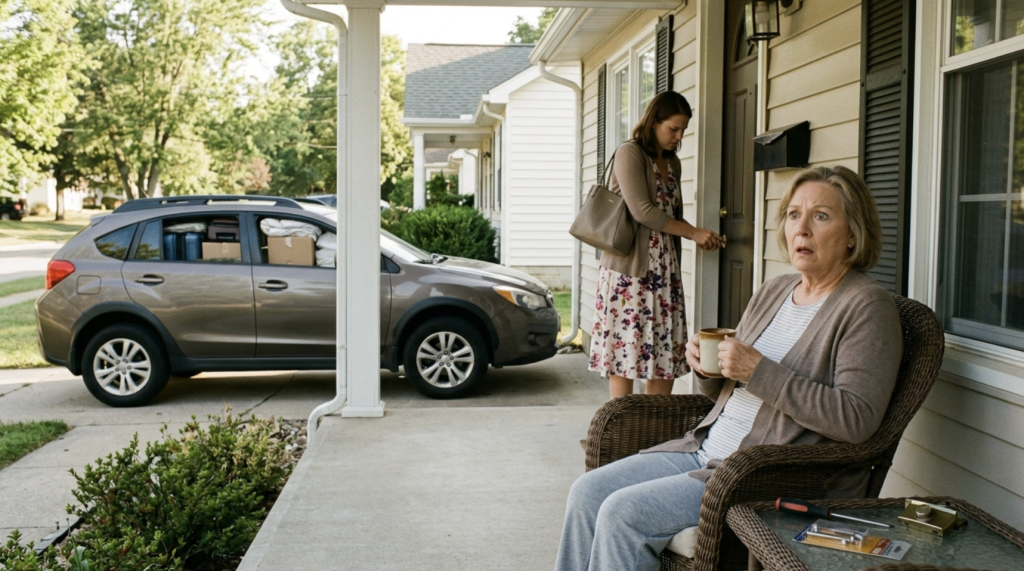
The front door had a new lock.
Not because I was afraid.
Because every time I turned the key, I remembered the morning I finally understood something Walter had known all along.
A house is not valuable because of its walls.
It is valuable because of the life lived inside it.
And no one gets to decide when that life is over simply because they think an old woman is too tired to fight.
I was tired.
I was seventy-eight years old.
My eyes were failing.
My knees hurt.
My hands weren’t as steady as they used to be.
But I was still Eleanor.
Walter’s wife.
Curtis’s mother.
Rosalind’s best friend.
And the woman who had built a life inside that house for more than fifty years.
That morning, I thought changing the locks would be the beginning of a war.
Instead, it became the beginning of my freedom.
And every Sunday after that, when Curtis came to lunch, he would knock on the door.
He never used a key.
He never assumed.
He always waited.
And every time I opened the door, I would smile and say the same thing.
“Come in, son.”
Because forgiveness, I learned, doesn’t mean forgetting.
It means remembering exactly what happened…
and choosing not to let it destroy what can still be saved.
The house remained mine.
The silver chest remained in the dining room.
Walter’s letter remained in my bedside drawer.
And the locks?
I never changed them again.
I didn’t need to.
Because now everyone who entered my home understood something very simple:
The door belonged to me.
And so did the life behind it.
The End.

Related Posts

I Asked My Wife What Was for Dinner 4 Hours After Her C-Section. What I Overheard at Midnight Forced Me to Face the Truth

They Gave Him $1 While Coworkers Got $250,000. Then He Read Page 19 of the Contract They Wanted Him to Sign