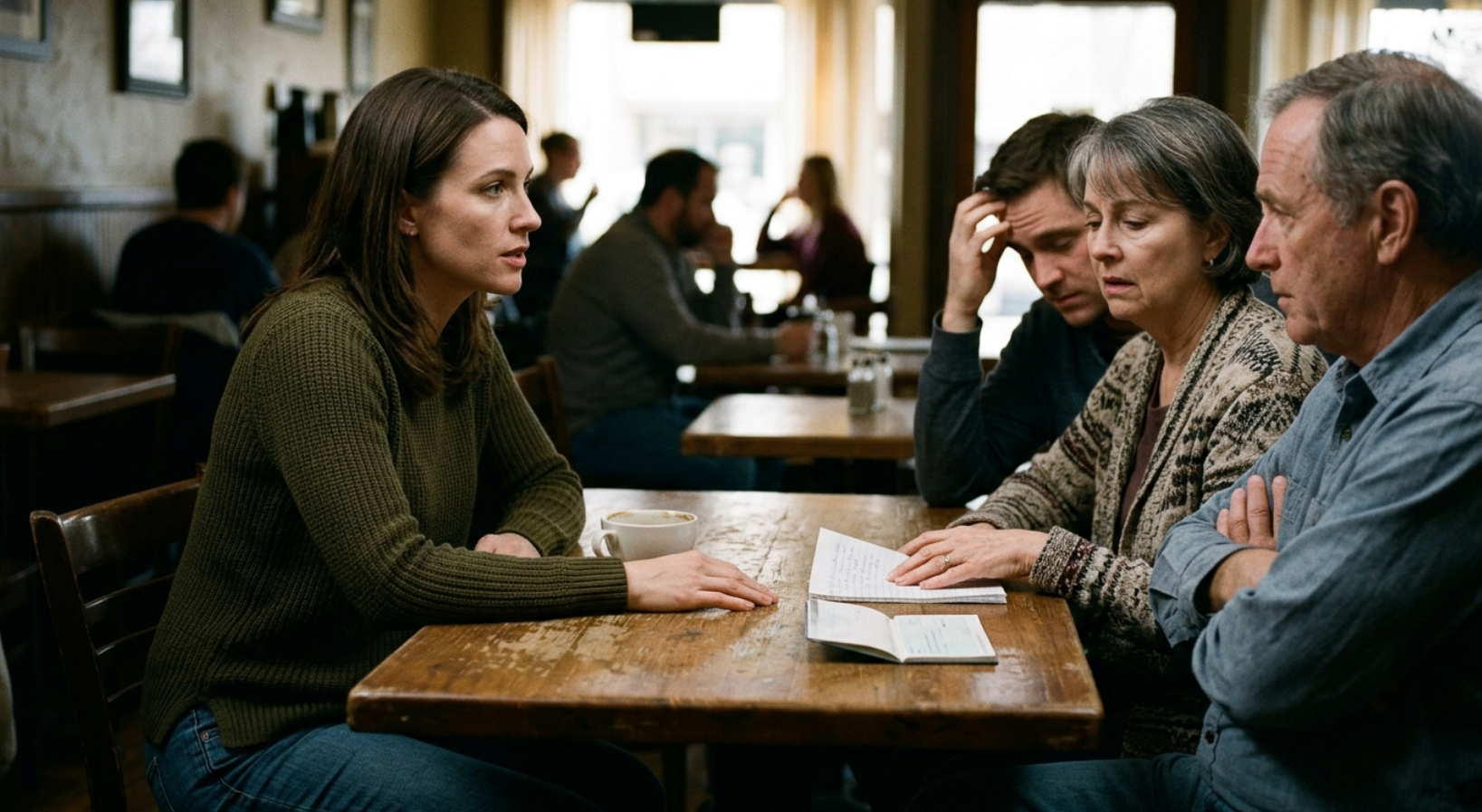
My Family Left Me Out of Their Celebration, Then Came Begging for My Money
PART 4
Three days later, Michael called me at 7:14 in the morning.
“Laura, I need you to come to my office.”
His voice was different.
Not worried exactly.
Careful.
“What did you find?”
“I’d rather show you.”
I knew immediately that whatever he had uncovered was worse than another hidden loan.
I got dressed, drove downtown, and arrived before eight.
Michael was already waiting with two thick folders on the conference table.
Beside them was a laptop.
And on the screen was a document I recognized.
My parents’ signature.
I sat down.
“What is this?”
Michael slid the first folder toward me.
“This is the original purchase agreement for the farmhouse.”
I opened it.
The purchase price was exactly what he’d told me.
Almost one hundred and eighty thousand dollars below what the property was reasonably worth.
“That isn’t necessarily suspicious,” I said.
“No.”
He opened the second folder.
“But this is.”
Inside was a private agreement between my parents and a company registered under John’s name.
I read the first page.
Then the second.
Then I stopped.
“John gets the option to purchase the house?”
“Correct.”
“For what price?”
Michael pointed to the number.
I stared at it.
It was almost exactly what my parents had paid for the property.
Not the current market value.
Not the improved value.
The original price.
“So if the house increases in value, John gets it anyway.”
“Yes.”
“And if they need money later?”
“They’re supposed to sell to him under this agreement.”
“For the same price?”
“Yes.”
I looked up.
“Why would my parents agree to this?”
Michael leaned back.
“That is what I wanted to know.”
He clicked on the laptop.
“There are three versions of the agreement.”
“Three?”
“The first one was signed by your parents.”
“When?”
“Six months before the house purchase.”
I felt a chill.
Six months.
That meant this had been planned long before the photograph.
Long before I knew anything.
Michael continued.
“The second version was amended two months later.”
“What changed?”
“John’s company was added as the beneficiary.”
I frowned.
“Beneficiary of what?”
“The property transfer.”
My stomach tightened.
“And the third?”
Michael looked at me.
“The third version gives John authority to manage certain financial obligations connected to the property.”
I stared at the document.
“So my parents gave him control.”
“Limited control.”
“Over their house.”
“Yes.”
“And then he asked for thirty thousand dollars.”
“Yes.”
I closed my eyes.
Everything suddenly made sense.
The new house hadn’t been the beginning.
It had been the final piece.
John had found a way to make my parents believe they were helping him while convincing them they were simply making a smart investment.
But there was still one question.
“Did my parents understand what they signed?”
Michael didn’t answer immediately.
“I don’t know.”
“Then find out.”
“I already started.”
He opened another file.
“This is the part you need to see.”
It was an email.
From John.
To my father.
The subject line read:
THE HOUSE PLAN
I read it.
John explained that the farmhouse was undervalued and that if they purchased it, renovated it, and transferred certain financial obligations through his company, the family could eventually own the property “without unnecessary outside interference.”
Outside interference.
I knew exactly who he meant.
Me.
I continued reading.
The next paragraph said:
Laura will object if she knows the full structure. Don’t involve her until everything is finalized. Once the house is completed, she’ll understand that we’re doing this for Mom and Dad.
I stared at the screen.
For several seconds, I couldn’t breathe.
They had deliberately hidden it from me.
Not because they were ashamed.
Because they knew I would stop it.
Michael quietly closed the laptop.
“I’ve also found something else.”
“What?”
“Your father signed another document.”
He pushed it across the table.
I read the heading.
Power of Attorney — Limited Financial Authority.
John had been given authority to make certain financial decisions on my father’s behalf.
“Why would Dad give him this?”
Michael answered carefully.
“Your father told the attorney he trusted John to handle property-related matters.”
I shook my head.
“Does Mom know?”
“Yes.”
“And the trust?”
“That’s where it gets complicated.”
He pulled out another page.
“Your mother recently asked the trust administrator to add John as an emergency authorized recipient.”
I stared at the paper.
“Without telling me?”
“Yes.”
“Did the administrator approve it?”
“No.”
“Why?”
“Because the trust agreement doesn’t permit it without trustee approval.”
I almost laughed.
The trust had survived exactly as I had designed it.
The problem wasn’t the trust.
It was the people trying to get around it.
I leaned back.
For the first time in days, I felt strangely calm.
“Michael.”
“Yes?”
“Can I remove myself as trustee?”
He studied me.
“You can resign, but I wouldn’t recommend doing anything until we know whether there are additional obligations.”
I looked at him.
“I don’t want to control their money forever.”
“That isn’t what I’m saying.”
“What are you saying?”
“I’m saying you created this trust to protect them. If you resign before we understand what John has done, someone else may have to take over.”
“Who?”
“We could appoint an independent professional trustee.”
I thought about it.
That might be the answer.
Not me.
Not John.
Not my parents.
Someone neutral.
Someone who didn’t care about family pressure.
“Do it,” I said.
Michael nodded.
“I’ll prepare the paperwork.”
I stood.
Then stopped.
“What about the house?”
“That depends on what your parents want.”
I looked at him.
“What do you mean?”
“If they genuinely want to own the house, they can. But we need to separate their decisions from John’s financial arrangements.”
I nodded.
“And if they don’t?”
“Then we address that.”
I left his office feeling lighter than I had in months.
But the hardest conversation was still waiting.
My parents.
That afternoon, I drove to their new house.
For the first time, I saw it in person.
It was beautiful.
Too beautiful, maybe.
A huge stone entrance.
Wide windows.
A long driveway.
A landscaped yard.
A covered porch.
The house looked like something from a magazine.
And I suddenly understood why my parents had been so excited.
They had spent their entire lives living modestly.
Now they had a house that looked like a reward.
I parked outside.
My mother opened the door before I could knock.
She looked surprised.
“Laura?”
“Can I come in?”
She stepped aside.
My father was sitting in the living room.
John was there too.
Lucy sat beside him.
The room went silent.
Nobody had expected me.
Good.
I wanted them uncomfortable.
Not because I wanted revenge.
Because I wanted honesty.
I placed a folder on the coffee table.
“What’s that?” my father asked.
“Everything.”
John immediately stood.
“You had no right to investigate us.”
I looked at him.
“I didn’t investigate you.”
Michael had.
Using documents they had signed.
“Those are private agreements,” John said.
“Then you shouldn’t have used my parents’ retirement trust to fund them.”
My mother looked at John.
“What is she talking about?”
He froze.
That was when I knew.
She hadn’t known everything.
My mother turned toward him.
“John?”
He said nothing.
I opened the folder.
“Mom, Dad, before we discuss anything, I need you to read this.”
I handed them copies.
My mother started reading.
My father read beside her.
John tried to take the pages away.
“Dad, don’t.”
My father pulled them closer.
“Let us read.”
The room remained silent.
I watched my mother’s face change.
Confusion.
Then realization.
Then hurt.
She looked at John.
“You said this was only temporary.”
John swallowed.
“It is.”
“You told us the house would remain ours.”
“It will.”
“You said the agreement was just protection.”
“It is protection.”
“For whom?”
John didn’t answer.
My father slowly lowered the papers.
“You were going to buy this house from us.”
John shook his head.
“No. That’s not what it means.”
I pointed to the clause.
“It says exactly that.”
“You don’t understand the legal language.”
“I understand it perfectly.”
John looked at my father.
“Dad, I was trying to protect the property.”
My father stared at him.
“From what?”
John looked at me.
“From her.”
The words landed heavily.
My mother whispered, “Laura?”
John continued.
“She would eventually take control of everything.”
I stared at him.
“I never wanted your house.”
“You wanted the trust.”
“I wanted Mom and Dad to have money when they were eighty.”
“You always think you know what’s best.”
“No.”
I looked around the room.
“I think you should be allowed to make your own decisions. I just don’t think you should be allowed to make them with money you don’t have.”
John’s face reddened.
My mother looked down at the documents again.
“Did you arrange the thirty-thousand-dollar loan?”
John didn’t answer.
My father stood.
“Answer her.”
“Yes.”
My mother’s eyes filled with tears.
“You told me the money was for construction.”
“It was.”
“No.”
She shook her head.
“You told me the builder required it.”
“I needed it for the company.”
“You lied to us.”
John’s voice became defensive.
“I was going to pay it back.”
“With what?”
He didn’t answer.
My father sat down.
For the first time in years, he looked old.
Not physically.
Emotionally.
Like a man who had finally realized that protecting his son had become another way of hurting everyone around him.
My mother looked at me.
“Why didn’t you tell us?”
“I tried.”
She shook her head.
“No. Why didn’t you tell us what you knew?”
“Because I didn’t want to embarrass you.”
Her face crumpled.
“You should have.”
I sat beside her.
“Mom, I wasn’t trying to take your choices away.”
“I know.”
“I was trying to protect you from losing the one thing I couldn’t replace.”
She reached for my hand.
I let her hold it.
For several seconds, nobody spoke.
Then my father said something I never expected.
“We owe you an apology.”
I looked at him.
He continued.
“Not for the house.”
I waited.
“For making you feel like you weren’t family.”
My throat tightened.
He looked toward the photograph hanging on the wall.
“The picture.”
I nodded.
“I know.”
“We should have invited you.”
“Yes.”
“We should have told you.”
“Yes.”
“We shouldn’t have written that caption.”
My mother began crying.
“I thought you didn’t care.”
I looked at her.
“I cared more than anyone.”
“I know that now.”
There was no dramatic reconciliation.
No magical moment where everything suddenly became perfect.
Because families don’t heal that way.
Sometimes the first step is simply admitting the wound exists.
I turned toward John.
“What happens now?”
He looked at me.
“I don’t know.”
I nodded.
“That depends on you.”
“What does that mean?”
“It means I’m not going to rescue you.”
He looked angry.
I continued.
“But I’m not going to destroy you either.”
He stared at me.
“I’ll give you one opportunity to fix what you’ve done.”
“How?”
“You cancel the private ownership agreement.”
His expression changed.
“And the thirty thousand?”
“You repay it.”
“I don’t have it.”
“Then create a repayment plan.”
“And my company?”
“That is your responsibility.”
John looked toward my parents.
“Mom?”
My mother wiped her eyes.
“Your sister is right.”
He looked stunned.
“Dad?”
My father nodded.
“She’s right.”
John sat back down.
For the first time, nobody rushed to save him.
And I think that was the moment he finally understood that consequences weren’t punishment.
They were simply what happened after choices.
Over the next month, everything changed.
The private property agreement was legally canceled.
The attempted transfer from the trust was reversed.
The thirty thousand dollars remained untouched.
The independent trustee was appointed.
My parents kept the farmhouse.
John sold two of his vehicles and closed the business account that had been draining his personal finances.
He started repaying the money in monthly installments.
It wasn’t glamorous.
It wasn’t easy.
But it was honest.
And something else happened.
My parents invited me to dinner.
Not because they needed money.
Not because there was a legal document to sign.
Not because something had gone wrong.
Just dinner.
I almost didn’t go.
Then I did.
My mother made the same roast chicken she used to make when I was a child.
My father opened a bottle of wine.
John arrived twenty minutes late.
Lucy didn’t come.
For once, nobody talked about money.
Nobody talked about the house.
Nobody talked about the trust.
We talked about ordinary things.
Work.
Weather.
An old family dog.
A neighbor.
A television show.
It felt strange.
Almost unfamiliar.
After dinner, my mother walked me to the door.
“Laura.”
“Yes?”
“I owe you something.”
“What?”
She smiled sadly.
“A photograph.”
I laughed.
She held up her phone.
“Stand there.”
“Mom, what are you doing?”
“Taking a picture.”
She took it.
Then she looked at the screen.
“This one feels right.”
I glanced at it.
My mother.
My father.
Me.
No expensive house behind us.
No champagne.
No perfect family pose.
Just the three of us standing on a porch.
She sent it to me.
Underneath it, she wrote:
The family that finally learned to tell the truth.
I stared at the message.
Then I smiled.
Months later, I received a letter from the independent trustee.
The trust was healthy.
My parents’ retirement was secure.
No withdrawals had been made.
The property was entirely theirs.
And John’s repayment plan was on schedule.
For the first time in years, I stopped checking their finances.
I stopped monitoring my brother.
I stopped waiting for the next emergency.
I finally understood something I should have understood much earlier.
Love doesn’t always mean stepping in.
Sometimes love means stepping back.
Sometimes helping someone means refusing to make their consequences disappear.
And sometimes the strongest thing you can do for your family is stop trying to earn your place in it.
I had spent years believing I needed to prove I was a good daughter.
I thought if I paid enough bills, solved enough problems, signed enough papers, and rescued everyone often enough, eventually they would see my value.
But the night my family left me out of that photograph, something inside me changed.
I realized I didn’t need to buy my way into a family that should have loved me without a price tag.
The thirty thousand dollars had never really been the issue.
The house had never really been the issue.
The photograph had simply exposed something that had been there for years.
I had confused being needed with being loved.
And those were not the same thing.
A year after everything happened, my parents invited everyone to a small family gathering at the farmhouse.
This time, the invitation arrived personally.
My mother called me.
“Will you come?”
I smiled.
“Of course.”
“John will be here.”
“That’s okay.”
“Lucy too.”
I paused.
“That’s okay too.”
When I arrived, the driveway was full.
My cousins were there.
My aunts and uncles.
My brother.
My parents.
And this time, there was no special effort to make the gathering look perfect.
People were laughing.
Children were running through the yard.
Someone had burned the first batch of burgers.
My father was arguing with John about a broken lawn mower.
My mother was telling everyone that nobody knew how to cook properly.
And I stood there watching them.
Not as the family outsider.
Not as the family banker.
Not as the person responsible for fixing everything.
Just as Laura.
Their daughter.
John’s sister.
A member of the family.
My mother walked over and hugged me.
“You’re staying for dinner?”
“Yes.”
“Good.”
Then she whispered,
“And no one is asking you for money.”
I laughed.
“That’s a start.”
She laughed too.
Later that evening, my father stood up with a glass in his hand.
“I want to say something.”
Everyone groaned.
He smiled.
“I know, I know. Nobody wants a speech.”
But he continued.
“A year ago, we almost let money destroy this family.”
The room became quiet.
“We thought asking for help was the same as having a right to someone else’s sacrifice.”
He looked at me.
“We were wrong.”
I shook my head slightly.
But he continued.
“My daughter taught me something.”
He raised his glass.
“Family isn’t the people who stand beside you when everything looks beautiful.”
He paused.
“It’s the people who are willing to tell you the truth when you’re making a terrible decision.”
Nobody spoke.
Then my father said,
“To Laura.”
Everyone raised their glasses.
I looked around the table.
For years, I had wanted this.
Not the toast.
Not the apology.
Not the house.
Just this feeling.
Belonging without having to purchase it.
I raised my glass.
“To family.”
And this time, I meant it.
Not the perfect family.
Not the family that never hurt each other.
Not the family that always agreed.
The real family.
The one that had finally learned that love could exist alongside boundaries.
The one that had learned that forgiveness didn’t mean forgetting.
The one that had learned that helping someone didn’t mean carrying them forever.
And the one that finally understood that I wasn’t valuable because I could solve their problems.
I was valuable because I was their daughter.
That night, when I drove home, my phone buzzed.
A message from my mother.
It was another photograph.
Everyone at the dinner table.
Everyone laughing.
And this time, I was in the picture.
No caption about who had stuck together.
No mention of money.
No hidden message.
Just a photograph.
I saved it.
Then I put my phone down and drove home.
For the first time, I didn’t wonder whether my family wanted me there.
I knew.
And that was worth far more than thirty thousand dollars.
THE END