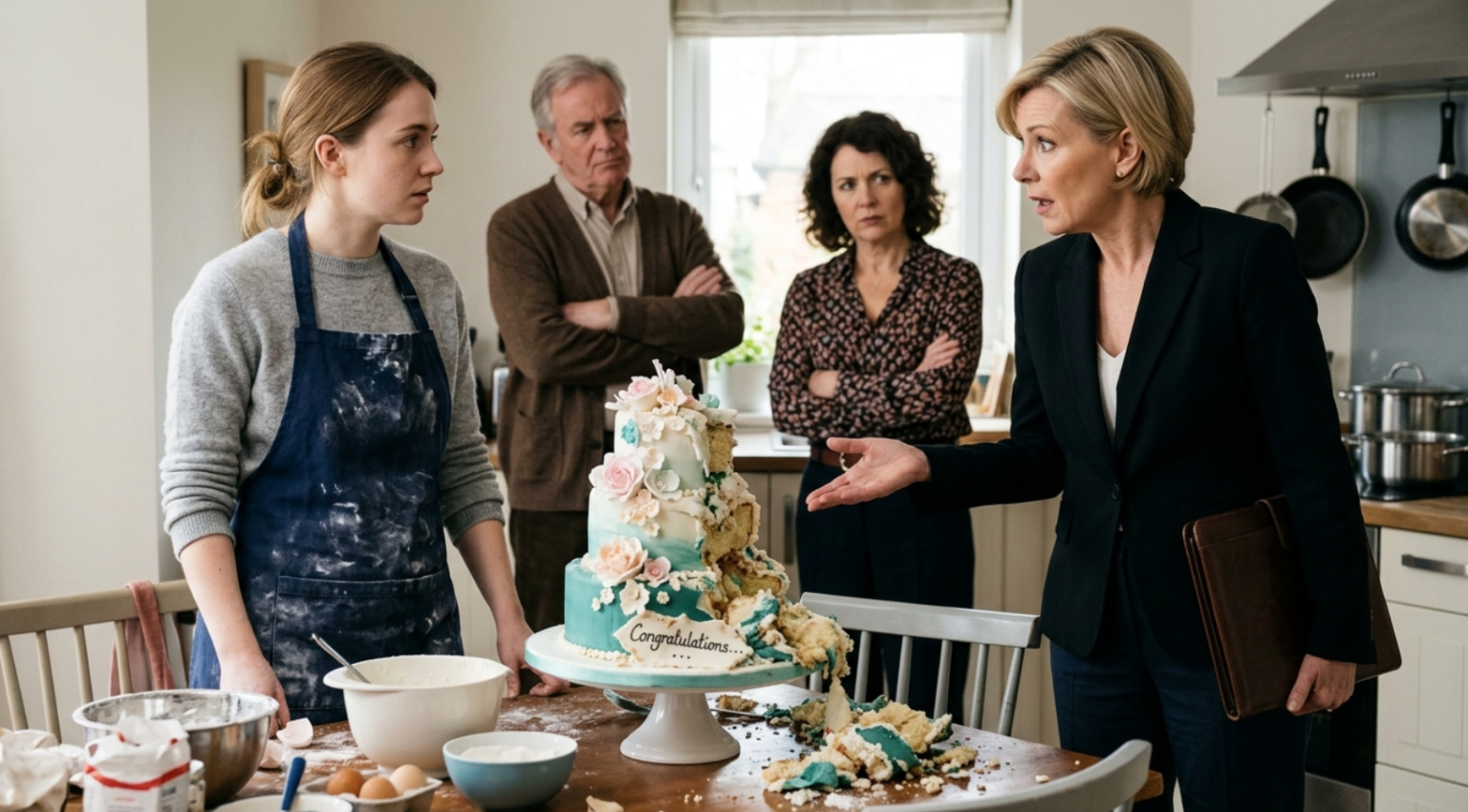
My Stepmother Destroyed My $4,650 Wedding Cake—Then My Biggest Client Saw What I Did Next
PART 4
The following Monday began like any ordinary morning at Claire’s Table.
At least, that was what I thought.
I arrived before six, unlocked the front door, turned on the lights, and started preparing the first batch of cinnamon rolls.
The bakery had been open for almost eight months.
Eight months.
Sometimes I still had to remind myself that it was real.
The little storefront that had once been an empty shell was now warm and bright. The front windows displayed cakes, pastries, and handwritten cards from customers. The walls carried photographs of celebrations I had catered.
And above the register was Mom’s photograph.
Beside it sat her old offset spatula.
I had learned to stop asking whether she would have been proud.
I knew.
She would have been.
My business had grown faster than I expected.
Vanessa had kept her promise.
The six-month partnership became a year-long contract.
Then other event planners started calling.
Corporate celebrations.
Wedding receptions.
Charity dinners.
Anniversary parties.
One month, I had to turn down eleven orders because I simply didn’t have enough ovens.
That was when I finally hired two assistants.
I had gone from being the woman baking alone in a kitchen while her family demanded free cakes to becoming the owner of a real bakery with employees depending on me.
But there was one thing I hadn’t expected.
Success didn’t erase the past.
It simply gave me enough distance to see it clearly.
And sometimes that was harder.
Especially when my family came back.
It started with Brooke.
She called me on a Thursday afternoon.
I almost didn’t answer.
When I did, there was silence on the other end.
“Claire?”
“Yes.”
“It’s me.”
“I know.”
Another pause.
“Can I come see you?”
I looked around the bakery.
“I have customers.”
“I can come after closing.”
I hesitated.
“Why?”
She took a breath.
“I need to apologize.”
I leaned against the counter.
“You already apologized.”
“Not really.”
She sounded different.
Older somehow.
“I said sorry because everything blew up that day.”
She paused.
“I didn’t understand what you had been dealing with.”
I didn’t respond.
She continued.
“Mom told me you were refusing because you didn’t care about my wedding.”
My stomach tightened.
“And you believed her.”
“Yes.”
She sounded ashamed.
“I believed her.”
“What changed?”
“Everything.”
She laughed softly.
“Actually, nothing changed.”
Then she said,
“I just finally started looking at things myself.”
We agreed to meet after closing.
At seven thirty, Brooke walked through the door.
She looked nervous.
She was wearing a simple coat and carrying a small paper bag.
She put it on the counter.
“I brought you something.”
I opened it.
Inside was a framed photograph.
It was Mom’s old wooden stool.
Or rather, a photograph of it.
I looked at Brooke.
“Why?”
“Because Dad told me what he gave you.”
I nodded.
“He said you were keeping it here.”
“He did.”
Brooke looked toward the photograph of Mom.
“I barely remember her.”
“You were young.”
“I remember that you loved her.”
I smiled sadly.
“She was my best friend.”
Brooke swallowed.
“I think I was jealous of that.”
I looked at her.
She continued.
“After my dad left, I always felt like I was the second person in the family.”
I had never known that.
“Then Dad married Natalie, and suddenly everything revolved around keeping her happy.”
She looked down.
“I learned very early that if I wanted something, Mom would make sure I got it.”
“And I learned that if I wanted something, I had to earn it.”
Brooke nodded.
“Exactly.”
Neither of us spoke.
Then she said,
“I don’t want to be like her.”
I looked at her.
“You aren’t.”
“I’m scared I might be.”
“You have a choice.”
She smiled faintly.
“I know.”
She reached into her bag.
“This is for you.”
It was an envelope.
Inside was a handwritten letter.
I recognized the handwriting immediately.
Mom’s.
My hands began to tremble.
“Where did you get this?”
Brooke looked at me.
“Dad gave it to me.”
I opened it.
It was another note.
Short.
Probably written sometime during the last year of Mom’s life.
I read it slowly.
“Claire, people will sometimes ask you to make yourself smaller so they can feel bigger. Don’t do it. Kindness isn’t weakness, and saying no doesn’t make you cruel. One day, you’ll build something with your own hands. Protect it.”
I couldn’t breathe for a moment.
I looked at Brooke.
“Why did Dad have this?”
“He said he found it after Mom died.”
“And he kept it?”
“Yes.”
I folded the letter carefully.
“He should have given it to me years ago.”
Brooke nodded.
“I know.”
She looked toward the door.
“I should go.”
“Brooke.”
She stopped.
“Thank you.”
She smiled.
“I meant what I said.”
Then she left.
I thought that was the end of it.
It wasn’t.
Two weeks later, Dad came back.
This time, Natalie was with him.
I knew something was wrong immediately.
Natalie walked into the bakery wearing the same expression she had worn the morning she destroyed my cake.
Only now, there was something different behind it.
Fear.
She approached the counter.
“Claire.”
“Natalie.”
Dad stood behind her.
He looked uncomfortable.
Natalie placed a folder on the counter.
“We need to discuss something.”
I didn’t touch it.
“What?”
“Brooke’s wedding.”
I stared at her.
“That wedding was almost a year ago.”
“We’re planning the anniversary celebration.”
I blinked.
“You’re planning a wedding anniversary party?”
“Yes.”
“And?”
Natalie took a breath.
“We want you to cater it.”
I almost laughed.
“No.”
She frowned.
“You haven’t even heard the offer.”
“I don’t need to.”
“You’d be paid.”
That caught my attention.
Not because I wanted the job.
Because it was the first time she had ever mentioned payment before asking me to work.
“How much?”
She named a figure.
It was fair.
Actually, it was generous.
I looked at Dad.
“Did you agree to this?”
He nodded.
“I told her if she wanted Claire’s Table, she had to pay Claire’s Table.”
Natalie looked irritated.
But she didn’t argue.
I opened the folder.
There was a contract.
A real contract.
Not a favor.
Not a family promise.
Not “you don’t charge family.”
A contract.
I read it carefully.
Then I closed it.
“I’ll consider it.”
Natalie looked surprised.
“Really?”
“Yes.”
“But there’s one condition.”
“What?”
“Everything goes through my business.”
She nodded.
“No special favors.”
“No unpaid extras.”
“No changing the menu the day before.”
“And nobody enters my kitchen without permission.”
Natalie hesitated.
Then she said,
“Fine.”
I looked at Dad.
He smiled.
I signed the contract.
Not because I had forgiven everything.
Not because I needed their approval.
But because I had finally reached a place where working with them didn’t mean surrendering myself.
It meant I had boundaries.
The anniversary celebration took place three months later.
I catered the entire dessert table.
But this time, when I delivered the cakes, Natalie didn’t tell me they weren’t enough.
She thanked me.
And when she handed me the final payment, she looked at me for several seconds.
“I was wrong.”
I said nothing.
She continued.
“I thought because you were family, you owed us.”
I looked at her.
“You did make me feel that way.”
“I know.”
Her voice was quiet.
“I destroyed something you worked hard on because I was angry.”
“Yes.”
“I’ll regret that for the rest of my life.”
I didn’t know whether she meant it.
Maybe she did.
Maybe she didn’t.
But I didn’t need to decide.
“I hope you don’t do it to anyone else,” I said.
She nodded.
“I won’t.”
Then she walked away.
Dad stayed behind.
He looked at me.
“Are you okay?”
I smiled.
“I’m getting there.”
He nodded.
Then he looked at the cake.
“Your mother would have loved this.”
I smiled.
“I think so too.”
He pointed toward the sugar flowers.
“She taught you that?”
“Every flower.”
He smiled.
“I wish I’d paid more attention.”
I looked at him.
“So do I.”
He laughed quietly.
Then he hugged me.
I let him.
It wasn’t a perfect reconciliation.
There were still things we hadn’t discussed.
Years of favoritism couldn’t disappear because of one apology.
But sometimes healing isn’t about pretending nothing happened.
Sometimes it’s about finally being able to remember what happened without allowing it to control what happens next.
A year after opening Claire’s Table, I expanded.
I rented the empty space next door and turned it into a small teaching kitchen.
I named it the Laura Whitaker Baking Room.
The first class was for children.
I bought small stools.
Aprons.
Piping bags.
Plastic spatulas.
On opening day, seven children arrived.
One little girl climbed onto a stool.
She looked at the frosting in front of her.
Then she made a crooked flower.
She frowned.
“This is ugly.”
I smiled.
“Leave it.”
She looked at me.
“Why?”
I picked up the piping bag.
“Because the next one will be better.”
She smiled.
And suddenly I could see Mom standing behind me.
Not as a memory.
As a feeling.
A part of me.
That evening, after everyone left, I sat alone in the teaching kitchen.
The bakery was quiet.
The ovens had cooled.
The lights from the street came through the windows.
I opened Mom’s recipe notebook.
Between two pages was the photograph of us.
I touched the corner.
“Mom,” I whispered.
“I finally did it.”
I looked around the room.
At the ovens.
The tables.
The children’s drawings taped to the wall.
The little wooden stools.
Everything I had built.
Everything I had once thought I needed permission to become.
I finally understood something.
The cake Natalie destroyed had been worth $4,650.
But what she destroyed that morning was worth much more to me.
It was the belief that my work mattered.
For years, I had allowed people to treat my talent like something I owed them.
I thought saying yes made me a good daughter.
A good sister.
A good person.
But Mom had been right.
Kindness without boundaries eventually becomes self-abandonment.
And love isn’t measured by how much of yourself you are willing to give away.
Sometimes love means helping.
Sometimes it means forgiving.
And sometimes it means saying,
“No.”
Not because you don’t care.
But because you finally care enough about yourself to stop disappearing.
I closed the notebook.
Then I looked at Mom’s photograph one last time.
The first buttercream flower I ever made had been ugly.
But she hadn’t scraped it away.
She had left it there.
Because she knew something I didn’t.
Beautiful things don’t always begin beautifully.
Sometimes they begin broken.
Sometimes they begin with disappointment.
Sometimes they begin with someone telling you that you’re selfish for wanting something of your own.
And sometimes they begin with a ruined cake on a kitchen floor.
But what matters isn’t what gets destroyed.
What matters is what you decide to build afterward.
I turned off the lights.
Before leaving, I touched Mom’s old spatula.
“Goodnight, Mom.”
Then I locked the door.
Above me, the sign glowed softly in the darkness:
CLAIRE’S TABLE
Underneath it was a smaller line I had added after the bakery opened.
Made with love. Never without boundaries.
And for the first time in my life, I didn’t wonder whether I had finally become enough.
I knew.
I had been enough all along.