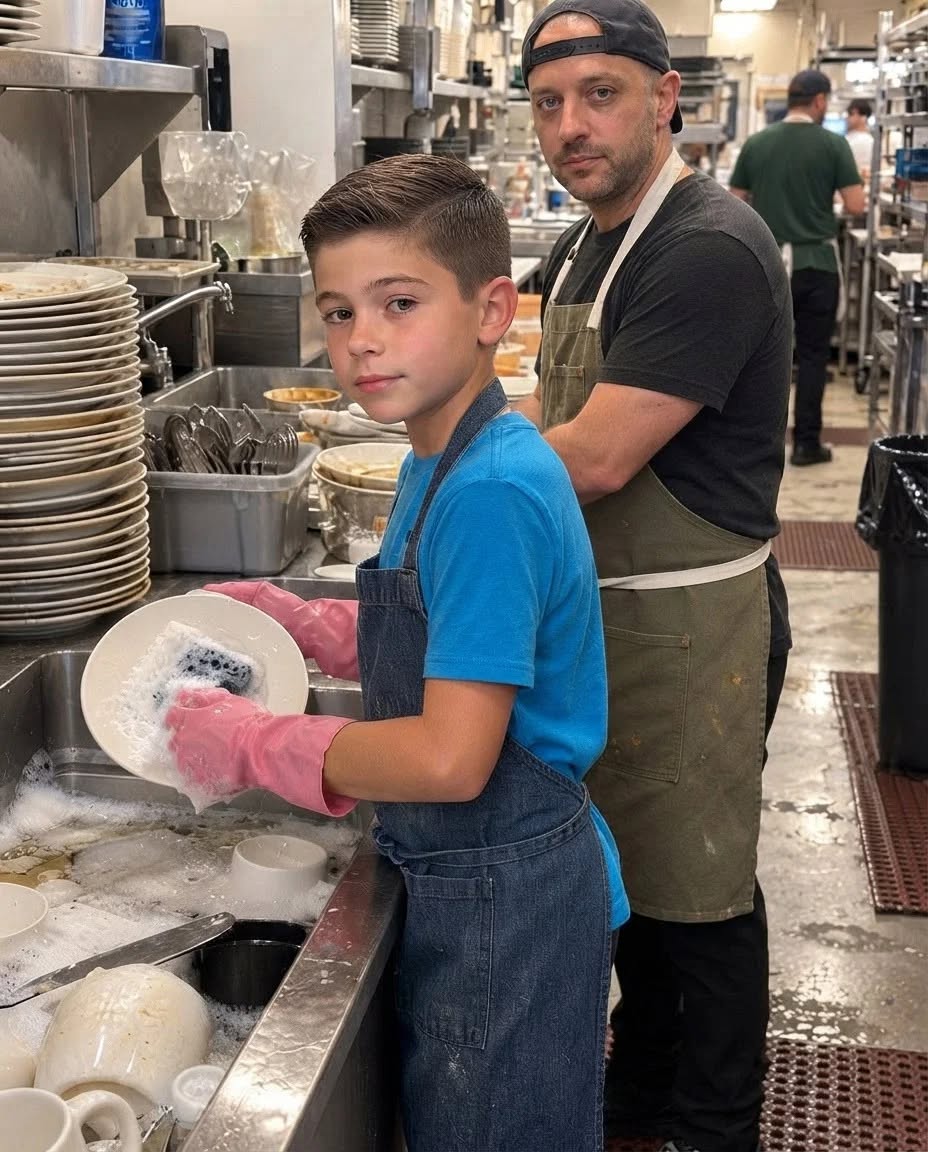
My thirteen-year-old son took a weekend dishwashing job to save for a new bike. Six months later, the bike still hadn’t appeared. Then his boss called me and asked, “Do you know what Evan does with every paycheck?”
“Making sure Mr. Walter made it through winter.”
For several seconds, nobody in that diner kitchen moved.
The dishwasher hissed behind us.
Water dripped from a metal rack.
Somewhere beyond the swinging kitchen doors, a customer laughed, silverware touched a plate, and the ordinary world continued as though my thirteen-year-old son had not just broken my heart open in the middle of a room that smelled like soap and fried onions.
I held Evan against me.
His body shook.
Not the dramatic sobbing of a little boy who wanted comforting.
These were exhausted tears.
The kind that had apparently been waiting six months for permission.
I pulled back and looked at him.
“You’ve been doing this every Saturday?”
He wiped his face with the back of his hand.
“Mostly.”
“Mostly?”
“Sometimes after school.”
My stomach tightened.
“Evan.”
“I finished my homework first.”
That answer was so painfully him that I almost laughed.
Instead, I cried.
Sal bent down and began gathering the papers scattered across the floor.
“Mrs. Carter,” he said gently, “there’s more you need to know.”
I looked at him.
Evan immediately shook his head.
“Sal.”
“No, kid.”
“Please.”
“You’re thirteen.”
Sal’s voice softened.
“You’ve carried enough.”
Evan stared at the floor.
Sal handed me a stack of receipts held together with a rubber band.
On the top was a pharmacy receipt.
Thirty-eight dollars and sixteen cents.
Underneath it, groceries.
Twenty-two dollars.
Then propane.
Forty-one.
Dog food.
Twelve.
Another pharmacy.
Twenty-seven.
Electric company payment receipt.
One hundred and eighty dollars.
I kept turning pages.
Every receipt was small.
That somehow made them worse.
There was no grand purchase.
No dramatic gesture.
Just milk.
Bread.
Soup.
Medicine.
Batteries.
Soap.
Canned beans.
Propane.
Bandages.
A cheap flashlight.
A bag of apples.
A pair of gloves.
The quiet expenses required to keep another human being alive.
I looked at Evan.
“How much?”
He shrugged.
“How much have you spent?”
“I don’t know.”
Sal answered.
“More than eleven hundred dollars from what I can figure.”
I stared at my son.
The bicycle cost six hundred and forty-nine.
Evan had earned enough to buy it.
Almost twice.
He could have been riding it for months.
Instead, he had been carrying grocery bags down a muddy creek bank to an old man’s trailer.
“Why?”
I whispered.
Evan looked confused.
“Because he needed it.”
“No, sweetheart.”
I knelt in front of him.
“Why you?”
His eyes filled again.
“Because nobody else was doing it.”
That sentence stayed with me for the rest of my life.
Not because it was heroic.
Because it was dangerous.
There is something beautiful about a child who notices suffering.
There is something frightening about a child who believes noticing makes him solely responsible for fixing it.
I took his hands.
They were red and dry.
Tiny cracks crossed his knuckles from dishwater.
“You should have told me.”
“You would’ve stopped me.”
“I would have helped you.”
“You don’t have extra money.”
There it was.
The sentence I had never wanted my child to learn.
I closed my eyes.
Three years earlier, when Evan’s father died, our finances collapsed almost as quickly as our family did.
David had been forty-one.
Healthy, we thought.
He went to work on a Tuesday morning.
At 11:17, I received a call saying he had collapsed.
By noon, he was gone.
An undiagnosed heart condition.
No goodbye.
No warning.
No final conversation.
Just breakfast dishes in the sink and a pair of work boots beside the door that remained there for three weeks because neither Evan nor I could bear to move them.
Afterward, money became another kind of grief.
Funeral expenses.
Reduced income.
Insurance confusion.
Repairs.
School costs.
Groceries.
Everything seemed to have a number attached.
I thought I had hidden my fear from Evan.
Children see through walls adults imagine are solid.
He had heard me on the phone asking for extensions.
He had seen envelopes stacked on the counter.
He had watched me compare prices in grocery aisles.
He had noticed when I stopped buying coffee on the way to work.
And apparently he had learned a lesson I never meant to teach:
Mom already has enough problems. Don’t become another one.
I squeezed his hands.
“Evan, look at me.”
He did.
“I may worry about money.”
“I may have to say no sometimes.”
“But you are never required to protect me from being your mother.”
His lip trembled.
“I didn’t want you worrying about Walter too.”
“That wasn’t your decision to make for me.”
His face fell.
I softened my voice.
“And it wasn’t your responsibility to carry alone.”
Sal nodded.
“I’ve been telling him.”
I looked at Sal.
“How long have you known?”
“About two months.”
“Two months?”
He winced.
“I know.”
“You knew my thirteen-year-old was taking money to a stranger’s trailer and you didn’t call me?”
“Mom.”
Evan stepped between us.
“I made him promise.”
I looked at Sal.
“You promised a child?”
“I promised him I wouldn’t tell unless I thought he was in danger.”
I pointed at Evan’s torn sleeve.
“This looks like danger.”
Sal’s face tightened.
“That’s why I called.”
Fair.
I hated that it was fair.
“What happened today?”
Sal leaned against the stainless-steel counter.
“Walter’s prescription changed.”
“For what?”
“Heart medication.”
My stomach dropped.
Of course.
Heart medication.
The universe has a cruel sense of repetition.
“Evan came in upset.”
Sal continued.
“He asked whether I’d pay him three months in advance.”
“I said no.”
“Then he emptied his backpack and offered me everything he had.”
“The cash you saw.”
I looked at Evan.
“How much?”
“Three hundred and twelve.”
Sal answered.
“Walter’s prescription wasn’t three hundred dollars.”
“No.”
“What else?”
Evan stared at his shoes.
“His heater.”
I closed my eyes.
“Of course.”
“The trailer heater quit.”
“He was using a little space heater, but the electric bill—”
“I understand.”
I stood.
“Where is Walter now?”
Evan looked up.
“At the trailer.”
“Is he alone?”
“Yes.”
“How sick is he?”
“I don’t know.”
“When did you last see him?”
“Today.”
“That is why you were muddy?”
Evan nodded.
“He fell again?”
“No.”
His voice became small.
“I did.”
“Why?”
“The footbridge is slippery.”
Footbridge.
Creek.
Mud.
Thirteen.
Enough.
“Get your coat.”
Evan blinked.
“What?”
“We’re going to see Walter.”
His eyes widened.
“Really?”
“Yes.”
“But—”
“And then we’re going to decide what happens next.”
Hope flickered across his face.
“Are you mad?”
“Yes.”
It disappeared.
I touched his cheek.
“Not because you helped him.”
“I’m angry because you thought you had to become an adult in secret.”
His eyes filled.
“There’s a difference.”
Sal walked us to the door.
Before we left, he pressed an envelope into my hand.
“What is this?”
“Nothing.”
“Sal.”
“Employees took up a collection.”
I stared.
“When?”
“After Evan tried to hand me his savings.”
Inside was cash.
A lot more than nothing.
I looked around the kitchen.
The cook suddenly became very interested in wiping a counter.
A waitress pretended to organize napkins.
A teenage busboy looked away.
“You all did this?”
Sal shrugged.
“Kid’s been washing our dishes for six months.”
“Least we can do is help clean up one of his messes.”
Evan laughed through tears.
Then hugged Sal.
Sal looked startled.
Then hugged him back.
“Still not giving you three months’ wages in advance.”
“I know.”
“And next time something like this happens?”
Evan sighed.
“I tell my mom.”
“Louder.”
“I tell my mom.”
I almost smiled.
“Good.”
We drove toward the creek.
The rain had stopped, but the road remained slick.
Evan gave directions.
I knew the general area.
I had no idea my son had been walking there alone.
That realization made my hands tighten around the steering wheel.
“How far do you walk?”
“About a mile from the diner.”
“Every Saturday?”
“Not every Saturday.”
I glanced at him.
“Evan.”
“Most Saturdays.”
I breathed through my nose.
“Mom?”
“Yes?”
“Please don’t be mad at Walter.”
“I’m not mad at Walter.”
“He didn’t ask me at first.”
“At first?”
“He told me to go away.”
That sounded promising.
“What changed?”
“I kept coming.”
Of course he did.
The road narrowed.
We parked near an old bridge and continued on foot.
Within five minutes, I understood the muddy sneakers.
The path was terrible.
The creek had swollen from rain.
Branches crowded the trail.
“Evan Carter.”
“I know.”
“You have been walking this alone?”
“Mostly.”
“If you say mostly one more time, I may lose my mind.”
He almost smiled.
Then we saw the trailer.
It was worse than I imagined.
Not filthy.
Poor.
There is a difference people too often refuse to understand.
The little trailer was old.
Metal siding rusted along the bottom.
Plastic covered one window.
A folding chair sat beside the door.
There were stacked pieces of firewood beneath a tarp.
A brown dog barked when we approached.
“That’s Roscoe.”
Evan called.
“Hey, buddy.”
The dog stopped barking and began wagging his entire body.
Traitor.
Evan knocked.
No answer.
He knocked again.
“Mr. Walter?”
Nothing.
Evan’s face changed.
He tried the door.
Locked.
“Walter!”
He pounded.
I felt cold.
“Step back.”
I called emergency services.
While I spoke, Evan ran around the trailer checking windows.
“Mom!”
I followed.
Through the side window, we could see Walter lying on the floor.
Evan screamed.
Everything happened quickly after that.
Paramedics.
Questions.
A forced door.
Roscoe barking.
Evan crying.
Walter was alive.
Barely conscious.
His blood pressure dangerously low.
He had missed medication.
He was dehydrated.
The heater had failed overnight.
The paramedics loaded him onto a stretcher.
As they carried him out, his eyes opened.
He saw Evan.
“Bike boy.”
he whispered.
Evan laughed and sobbed at the same time.
“Hi, Walter.”
The old man’s eyes moved toward me.
“Your mama?”
“Yeah.”
Walter managed the faintest smile.
“Finally.”
Even half-conscious, he knew.
I wanted to be offended.
Instead, I almost laughed.
At the hospital, a social worker met us.
Her name was Marlene.
She listened.
Actually listened.
That mattered.
She did not treat Walter like a problem.
She did not treat Evan like a saint.
She treated both of them like people who had been failed by systems larger than either of them.
Walter’s benefits had not simply “disappeared.”
There had been paperwork.
A missed recertification notice.
An address problem.
A bureaucratic chain that made perfect sense on paper and absolutely no sense when applied to a seventy-four-year-old widower with poor eyesight, no internet, limited transportation, and a stack of unopened letters.
Marlene looked through what Evan had brought.
“You kept all these receipts?”
she asked.
Evan nodded.
“Why?”
“Dad always kept receipts.”
I turned away.
David did.
Every receipt.
Every warranty.
Every instruction manual.
He had folders for appliances we no longer owned.
I used to tease him.
Apparently Evan remembered.
Marlene smiled.
“These may actually help.”
Evan sat straighter.
“Really?”
“Yes.”
“Some document expenses and dates.”
She looked at me.
“We can work on benefits restoration.”
“Utility assistance.”
“Medication support.”
“Home-delivered meals.”
“Transportation.”
“Possibly housing repair or relocation depending on eligibility.”
I stared at her.
All those things existed.
Evan had been trying to replace an entire safety net with Saturday dishwashing money.
He looked overwhelmed.
“You can do all that?”
“We can try.”
“Does it cost money?”
“Not from you.”
He looked suspicious.
Marlene laughed.
“I promise.”
For the first time, I saw my son relax.
Only slightly.
But enough.
Walter remained in the hospital for five days.
Evan visited every afternoon.
So did I.
The first time Walter was fully awake, he looked at me for a long time.
“You’re David’s wife.”
I froze.
“What?”
Evan looked between us.
“You knew Dad?”
Walter’s eyes moved to him.
“You didn’t know?”
Evan shook his head.
Walter leaned back.
“Well.”
he said.
“That explains a lot.”
I sat down.
“How did you know David?”
Walter smiled faintly.
“Your husband used to come by my garage.”
“What garage?”
“Walter’s Auto.”
I remembered.
A small repair shop near the old highway.
Closed years ago.
David had taken our car there when Evan was little.
“You owned that?”
“Thirty-eight years.”
Walter looked at Evan.
“Your daddy couldn’t afford a transmission repair once.”
I remembered that too.
Evan had been four.
Money had been tight.
David came home one evening and told me the mechanic had “worked something out.”
I never knew what.
Walter continued.
“He was short about nine hundred dollars.”
“I told him to pay me when he could.”
My eyes filled.
“He did.”
“Every month.”
“Sometimes fifty.”
“Sometimes twenty.”
“Once he brought me a homemade pie.”
I laughed through tears.
“That was my pie.”
Walter smiled.
“Then he still owes you an apology.”
Evan laughed.
I cried harder.
“Why didn’t you tell him?”
I asked Evan.
He looked bewildered.
“I didn’t know.”
Walter nodded.
“He didn’t.”
Then he looked at me.
“First time this boy brought me food, I asked his name.”
“Evan Carter.”
“I knew.”
“Same eyes.”
I looked at my son.
“So you knew who he was?”
“Pretty quick.”
“Why didn’t you tell him?”
Walter shrugged.
“Didn’t seem important.”
I stared.
“Walter.”
“Fine.”
He sighed.
“I didn’t want him thinking he owed me.”
The room went quiet.
Evan frowned.
“Owed you?”
“For helping your dad.”
Walter pointed a thin finger toward him.
“That’s not how kindness works, kid.”
“You don’t send an invoice twenty years later.”
Evan looked down.
“But you needed help.”
“That’s different.”
“How?”
Walter thought.
“Maybe it isn’t.”
That answer made me smile.
The story became clearer.
Evan had first noticed Walter behind the diner six months earlier.
Sal sometimes gave leftover food to people at closing.
Walter had been too proud to ask.
Evan brought him a meal.
Then another.
Walter refused money.
So Evan began buying things instead.
Dog food.
Medicine.
Propane.
When Walter realized what the boy was doing, he tried to stop him.
Evan lied.
He said Sal gave him the supplies.
Walter believed that for a while.
Eventually, he figured it out.
By then, pride had already lost several battles to hunger.
“Your boy is stubborn.”
Walter told me.
“Wonder where he got that.”
Evan and I both looked at each other.
“His father.”
we said simultaneously.
Walter laughed so hard he coughed.
That evening, after Evan went to get water, Walter became serious.
“Don’t punish him too hard.”
“I’m not punishing him.”
“You’re mad.”
“I’m terrified.”
He nodded.
“Fair.”
“He was walking down there alone.”
“I know.”
“You let him?”
Walter’s face changed.
“No.”
“I told him to stay away.”
“More than once.”
“He kept coming.”
“That doesn’t make it okay.”
“No.”
Walter looked toward the hallway.
“But don’t teach him that caring was the mistake.”
That stopped me.
Because that was exactly what I was afraid of doing.
I wanted to protect Evan so badly that I could easily turn the lesson into:
Don’t help strangers.
Don’t trust people.
Don’t get involved.
Keep walking.
Protect yourself.
But Walter was right.
Compassion was not the problem.
Secrecy was.
Isolation was.
A thirteen-year-old believing he alone had to keep a seventy-four-year-old alive was the problem.
“I won’t.”
I promised.
Walter nodded.
“Good.”
Then:
“Still ground him for walking that creek.”
“Oh, absolutely.”
“Mom!”
Evan had returned.
Walter grinned.
“Sorry, Bike Boy.”
The name stuck.
The community learned about Walter.
Not because I posted some dramatic story online.
Sal did something simpler.
He placed a jar near the register.
WALTER’S WINTER FUND — ASK EVAN WHY.
I made him change it.
Evan was mortified.
The new sign read:
NEIGHBOR HELP FUND.
People contributed.
A plumber fixed Walter’s pipes.
An electrician inspected the trailer.
A local pharmacy helped sort his prescription assistance.
Marlene restored his benefits.
A church arranged meal deliveries.
A retired contractor repaired the steps.
Someone donated a safer heater.
Another person brought Roscoe twenty pounds of dog food and three absurd squeaky toys.
Evan watched all of this happen.
One evening he said:
“I could’ve done more if I made more money.”
I put down my plate.
“No.”
He looked at me.
“You’re learning the wrong lesson.”
“What lesson?”
“That if you had more, you should have carried more.”
He frowned.
“What should I learn?”
“That you should have asked for help sooner.”
He considered that.
“But what if nobody helped?”
“Then you ask someone else.”
“And if they don’t?”
“Someone else.”
“How many?”
“As many as it takes.”
I leaned forward.
“Evan, there are problems one person cannot solve.”
“That doesn’t mean we ignore them.”
“It means we build a bigger table.”
He liked that.
I could tell.
Months passed.
Winter arrived.
Walter made it through.
Not because Evan bought enough propane.
Because dozens of people began carrying pieces of what Evan had tried to carry alone.
He hated being called a hero.
The local newspaper contacted Sal.
Evan refused an interview.
“Why?”
I asked.
“Because Walter isn’t a charity project.”
Thirteen.
Thirteen years old.
I hugged him.
“You’re right.”
He tolerated the hug for approximately four seconds.
Then escaped.
Teenagers.
By spring, something changed in Evan.
He stopped talking about the bicycle.
At first, I thought he no longer wanted it.
One Saturday, we passed the sporting-goods store.
The matte-black bike was still there.
New model year.
Slightly different orange lettering.
Evan looked.
Only for a second.
Then kept walking.
“You still like it?”
“Yeah.”
“Why don’t you start saving again?”
He shrugged.
“Maybe.”
I knew that shrug.
It meant:
There are more important things.
I hated it.
Not because there weren’t more important things.
There always are.
That is how people postpone joy until they die.
There will always be medicine someone needs.
A bill someone cannot pay.
A roof leaking somewhere.
A hungry person.
A sick dog.
A crisis.
Compassion cannot require permanent self-denial.
That is not compassion.
That is disappearance.
So I began saving.
Ten dollars here.
Twenty there.
I did not have much.
Sal found out.
Of course he did.
Then the diner staff found out.
Then Walter.
That man nearly ruined everything because he had absolutely no ability to keep a secret.
Six months after the phone call, Evan turned fourteen.
We told him Walter needed help moving something.
Evan complained the entire drive.
“It’s my birthday.”
“I know.”
“You said I didn’t have to work today.”
“This isn’t work.”
“It sounds exactly like work.”
When we pulled into the diner parking lot, everyone was outside.
Sal.
Marlene.
Walter.
Two cooks.
Three waitresses.
The busboy.
My mother.
A few regular customers.
Evan stared.
“What is happening?”
Then Sal moved aside.
The bicycle stood behind him.
Matte black.
Orange lettering.
The exact one.
For once, Evan had no words.
He looked at me.
Then Sal.
Then Walter.
Then the bicycle.
“No.”
he whispered.
Walter crossed his arms.
“What?”
“No.”
Evan shook his head.
“I can’t take that.”
Walter groaned.
“Here we go.”
“It costs too much.”
“So?”
“That money could help somebody.”
I walked toward my son.
“It did.”
He looked at me.
“How?”
“It helped us give something to you.”
His eyes filled.
“I don’t need it.”
“I know.”
“That is not the same as not being allowed to have it.”
He stared at the bike.
“But Walter—”
Walter interrupted.
“Has heat.”
“Meds.”
“Food.”
“Benefits.”
“A dog who eats better than I do.”
Everyone laughed.
Walter stepped closer.
“Kid.”
Evan looked at him.
“You know what your problem is?”
“Which one?”
“You think being good means always going without.”
Evan’s face changed.
Walter touched the handlebars.
“Your dad had the same disease.”
I smiled through tears.
“He did.”
Walter looked at Evan.
“Your father eventually paid me every dollar he owed.”
“But you know what I remember?”
Evan shook his head.
“The pie.”
I laughed.
Walter smiled.
“People remember money because it has numbers.”
“But kindness isn’t arithmetic.”
He pushed the bicycle toward Evan.
“You gave me six months of Saturdays.”
“Let people give you one thing back.”
Evan started crying.
He hugged Walter.
Then Sal.
Then me.
Then, apparently embarrassed by the amount of emotion happening in public, he wiped his face and said:
“Can I ride it?”
Everyone laughed.
“Yes.”
I said.
He climbed on.
The bicycle was slightly too tall.
He wobbled.
Sal shouted:
“Don’t scratch it!”
Evan shouted something back that I will not repeat.
Then he rode across the parking lot.
Fast.
Free.
Fourteen.
For the first time in years, he looked completely like a child.
I cried so hard Walter handed me a napkin.
“That’s disgusting.”
I said.
“What?”
“This has ketchup on it.”
“Other side’s clean.”
“Walter.”
He laughed.
I used it anyway.
Evan kept the diner job.
But we made rules.
School first.
No walking to Walter’s trailer alone.
No giving away entire paychecks.
No secret rescue missions.
If someone needed serious help, an adult had to know.
Evan protested the paycheck rule.
“What if it’s my money?”
“It is.”
“Then why can’t I give it away?”
“You can give some.”
“How much?”
We negotiated.
Eventually, Evan created three envelopes.
SAVE.
SPEND.
GIVE.
His idea.
Not mine.
Every paycheck went into all three.
Sometimes Give received more.
Sometimes Save.
Spend was usually neglected.
I reminded him.
“Buying yourself a milkshake is not moral failure.”
“I know.”
“Prove it.”
“Fine.”
He bought a milkshake.
Then bought Walter one too.
Progress is imperfect.
Walter lived another seven years.
Seven.
When I think about how close he came to dying alone on that trailer floor, seven years feels enormous.
He eventually moved into a small senior apartment closer to town.
He fought us for three months.
“I have a trailer.”
“You have rust held together by memories.”
“It is my rust.”
Marlene finally convinced him.
Roscoe came too.
That was nonnegotiable.
Evan visited every week.
Not because he had to.
Because Walter became family.
Walter taught him engines.
Real engines.
He showed Evan how to change brake pads.
Replace belts.
Listen for bad bearings.
“Machines talk.”
he would say.
“You just have to stop being stupid long enough to listen.”
Wonderful influence.
Evan loved him.
At sixteen, Evan got his driver’s license.
Walter gave him an old toolbox.
It had belonged to him at Walter’s Auto.
Inside the lid, scratched into the metal, were the initials:
W.H.
Below them, newly carved:
E.C.
Evan cried.
Walter pretended not to notice.
At seventeen, Evan was accepted into a technical program focused on mechanical engineering and automotive systems.
I expected him to become a mechanic.
He surprised us.
“I want to design bicycles.”
Walter stared.
“Bicycles?”
“Yeah.”
“All those engines I taught you and you’re going backward?”
“They have gears.”
“So does my can opener.”
Evan laughed.
But he meant it.
The bike had become more than a bike.
It represented independence.
Work.
Sacrifice.
And eventually, balance.
Evan became fascinated with designing durable, repairable bicycles that could be maintained cheaply.
At eighteen, he left for college with scholarships, savings, and the matte-black bicycle strapped to the back of our car.
The frame was scratched by then.
The orange lettering faded.
He refused to replace it.
“That thing is ancient.”
I said.
“It’s four years old.”
“Exactly.”
“Mom.”
He took it.
Walter stood beside me when we said goodbye.
After Evan drove away, Walter cried.
I pretended not to notice.
Fair was fair.
“He’ll be all right.”
I said.
Walter nodded.
“Your husband would be proud.”
That sentence still had the power to open something inside me.
“I think so.”
“No.”
Walter looked at me.
“He would.”
Then he smiled.
“And he’d probably ask me for another transmission loan.”
I laughed.
Walter died during Evan’s second year of college.
Peacefully.
In bed.
Roscoe asleep beside him.
Marlene called me first.
I called Evan.
He answered immediately.
“Mom?”
I couldn’t speak.
He knew.
“Walter?”
“Yes.”
Silence.
Then:
“I’m coming home.”
“You have an exam tomorrow.”
“I’m coming home.”
I did not argue.
Some things are more important than exams.
Evan arrived six hours later.
He went directly to Walter’s apartment.
Sat in the old man’s chair.
Held Roscoe.
Cried.
At the funeral, the room was full.
People Walter never knew had helped him.
Diner employees.
Neighbors.
Marlene.
Pharmacy staff.
The contractor.
Church volunteers.
People from the senior apartment building.
And families from Walter’s old garage.
One man stood and said Walter once repaired his car for free when his daughter was in the hospital.
A woman said Walter replaced her tire in a storm and refused payment.
Another said he let her husband pay a repair bill ten dollars at a time.
Evan looked at me.
I understood.
Walter had spent a lifetime doing what Evan did.
Quietly.
One person at a time.
No newspaper.
No fundraiser.
No plaque.
Kindness moving through a town so quietly nobody realized how much of it belonged to one man until he was gone.
Then Walter’s attorney approached Evan.
“There is something for you.”
Evan looked alarmed.
“What?”
The toolbox, we already had.
Walter owned little.
His estate was tiny.
But he had left Evan one thing.
A sealed envelope.
Inside was a letter.
Evan read it aloud later, sitting at our kitchen table.
Bike Boy,
If you’re reading this, I finally managed to go somewhere you can’t follow me with groceries.
Evan laughed and cried.
Good.
You were thirteen when you decided it was your job to keep me alive.
It wasn’t.
I’m glad you tried anyway.
But I hope by now you’ve learned the difference between helping somebody and carrying them.
Helping says, “I’ll take some of this weight.”
Carrying says, “Give me all of it.”
One is kindness.
The other will break your back if you do it long enough.
Evan stopped reading.
His hands shook.
Then he continued.
Your daddy helped me once too, though he probably never told you.
That’s how I knew what kind of family you came from.
But your dad eventually paid his bill.
You never owed me one.
Neither did he, not really.
Money was money.
What mattered was that when I was old and invisible, some skinny kid with dishpan hands looked at me and decided I was still worth noticing.
That was enough.
Ride your bike.
Buy yourself things sometimes.
Eat dessert.
Help people.
Ask for help.
And for God’s sake, stay away from muddy creek banks.
—Walter
Evan folded the letter.
Then put his head on the table and cried.
I sat beside him.
We cried together.
Roscoe came to live with us.
He was old.
Fat.
Spoiled.
He slept in Evan’s room whenever Evan was home from college.
When Evan wasn’t home, Roscoe slept outside his door anyway.
Dogs understand absence differently.
They expect return.
Roscoe lived another two years.
When he died, we buried him beneath the maple tree behind our house.
Evan placed one of Walter’s squeaky toys beside him.
“You know that’s going to decompose terribly.”
I said.
“Mom.”
“Sorry.”
Grief and humor had learned to coexist in our family.
Years passed.
Evan graduated.
His first job was with a bicycle manufacturer.
His second was with a smaller company designing commuter bikes.
At twenty-eight, he started his own business with two friends.
I panicked.
He reminded me I had raised him to ask for help.
So he did.
Investors.
Mentors.
Accountants.
Lawyers.
No secret burdens.
His company focused on modular bicycles designed to be repaired rather than discarded.
Affordable parts.
Simple tools.
Durable frames.
The first model had matte-black paint.
Orange lettering.
I noticed.
He pretended it was coincidence.
“Liar.”
I said.
He smiled.
The model was called the Walter.
That was not coincidence.
The company did well.
Not overnight.
Not magically.
There were bad years.
Supply problems.
A failed product launch.
A warehouse flood.
One investor backed out.
Evan nearly lost the business once.
The thirteen-year-old version of him would have hidden everything and tried to solve it alone.
Adult Evan called people.
He asked.
That made me prouder than the company itself.
One evening, when he was thirty-two, he called.
“Mom?”
“Yes?”
“I need help.”
My heart almost burst.
Not because he was struggling.
Because he said it.
“What kind?”
“Can you watch my dog for three days?”
I laughed.
“That is your emergency?”
“It’s a difficult dog.”
It was.
Still.
Progress.
Evan married a woman named Claire.
She was a physical therapist.
Practical.
Warm.
Entirely unimpressed by his tendency to bring home broken bicycles because “the frame still has potential.”
At their wedding, I kept looking at the empty chair we reserved for David.
Beside it was another empty chair.
Walter.
On Walter’s chair sat the old toolbox.
On David’s sat a photograph.
Evan saw me looking.
“Too much?”
he asked.
“No.”
I touched his face.
“Just enough.”
When their first child was born, a boy named David Walter Carter, I had to sit down.
“You used both?”
I asked.
Claire laughed.
“I tried to stop him.”
“No, you didn’t.”
Evan said.
“No.”
She smiled.
“I didn’t.”
Little David grew up hearing stories.
About the grandfather he never met.
About Walter.
About Roscoe.
About the diner.
And eventually about the bicycle.
When he was seven, he asked Evan:
“Were you poor?”
Evan thought.
“We didn’t have much extra.”
“Did Grandma not buy you stuff?”
I was sitting right there.
“Careful.”
I said.
Evan laughed.
“Grandma bought me what I needed.”
“I wanted something expensive, so I decided to work for it.”
“What?”
“A bike.”
“Where is it?”
Evan pointed toward the garage.
The matte-black bicycle still hung there.
Twenty years old.
Scratched.
Repaired.
Orange lettering barely visible.
Little David stared.
“That old thing?”
I laughed so hard I nearly fell out of my chair.
Evan looked personally wounded.
“That old thing changed my life.”
“How?”
Evan thought.
Then said:
“Because I didn’t buy it.”
Little David looked completely confused.
One day he would understand.
At forty, Evan opened something beside his company headquarters.
A community repair shop.
Not a charity exactly.
A place where teenagers could learn bicycle repair, earn money, fix donated bikes, and help provide affordable transportation to families who needed it.
He called it:
WALTER’S GARAGE.
I stood beneath the sign on opening day.
“You know he would complain.”
Evan smiled.
“He’d say bicycles aren’t real machines.”
“Correct.”
Inside, mounted behind the front desk, was Walter’s old letter.
Beside it was a photograph.
Thirteen-year-old Evan standing beside Walter.
Mud on his shoes.
Both of them scowling because neither liked photographs.
Below it was a sentence:
HELP PEOPLE. ASK FOR HELP.
No heroic language.
No story about a selfless boy saving an old man.
Evan refused that version.
“I didn’t save Walter.”
he told people.
“We found each other.”
That was closer to the truth.
Walter gave Evan something too.
A connection to his father.
A reason to understand that kindness could travel across decades without becoming debt.
And perhaps most importantly, Walter taught him that receiving care did not make a person weak.
I grew older.
Evan did too.
That always surprises mothers.
Your children age, but somewhere inside you they remain every version at once.
At fifty, Evan still looked thirteen to me when he was tired.
At sixty, he still frowned exactly as he had while counting money on his bedroom floor.
My hair turned white.
My hands developed arthritis.
Evan started calling too often.
I accused him of checking on me.
He denied it.
Poorly.
Then one winter, my furnace failed.
Evan came over immediately.
He called a repairman.
Paid the bill.
I protested.
“I can afford it.”
“I know.”
“Then let me pay.”
“No.”
“Evan.”
“Mom.”
“This is different.”
“How?”
“Because I’m your mother.”
He smiled.
“That isn’t an argument.”
I stared at him.
Then laughed.
“Fine.”
I let him pay.
That was harder than it should have been.
Perhaps I finally understood Walter.
Receiving can require humility too.
Years later, when I needed help regularly, Evan and Claire provided it.
But Evan did something beautiful.
He never took over without asking.
“Do you want me to handle this?”
“Do you want advice?”
“Do you want company?”
“Do you want me to fix it?”
Questions.
Choice.
He had learned that helping someone does not mean replacing them.
When I was eighty-one, Evan took me to the old sporting-goods location.
The store was gone.
Now it was a pharmacy.
“Why are we here?”
I asked.
He parked.
“Remember?”
I looked through the windshield.
Then I did.
The window.
The matte-black bicycle.
The orange letters.
Thirteen-year-old Evan staring.
“Yes.”
He smiled.
“I used to think that bike was the thing I wanted most in the world.”
“What do you think now?”
“That I wanted what it represented.”
“Which was?”
He thought.
“Being able to earn something for myself.”
I nodded.
“And then?”
“Walter happened.”
We laughed.
“He had terrible timing.”
“The worst.”
Evan looked at me.
“Do you know why I didn’t tell you?”
“I thought I did.”
“You were worried about money.”
“That was part of it.”
“What was the rest?”
He looked through the windshield.
“Dad.”
My heart tightened.
“What about him?”
“The night he died, you thought I was asleep.”
I became still.
“You were sitting at the kitchen table.”
“Bills everywhere.”
“You were crying.”
I remembered.
God.
I remembered.
“I heard you say, ‘David, I don’t know how to do this without you.’”
My eyes filled.
Evan continued.
“I thought you meant money.”
“Oh, sweetheart.”
“I know now.”
He smiled sadly.
“You meant everything.”
“Yes.”
“But I was ten.”
“So I decided money was the thing making you sad.”
He wiped his eyes.
“When I saw Walter, I thought if I told you, you’d have one more person to worry about.”
“So I handled it.”
I reached for his hand.
“I am so sorry you heard me.”
“No.”
He shook his head.
“You were allowed to cry.”
“I’m sorry I misunderstood.”
“You were ten.”
“I’m sorry I thought being your son meant making myself inexpensive.”
That broke me.
I turned toward him.
“Evan.”
He was crying now.
“I spent years thinking the best thing I could do for you was need less.”
I held his hand.
“No.”
“I know.”
he whispered.
“Now.”
I cried.
“My darling boy.”
“Children are supposed to need things.”
“Shoes.”
“Food.”
“Bicycles sometimes.”
“Comfort.”
“Attention.”
“Help.”
“You were never expensive to me.”
He laughed through tears.
“I was definitely expensive.”
“Emotionally, perhaps.”
“Thanks.”
I smiled.
“You know what I mean.”
“I do.”
We sat in that parking lot for a long time.
Two adults grieving a ten-year-old boy’s misunderstanding decades too late to correct it, yet somehow not too late to heal it.
Before we left, Evan said:
“I’m glad you didn’t buy me the bike.”
I stared.
“After all that?”
“Yeah.”
“Why?”
“Because then I wouldn’t have taken the job.”
“Maybe.”
“I wouldn’t have met Walter.”
“Probably.”
“I wouldn’t have learned half the things I learned.”
“Possibly.”
“I might not have started the company.”
“Evan.”
“What?”
“Do not turn poverty into destiny.”
He looked at me.
“You don’t have to be grateful that we struggled.”
He became quiet.
“You can be grateful for what you built afterward.”
“But the struggle itself?”
I shook my head.
“I would still have spared you some of it if I could.”
He nodded.
“That’s fair.”
Pain does not need to be romanticized to be survived.
That became another family lesson.
When I turned eighty-six, Walter’s Garage opened its tenth location.
Evan wanted me at the ceremony.
I complained about traveling.
He bribed me with pie.
Walter would have approved.
The new location served teenagers in a neighborhood where reliable transportation was difficult.
Young people earned hourly wages learning repairs.
Some fixed bikes for themselves.
Some sold refurbished bikes.
Some donated them.
Every teenager had to divide earnings into three categories.
Save.
Spend.
Give.
I laughed when I saw the envelopes.
“You kept that?”
“Best financial system I ever had.”
A fourteen-year-old girl asked Evan why “Spend” was mandatory.
He smiled.
“Because you’re allowed to enjoy some of what you earn.”
She looked skeptical.
I recognized the expression.
Evan did too.
“Trust me.”
he said.
“Learn it now.”
After the ceremony, he wheeled something toward me.
The original bicycle.
Restored.
Matte black.
Fresh orange lettering.
I touched the handlebars.
“You restored it?”
“Kids here did.”
“Why?”
“For you.”
“I can’t ride a bicycle.”
“Obviously.”
“Rude.”
He laughed.
Then showed me a small metal plate attached to the frame.
It read:
ALMOST THERE.
My eyes filled immediately.
For six months, that phrase had frightened me.
Whenever I asked about the bicycle:
“Almost there.”
I had thought it meant money.
Then I learned it meant Walter.
Years later, I understood it meant something even larger.
Evan had been almost there his entire life.
Almost learning that kindness did not require self-erasure.
Almost learning that asking for help was not failure.
Almost learning that enjoying his own life did not betray people who had less.
Almost learning that his father’s death was not a command to grow up overnight.
Almost learning he was allowed to be cared for too.
Maybe all of us are almost there.
I touched the little plate.
“This belongs to you.”
“No.”
Evan smiled.
“The bike belongs to Walter’s Garage now.”
“What?”
“It’s going on the wall.”
“Then why show me?”
“Because there’s another plate on the other side.”
I bent closer.
It said:
FOR MOM — WHO TAUGHT ME THAT HELPING IS NOT THE SAME AS CARRYING.
I cried.
Naturally.
At my age, tears had become a hobby.
Evan put his arm around me.
“You okay?”
“No.”
“Good no or bad no?”
“Good.”
He kissed my forehead.
The bicycle went on the wall.
Below it, they placed Walter’s letter.
Not the whole thing.
Only four lines:
Help people.
Ask for help.
Ride your bike.
Stay away from muddy creek banks.
That last line became strangely famous among the kids.
They printed it on shirts.
Evan pretended to hate them.
Walter would have truly hated them.
Which made it perfect.
My final years were quiet.
I liked that.
After all the fear following David’s death, quiet felt luxurious.
I watched my grandchildren grow.
I watched Evan become a grandfather.
I watched Walter’s Garage expand.
I watched teenagers arrive defensive and leave knowing how to change a tire, make a budget, and ask an adult for help.
Not all of them transformed.
Real life does not work like that.
Some dropped out.
Some made mistakes.
Some returned years later.
Some simply earned money and moved on.
That was enough.
Programs do not have to manufacture inspirational endings to matter.
Sometimes a safe Saturday is enough.
A paycheck.
A meal.
An adult who remembers your name.
A repaired bicycle.
Enough.
At ninety, I moved in with Evan and Claire.
I protested.
Evan reminded me I had once driven down a muddy road to find Walter.
“This is different.”
I said.
“Why?”
“I’m not living in a trailer.”
“Give it time.”
I threw a napkin at him.
He had become impossible.
Just like Walter.
One evening, little David—no longer little, now a father himself—brought his daughter to visit.
Her name was Sophie.
She was thirteen.
Thirteen.
That age always did something to me.
She sat beside my chair and said:
“Great-Grandma, Dad says Uncle Walter wasn’t actually Uncle Walter.”
“Correct.”
“So why do we call him that?”
“Because families sometimes acquire people.”
“How?”
“Usually by accident.”
She thought.
Then asked:
“Is the bike story true?”
“What version?”
“That Grandpa Evan worked for six months to buy a bike but gave all the money to an old man.”
“Mostly.”
“That’s crazy.”
“Yes.”
She blinked.
I smiled.
“Your grandfather was a very strange child.”
From across the room, Evan shouted:
“I can hear you.”
“Good.”
Sophie laughed.
Then she became serious.
“Would you let me do that?”
“No.”
“Why?”
“Because you are thirteen.”
“But Grandpa did.”
“And it was dangerous.”
“But it helped Walter.”
“Yes.”
She frowned.
“So was it good or bad?”
There it was.
The question people spend entire lives trying to simplify.
“It was kind.”
I said.
“And unsafe.”
“Both?”
“Yes.”
“He did something generous.”
“And he lied to me.”
“He noticed someone suffering.”
“And he took responsibility for more than a child should.”
“He helped Walter.”
“And he needed help himself.”
Sophie nodded.
“So things can be good and bad at the same time?”
“Most important things are more complicated than one word.”
She thought about that.
Then:
“Can I work at Walter’s Garage?”
“Ask your grandfather.”
“I did.”
“What did he say?”
“School first.”
I laughed.
Some things travel beautifully through generations.
I died the following spring.
Peacefully.
Evan was beside me.
So was Claire.
The last weeks were gentle.
One afternoon, Evan brought Walter’s old letter from the garage.
“You stole that?”
I asked.
“Borrowed.”
“Criminal.”
“Rest.”
“Bossy.”
He sat beside me.
“Mom?”
“Yes?”
“Do you remember Sal’s phone call?”
I smiled.
“Every word.”
“Were you scared?”
“Terrified.”
“What did you think I’d done?”
“Everything.”
He laughed.
“Drugs?”
“Yes.”
“Crime?”
“Yes.”
“Secret girlfriend?”
“Yes.”
“Mom!”
“You were thirteen and hiding cash.”
“Fair.”
He became quiet.
“I’m sorry.”
“For what?”
“For lying.”
I looked at my son.
Gray-haired now.
A grandfather.
Still the boy in the diner kitchen.
“I forgave that before you turned fourteen.”
“I know.”
“But I understand it better now.”
“What?”
“Why you lied.”
He looked at me.
“You weren’t trying to deceive me for your benefit.”
“You were trying to protect me.”
“Yes.”
“That still made it wrong.”
“I know.”
I smiled.
“Good.”
He took my hand.
“Walter used to say you were terrifying.”
“He was correct.”
“He also said you were the reason I turned out okay.”
“Also correct.”
Evan laughed.
Then cried.
“Mom.”
“Yes?”
“Did I make your life harder?”
The question broke my heart because somewhere inside the old man sitting beside me, the ten-year-old boy was still asking whether he had cost too much.
“No.”
I said.
“Listen carefully.”
“You made my life fuller.”
“Those are not the same thing.”
He lowered his head.
I touched his hair.
“You needed shoes.”
“Food.”
“School supplies.”
“Comfort.”
“Therapy after your father died.”
“Sometimes things I couldn’t afford.”
“Sometimes patience I didn’t think I had.”
“That was parenting.”
“You were never a bill.”
He sobbed.
“You were my son.”
I squeezed his hand.
“And you still are.”
He kissed my forehead.
“Love you, Mom.”
“I love you too.”
Then I smiled.
“Did you ever actually calculate how much you spent on Walter?”
He laughed through tears.
“Eventually.”
“How much?”
“$1,427.63.”
I stared.
“You remember the cents?”
“Dad taught me receipts.”
Of course.
“Was he worth it?”
Evan looked at me.
“No.”
I blinked.
Then he smiled.
“People don’t have prices.”
I cried.
That was my boy.
I died three days later.
At my memorial, Evan did not tell the story of the bicycle first.
He told everyone about David.
About our marriage.
About the years after his father’s death.
About how hard I worked.
About my terrible meatloaf.
It was not terrible.
He lied even at my funeral.
Then, eventually, he talked about being thirteen.
“My mother thought I was saving for a bicycle.”
he said.
“I wasn’t.”
“I was trying to keep an old man alive with dishwashing wages.”
People laughed softly.
“I thought I was doing something noble.”
“Parts of it were.”
“Parts were foolish.”
“My mother taught me the difference.”
He looked toward the matte-black bicycle displayed near my photograph.
“She did not teach me to stop caring.”
“She taught me that caring works better when it isn’t secret.”
“She taught me that asking for help can multiply kindness.”
“She taught me that there is no virtue in drowning beside someone just because you were too proud to call for a boat.”
Then he held up three old envelopes.
Save.
Spend.
Give.
“My mother also taught me something I resisted for years.”
“You belong in your own budget.”
That made people laugh.
But he meant it.
“If every dollar goes to someone else, eventually you have nothing left to give.”
“If every hour goes to someone else, eventually you have no life left to share.”
“Generosity needs boundaries.”
“Not because other people matter less.”
“Because the giver matters too.”
Then he looked at his children.
His grandchildren.
The people from Walter’s Garage.
Sal, very old now, sitting in the front row.
Marlene beside him.
“She taught me that I was allowed to want the bicycle.”
His voice broke.
“And Walter taught me I was allowed to ride it.”
After the memorial, Sophie found Evan standing beside the old bike.
“Grandpa?”
“Yeah?”
“Are you sad?”
“Very.”
“Can I do anything?”
Evan looked at her.
For a second, he nearly said no.
Old habits.
Then he remembered.
“Yes.”
“What?”
“Sit with me.”
So she did.
No money.
No fixing.
No heroic gesture.
Just company.
Sometimes that is the help someone needs.
Years later, after Evan was gone too, Walter’s Garage continued.
Not because of one boy.
Not because of one old man.
Because enough people decided to carry pieces.
The first location kept the original bicycle on the wall.
The paint was pristine from restoration.
Orange lettering bright.
Underneath it remained the little plate:
ALMOST THERE.
Teenagers often asked what it meant.
The instructors told them the story.
Not as a fairy tale about selflessness.
As a warning and an invitation.
Notice people.
Help when you can.
Speak when something is too large.
Do not mistake secrecy for strength.
Do not make children responsible for adult survival.
Do not make suffering a competition.
Give.
Save.
Spend.
Ask.
Receive.
And understand that sometimes the person who needs permission to accept kindness is you.
In a glass case beneath the bicycle sat Walter’s old letter.
Beside it was the original jar from the diner.
Not Evan’s cash.
The community jar.
On its faded paper label, beneath crossed-out handwriting, were the words:
NEIGHBOR HELP FUND.
That was the real story.
Evan began alone.
A thirteen-year-old boy.
Red hands.
Grease on his shirt.
Cash hidden in a backpack.
Walking down a muddy creek bank because he thought kindness meant carrying everything himself.
Then Sal noticed.
I noticed.
Marlene noticed.
The diner noticed.
The neighborhood noticed.
And suddenly the burden became small enough to carry because enough hands were underneath it.
Walter got seven more years.
Evan got his bicycle.
I got my son back from a responsibility he should never have carried alone.
And a town learned that sometimes the difference between a tragedy and a community is simply whether someone finally says:
I can’t do this by myself.
For six months, whenever I asked Evan about that bicycle, he gave me the same answer.
“Almost there.”
For years, I thought he had been lying.
Eventually, I understood he had accidentally told the truth.
He was almost there.
Almost at the moment he would learn that compassion did not require sacrifice without end.
Almost at the moment I would learn that protecting my son did not mean teaching him to look away from suffering.
Almost at the moment Walter would learn that accepting help did not erase his dignity.
Almost at the moment a diner full of ordinary people would discover a problem hidden a mile down the road.
Almost there.
We spend so much of life almost there.
Almost brave enough to ask.
Almost humble enough to receive.
Almost wise enough to know when helping has become carrying.
Almost ready to believe that our own happiness deserves a place beside everyone else’s needs.
And perhaps that is why I loved that scratched old bicycle so much.
It was never really about transportation.
It was proof that Evan eventually learned to move forward without abandoning either himself or the people beside him.
He helped.
He asked.
He received.
He rode.
And somewhere, I like to imagine Walter watching that thirteen-year-old boy race across the diner parking lot for the first time, shouting after him with that rough old voice:
“Slow down, Bike Boy!”
Evan doesn’t.
Of course he doesn’t.
He’s fourteen.
The wind catches his shirt.
The orange letters flash beneath the sunlight.
His hands grip the handlebars.
His mother is crying.
Sal is laughing.
Walter is pretending he has something in his eye.
And for one beautiful afternoon, nobody needs rescuing.
Nobody is hungry.
Nobody is cold.
Nobody is carrying the whole world.
There is only a boy—
on the bicycle he once gave up—
finally understanding that being kind to other people never required him to disappear.
And that, more than the bike, more than the money, more than anything he could ever have bought with six months of Saturdays—
was what he had truly been saving for.
THE END STORIES! THANK YOU FOR READING GOOD LUCK !❤️