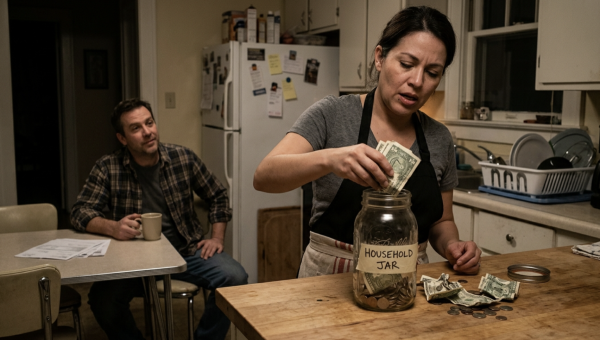
My Husband Stole $880 From Our Tip Jar—Then I Discovered Who His “Girl” Really Was
PART 4
The message lit up before Duane could grab the phone.
MY GIRL ❤️
Did she find out about us?
Nobody breathed.
Dolores was still holding the photo from the gas station. Megan had arrived only minutes earlier because I had asked her to come tell the truth herself. The three of us watched Duane lunge across the table and snatch his phone as if that could erase what we’d all seen.
I didn’t yell.
I didn’t cry.
I simply asked, “Is Megan still going to be your explanation?”
His mouth opened.
Nothing came out.
Dolores stood so abruptly her chair tipped backward.
“Answer your wife.”
“It’s… it’s not what it looks like.”
She slapped the table hard enough to rattle the glass jar.
“I raised you better than that sentence.”
For the first time since I’d met her, my mother-in-law looked embarrassed to call him her son.
The Truth Had Layers
I held out my hand.
“Phone.”
Duane shook his head.
“No.”
“Then I’ll assume the message is exactly what it sounds like.”
“Lita—”
“Phone.”
He backed away.
I nodded once.
“Okay.”
I picked up my purse instead.
“Where are you going?” he asked.
“To the phone company.”
His face changed instantly.
That was my answer.
Twenty minutes later I was sitting in the parking lot of our carrier’s store. Our family plan was in both our names because I’d insisted years ago that married people shouldn’t have one person controlling everything.
The employee asked for my ID.
Then he slid the account across the counter.
“I’m sorry you’re dealing with this,” he said quietly. “Which number did you need?”
I pointed at Duane’s.
“I need the detailed billing.”
Five years of calls would have been overwhelming.
So I asked for six months.
The printer hummed.
Page after page spilled into the tray.
One number appeared more than any other.
Not Megan.
A number I didn’t recognize.
Hundreds of calls.
Late nights.
Lunch breaks.
Every Monday after work.
I thanked the employee, folded the papers carefully, and drove home.
I didn’t call the number.
Not yet.
People reveal more when they don’t know you’ve already found them.
Sunday Dinner Was Canceled
Every Sunday, Duane’s family ate together.
His brothers.
Their wives.
Kids running through Dolores’s backyard.
It had been tradition for twelve years.
At 3:15, Dolores called everyone.
“Don’t come.”
Apparently nobody argued with Dolores.
By four o’clock it was just the five of us in her dining room: Dolores, Duane, Megan, me, and the untouched blueberry muffins.
I laid the phone records on the table.
“I don’t know her name,” I said. “But I know her number.”
Duane didn’t even look.
He already knew.
Dolores picked up the first page.
“There are two hundred and seventeen calls.”
I added another sheet.
“And eighty-three text conversations that lasted over an hour.”
Megan looked physically sick.
“So there really is someone,” she whispered.
Duane rubbed his face.
“Yes.”
There it was.
One word.
Small enough to fit in a whisper.
Big enough to end a marriage.
Dolores closed her eyes.
“Who is she?”
He stared at the window.
“Her name is Rachel.”
I had never heard the name before.
“From the plant?” I asked.
He nodded.
“How long?”
He whispered, “Eight months.”
Eight months.
Almost exactly twenty-two weeks.
The same length of time forty dollars had disappeared from my jar.
I felt something click into place.
The scratch tickets hadn’t been the beginning.
They’d been the cover.
Monday Girl
I finally called the number the next morning.
A woman answered on the third ring.
“Hello?”
“Is this Rachel?”
“Yes?”
“My name is Carlotta.”
Silence.
Then a very quiet, “…Duane’s wife?”
She already knew me.
“I’d like to meet.”
“I don’t think that’s a good idea.”
“I wasn’t asking because it’s good.”
Another silence.
Finally she sighed.
“There’s a coffee shop on Pine. Noon.”
She was younger than me.
Maybe twenty-nine.
No wedding ring.
Nervous hands.
She stood when I walked in.
“I’m sorry.”
“Don’t apologize yet,” I said. “Tell me what you know.”
She nodded.
“He told me you were separated.”
Of course he had.
“He said you lived together because of your daughter.”
Lie.
“He said the money problems came from alimony.”
Lie.
“He said the scratch-ticket story was something he joked about with his coworkers.”
Lie.
I watched her realize she had been dating a man who had built his life out of borrowed stories.
She opened her purse.
“I brought something.”
It was a small velvet box.
She pushed it across the table.
I opened it.
A diamond necklace.
Beautiful.
Tiny.
Expensive.
“I told him I couldn’t accept it,” she said.
“When?”
“June.”
June.
The month he won four thousand dollars.
My hands trembled.
“He bought this with that money?”
“I think so.”
“I don’t want it.”
“I know.”
She looked at me with tears in her eyes.
“I ended it last week.”
I looked up.
“What?”
“He got angry because I asked why he never posted photos of us. That’s when I started suspecting I wasn’t dating a separated man.”
She laughed bitterly.
“I found your Facebook.”
The room suddenly felt very small.
She reached into her purse again and handed me an envelope.
Inside were printed screenshots.
Messages.
Photos.
Bank transfers.
Nothing intimate enough to destroy me.
But enough to prove every lie.
She had highlighted one message.
Duane: I have to move forty from the jar tomorrow. She never notices.
Rachel looked horrified.
“I didn’t understand what ‘the jar’ meant.”
I folded the paper carefully.
“I do.”
The Notebook and the Jar
That evening I returned home.
Duane was sitting alone in the kitchen.
The jar was still on the counter.
Empty.
He looked exhausted.
“I deserve whatever you’re about to say.”
“I didn’t come to say anything.”
I placed three things on the table.
My notebook.
The screenshots.
The necklace.
His face lost all color.
“Rachel gave those to you?”
“She thought you were separated.”
He covered his eyes.
“I ruined everyone’s life.”
“No,” I said quietly. “You ruined your own. The rest of us are deciding what to do with ours.”
I picked up the jar.
For eleven years it had been our symbol of marriage.
Shared money.
Shared trust.
Shared sacrifice.
I turned it upside down.
A single quarter rolled onto the table.
Twenty-five cents.
That was all that remained.
I smiled sadly.
“Funny.”
He looked up.
“After eleven years, that’s the only amount in this house you didn’t steal.”
I slid my notebook back into my bag.
Then I walked toward the bedroom.
Behind me, his voice cracked.
“Lita… are you leaving tonight?”
I stopped at the hallway.
Without turning around, I answered,
“No.”
He sounded relieved.
Then I finished the sentence.
“I’m packing your suitcase.”
PART 5
I wasn’t leaving. I was packing his suitcase.
For a long moment, the house was completely silent.
Duane stayed in the kitchen, staring at the empty glass jar. I walked into our bedroom, opened the closet, and pulled out his duffel bag—the faded navy one we’d used on family vacations before life became something we simply survived instead of enjoyed.
I folded his jeans carefully.
His work shirts.
His boots.
Nothing was thrown. Nothing was ripped. There was no dramatic revenge.
Because anger burns hot.
Dignity lasts longer.
When I zipped the bag, I carried it to the front door and set it beside the welcome mat.
He finally appeared in the hallway.
“You already packed it?”
“I’ve been organizing this house for eleven years,” I said. “Packing one suitcase isn’t difficult.”
His eyes filled with tears.
“Please don’t do this.”
“I didn’t do this.”
He looked at our wedding photo hanging above the fireplace.
“We can fix it.”
I shook my head.
“You keep talking about fixing the ending. You should’ve protected the middle.”
The Daughter Who Heard Everything
Our daughter, Ava, was sixteen.
She had spent the weekend at a debate tournament and came home Sunday evening with a silver medal hanging around her neck.
She walked through the front door smiling.
“Mom, guess wha—”
Then she saw the suitcase.
She looked from me to her father.
“What happened?”
I had promised myself one thing years ago.
If my marriage ever broke, my child would never become the messenger.
I sat her down.
“Your dad has something to tell you.”
Duane cried before he spoke.
He admitted the gambling.
The stolen tip money.
Rachel.
He didn’t blame stress.
He didn’t blame work.
For the first time in years, he simply said, “I lied.”
Ava listened without interrupting.
When he finished, she quietly removed the silver medal from around her neck.
“I won this today,” she said.
He nodded.
“I kept looking for you in the audience.”
He closed his eyes.
“I know.”
“I wasn’t looking because I needed applause.”
She placed the medal on the coffee table.
“I was looking because you’re my dad.”
Then she stood, walked to me, and took my hand.
That hurt him more than shouting ever could.
Dolores Paid a Visit
The next morning, my mother-in-law arrived before sunrise.
She wasn’t carrying muffins.
She was carrying a small metal cash box.
“I think this belongs to you.”
Inside were envelopes, neatly labeled in her handwriting.
LITA – CHRISTMAS
LITA – EMERGENCY
LITA – VACATION
I looked at her, confused.
“What is this?”
She sighed.
“For years, every birthday and holiday, I gave Duane money and told him to spend it on you.”
My stomach dropped.
“He always said he did.”
She nodded sadly.
“I found every envelope in his workshop.”
There was $2,300 inside.
Money I had never known existed.
Dolores wiped her eyes.
“I failed you too.”
“You didn’t know.”
“I should have.”
She reached across the table.
“You were never helping out, Carlotta. You were carrying my son.”
It was the first time she’d ever called me by my full name.
Some apologies arrive too late.
They’re still worth hearing.
Eleven Years in Black Notebooks
Three weeks later, my coworkers surprised me after closing.
Tina taped a sign above the break-room table.
LITA’S FREEDOM FUND
Everyone laughed when they saw my face.
“Sit down,” Tina ordered.
Servers emptied their aprons onto the table—not to give me money, but to count with me.
One by one.
Just like we’d done after every shift.
Maria grinned.
“Show us these famous notebooks.”
I brought them out.
Eleven little black books.
Grease stains.
Coffee rings.
Tiny handwriting.
A decade of receipts, tips, birthdays, snowstorms, Valentine’s rushes, and Mother’s Day doubles.
Tina flipped through one and whistled.
“You knew exactly what you earned every day?”
“I always did.”
She smiled.
“Then you always knew your worth.”
I hadn’t realized those were the same thing.
Courtroom Number Three
The divorce wasn’t dramatic.
There were no screaming matches.
The notebooks did all the talking.
Every weekly entry matched my deposit slips.
Every missing forty dollars matched the pattern.
The judge looked over the records for a long time before asking Duane one question.
“Do you dispute these figures?”
He quietly answered,
“No, Your Honor.”
The reimbursement wasn’t enormous.
It wasn’t about becoming rich.
It was about something much more valuable.
The court ordered him to repay the missing money and recognized my documented earnings when dividing our finances.
For once, writing things down mattered exactly as much as I’d always believed it did.
One Year Later
The steakhouse promoted me to floor manager.
I still wore comfortable shoes.
I still counted receipts.
But now, at the end of every night, young servers would ask me to double-check their cash.
“You’re the notebook lady,” they’d joke.
I became strangely famous for teaching nineteen-year-olds how to protect their tips.
Ava got into college on an academic scholarship.
The first thing she bought with her own part-time paycheck was a leather journal.
She slid it across the kitchen table.
“Look.”
On the first page she’d written:
Count what matters.
Not just money.
Time.
Trust.
Promises.
Respect.
The Jar
I never threw the glass jar away.
People expected me to smash it.
Instead, I washed it until it sparkled.
It sits on my kitchen windowsill today.
Not for cash.
Not for bills.
Inside are folded pieces of paper.
Every Sunday, Ava and I each write one good thing that happened that week.
A promotion.
A perfect steak cooked medium rare.
A phone call from Megan, who’s rebuilding our relationship one honest conversation at a time.
A sunset.
A laugh.
A quiet dinner.
Things no one can steal.
Last Sunday, Ava unfolded the oldest note in the jar.
It was mine.
She smiled and read it aloud.
Today I finally stopped confusing being needed with being valued.
I looked out the window and realized something beautiful.
For eleven years, I’d been making deposits into the wrong account.
Now, every good day was earning interest in a life that truly belonged to me.