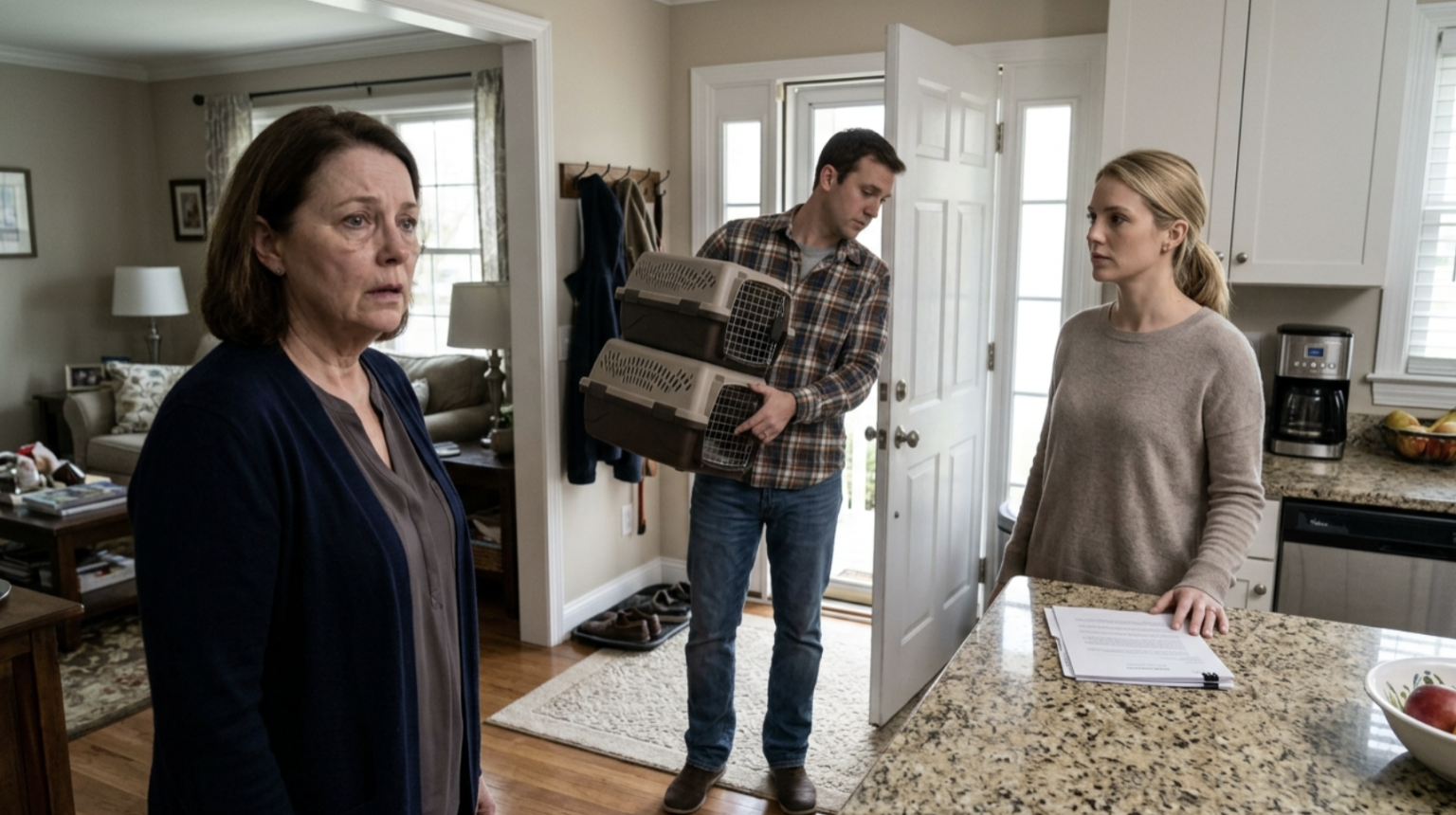
Nine Days After My Husband’s Funeral, My Son Left His Pets at My Door—He Had No Idea I Was Already Leaving
PART 3
His concern was that I had failed to remain exactly where he had left me.
I turned my phone face down.
“I’m fine,” I told the driver.
And for once, I meant it.
The highway stretched ahead of us, dark and nearly empty.
I watched the city disappear behind me.
Thomas had always loved early mornings.
He used to say the world felt more honest before everyone woke up.
There was something about those quiet hours when there were no meetings, no ringing phones, no demands, no expectations.
Just the road.
The sky.
The promise of another day.
I remembered one morning several years earlier.
Thomas and I had been driving north after visiting our daughter-in-law’s parents.
David had called three times during the first hour.
The moment I answered, he started explaining everything that had gone wrong.
His babysitter had canceled.
His car battery was dead.
Sarah had an important presentation.
The children needed to be picked up.
Could I come?
Thomas had been driving.
He looked at me after I hung up.
“You’re going to turn around.”
I smiled apologetically.
“I have to.”
He shook his head.
“No, honey. You want to.”
I remember laughing.
“What’s the difference?”
Thomas kept his eyes on the road.
“One leaves you with a choice.”
At the time, I thought he was being philosophical.
Now I understood.
I had spent years confusing being needed with being loved.
The distinction hurt.
But it also freed me.
When we reached the port, the sun was beginning to rise.
I stepped out of the Uber and stood there with my suitcase beside me.
The cruise ship towered above the terminal.
White.
Massive.
Almost unreal.
I looked up at it and felt something strange in my chest.
Fear.
Excitement.
Grief.
And beneath all three, something I had not felt in years.
Anticipation.
I checked in.
A young woman at the counter smiled.
“Traveling alone?”
I hesitated.
Then I nodded.
“Yes.”
She handed me my keycard.
“Have a wonderful trip.”
I looked at the card in my hand.
For years, I had been somebody’s wife.
Somebody’s mother.
Somebody’s grandmother.
Somebody’s emergency contact.
Somebody’s backup plan.
But standing there with a suitcase in one hand and a boarding pass in the other, I realized something.
I was still somebody.
Even without everyone needing something from me.
I boarded the ship.
And as the vessel slowly pulled away from Seattle, I stood at the railing and watched the shoreline disappear.
I expected guilt.
Instead, I felt tears.
But they were not only tears of sadness.
They were tears of release.
I pressed my fingers against the cold metal railing.
“Thomas,” I whispered.
“I’m going.”
The wind carried the words away.
For the first time since his funeral, I smiled.
Not because I had stopped missing him.
Because I knew he would have wanted this.
Three hours later, my phone had accumulated twenty-three missed calls.
Seventeen from David.
Five from Sarah.
One from a number I didn’t recognize.
I finally turned the phone on airplane mode.
Then I sat on the balcony of my cabin and opened the envelope containing the letter Thomas had given me months before he died.
He had told me not to open it until I was ready.
I had opened it once.
But I had never finished reading it.
The first page was familiar.
The handwriting was shaky.
My beautiful Margaret,
If you’re reading this, then I lost the argument with time.
I smiled through tears.
That sounded exactly like Thomas.
He had always hated losing.
Even to death.
I continued.
I know you. You’ll want to spend the next few years making sure David is okay. You’ll worry about Sarah. You’ll worry about the grandchildren. You’ll tell yourself that staying busy is how you survive.
My vision blurred.
I wiped my eyes.
Please don’t.
I stopped reading.
The ship moved beneath me.
The water stretched endlessly toward the horizon.
I forced myself to continue.
David is my son, and I love him. But loving our children does not mean protecting them from every consequence.
I stared at those words for a long time.
Then I turned the page.
If you spend the rest of your life solving problems they are perfectly capable of solving themselves, you won’t be helping them. You’ll be teaching them that your life belongs to them.
My chest tightened.
Because Thomas had understood.
He had seen something I had refused to see.
The next sentence broke me.
And Margaret, your life does not belong to anyone anymore.
I covered my mouth.
For several minutes, I cried silently.
Not the frantic crying I had done at the funeral.
Not the helpless crying I had done alone in the bathroom.
This was different.
It felt like mourning an old version of myself.
The woman who had spent thirty-five years putting herself last.
The woman who believed saying no made her selfish.
The woman who apologized when other people disappointed her.
The woman who thought being a good mother meant always being available.
I folded the letter carefully.
Then I placed it beside me.
My phone remained silent because I had turned it off.
And for the first time in years, nobody could reach me.
On the second day of the cruise, I met a woman named Evelyn.
She was sitting alone at breakfast, staring at the ocean.
She looked to be in her seventies.
Silver hair.
Blue sweater.
A small wedding ring still on her finger.
She noticed my book and smiled.
“Good book?”
I looked at the cover.
“I haven’t read a single page.”
She laughed.
“Then you’re doing it correctly.”
I smiled.
We started talking.
Her husband had died two years earlier.
She had taken the same cruise alone the following spring.
“Did you feel guilty?” I asked.
She knew exactly what I meant.
“All the time.”
“What changed?”
She stirred her coffee.
“I realized guilt is sometimes just grief wearing a different coat.”
I stared at her.
She continued.
“We think we’re guilty because we’re doing something wrong. Sometimes we’re guilty because we’re doing something new.”
I looked out at the water.
“That makes sense.”
Evelyn smiled.
“Do you have children?”
“One son.”
“Does he worry about you?”
I almost laughed.
“He worries when I don’t do what he expects.”
She nodded slowly.
“That sounds familiar.”
And just like that, I knew I was not alone.
We spent the next hour talking.
She told me about her husband.
I told her about Thomas.
We laughed about old marriages, difficult children, bad vacations, and the strange things grief did to ordinary days.
When we finally stood to leave, Evelyn touched my arm.
“You look like someone who hasn’t been allowed to be herself for a long time.”
I froze.
She smiled gently.
“Maybe this trip isn’t about escaping your family.”
I waited.
“Maybe it’s about meeting yourself again.”
That sentence followed me for the rest of the day.
Meanwhile, back home, David was discovering that his mother had been much more organized than he had ever realized.
He called the pet boarding facility.
The receptionist told him everything was arranged.
Paid.
Authorized.
Emergency contacts listed.
Medication instructions documented.
Even the cat’s favorite blanket had been delivered.
“What about my mother’s house?” David asked.
The receptionist paused.
“I don’t have information about that.”
“Where is she?”
“I’m sorry. We don’t disclose client travel information.”
David hung up.
Then he called my attorney.
Mr. Sterling answered.
“Mr. Carter.”
“Where is my mother?”
“I’m not at liberty to discuss her personal travel.”
“She left me three animals and disappeared!”
Mr. Sterling’s voice remained calm.
“Your mother made arrangements for the animals. They’re safe.”
“She was supposed to watch them.”
“I don’t believe she agreed to that.”
David went quiet.
That was the first moment he realized something.
Maybe I had never actually agreed.
Maybe I had simply stopped arguing.
There was a difference.
“Is she okay?” he finally asked.
Mr. Sterling paused.
“Yes.”
“Can I talk to her?”
“No.”
“Why?”
“Because she asked not to be disturbed.”
The silence that followed lasted several seconds.
Then David said something that would later come back to haunt him.
“She wouldn’t do this.”
Mr. Sterling replied quietly.
“Perhaps that’s the problem.”
Then he ended the call.
By the fourth day, I had stopped checking my phone.
I spent mornings drinking coffee on the balcony.
I attended lectures.
I watched glaciers from the deck.
I ate dinner without rushing.
I listened to music.
I took photographs.
I laughed with Evelyn.
And I cried sometimes.
Grief didn’t disappear.
But it stopped controlling every minute.
One afternoon, while standing on the deck watching mountains rise from the water, I heard someone say my name.
I turned.
It was my daughter.
My only daughter.
Emily.
She was standing behind me with tears in her eyes.
For a second, neither of us moved.
Then she rushed forward and hugged me.
“Mom.”
I held her tightly.
“What are you doing here?”
She pulled back.
“I came because I was worried.”
I looked at her.
“David called you?”
She nodded.
“He said you disappeared.”
I sighed.
“I didn’t disappear.”
“Where did you go?”
I smiled.
“On a cruise.”
She blinked.
“To Alaska?”
“Yes.”
“Alone?”
I nodded.
Emily stared at me.
Then she smiled.
“I think Dad would have loved that.”
My throat tightened.
“He did.”
She looked at me carefully.
“Mom, can I ask you something?”
“Of course.”
“Why didn’t you tell me?”
I looked toward the mountains.
“Because I wasn’t sure I was allowed to go.”
Emily’s expression changed.
“You don’t need permission.”
“I know that now.”
She reached for my hand.
“Then maybe this trip is exactly what you needed.”
We stood together in silence.
Then Emily said something I had not expected.
“David is angry.”
I nodded.
“I know.”
“He says you abandoned him.”
I looked at her.
“Did I?”
She shook her head.
“No.”
Then she hesitated.
“He also found some old documents.”
My heart sank.
“What documents?”
“The estate paperwork.”
I felt the air change.
“What did he find?”
Emily looked uncomfortable.
“Something about the house.”
“What about it?”
She lowered her voice.
“He thinks Dad changed the ownership before he died.”
I said nothing.
Because he had.
And David didn’t know the full story.
Not yet.
Thomas and I had spent months making those arrangements.
There was one final document.
One document David had never seen.
One document that would completely change what he believed about the future.
Emily squeezed my hand.
“Mom?”
I turned toward her.
“What did Dad leave you?”
I looked out at the endless Alaskan water.
Then I whispered,
“Not money.”
Emily frowned.
“Then what?”
I looked at her.
“A choice.”
Before I could explain, my phone—still in my purse—began ringing.
I hadn’t turned it on.
I pulled it out.
The screen showed a number I had never seen before.
I answered.
“Hello?”
There was silence.
Then a man’s voice said,
“Mrs. Carter, my name is Daniel Reeves. I was your husband’s financial advisor for the last twelve years.”
I stood perfectly still.
He continued.
“There is something Thomas instructed me never to tell your son.”
My heart began pounding.
“What is it?”
Daniel took a breath.
“It concerns a second property.”
I frowned.
“What second property?”
His answer made my fingers go cold.
“The one your husband bought eighteen months before he died.”
I looked at Emily.
She had heard enough to know something was wrong.
Daniel continued.
“And Mrs. Carter, there is another detail.”
“What?”
“The property isn’t in your name.”
My stomach dropped.
“Whose name is it in?”
Daniel was silent for two seconds.
Then he said,
“Your son’s.”
I couldn’t breathe.
Because Thomas had never mentioned buying another property.
And if David owned it…
Then there was only one question left.
Why?
And as the ship continued toward Alaska, I suddenly understood that the trip I had thought was about finding myself might actually be the beginning of uncovering the truth my husband had taken to his grave.
CONTINUE READ NEXT PART… 👇