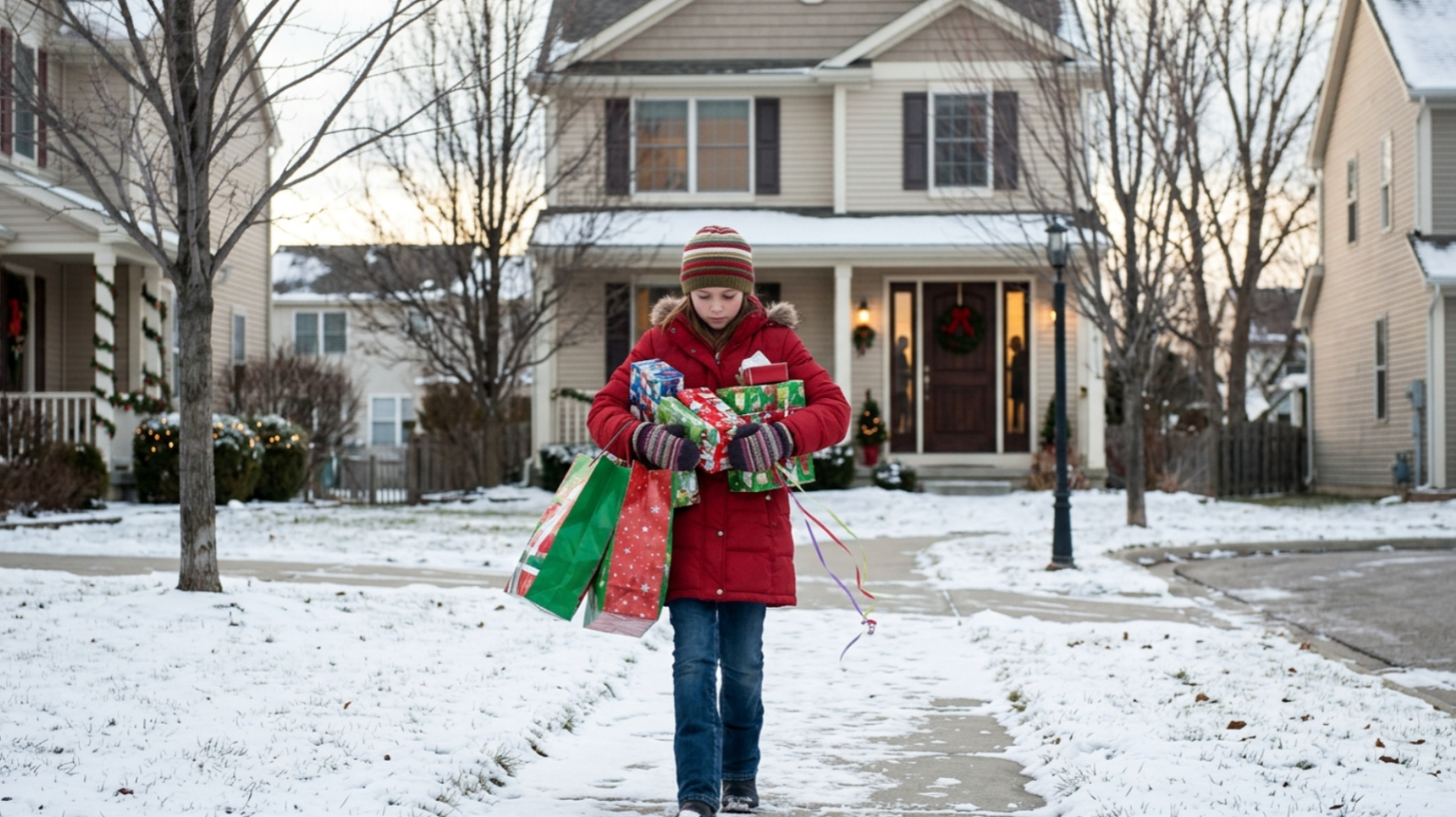
They Shut the Door on My 11-Year-Old Daughter—They Never Knew What That House Would Cost Them
PART 4
I didn’t ask Dana to repeat the name.
I already knew it.
My hands went cold.
“Are you sure?”
Dana started crying again.
“Yes.”
“Did you actually see him?”
“Yes.”
“With Mom and Dad?”
“Yes.”
“On Christmas?”
“Yes.”
I closed my eyes.
For three years, I had trusted that man with financial advice.
He had helped me understand the documents surrounding my grandmother’s estate. He had encouraged me to keep records. He had even told me, more than once, that my parents were “just getting older” and that I should avoid unnecessary conflict with them.
Now Dana was telling me he had been sitting in their house on Christmas Day discussing how to take my inheritance.
It didn’t make sense.
Unless I had been trusting the wrong person all along.
“Where are you?” I asked.
“At home.”
“Don’t touch the folder.”
“I already did.”
“Dana.”
“I only opened it.”
“Put it back exactly where you found it.”
“I will.”
“And don’t tell Mom or Dad that you called me.”
She hesitated.
“Okay.”
“I’ll meet you later.”
“No.”
Her answer surprised me.
“Why?”
“Because Dad is watching the house.”
I frowned.
“What do you mean?”
“He asked me where I was going this morning.”
“Did he know you had the folder?”
“I don’t think so.”
“Then don’t leave.”
“What should I do?”
“Stay there. Keep your phone with you.”
I ended the call.
When I turned around, Emma was standing behind me.
She had heard enough.
“Mom?”
I immediately softened my voice.
“Hey.”
“Are we in trouble?”
“No.”
She looked at me carefully.
“Are Grandma and Grandpa in trouble?”
I took a breath.
“Adults are dealing with an adult problem.”
“Because of me?”
I walked toward her.
“No.”
“But they got the papers because I went there.”
“No, sweetheart.”
I knelt in front of her.
“Listen to me. You did not cause any of this.”
She stared at me.
“Then why did they make me leave?”
“Because they made a choice.”
“Was it because they don’t love me?”
That question hurt more than anything else.
I pulled her into my arms.
“I don’t know why they made that choice.”
I kissed the top of her head.
“But I know this.”
She waited.
“You are not difficult to love.”
Her arms tightened around me.
“You never have to earn your place at my table.”
She started crying.
I held her until she stopped.
Then I called Martin.
I told him everything Dana had said.
He listened without interrupting.
When I finished, he said:
“Do not confront anyone.”
“I wasn’t planning to.”
“Good.”
“What should I do?”
“Bring me the original documents your grandmother gave you.”
“I have them.”
“Keep them somewhere safe.”
“Are they really about my inheritance?”
“We don’t know yet.”
“Then what are my parents trying to get me to sign?”
“That is what we need to find out.”
I looked at Emma.
“Can you come to my house?”
“No.”
“Why?”
“Because I don’t want your parents knowing where we are going.”
“Martin, you’re scaring me.”
“I’d rather scare you than have you walk into a situation you’re not prepared for.”
He paused.
“There’s one more thing.”
“What?”
“The person Dana named has already contacted me.”
I froze.
“Why?”
“He claims he wants to resolve the dispute privately.”
“Did he mention me?”
“Yes.”
“What did he say?”
“He said you were emotionally unstable after what happened to your daughter and that you might misunderstand the documents.”
I felt my jaw tighten.
“Emotionally unstable?”
“He used those words.”
I almost laughed.
Not because it was funny.
Because suddenly everything became clear.
They were preparing a story.
If I questioned the documents, they would say I was angry.
If I demanded answers, they would call me unreasonable.
If I refused to sign, they would say I was being manipulated by my grandmother.
And if I told anyone what happened to Emma, they would call it a family misunderstanding.
I had seen this pattern before.
But this time, I had documents.
And witnesses.
And something my parents had never expected.
I was no longer willing to protect their reputation.
That afternoon, Martin arranged for me to meet him at his office.
I brought Emma with me.
Not because she needed to hear everything.
But because I didn’t want to leave her with anyone else.
When we arrived, Martin stood waiting.
He shook my hand, then crouched slightly to Emma’s level.
“You’re the young lady who made the ornament?”
Emma nodded shyly.
“I heard it was beautiful.”
She looked down.
“It wasn’t good enough.”
Martin looked at me.
Then back at her.
“Anyone who makes something with love has already made something valuable.”
Emma smiled for the first time since Christmas.
Martin led us into a conference room.
On the table were several folders.
He pointed to one.
“This is the original trust.”
Another.
“This is the property agreement.”
Another.
“This is the lien.”
Then he placed a final folder on the table.
“This is the document your parents wanted you to sign.”
My stomach tightened.
“What is it?”
“A release.”
“A release of what?”
“Your inheritance rights.”
I stared at him.
“What?”
“According to this document, you would voluntarily surrender any current or future claim connected to your grandmother’s estate.”
I shook my head.
“Why would I sign that?”
Martin looked at me.
“Because the document makes it appear that you’re receiving something in return.”
“What?”
“Your parents’ house.”
I stared at the page.
“They were going to give me the house?”
“No.”
He turned the page.
“They were going to give you the house subject to all outstanding debts and obligations.”
I felt sick.
“So they would transfer a property they couldn’t legally transfer, with a debt they weren’t authorized to put on it, and in exchange I’d surrender my inheritance?”
“That’s how it appears.”
Emma was sitting quietly in the corner drawing on a piece of paper.
I looked at Martin.
“How much is the debt?”
He slid another document toward me.
I read the number.
Eighty-four thousand dollars.
Plus interest.
Plus legal fees.
Plus another smaller obligation I hadn’t known about.
I looked up.
“They were trying to give me their debt.”
“Yes.”
“And make me surrender my inheritance.”
“Yes.”
“Why?”
Martin leaned back.
“Because your grandmother’s estate is considerably larger than your parents’ house.”
I didn’t answer.
He continued.
“Your grandmother owns several investment accounts, a small commercial property, and two parcels of land.”
I stared at him.
“I knew about the land.”
“You didn’t know about the investment accounts.”
“No.”
“She kept them private because she wanted to prevent family disputes.”
I laughed bitterly.
“She certainly failed.”
Martin gave me a sympathetic look.
“She also changed her estate plan.”
“When?”
“Three years ago.”
“Why didn’t she tell me?”
“Because she wanted to see whether certain family members would change their behavior.”
My heart sank.
“Did they?”
“No.”
The room became silent.
Then Martin opened the final folder.
“This is the current will.”
I didn’t touch it.
“Read it.”
I looked at the first page.
My name appeared near the top.
Then Emma’s.
I kept reading.
The majority of my grandmother’s estate had been placed into a protected family trust.
My parents were not beneficiaries in the way I had assumed.
They had limited rights to certain assets.
My sister had a separate provision.
And Emma had something too.
A protected educational trust.
My eyes filled with tears.
“She did this for Emma?”
“Yes.”
I looked at Martin.
“Why?”
“Your grandmother said she wanted Emma to have opportunities that no one could take away from her.”
I covered my mouth.
Emma looked up.
“Mom?”
I wiped my face.
“It’s okay.”
She returned to her drawing.
I looked back at Martin.
“What about my parents?”
“They don’t lose everything.”
That mattered.
Even after everything they had done, I didn’t want revenge.
I wanted the truth.
“They retain certain rights under the old agreement,” Martin explained.
“But the property can be recovered if the trust was violated.”
“And the forged authorization?”
“We’re having it examined.”
“Will they go to jail?”
Martin paused.
“That isn’t for me to decide.”
I nodded.
“Good.”
He looked surprised.
“You don’t want them punished?”
“I want them accountable.”
I looked at the documents.
“But I don’t want to become someone who enjoys destroying people.”
Martin nodded slowly.
“That distinction may matter more than you realize.”
That evening, I went to my parents’ house.
Not alone.
Martin came with me.
So did an independent property specialist and a notary.
I didn’t tell my parents we were coming.
When my father opened the door and saw me, his face went pale.
“What are you doing here?”
I looked past him.
“I want my daughter’s things.”
My mother appeared behind him.
“Kate—”
“Her gifts.”
My father stepped aside.
“Fine.”
But I didn’t move.
“Everything she brought.”
My mother looked away.
Then I saw the boxes.
They were still there.
Emma’s name written across them.
I picked them up one by one.
Her ornament was inside.
I held it carefully.
Then my mother spoke.
“We didn’t mean to hurt her.”
I looked at her.
“You told an eleven-year-old child there was no room for her.”
“We were overwhelmed.”
“You let her walk home alone.”
“We thought she’d call you.”
“She tried.”
My mother’s face changed.
I continued.
“You refused to let her use the phone.”
She started crying.
“I didn’t know her phone was dead.”
“You didn’t ask.”
My father looked at me.
“Kate, enough.”
“No.”
I looked directly at him.
“Not this time.”
I handed Martin the documents.
He stepped forward.
“The property is now subject to formal review.”
My father’s face hardened.
“You’re doing this to us?”
“No.”
I shook my head.
“You did this to yourselves.”
My mother whispered:
“Family doesn’t do this.”
I looked at her.
“Family doesn’t lock an eleven-year-old out of Christmas.”
Silence.
Then Dana walked into the room.
Everyone turned.
My father stared at her.
“What are you doing here?”
Dana held the folder.
“I found this.”
My father’s face changed.
My mother looked terrified.
Dana put the folder on the table.
“I know what you were planning.”
My father said nothing.
Dana looked at me.
“I’m sorry.”
I nodded.
Then she turned to our parents.
“You made me believe Kate was the problem my entire life.”
My mother started crying.
Dana continued.
“You always told me she was selfish.”
“You told me she was difficult.”
“You told me she thought she was better than us.”
She looked at me.
“But now I realize something.”
“What?”
“She was just the only one who kept saying no.”
No one spoke.
My father sat down.
For the first time in my life, he looked old.
Not powerful.
Not intimidating.
Just tired.
He looked at me.
“We were going to fix it.”
“How?”
“We thought if you signed the release, everything would be easier.”
“For who?”
He couldn’t answer.
“For you?”
He looked down.
“Yes.”
“And for Mom?”
“Yes.”
“And for Dana?”
“No.”
He shook his head.
“Dana wasn’t supposed to know.”
Dana laughed through her tears.
“Of course I wasn’t.”
My mother whispered:
“We were afraid.”
I looked at her.
“Of what?”
“That we’d lose everything.”
I took a slow breath.
“You almost made Emma believe she had lost her family.”
My mother’s face collapsed.
“I know.”
She began sobbing.
I wanted to feel satisfied.
I didn’t.
I only felt tired.
The next few weeks were difficult.
The property investigation continued.
The private loan was challenged.
The questionable authorization was submitted for examination.
My parents had to answer questions they had spent years avoiding.
The house wasn’t immediately taken from them.
Instead, the court and trustees reviewed the trust terms, the debt, and the unauthorized transaction.
Eventually, the lien was removed after the lender agreed to release its claim when the documentation problems became clear.
My parents were allowed to remain in the house under a revised occupancy agreement.
But they no longer controlled it as if it belonged entirely to them.
They couldn’t borrow against it.
They couldn’t sell it.
And they couldn’t use it to manipulate anyone again.
As for the inheritance, Grandma Ruth changed the structure once more.
Not because she hated my parents.
Because she wanted the family assets protected from family pressure.
My parents received what the will specifically allowed.
Dana received her share.
And Emma’s educational trust remained protected.
I didn’t take my parents’ house.
I didn’t want it.
I didn’t need it.
That was something my father never understood.
The house wasn’t the victory.
The truth was.
Months later, Christmas came again.
This time, Emma stood in our kitchen wearing a new red dress.
She was older by one year.
But somehow, she seemed much stronger.
She held a handmade ornament in her hands.
“Mom?”
“Yes?”
“Should I put Grandma’s name on it?”
I looked at her.
She was asking sincerely.
Not bitterly.
Not sarcastically.
Just asking.
I smiled.
“If you want to.”
She thought for a moment.
Then she painted carefully.
Grandma.
Nothing else.
That evening, Grandma Ruth came over.
She hugged Emma for a long time.
Then she looked at the ornament.
“Beautiful.”
Emma smiled.
“I made one for Grandpa too.”
I looked at her.
She had made one for him.
Even after everything.
I didn’t tell her not to.
I didn’t tell her she owed him forgiveness.
I simply let her choose.
Later that night, there was a knock at the door.
My father stood outside.
Alone.
He wasn’t carrying anything.
He looked at me.
“Can I come in?”
I stepped aside.
He walked into the house.
Emma looked up from the Christmas tree.
He swallowed.
“I brought something.”
He handed her a small box.
She opened it.
Inside was the ornament she had made for my mother the year before.
The one they had refused to take.
It had been carefully repaired.
My father looked at Emma.
“I should have taken this.”
Emma held it quietly.
“You should have let me in.”
My father’s eyes filled with tears.
“Yes.”
He nodded.
“I should have.”
No excuses.
No explanation.
Just those words.
Emma looked at him for a long time.
Then she walked to the tree.
She hung the ornament.
Not on the front.
Not hidden.
Right in the middle.
My father cried.
I didn’t.
I simply watched my daughter.
She had been eleven when they shut the door.
She was twelve when she finally decided what that door meant.
It didn’t mean she wasn’t loved.
It meant some people weren’t capable of loving her the way she deserved.
And that was their loss.
My parents never got the family Christmas they had imagined.
But they eventually learned something more important.
A family isn’t a house.
It isn’t a deed.
It isn’t an inheritance.
And it certainly isn’t a room where someone decides who is worthy of a chair.
Family is who opens the door.
Who makes space.
Who notices when a child is standing outside carrying gifts with both hands.
And who never makes that child wonder whether she belongs.
As for me, I kept the documents.
Not because I was waiting for another fight.
But because I finally understood something my grandmother had tried to teach me.
Boundaries aren’t revenge.
Sometimes, they’re the only way to protect the people you love.
And every Christmas after that, Emma and I kept one tradition.
Before dinner, we’d leave one empty chair at the table.
Not for someone who had hurt us.
Not for someone who expected forgiveness.
But as a reminder.
There would always be room in our home for anyone who came with love.
And there would never again be a locked door between my daughter and the people who claimed to be her family.