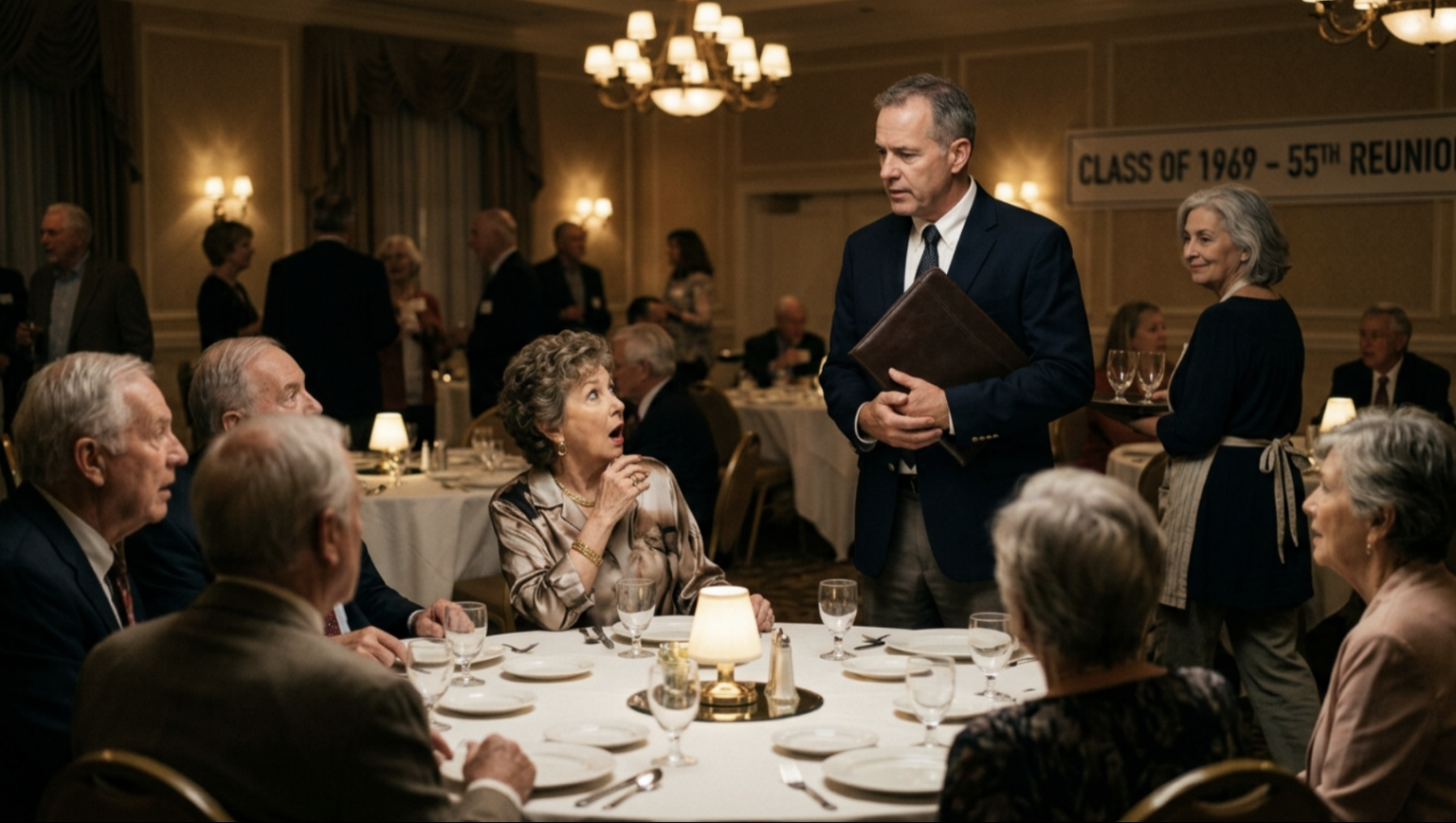
She Made Me Wear an Apron at Our 55th Reunion—Then the Hotel Manager Walked In and Asked, “Mrs. Bellamy, Are You Ready to Sign?”
PART 4
The next morning, I woke before sunrise.
For several minutes, I lay in bed staring at the ceiling.
The reunion kept replaying in my mind.
Celeste’s voice.
Edwin’s apology.
The scholarship.
The apron.
And, most of all, the blue-check dress.
I got out of bed and walked into the spare room where I kept the things I couldn’t bring myself to throw away.
Malcolm’s old watch.
Photographs.
His work gloves.
My mother’s sewing basket.
And the dress.
I took it from the box.
The fabric had faded slightly over the years, but I could still see the little blue checks.
I ran my fingers over the uneven waist.
My mother had been right.
The dress had never been ugly.
I had simply allowed someone else’s laughter to become my memory of it.
I carried it downstairs.
Peter was already in the kitchen when I arrived.
My son looked up from his coffee.
“Mom?”
“I couldn’t sleep.”
He smiled.
“Reunion hangover?”
“Something like that.”
I placed the dress on the table.
Peter looked at it.
“Is that the dress?”
“Yes.”
“The one Grandma made?”
“Yes.”
He picked it up carefully.
“I’ve heard about this dress my entire life.”
“I know.”
He studied the stitching.
“It’s beautiful.”
I laughed.
“Your grandmother would have liked you saying that.”
Peter smiled.
Then he noticed the apron beside it.
“What happened?”
I told him everything.
He listened without interrupting.
When I finished, he leaned back.
“So Celeste gave you an apron.”
“Yes.”
“And you wore it.”
“Yes.”
“And then the general manager announced who you were.”
“Yes.”
Peter grinned.
“Mom.”
“What?”
“That is the most you thing I’ve ever heard.”
I laughed.
“Why?”
“Because you didn’t need to prove anything.”
I looked at him.
“What do you mean?”
“You could have walked into that ballroom wearing diamonds and announced you owned half the linen contracts in the county.”
“I don’t own half.”
“Fine. A respectable portion.”
I smiled.
“But you didn’t.”
“No.”
“You just worked.”
I looked at the apron.
“I’ve spent my whole life working.”
Peter nodded.
“That is why I respect you.”
I reached across the table and squeezed his hand.
Then my phone rang.
It was Mr. Deshmukh.
“Good morning, Mrs. Bellamy.”
“Good morning.”
“I wanted to make sure you received the final documents.”
“I did.”
“There’s another matter.”
“What kind?”
“Celeste called.”
I sat straighter.
“What did she want?”
“She asked whether the scholarship could be expanded.”
I was silent.
“She wants to contribute personally.”
That surprised me.
“How much?”
“She didn’t say.”
“Then let her decide.”
Mr. Deshmukh chuckled.
“I thought you might say that.”
“Why?”
“Because she also asked whether you would attend the scholarship committee meeting.”
I looked at Peter.
“When is it?”
“Friday.”
“I’ll be there.”
After we hung up, I stared at the window.
For most of my life, I thought closure would feel like winning.
It didn’t.
It felt quiet.
Almost ordinary.
Like opening a window after a storm.
Friday came quickly.
The scholarship meeting was held at Westbrook High.
The building had changed dramatically since 1971.
The lockers were newer.
The floors were brighter.
The old staircase had been replaced.
But the hallway still smelled faintly of floor wax.
I stood outside the auditorium.
Peter was beside me.
“You okay?”
“Yes.”
“You sure?”
I smiled.
“I’ve walked into hospital boardrooms with fifty people waiting for me.”
“That’s different.”
“How?”
“You didn’t go to school there.”
I laughed.
He was right.
This place had memories buried in the walls.
I walked inside.
A group of teachers greeted me.
Then Celeste arrived.
She looked different without the confidence she had worn at the reunion.
She carried a small envelope.
We sat across from each other.
The principal opened the meeting.
“We are here to establish the Ruth Mercer Bellamy Vocational Scholarship.”
I immediately raised my hand.
“I’m sorry.”
Everyone looked at me.
“I don’t want it named after me.”
The principal smiled.
“We assumed you might say that.”
Celeste spoke.
“It should be.”
I looked at her.
She continued.
“You built the program.”
“No.”
“You inspired it.”
“My mother inspired it.”
“Then name it after her.”
I paused.
“What was her full name?”
Celeste asked.
I smiled.
“Eleanor Mercer.”
Celeste nodded.
“Then call it the Eleanor Mercer Scholarship.”
The principal wrote it down.
I felt tears gathering in my eyes.
That was better.
Much better.
My mother deserved her name in a school hallway far more than I ever did.
The principal explained that the first scholarship would go to a graduating student who planned to pursue vocational education.
The committee had already selected a finalist.
Her name was Elena Ruiz.
The young hotel employee from the reunion.
She walked into the room.
She looked terrified.
The principal smiled.
“Elena, this scholarship will cover your first two years of tuition and provide paid internship opportunities at the Ashford Grand.”
Elena stared at me.
“You did this?”
I shook my head.
“Your work did.”
She began crying.
Then she hugged me.
I hugged her back.
Over her shoulder, I saw Celeste watching us.
She smiled.
Not the smile from the reunion.
Not the smile she used when she wanted people to notice her.
This one was smaller.
Sadder.
Real.
After the meeting, Celeste and I walked outside together.
The autumn air was cool.
Leaves moved across the sidewalk.
She said, “I never imagined this.”
“What?”
“That the girl I laughed at would come back and help students like me.”
I looked at her.
“Students like you?”
She smiled.
“Students who don’t know what they’re capable of yet.”
I considered that.
Then I said, “None of us knew.”
She nodded.
We walked another few steps.
Then she stopped.
“Ruth?”
“Yes?”
“I still have something.”
She reached into her purse and pulled out a small envelope.
She handed it to me.
“What is this?”
“Open it.”
Inside was a photograph.
I recognized it immediately.
The junior prom.
I was standing in my blue-check dress.
My mother was beside me.
And there was Celeste.
Standing several feet away.
Watching.
I looked closer.
On the back, something was written in faded ink.
I read it.
She looks beautiful.
I looked at Celeste.
“You wrote this?”
She nodded.
“I took the photograph.”
I stared at her.
“Why didn’t you ever tell me?”
“Because I was embarrassed.”
She looked down.
“I wrote it after you left.”
I swallowed.
“I thought you hated the dress.”
“I hated that I wanted one like it.”
I smiled sadly.
“You should have told me.”
“I know.”
We stood there for a long moment.
Then I put the photograph back in the envelope.
“Thank you.”
She nodded.
That was the last apology I needed.
Not because it erased anything.
It didn’t.
But because it gave the past a different ending.
Three months later, the first scholarship ceremony was held at Westbrook High.
The auditorium was full.
Parents.
Students.
Teachers.
Former classmates.
Even Edwin came.
Celeste sat in the front row.
I stood at the podium.
Behind me was a photograph of my mother.
She was sitting at our kitchen table.
Her hands were covered in thread.
Her hair was tied back.
And she was smiling.
I looked at the students.
“When I was seventeen,” I began, “someone laughed at the dress my mother made for me.”
A few people smiled.
“I believed that laughter for many years.”
I paused.
“Then I learned something.”
The room became quiet.
“A person’s value is not determined by the people who fail to recognize it.”
I looked at Elena.
“It is determined by what they choose to do with what they have been given.”
I told them about my mother.
About sewing.
About my father.
About the laundromat.
About Malcolm.
About the first nursing home contract.
About the flooded laundry room.
About the trucks.
About the nights when we had barely enough money to make payroll.
And about the people who trusted us before we trusted ourselves.
Then I held up the old blue-check dress.
I had brought it from home.
The room became completely silent.
“This dress was made from fabric my grandmother had saved for a tablecloth.”
I smiled.
“It wasn’t expensive.”
I looked down at it.
“But it was priceless.”
I told them why.
Because my mother had made it with her own hands.
Because she had sat beside me for three weekends.
Because she had believed I was beautiful before I knew how to believe it myself.
Then I said:
“Never let someone else’s cruelty become the voice you use to speak to yourself.”
There was applause.
I looked toward Celeste.
She was crying.
I smiled at her.
She smiled back.
After the ceremony, Elena came running toward me.
“Mrs. Bellamy!”
I turned.
She threw her arms around me.
“Thank you.”
I laughed.
“Don’t thank me yet.”
She pulled back.
“Why?”
“Because now you have to work.”
She laughed.
“I will.”
“And someday, you may have to teach someone else.”
She nodded.
“I will.”
“That is the important part.”
She looked at the dress.
“Can I touch it?”
“Of course.”
She gently touched the fabric.
“It’s beautiful.”
I smiled.
“Yes.”
On the drive home that evening, Peter was quiet for several minutes.
Then he said, “Mom?”
“Yes?”
“Do you ever wish you could go back?”
“To what?”
“Seventeen.”
I looked out the window.
“No.”
“Not even for one day?”
I smiled.
“Absolutely not.”
“Why?”
“Because that girl had no idea what was coming.”
Peter laughed.
“Fair enough.”
I touched the photograph on my lap.
“What I would want is to go back for five minutes.”
“To tell yourself what?”
I thought about my mother.
Her hands.
Her voice.
The kitchen table.
The blue-check dress.
“I would tell her that she’s going to be okay.”
Peter nodded.
“Would she believe you?”
“No.”
“Why?”
“Because she was seventeen.”
We both laughed.
Then I looked at the sunset.
Orange light spread across the sky.
For fifty-five years, I had thought that night at the prom was the beginning of something terrible.
I was wrong.
It wasn’t the beginning.
It was simply one moment.
A painful moment.
A small moment.
A moment that only became powerful because I kept carrying it.
My mother had given me a dress.
Celeste had given me humiliation.
Malcolm had given me love.
My son had given me a reason to keep building.
And life had given me something none of them could have predicted.
A second chance to understand myself.
That night, when I got home, I hung the blue-check dress beside Malcolm’s photograph.
Then I placed the old apron underneath it.
I stood there for a long time.
The dress represented the girl I had been.
The apron represented the woman I became.
Neither one embarrassed me anymore.
I turned off the light.
Before going to bed, I checked my phone.
There was one new message.
It was from Celeste.
Thank you for not becoming like me.
I read it twice.
Then I typed:
Thank you for finally becoming someone who could say that.
I sent it.
A minute later, she replied.
Goodnight, Ruth.
I smiled.
Goodnight, Celeste.
And that was it.
No dramatic reconciliation.
No pretending fifty-five years had never happened.
Just two seventy-three-year-old women finally putting down something they had carried for far too long.
The following spring, Elena graduated.
She became the first recipient of the Eleanor Mercer Scholarship.
Years later, she would become the operations director of a large hotel.
Then she opened her own hospitality training program.
Every year, she sent me a photograph of her students.
And every year, she told them the same story.
About a woman who once wore a dress made from tablecloth fabric.
About a mother who taught her daughter that nothing made with love was worthless.
About a girl who was laughed at.
About a woman who built a company.
And about an apron that was meant to make her feel small but ended up reminding her of how far she had come.
I kept the apron.
I kept the dress.
I kept the photograph.
But I never kept the shame.
That belonged to the past.
And the past, finally, belonged where it should have been all along.
Behind me.
I was Ruth Bellamy.
I was seventy-three.
I had been poor.
I had been mocked.
I had been underestimated.
I had been loved.
I had been widowed.
I had built something.
I had lost things.
I had forgiven people.
And I had finally learned the lesson my mother tried to teach me when I was seventeen:
Someone else’s opinion of you is never a measurement of your worth.
The girl in the blue-check dress had believed she wasn’t enough.
The woman who walked out of the reunion wearing that same history knew better.
And for the first time in my life, when I looked in the mirror, I didn’t see the girl everyone had laughed at.
I saw the woman who had survived it.
And she was beautiful.