My Husband Took My Children and My Home—But My Late Mother Left Me a Secret That Destroyed His Entire Plan
PART 4
For several seconds, I could not move.
My hand remained on the door.
Daniel stood outside in the cold, rain beginning to gather on the shoulders of his coat.
“My children,” I whispered.
He nodded.
“Let me in.”
I looked at him through the narrow opening.
“How do I know you’re telling the truth?”
“You don’t.”
The answer surprised me.
Daniel didn’t try to persuade me.
He didn’t tell me to trust him.
He simply said, “Your mother told me that if you ever asked that question, I should tell you exactly that. She said trust should be earned, especially after what you’ve been through.”
I studied his face.
Then I remembered Mom’s letter.
Do not waste time proving to a thief that you are kind. Be brave enough to be believed by yourself first.
I closed the door.
For a second, Daniel looked disappointed.
Then I heard his footsteps retreat.
I watched through the window as he walked back toward his SUV.
He stopped before opening the door.
Without turning around, he said loudly enough for me to hear:
“Tomorrow morning. Maple Ridge Library. Eight o’clock.”
Then he drove away.
I locked every door.
I checked every window twice.
Then I carried the laptop, the flash drive, the letter, and the brass key into my mother’s bedroom.
I barely slept.
At seven the next morning, I drove to Maple Ridge.
The library was almost empty.
Daniel sat at a table in the back with a paper cup of coffee and a cardboard box.
He stood when he saw me.
“You came.”
“I almost didn’t.”
“I know.”
I sat across from him.
He pushed the box toward me.
“Your mother left this with me two years ago.”
I didn’t touch it.
“Why didn’t you give it to me sooner?”
“Because she specifically told me not to.”
“Why?”
“She said you needed to come to it yourself.”
I stared at him.
“She knew Richard would eventually force your hand.”
Daniel nodded.
“She knew.”
I opened the box.
Inside was an old digital recorder.
A stack of handwritten notes.
And a sealed envelope.
My name was written on it.
I opened the envelope.
Inside was another note from Mom.
Miranda,
If you are reading this, then I was right about the one thing I hoped I was wrong about.
Listen to the recording before you confront Richard. Do not warn him. Do not threaten him. Do not tell him what you know.
Let him believe you are still the woman he thought he could control.
Then let the truth speak for itself.
My hands were trembling.
I pressed play.
Static filled the room.
Then my mother’s voice.
Older.
Tired.
But unmistakably hers.
“Richard, you shouldn’t have come here.”
His voice followed.
“I need you to reconsider.”
“You’ve asked me three times.”
“And you’ve refused three times.”
“Because the answer is no.”
There was a long silence.
Then Richard said something that made my stomach turn.
“You don’t understand the situation.”
“I understand perfectly.”
“You own land that is strategically important.”
“I own a farm.”
“You own access.”
“To what?”
Silence.
My mother continued.
“Tell me why you really want the property.”
Richard sighed.
“Because your daughter won’t sell it.”
My mother laughed softly.
“She doesn’t even know what she owns.”
“Exactly.”
My blood went cold.
Richard continued.
“She trusts people too easily.”
“You mean she trusts you.”
“I mean she’s predictable.”
My mother’s voice sharpened.
“What are you planning?”
Richard didn’t answer immediately.
Then:
“If Miranda doesn’t cooperate, I’ll make sure she has no reason to stay here.”
My mother’s breathing changed.
“You’re talking about my daughter.”
“I am talking about protecting my investment.”
“And the children?”
A long pause.
Then Richard said:
“The children are leverage.”
I stopped the recording.
I couldn’t breathe.
Daniel reached across the table.
“Miranda—”
“No.”
I stood so quickly the chair scraped the floor.
“No.”
I walked toward the window.
People were entering the library.
A mother with two children.
An elderly man carrying newspapers.
A teenager with headphones.
Normal life.
It felt offensive.
I pressed my palm against the glass.
“He said my children were leverage.”
Daniel didn’t respond.
I turned.
“What does he want?”
Daniel looked down.
“The land.”
“Why?”
“Because underneath your mother’s property is an old groundwater reserve.”
I stared at him.
“What?”
“Your mother discovered it years ago. A development consortium has been trying to secure rights to it. Richard’s companies were positioned to acquire the surrounding properties cheaply.”
I remembered the spreadsheet.
The shell companies.
The transfers.
The $82,000 offer.
“The land isn’t worth three million.”
Daniel shook his head.
“No.”
“How much?”
He hesitated.
“Potentially much more.”
“How much?”
“Your mother estimated between twelve and twenty million if the development plan went through.”
I laughed.
Not because it was funny.
Because the number was too large for my brain to process.
“So he destroyed my marriage for land?”
Daniel corrected me.
“He didn’t destroy your marriage for land.”
He looked directly at me.
“He destroyed your life because he thought you were the final obstacle.”
I sat down.
For years I had wondered why Richard became so determined to make me look unstable.
Now I understood.
If I looked unreliable, nobody would believe me.
If I lost custody, I would be desperate.
If I lost the house, I would need money.
If I needed money, I would sell the property.
He didn’t need to steal the land.
He needed me to give it away willingly.
I looked at the recording.
“What do I do?”
Daniel leaned forward.
“Your mother already knew what you would ask.”
He reached into the box and pulled out another document.
“She hired an attorney.”
I looked at the name.
Eleanor Shaw.
“Who is she?”
“Estate attorney. She represented your mother for fifteen years.”
“Why haven’t I ever heard of her?”
“Because your mother told her not to contact you unless the conditions in the letter were met.”
I almost laughed.
“My mother planned my life from beyond the grave.”
Daniel smiled faintly.
“She planned for you to have a chance.”
That afternoon, I met Eleanor.
She was seventy-two, sharp-eyed, silver-haired, and completely unimpressed by my tears.
After hearing everything, she closed the folder.
“Miranda, I’m going to tell you something difficult.”
“Okay.”
“You cannot fight Richard emotionally.”
“I know.”
“You cannot fight him by exposing him on social media.”
“I wasn’t planning to.”
“You cannot threaten him.”
“I won’t.”
“And you absolutely cannot tell him what evidence you have.”
“I understand.”
She nodded.
“Good.”
Then she slid another folder toward me.
“Because your mother left you something more important than money.”
I opened it.
Inside was a copy of the original trust.
Eleanor pointed to one paragraph.
“This trust was designed to activate under specific circumstances.”
“What circumstances?”
“Divorce involving coercion, fraud, or financial misconduct.”
I looked at her.
“What happens then?”
“The trust becomes independently administered.”
“By whom?”
“Me.”
I stared.
“So Richard can’t touch it?”
“He cannot touch the property.”
“What about me?”
“You are the beneficiary.”
I felt something inside me loosen.
For the first time since the courthouse, I felt protected.
Not rescued.
Protected.
There was a difference.
Eleanor continued.
“And there’s another provision.”
“What?”
“If your spouse attempts to obtain the property through deception or legal coercion, the trust releases evidence of the attempted transaction to the appropriate authorities.”
I looked at her.
“My mother knew.”
“Yes.”
“She knew he would try.”
“She suspected.”
I swallowed.
“What do we do now?”
Eleanor smiled.
“Now we let Richard think he won.”
Three weeks later, I called Richard.
He answered on the second ring.
“Miranda?”
“I want to sell the property.”
Silence.
Then I heard him breathe.
“You do?”
“Yes.”
He tried to sound cautious.
“I thought you loved that place.”
“I did.”
“And now?”
“I need money.”
That was the first lie I had ever told Richard that made me feel strangely calm.
He asked how much.
I named a number slightly below the market estimate.
He accepted immediately.
Too immediately.
We scheduled a meeting.
But Eleanor had already arranged everything.
The buyer was not a real buyer.
It was a controlled transaction involving investigators, attorneys, and financial auditors.
Richard arrived with two lawyers.
I arrived alone.
At least that’s what he thought.
He smiled when he saw me.
It was the same smile I had seen during our marriage.
The smile that said he believed the room belonged to him.
“Miranda.”
“Richard.”
“You look well.”
“I am.”
He laughed softly.
“I’m glad.”
His attorney slid documents across the table.
“This should be straightforward.”
I looked at them.
Then at Richard.
“Before I sign, I have one question.”
“Of course.”
“Why did you want this land so badly?”
His face didn’t move.
“Because I thought it would be a good investment.”
“That’s all?”
“That’s all.”
I nodded.
Then I pushed a small recorder across the table.
His eyes dropped to it.
I pressed play.
His own voice filled the room.
The children are leverage.
Richard’s face changed.
Completely.
For the first time, I saw the man behind the calm expression.
Fear.
Not guilt.
Fear.
He looked at his attorney.
Then at me.
“Where did you get that?”
I didn’t answer.
The recording continued.
My mother’s voice.
Richard’s voice.
His plans.
His admissions.
His desire for the property.
His willingness to use our children.
Then another recording played.
This one was from a conversation between Richard and Daniel.
Then another.
Emails appeared on a screen behind me.
Bank transfers.
Shell companies.
Property negotiations.
Payments to the private investigator.
The custody strategy.
The forged financial disclosures.
The hidden accounts.
The room became silent.
Richard’s attorney slowly closed the folder.
“Richard,” he said quietly, “you need to stop talking.”
Richard stood.
“You set me up.”
I looked at him.
“No.”
I stood too.
“You set yourself up.”
He stared at me.
“You think this ends here?”
“No.”
My voice was surprisingly steady.
“It ends when you stop trying to own everyone around you.”
His expression hardened.
“You’ll regret this.”
I shook my head.
“I regretted trusting you.”
Then I walked away.
The investigation lasted months.
The divorce decree was challenged.
The court reviewed the financial evidence.
The custody order was reopened.
The supervised visitation requirement was removed.
The children came home.
Not immediately.
There were hearings.
Evaluations.
Statements.
Weeks of uncertainty.
But eventually, one Friday afternoon, I parked outside my mother’s house.
Lily jumped out before I had fully opened the door.
She ran into my arms.
I dropped to my knees.
Jonah came next.
He wrapped both arms around my neck.
“You’re really staying?”
I squeezed him.
“Yes.”
“For good?”
I looked at the old country house.
The peeling paint.
The crooked shutters.
The porch where Mom used to sit.
Then I looked at my children.
“Yes,” I said.
“For good.”
We rebuilt slowly.
Lily planted flowers beside the porch.
Jonah fixed the old mailbox with me.
We painted the kitchen yellow because Lily said Grandma would have liked it.
I kept the safe.
I kept the letter.
I kept the brass key.
And I kept my mother’s red notebook.
Richard eventually lost control of most of the companies tied to the investigation.
Several financial transactions were frozen.
His attorney withdrew.
The custody arrangement changed.
The children lived primarily with me, with a structured parenting schedule for Richard.
I never celebrated his losses.
That surprised people.
They expected revenge.
They expected me to enjoy watching him fall.
But I had learned something during those months.
Revenge keeps you looking backward.
I wanted my children to see me looking forward.
One evening, almost a year after the courthouse, I sat on the porch while Lily read beside me.
Jonah was throwing a baseball against the barn.
The sunset turned the fields gold.
I held the brass key in my palm.
Lily looked up.
“Mom?”
“Yes?”
“What’s that key for?”
I smiled.
“It’s a reminder.”
“Of what?”
“That sometimes the door you thought was locked forever was never really locked.”
She frowned.
“That doesn’t make sense.”
I laughed.
“You’re seven.”
“I’m eight now.”
I smiled.
“Right. Sorry.”
She leaned against me.
“Did Grandma know all this would happen?”
I looked toward the old hallway inside the house.
“I don’t think she knew exactly what would happen.”
“What did she know?”
I thought about the letter.
About the safe.
About the recordings.
About the woman who had spent years preparing for a daughter who didn’t yet understand what she was worth.
“She knew me,” I said.
“And she knew that someday I would need to remember who I was.”
Lily was quiet.
Then she asked:
“Are you happy now?”
I looked across the yard.
At Jonah.
At the house.
At the children.
At the life that wasn’t the one I had planned.
But it was mine.
“Yes,” I said.
“I am.”
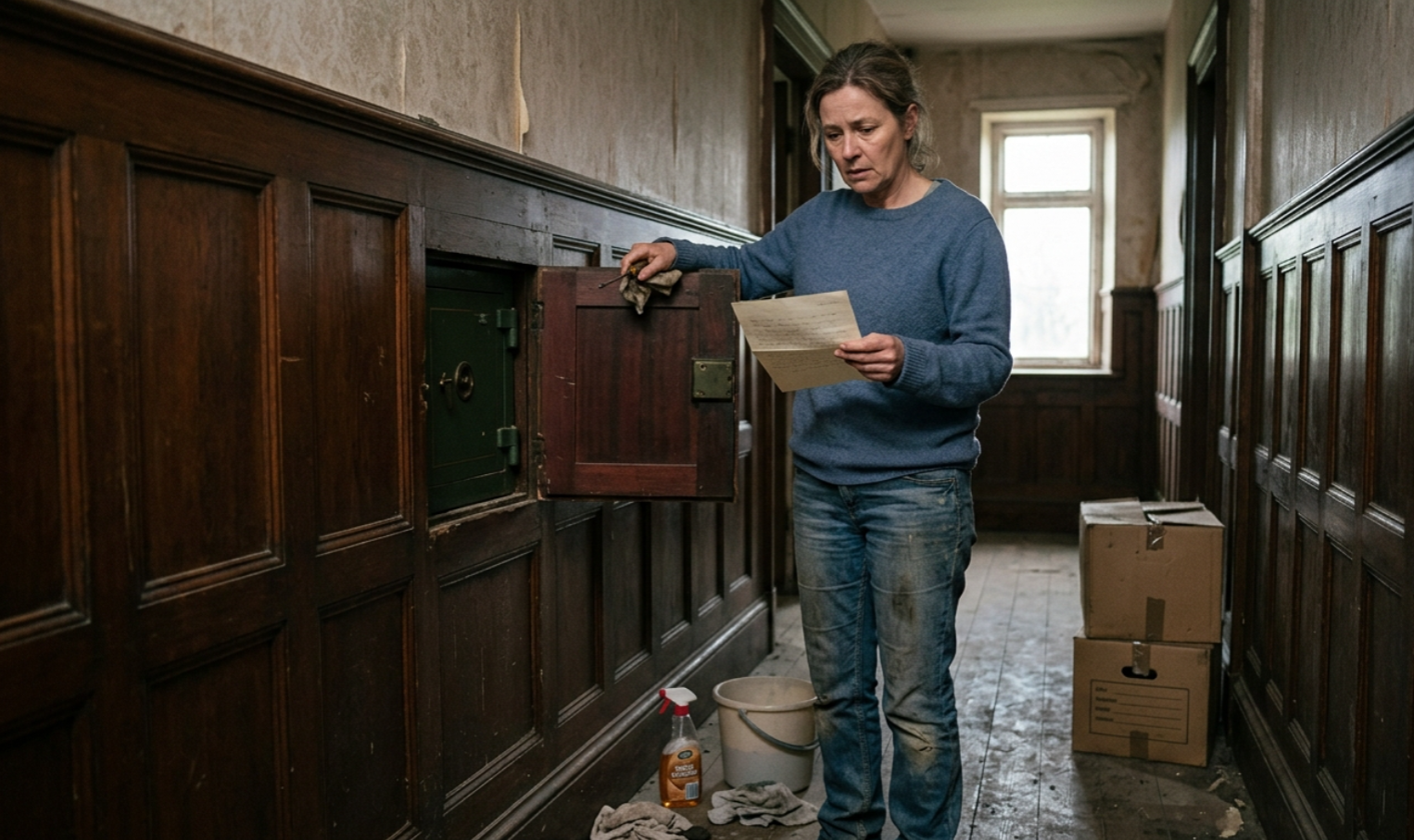
That night, after the children went to bed, I walked into the hallway.
The hidden panel was still there.
The safe was open.
Inside sat the letter.
The flash drive.
The brass key.
I touched the letter one last time.
I finally understood what Mom had really left me.
It wasn’t three million dollars.
It wasn’t land.
It wasn’t a secret safe.
It was the ability to survive the moment when someone convinced me I had no value without them.
Richard had taken the house I thought was my security.
He had taken years I could never recover.
He had taken my confidence.
For a while, he had even taken my children.
But he couldn’t take the part of me my mother had protected long before I knew I needed protecting.
I closed the safe.
Then I replaced the panel.
But this time, I didn’t hide it.
I painted the hallway around it and left the panel visible.
A reminder.
Not of Richard.
Of Mom.
Of the woman who understood that sometimes love meant preparing someone for a battle you hoped they would never have to fight.
The next morning, I found an envelope on the porch.
There was no return address.
Inside was a single photograph.
My mother.
Young.
Standing beside the country house.
On the back, in her handwriting, were six words:
You were always worth protecting, Miranda.
I held the photograph against my chest.
Then I looked through the kitchen window.
Lily was making pancakes.
Jonah was complaining that she had used too much syrup.
The house smelled like coffee and cinnamon.
For the first time in years, I didn’t feel like I was waiting for something terrible to happen.
I simply listened.
My children laughing.
The old floorboards creaking.
The wind moving through the trees.
Life.
Ordinary, imperfect, beautiful life.
And I finally understood the secret my mother had left me.
She hadn’t been waiting for betrayal.
She had been waiting for me to finally choose myself.
And when that day came, she had made sure I wouldn’t have to face it alone.