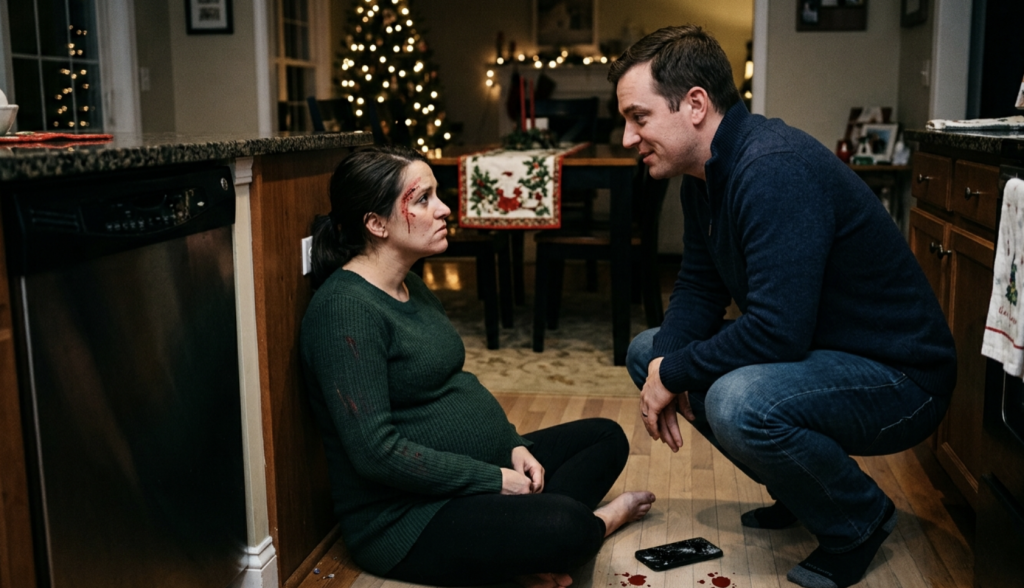
My Husband Said, “Who Do You Think They’ll Believe?”—Then He Learned My Father Was the Chief Justice
PART 4
Three days after I blocked Caleb’s number, I woke up to 47 missed calls.
Not from Caleb.
From people I barely knew.
Former classmates.
Neighbors.
People from Caleb’s law firm.
Even two women I had met only once at charity events.
My mother walked into the room holding her phone.
“Mara.”
I sat up.
“What happened?”
She handed me her phone.
A news article filled the screen.
The headline made my stomach drop.
LOCAL ATTORNEY DENIES ALLEGATIONS FOLLOWING CHRISTMAS INCIDENT INVOLVING PREGNANT WIFE
I stared at it.
“Who told them?”
My mother shook her head.
“I don’t know.”
I started reading.
The article said Caleb had been “deeply concerned” about my emotional state.
It said there had been “a misunderstanding during a stressful family gathering.”
It said he had never intentionally harmed me.
Then I reached the final paragraph.
A source close to the family claimed that my father was “attempting to use his judicial influence to interfere in a private marital dispute.”
I stopped breathing.
My mother saw my face.
“What?”
I handed her the phone.
She read it.
Her expression hardened.
“He did this.”
I nodded.
“He’s trying to make it look like Dad is using his position.”
My father walked into the room.
He had already seen the article.
He looked calm.
Too calm.
“Dad?”
He sat beside me.
“I have already contacted the appropriate ethics office.”
“What are you going to do?”
“Nothing personally.”
I frowned.
“But they’re accusing you.”
“I know.”
“Aren’t you angry?”
“Yes.”
He looked at me.
“But anger doesn’t give me permission to misuse my office.”
He picked up his phone.
“I have recused myself from anything involving your case.”
I stared at him.
“You did?”
“Immediately.”
“Why?”
“Because the truth should survive without my position.”
He squeezed my hand.
“And because I want the person who hurt you to answer for what he did because of his actions, not because he is afraid of your father.”
I started crying.
My father continued.
“Your husband wants people to believe this is about me.”
He shook his head.
“It isn’t.”
“This is about you.”
That afternoon, Detective Alvarez called.
“We have reviewed the footage.”
My heart started beating faster.
“And?”
“There is no ambiguity.”
I closed my eyes.
“Are you sure?”
“Yes.”
She explained that the recording showed Judith approaching me from behind.
It showed Judith placing both hands on my shoulders.
It showed her pushing me backward.
It showed me striking the granite counter.
It showed Caleb entering the room.
And then it showed something even worse.
Me reaching for my phone.
Caleb taking it.
Me trying to retrieve it.
Caleb throwing it against the wall.
Then the audio captured his words.
“You’re not calling anyone.”
Then:
“Nobody needs to know about this.”
And finally:
“Who do you think they’re going to believe?”
I covered my mouth.
Detective Alvarez continued.
“We also recovered the broken phone.”
“Can it be used?”
“Yes.”
“Even though the screen is destroyed?”
“Some data was recovered.”
My voice trembled.
“What data?”
“Several text messages between you and your husband.”
I knew immediately what they contained.
Years of messages.
Apologies.
Threats disguised as jokes.
Manipulation.
Warnings.
Promises.
Excuses.
And one message from six months earlier.
If you ever try to make me look bad in front of my mother, I will make sure you regret it.
I had forgotten that message existed.
Caleb hadn’t.
Apparently, he had deleted his copy.
But he hadn’t deleted mine.
Detective Alvarez said:
“We’re preparing the case.”
I whispered:
“Thank you.”
She paused.
“Mara?”
“Yes?”
“You did the right thing by telling the truth.”
I looked toward my daughter’s empty crib.
“I almost didn’t.”
“I know.”
“How did you know?”
“Because most people don’t.”
The next morning, Caleb’s law firm suspended him.
Not because of my father’s position.
Not because of the newspaper.
Because the firm’s partners had seen the recording.
Ronan Pierce had provided it.
And Ronan wasn’t finished.
He released a statement.
He said he had witnessed Caleb attempting to prevent emergency assistance.
He said he had heard Judith’s version change three times.
He said he had watched Caleb pressure witnesses at the house.
And then he said something that shocked everyone.
“I should have called 911 sooner.”
That sentence spread faster than anything else.
Because people understood it.
Ronan wasn’t claiming to be a hero.
He was admitting he had failed.
And that honesty made the rest of his statement difficult to dismiss.
Caleb responded through his attorney.
He denied wrongdoing.
He claimed the footage had been “misinterpreted.”
He claimed I was exaggerating.
He claimed the marriage had been under “significant emotional strain.”
Then his attorney used the phrase that made me furious.
“Mrs. Calloway’s account should be evaluated in the context of her pregnancy-related emotional state.”
My father read the statement.
He looked at me.
“Do you want to respond?”
“No.”
“Good.”
“Why?”
“Because you don’t need to fight every lie.”
He placed a folder on the table.
“Let the evidence speak.”
Three weeks later, my daughter was born.
Early.
But strong.
She arrived at 32 weeks.
Tiny.
Red-faced.
Furious at the world.
The moment I heard her cry, I forgot everything else.
Every insult.
Every threat.
Every Christmas dinner.
Every time I had swallowed my voice.
I cried so hard that the nurse smiled.
“She’s beautiful.”
I looked at my daughter.
“Yes.”
My mother stood beside me.
My father stood behind her.
“What are you naming her?” my mother whispered.
I looked at the tiny face.
Then I remembered Christmas.
The night everything broke.
The night I finally understood that silence was not peace.
And I knew.
“Hope.”
My mother smiled.
“Hope?”
I nodded.
“Because she was born after I finally found mine.”
The legal process continued while I learned how to be a mother.
Caleb tried to negotiate.
Then he tried to intimidate.
Then he tried to apologize.
Then he tried to blame Judith.
Judith blamed Caleb.
Caleb blamed me.
Everyone blamed everyone.
But the evidence remained unchanged.
Eventually, Caleb accepted a plea agreement related to the assault and obstruction charges.
Judith faced her own legal consequences.
The court also issued protective orders.
Caleb was prohibited from contacting me directly.
He could not enter my parents’ home.
He could not approach me at the hospital.
And all future contact concerning our daughter had to go through the appropriate legal channels.
I didn’t celebrate.
There was nothing to celebrate.
A family had been destroyed.
A marriage had ended.
A child had been born into a situation no mother ever wants.
But I was safe.
My daughter was safe.
That mattered.
Six months later, I sat in a small courtroom for the final hearing.
Caleb looked different.
Older.
Smaller.
He had lost the confidence he once carried like armor.
When the judge asked if I wanted to make a statement, I stood.
My hands shook.
But my voice didn’t.
“I spent four years believing that keeping peace meant keeping quiet.”
Caleb looked at me.
“I thought if I stayed patient, things would improve.”
I paused.
“They didn’t.”
I looked toward the judge.
“What happened on Christmas wasn’t the beginning.”
“It was simply the first time I refused to hide what was happening.”
The courtroom was silent.
“I don’t want revenge.”
Caleb lowered his eyes.
“I want boundaries.”
I looked at my daughter, who was sleeping in my mother’s arms.
“I want my daughter to grow up knowing that love doesn’t require fear.”
My voice cracked.
“I want her to know that family doesn’t mean protecting someone from the consequences of hurting you.”
I took a breath.
“And I want her to know that asking for help isn’t weakness.”
I sat down.
My father placed his hand over mine.
He didn’t say anything.
He didn’t need to.
A year after Christmas, I returned to the house.
Not alone.
A moving company was clearing out the last of my belongings.
I stood in the kitchen.
The granite counter was still there.
For a moment, I couldn’t move.
I remembered the pain.
The blood.
The broken phone.
Caleb’s voice.
Judith’s hands.
Then I looked at my daughter.
She was twelve months old.
She was sitting on my mother’s hip, laughing at something outside the window.
I looked at the counter again.
It no longer controlled me.
It was just stone.
I walked toward it.
I placed my hand against the surface.
Then I whispered:
“You don’t own that memory anymore.”
My mother looked at me.
“What did you say?”
“Nothing.”
I smiled.
Then I walked out.
I never went back.
Two years later, I had rebuilt my life.
I had returned to work.
I had bought a small house.
I had planted flowers along the front walkway.
My daughter had her own bedroom.
Pink curtains.
Books everywhere.
Stuffed animals covering the bed.
And one framed photograph above her dresser.
It was a picture of my parents holding her on the day she came home from the hospital.
One evening, she climbed into my lap.
“Mommy?”
“Yes?”
“Why don’t Daddy live with us?”
I took a breath.
Children deserve truth.
But they deserve it in a way they can understand.
“Sometimes adults don’t know how to treat each other with kindness.”
She thought about that.
“Did Daddy hurt you?”
I looked at her.
“Yes.”
Her little face became serious.
“Did Grandpa save you?”
I smiled.
“No.”
She looked confused.
“Then who did?”
I touched her chest.
“Me.”
She smiled.
“Mommy saved Mommy?”
I laughed softly.
“Yes.”
She hugged me.
“And you saved me too.”
I held her tightly.
“No, sweetheart.”
I kissed her forehead.
“You saved me too.”
Years passed.
My daughter grew.
And every Christmas, we did things differently.
No enormous dinner.
No impossible expectations.
No one standing in the kitchen before sunrise.
We cooked together.
We laughed.
We burned cookies.
We ordered pizza when we were too tired.
And nobody was allowed to make anyone feel guilty for needing to sit down.
One Christmas morning, my daughter handed me a present.
“For you.”
I opened it.
Inside was a small wooden frame.
She had written something herself.
It said:
HOME IS WHERE YOU FEEL SAFE.
I started crying.
She looked worried.
“Mommy, do you like it?”
I pulled her into my arms.
“I love it.”
She hugged me.
“Good.”
Then she whispered:
“Because I made it for our home.”
I looked around the living room.
The Christmas lights.
The crooked tree.
The wrapping paper.
The warm blankets.
My parents laughing in the kitchen.
My daughter beside me.
And I finally understood something.
Caleb had once convinced me that power belonged to people with titles, money, connections, and influence.
He had believed my father’s position made me dangerous.
He had been wrong.
The strongest thing I ever had wasn’t my father’s name.
It wasn’t his courtroom.
It wasn’t his authority.
It wasn’t the evidence.
It wasn’t even the law.
It was the moment I finally believed my own voice.
Because when someone spends years convincing you that nobody will believe you, the first person you have to convince is yourself.
And once I believed myself, everything changed.
I didn’t need revenge.
I didn’t need to destroy Caleb.
I didn’t need to prove that I was stronger than him.
I simply walked away.
And I built a life where my daughter would never have to wonder whether love was supposed to hurt.
That Christmas, I stood beside the window watching snow fall across the yard.
My daughter ran toward me.
“Mommy!”
I turned.
She wrapped her arms around my waist.
“Merry Christmas.”
I smiled.
“Merry Christmas, sweetheart.”
Then she looked up at me.
“Are you happy?”
I thought about the woman I had been four years earlier.
The woman standing in someone else’s kitchen.
Exhausted.
Pregnant.
Afraid.
Silenced.
Then I looked at the woman I had become.
A mother.
A survivor.
A woman who finally understood her worth.
“Yes,” I whispered.
“I am.”
And for the first time in my life, I knew exactly what Christmas meant.
It wasn’t about a perfect dinner.
It wasn’t about keeping a family together at any cost.
It wasn’t about pretending everything was fine.
It was about being surrounded by people who made you feel safe enough to be yourself.
My daughter took my hand.
We walked back toward the Christmas tree.
And I never looked back.