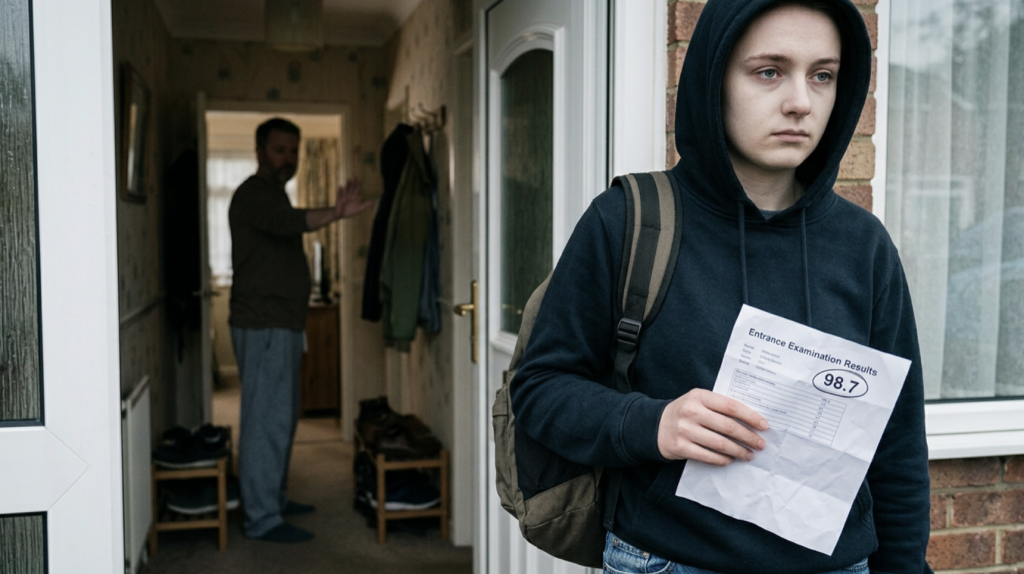
I Lied and Told My Dad I Failed With a 98.7 Score—Then I Exposed the Secret Plan to Steal My Mother’s House
PART 4
The ballroom fell into a silence so complete that I could hear the soft hum of the crystal chandeliers.
Three uniformed police officers walked steadily across the marble floor. Their polished shoes echoed between the round banquet tables where nearly two hundred guests sat frozen, champagne glasses still raised halfway to their lips.
Arthur Reynolds finally found his voice.
“This is some kind of misunderstanding,” he said, forcing a smile that looked more like a grimace. “Officers, this is my family. We’re celebrating my daughter’s achievement.”
The lead officer didn’t even glance at him.
Instead, he stopped in front of me.
“Miss Diane Reynolds?”
“Yes.”
“I’m Officer Hernandez. We received a report from Sterling Notary Services regarding suspected identity fraud and attempted unlawful transfer of estate property.”
Every photographer lifted their cameras.
The flashes began again.
Arthur immediately stepped forward.
“My daughter is emotional. Her mother died years ago. She doesn’t understand what she’s doing.”
I laughed.
It surprised even me.
Not because anything was funny—but because I had waited eighteen years to hear him say I was confused whenever the truth threatened him.
“No,” I replied calmly. “For the first time in my life, I understand exactly what I’m doing.”
I turned toward the guests.
“Before anyone leaves tonight, I think you deserve to know why my father threw me out of his house.”
Carol chose that exact moment to rush into the ballroom.
Her expensive emerald dress was wrinkled from the confrontation at the notary office. Her makeup had begun to smear, but she still carried herself with practiced confidence.
“Arthur!” she shouted. “Don’t say another word!”
Too late.
The guests were already staring.
Lily looked from Carol to me with growing confusion.
“Mom… what happened?”
Carol grabbed Lily’s hand.
“We’re leaving.”
Lily pulled away.
“No.”
It was the first time I had ever heard my stepsister say that word to her mother.
“No,” Lily repeated, louder. “Someone tell me what’s going on.”
Arthur rubbed his forehead.
“Lily, sweetheart—”
“Don’t call me sweetheart until you answer her.”
She pointed at me.
My father looked as though someone had stolen the script he had rehearsed for years.
Mr. Sanders stepped beside me carrying his leather briefcase.
“With Miss Reynolds’ permission,” he said, “I have evidence relevant to tonight’s events.”
I nodded.
He connected his tablet to the ballroom projector.
The giant congratulatory slideshow disappeared.
Instead, the screen displayed the date from two weeks earlier.
Then the audio began.
Carol’s unmistakable voice filled the ballroom.
“She just turned eighteen. We can finally take the house.”
Arthur answered.
“She’ll sign once she realizes she has nowhere else to go.”
Guests gasped.
One elderly woman covered her mouth.
A businessman sitting near the stage slowly lowered his wine glass.
Then came the sentence that destroyed everything.
“We’ll starve her financially until she gives up.”
The recording ended.
No music followed.
Only silence.
Lily slowly turned toward her parents.
“You said that?”
Carol immediately shook her head.
“It was edited!”
Mr. Sanders calmly replied, “The original recording has already been submitted to the police with metadata verification.”
Carol’s shoulders dropped.
She realized the lie wouldn’t survive another minute.
Lily stepped away from them completely.
She walked toward me.
I instinctively tensed.
For years she had been the golden child.
The favorite.
The one whose birthdays filled banquet halls while mine passed unnoticed.
She stopped only a few feet away.
Her eyes were red.
“Is it true?” she whispered.
I looked at her for several seconds.
Lily wasn’t the one who had planned this.
She was eighteen too.
Another daughter raised by the same adults—but loved differently.
“Yes.”
I handed her my mother’s letter.
She read it silently.
By the time she reached the final paragraph, tears were running freely down her face.
She looked back at Arthur.
“You were going to steal her mother’s house… for me?”
Arthur reached toward her.
“Lily, listen—”
She stepped back.
“I never asked for that.”
Carol interrupted sharply.
“We did this for your future!”
“My future?” Lily cried. “You built it by destroying hers!”
The words echoed through the ballroom.
Several guests quietly stood up and began leaving.
No one wanted to celebrate anymore.
Officer Hernandez spoke gently.
“Mr. Reynolds, Mrs. Reynolds, we need both of you to accompany us for questioning.”
Arthur’s face hardened.
“You don’t have a warrant.”
“We’re not arresting you at this moment,” the officer replied. “But we are investigating attempted fraud, identity theft conspiracy, and possible coercion involving estate property.”
Arthur looked around desperately.
His business partners avoided eye contact.
The country club president suddenly became fascinated by the centerpiece.
Even his own younger brother turned away.
His carefully constructed reputation was collapsing table by table.
Before following the officers, Arthur turned toward me.
“Diane.”
I met his eyes.
“For eighteen years,” he said quietly, “I fed you.”
I answered just as quietly.
“My mother left enough money to feed me. You just never told me.”
His expression cracked.
He had no reply.
The investigation lasted four months.
News spread faster than anyone expected.
Not because of social media.
Because wealthy communities thrive on whispered conversations.
The fake ID.
The paid impersonator.
The recorded conspiracy.
The forged relinquishment papers.
Everything became evidence.
Emily, the girl hired to pretend to be me, testified voluntarily.
She returned every dollar Carol had given her.
The district attorney later offered her immunity because she had cooperated immediately and had been recruited under false pretenses.
Carol was charged with identity fraud and conspiracy.
Arthur faced additional charges related to attempted theft by deception and coercive financial abuse.
Neither of them went to prison immediately.
There were hearings.
Appeals.
Lawyers.
But one thing happened almost instantly.
The judge issued an emergency order protecting my ownership of the Pasadena house.
No one could sell it.
No one could mortgage it.
No one could touch it except me.
On the first Saturday after the court order, Aunt Susan drove me to Pasadena.
The house looked smaller than I remembered.
The white paint had faded.
Bougainvillea vines had climbed over the front gate exactly like they had in my childhood photograph.
I stood outside holding the original brass key.
My hands trembled.
“Go ahead,” Susan whispered.
The lock clicked.
The front door opened.
Dust floated through the afternoon sunlight.
Everything smelled like cedar and old books.
The living room was almost untouched.
My mother’s piano still stood beside the window.
A knitted blanket rested over the sofa exactly as she had left it.
I walked from room to room without speaking.
In the kitchen, faded pencil marks still measured my height on the doorway.
Age six.
Age seven.
Age eight.
The last mark stopped just weeks before she died.
I pressed my fingers against it.
For the first time since her funeral, I cried.
Not because I was broken.
Because I had finally made it home.
A month later, Mr. Sanders invited me to his office.
“There’s one final matter in your mother’s estate.”
He handed me a small envelope I had never seen before.
Inside was a bank certificate.
My mother had created an education trust.
It contained enough money to pay for university, graduate school, and even living expenses.
I stared at the number.
“She planned all this?”
Mr. Sanders smiled sadly.
“She knew Arthur loved money more than responsibility.”
“She hoped you’d discover this only after the house was legally yours.”
My mother had protected me one final time.
Even after death.
Lily contacted me near Christmas.
Her message was only one sentence.
Can we talk—not as sisters by law, but as two girls who survived the same adults?
We met at a small café in Pasadena.
Neither of us knew how to begin.
Finally she slid an envelope across the table.
Inside was a cashier’s check.
Five thousand dollars.
“The amount Mom paid Emily,” she said.
“I sold my designer jewelry. It doesn’t erase anything, but I wanted that money out of my life.”
I pushed the envelope back.
“Donate it.”
“To who?”
I looked out the window.
Across the street, a group of high school students were walking home carrying backpacks.
“There are kids who’ll never get the chance my mom fought to give me.”
Lily nodded.
The following spring, we created something neither Arthur nor Carol had ever imagined.
The Eleanor Grant Scholarship—named after my mother.
Every year it would fund one student from a low-income family who earned admission to college but lacked financial support.
The first recipient was a girl whose single father worked night shifts as a janitor.
When she received the acceptance letter, she cried exactly the way I imagined my mother would have cried for me.
One year after the banquet disaster, I stood once again in the Pasadena garden.
The bougainvilleas were blooming brighter than ever.
Reporters occasionally still asked about the scandal.
They wanted the dramatic story.
The betrayal.
The courtroom.
The wealthy family that imploded.
But that was never the ending.
The real ending happened quietly.
It happened every morning I unlocked my own front door.
Every evening I studied at the desk beside my mother’s piano.
Every scholarship letter sent to another teenager who believed poverty would decide their future.
People think inheritance is about property.
They’re wrong.
My mother didn’t leave me a house.
She left me proof that love protects instead of controls, builds instead of bargains, and tells the truth even when lies seem easier.
I had lied only once—to say I failed.
That single lie exposed every truth my father had spent years trying to bury.
And in the end, I didn’t inherit his name.
I inherited my mother’s courage.