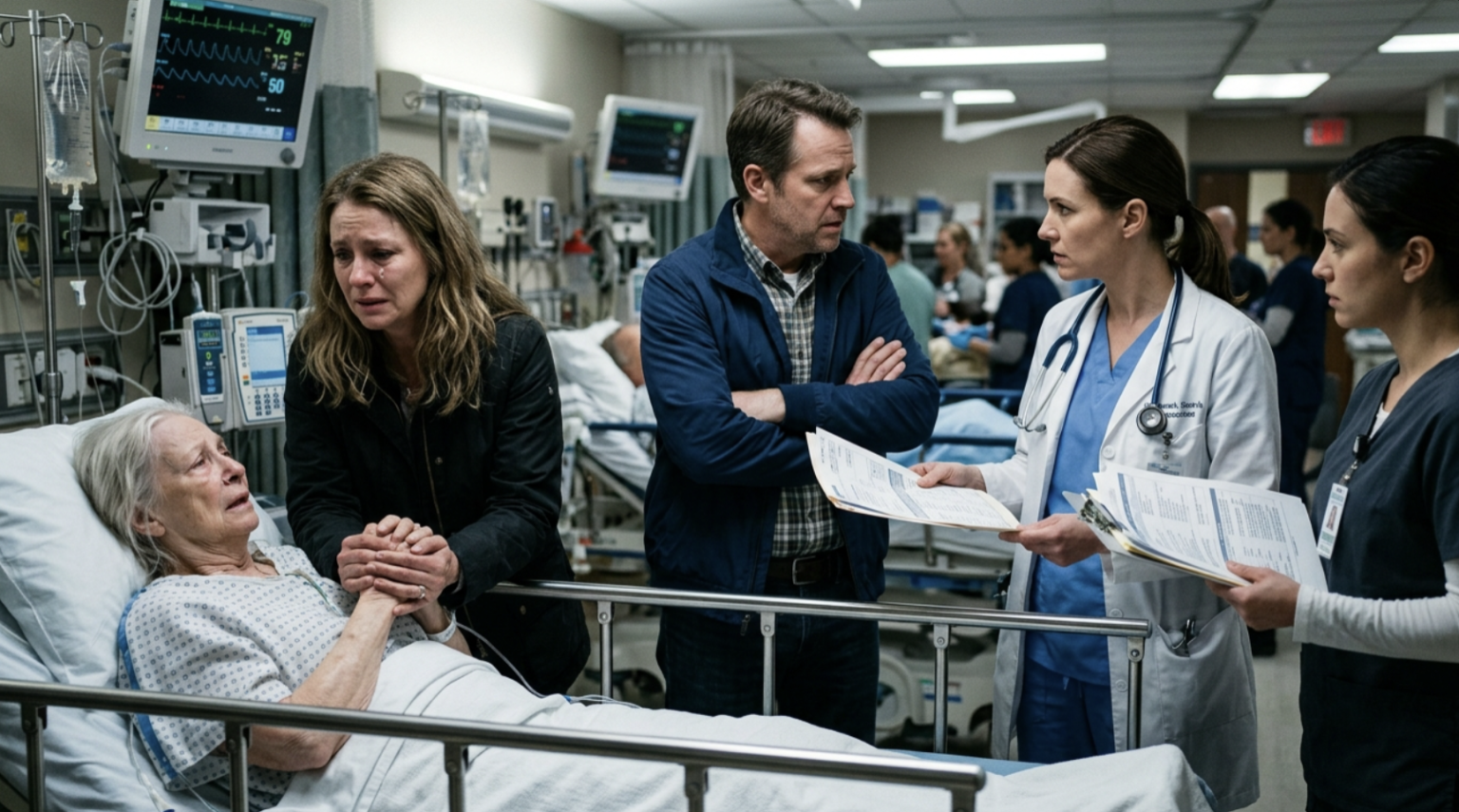
My Brother Called Mom a Liar in the ER—Then the Pharmacy Revealed the Truth
PART 3
PART 4
The detective looked at me for several seconds before speaking.
“Does your mother know exactly where that laptop is?”
She nodded.
“In my bedroom. Under the loose floorboard beside Dad’s old dresser.”
Detective Alvarez immediately called another officer.
Kyle had no idea we were coming.
And for the first time since I arrived at the hospital, I felt something I hadn’t felt in years.
Hope.
Not because I wanted my brother punished.
Not because I wanted revenge.
I just wanted the truth.
My mother deserved the truth.
And I deserved to know why my brother had spent two years convincing me that she didn’t need me.
We reached my mother’s house just after midnight.
The police went in first.
I followed behind them, carrying my mother’s house key.
Every room felt different now.
The same walls.
The same photographs.
The same furniture.
But everything suddenly looked like evidence.
Detective Alvarez walked toward the master bedroom.
“Where’s the dresser?”
“Against the far wall.”
He moved it carefully.
The floorboard beneath it was slightly darker than the others.
He knelt.
“Is this it?”
I nodded.
He lifted the board.
There was a shallow space underneath.
And inside was an old black laptop wrapped in a faded blue towel.
My father’s towel.
I picked it up.
My hands were shaking.
The laptop was ancient.
Scratched.
Dusty.
But intact.
Detective Alvarez opened it.
The battery was dead.
He connected it to a portable power source.
Nothing happened.
Then the screen flickered.
A password appeared.
I looked at Mom’s old family photos.
“What was Dad’s password?”
Mom thought for a moment.
Then she whispered:
“Your birthday.”
I typed it.
The screen unlocked.
There were only three folders.
Taxes.
Family.
Important.
Detective Alvarez opened Important.
There were twelve audio files.
All dated within the last eight months.
I stared at the screen.
“Who recorded these?”
Mom looked at me.
“I did.”
I couldn’t speak.
My mother had been quietly documenting everything.
She clicked the first file.
A man’s voice filled the room.
Kyle.
“You don’t need all of them.”
Then another voice.
A woman’s.
Marissa.
“What if she notices?”
Kyle laughed.
“She won’t.”
The room went silent.
My stomach turned.
The recording continued.
Marissa said, “You promised she’d sign the house over.”
“She will.”
“And the account?”
“Almost finished.”
“Her daughter?”
“She lives two hours away. By the time Tracy figures it out, Mom won’t have anything left to give her.”
I covered my mouth.
The detective looked at me.
But I couldn’t look at him.
I couldn’t look at anything.
The recording continued.
Kyle’s voice became clearer.
“She trusts me because I’m here every day.”
Marissa laughed.
“And the pills?”
“I control those too.”
My mother began sobbing.
I took her hand.
The recording continued.
“She’ll eventually become dependent enough that everyone will think she’s confused.”
Marissa asked, “And if she talks?”
Kyle answered:
“Then we say dementia.”
I felt something inside me break.
Not because I was surprised.
Because I wasn’t.
Some part of me had known.
I had known every time Mom’s voice sounded frightened.
Every time she canceled a visit.
Every time Kyle answered her phone.
Every time she said, “Kyle says I’m okay.”
I had just been too desperate to believe that my brother could do this.
Then another recording started.
This one was different.
Kyle sounded angry.
“You need to stop calling Tracy.”
Mom’s voice answered.
“She is my daughter.”
“She doesn’t need to be involved.”
“She deserves to know.”
“No.”
“Why?”
“Because once she comes here, everything falls apart.”
There was a pause.
Then Mom asked:
“What did you do with Dad’s watch?”
Kyle said:
“Sold it.”
“You lied.”
“I needed money.”
“You took my jewelry too.”
“I needed money.”
“You promised you’d pay it back.”
“I will.”
“With what?”
Silence.
Then Kyle said something that made my blood run cold.
“With the house.”
I looked at Detective Alvarez.
He was already taking notes.
Then the recording continued.
Kyle said:
“You don’t understand, Mom. Once the house is mine, everything changes.”
Mom asked:
“How would the house become yours?”
Kyle laughed.
“You’ll sign it.”
“I won’t.”
“You will.”
“No.”
“You don’t have a choice.”
There was a loud sound.
My mother gasped.
Then the recording ended.
I stared at the laptop.
“What happened there?”
Mom wouldn’t answer.
I turned toward her.
“Mom.”
She looked down.
“He pushed me.”
I closed my eyes.
“How bad?”
“I fell against the dresser.”
“When?”
“Three months ago.”
“And you never told me?”
“He apologized.”
I almost screamed.
But instead I knelt beside her.
“Mom, you don’t have to protect him anymore.”
She began crying harder.
“I thought I could fix him.”
“You can’t.”
“He wasn’t always like this.”
“I know.”
“He was your little brother.”
“I know.”
She looked at me.
“I kept thinking your father would know what to do.”
That sentence destroyed me.
Because Dad had been gone for four years.
And Mom had been trying to survive alone ever since.
Detective Alvarez copied the recordings.
Then he found something else.
A folder labeled:
DEED
He opened it.
There was a scanned document.
A property transfer agreement.
My mother’s house.
The document transferred ownership from my mother to Kyle.
But there was a problem.
The signature wasn’t hers.
I knew immediately.
“That isn’t Mom’s handwriting.”
Detective Alvarez zoomed in.
“Agreed.”
Mom stared at the screen.
“I never signed that.”
“Did you ever sign anything similar?”
“Kyle brought papers to me twice.”
“What did he tell you?”
“That they were for medical bills.”
Detective Alvarez’s face hardened.
“Your brother may have attempted to transfer your property without your consent.”
My mother looked at me.
“What happens now?”
I reached for her hand.
“Now we stop being afraid.”
Kyle was arrested the next morning.
Not at the hospital.
At his apartment.
The police found the prescription bottles.
Twenty-seven of them.
Some were unopened.
Some were empty.
Some still had my mother’s name on them.
They also found paperwork connected to her bank account.
And the deed.
The forged deed.
But Kyle didn’t confess.
He said everything belonged to him because he was her caregiver.
He said Mom had given him permission.
He said I was manipulating an elderly woman.
And then he made the mistake that finally destroyed his story.
He told the detective:
“My mother has memory problems. She doesn’t know what she signed.”
The detective placed the laptop recording on the table.
Kyle’s face went white.
They played the audio.
He listened to his own voice.
For almost two minutes, he said nothing.
Then he whispered:
“Where did you get that?”
Detective Alvarez leaned forward.
“That’s not your concern.”
Kyle stared at him.
“Was she recording me?”
“Yes.”
He lowered his head.
And for the first time, he looked afraid.
Mom spent twelve days in the hospital.
She had surgery on her hip.
Physical therapy followed.
She hated every minute of it.
But every morning I came early.
I helped her eat.
I brushed her hair.
I listened.
And slowly, she started becoming herself again.
One morning she looked at me and said:
“I owe you an apology.”
“You don’t.”
“I should have called you sooner.”
“You were scared.”
“I should have trusted you.”
I smiled.
“You’re my mom. You can call me anytime.”
She squeezed my hand.
“I was afraid you would believe him.”
“I almost did.”
She looked away.
“That hurts.”
“I know.”
“But I should have come sooner.”
She shook her head.
“No.”
I looked at her.
“This isn’t your fault.”
She smiled weakly.
“You always were stubborn.”
I laughed.
“So were you.”
For the first time in years, my mother laughed too.
Three months later, Kyle’s case went to court.
The evidence was overwhelming.
The pharmacy records.
The financial withdrawals.
The forged deed.
The storage locker.
The prescription bottles.
The recordings.
And most importantly, my mother’s testimony.
She sat in the courtroom with a cane beside her.
Kyle looked smaller than I remembered.
When it was her turn to speak, she looked directly at him.
“You were my son.”
Kyle looked down.
“I loved you.”
He swallowed.
“But you confused my love with permission.”
The courtroom was silent.
“You thought because I was old, I was weak.”
She paused.
“I wasn’t weak.”
Kyle finally looked at her.
“I was afraid.”
That was the only time I saw tears in his eyes.
But Mom wasn’t finished.
“You didn’t steal my money.”
Kyle lowered his head.
“You stole two years of my life.”
The judge eventually sentenced him.
The details mattered less to me than what happened afterward.
My mother got her house back.
Her bank accounts were restored as much as possible.
Her medications were placed under her own control.
A social worker helped her arrange safe transportation.
And I moved her closer to me.
Not because she couldn’t live alone.
Because she finally understood that accepting help wasn’t the same as losing independence.
One afternoon, we stood on the porch of her new little house.
She looked at the garden.
“Your father would have liked this.”
I smiled.
“He would’ve complained about the flowers.”
She laughed.
“He would’ve.”
Then she reached into her pocket.
She handed me something.
My father’s watch.
The police had recovered it from the storage locker.
I stared at it.
“I can’t take this.”
“Yes, you can.”
“Mom…”
“Your father wanted you to have it.”
I put it on.
The second hand moved steadily.
Tick.
Tick.
Tick.
Mom rested her head against my shoulder.
“You know what I learned?”
“What?”
“Family isn’t the person who shares your blood.”
I looked at her.
“It’s the person who tells you the truth when the truth is hard.”
I squeezed her hand.
“And sometimes,” she added, “it’s the person who drives ninety miles an hour because their mother called at three in the morning.”
I laughed.
“You’re never going to let me forget that, are you?”
“Never.”
We stood there together as the sun went down.
For two years, I had thought distance was my greatest failure.
I thought being two hours away meant I hadn’t been there enough.
But I finally understood something.
I hadn’t abandoned my mother.
Someone had worked very hard to convince us that we had abandoned each other.
And the moment the truth came out, we found our way back.
My mother looked at my father’s watch.
Then at me.
“Tracy?”
“Yes?”
“I’m glad you came.”
I smiled.
“Me too, Mom.”
And this time, when she reached for my hand, there was no fear in her grip.
Only love.
And for the first time in two years, she didn’t have to whisper.
PART 5
Six months after Kyle was sentenced, I thought the worst part of our family’s story was finally behind us.
I was wrong.
One Saturday morning, my mother called me.
Her voice sounded different.
Not frightened.
Not confused.
Just serious.
“Tracy, I need you to come over.”
I was already reaching for my keys.
“Are you okay?”
“Yes.”
“Did something happen?”
“No.”
She paused.
“I found something in your father’s things.”
I stopped.
“Something else?”
“Yes.”
“What is it?”
“I don’t want to tell you over the phone.”
Forty minutes later, I was sitting at her kitchen table.
Mom placed an old cardboard box in front of me.
It was covered in dust.
Across the top, in my father’s handwriting, were two words:
FOR TRACY.
I stared at it.
“Why didn’t you give me this before?”
“Because I didn’t know it existed.”
Inside was an old envelope.
There was a photograph.
Dad, Mom, Kyle, and me.
We were standing in front of the house when I was seventeen.
Kyle was laughing.
Dad had his arm around both of us.
For a moment, I couldn’t breathe.
We had been happy.
Or at least I remembered us being happy.
Then I found a letter.
My father’s handwriting covered three pages.
I read the first sentence.
“If my children ever become divided, I hope they remember that neither of them was ever my favorite.”
My eyes filled with tears.
Dad continued writing about us.
He wrote that Kyle had always struggled with responsibility.
He wrote that I had always tried to fix everything.
And then he wrote something that I had never known.
He had worried about Kyle for years.
Not because he thought Kyle was evil.
Because he thought Kyle believed love meant being entitled to what other people had.
Dad had written:
“If Kyle ever asks you for more than you can give, saying no does not make you a bad sister.”
I put the letter down.
Mom was crying.
“He knew.”
“He suspected.”
She nodded.
“Your father wanted to talk to Kyle.”
“Did he?”
“No.”
“Why?”
“He died before he got the chance.”
I looked at the photograph again.
For years, I had remembered my father’s death as the moment our family began falling apart.
Now I realized something else.
Maybe the cracks had been there long before.
We just hadn’t known how deep they were.
THE LETTER
At the bottom of the box was another envelope.
This one wasn’t from Dad.
It was from Kyle.
I stared at Mom.
“When did he write this?”
“After his sentencing.”
I opened it.
His handwriting was messy.
The first line said:
“I don’t expect you to forgive me.”
I almost stopped reading.
But I continued.
Kyle admitted everything.
Not because he suddenly became innocent.
Not because he wanted sympathy.
He admitted that he had convinced himself he deserved the house.
He said he had spent years comparing himself to me.
He believed Dad trusted me more.
He believed Mom loved me more.
And instead of dealing with those feelings, he turned them into resentment.
Then resentment became entitlement.
And entitlement became greed.
He wrote that once he started taking the money, he couldn’t stop.
The first withdrawal had been $300.
He told himself it was temporary.
Then $800.
Then $2,000.
Eventually, the amounts became so large that he knew he couldn’t return them.
So he created a bigger lie to hide the smaller ones.
And another lie to hide that.
Until Mom’s entire life had become something he controlled.
Then he wrote something that made me stop.
“The worst thing I did wasn’t taking her money.”
I read the next sentence twice.
“The worst thing I did was make her believe her daughter had stopped loving her.”
I closed my eyes.
That was the wound that hurt most.
Not the money.
Not the jewelry.
Not the house.
The two years Mom had spent believing I didn’t care enough.
I folded the letter.
Mom looked at me.
“Are you going to answer him?”
“No.”
She nodded.
“That’s okay.”
I put the letter back in the envelope.
“But I’m going to keep it.”
“Why?”
“So I never forget what happens when someone lets resentment become more important than love.”
ONE YEAR LATER
A year after the night at the emergency room, my mother walked without a cane.
She had planted roses around the front porch.
She joined a senior walking group.
She started attending Sunday lunches with neighbors.
And most importantly, she started making decisions without asking anyone’s permission.
Including mine.
One morning, she called me and said:
“I bought a blue car.”
I nearly dropped my coffee.
“You did what?”
“A blue car.”
“Mom, you haven’t driven in years.”
“I know.”
“Are you sure?”
She laughed.
“Tracy, I’m seventy-three, not dead.”
I laughed so hard I had to sit down.
She passed her driving test three weeks later.
The first time she drove to my house, she parked crookedly across two spaces.
I stood at the window watching her get out.
She waved proudly.
I opened the door.
“Mom.”
“What?”
“You’re terrible at parking.”
She smiled.
“I’ve survived worse.”
We hugged.
And for the first time, I realized something.
The woman who had been carried into that emergency room wasn’t the same woman standing in front of me.
She wasn’t helpless.
She wasn’t broken.
She had simply been trapped.
And now she was free.
THE FINAL VISIT
Two years after Kyle went to prison, Mom asked me to drive her somewhere.
“Where?”
“You’ll see.”
We drove for nearly an hour.
Eventually, she pointed toward an old cemetery.
I knew immediately.
Dad.
We walked to his grave.
Mom placed flowers beside the stone.
Then she stood silently.
I waited.
Finally, she whispered:
“He would be proud of her.”
I looked around.
“Who?”
She smiled.
“Me.”
I laughed through my tears.
“You’re right.”
She touched Dad’s name.
“I spent so long thinking I failed him.”
“You didn’t.”
“I thought if I had been stronger, Kyle wouldn’t have become who he became.”
“Mom.”
She looked at me.
“That wasn’t your fault.”
“I know that now.”
We stood there together.
Then Mom took my hand.
“Your father used to say something.”
“What?”
“He said the strongest families aren’t the ones that never break.”
She looked at me.
“They’re the ones that learn how to rebuild.”
I smiled.
“He was right.”
Mom nodded.
Then she looked toward the sky.
“I think we’re finally okay.”
I squeezed her hand.
“We are.”
THE PHONE CALL
That evening, we returned home.
Mom made tea.
We sat on the porch.
The sun disappeared behind the trees.
Then her phone rang.
She looked at the screen.
Her expression changed.
“Who is it?”
She didn’t answer.
The phone kept ringing.
Finally, she showed me.
It was Kyle.
For a moment, neither of us spoke.
Then Mom answered.
“Hello?”
I couldn’t hear his voice.
But I saw her face.
She listened.
Then she said:
“I forgive you.”
I looked at her.
She continued.
“But forgiveness doesn’t mean you get your old life back.”
Silence.
“I hope you become a better person.”
Another pause.
“I hope someday you understand what you did.”
She closed her eyes.
“But I’m not afraid of you anymore.”
Then she hung up.
She placed the phone on the table.
I didn’t say anything.
Neither did she.
After a few minutes, Mom looked at me.
“Was that okay?”
I smiled.
“That was perfect.”
She leaned back.
“I thought forgiveness would feel bigger.”
“It doesn’t have to.”
“What does it feel like?”
I looked at her.
“Peace.”
She smiled.
“Yes.”
TWO YEARS AFTER THAT NIGHT
Mom eventually sold the old house.
Not because Kyle had taken it from her.
Because she wanted a new beginning.
She kept Dad’s watch.
She kept the family photographs.
She kept one old recipe book.
Everything else went.
The new house was smaller.
Brighter.
Quieter.
There was a little garden in the back.
And in that garden, Mom planted one tree.
She called it Dad’s tree.
Every spring, we sat beneath it.
My daughter would bring lemonade.
My husband would bring food.
Mom would complain that everyone ate too much.
And every year, the family became a little bigger.
Not because Kyle came back.
But because Mom learned that family didn’t have to mean tolerating someone who hurt you.
Sometimes family meant protecting the people who were still capable of loving you.
One afternoon, my daughter asked Grandma:
“Why did you plant this tree?”
Mom smiled.
“To remember.”
“Remember what?”
“That bad things can happen.”
My daughter frowned.
“That’s sad.”
Mom shook her head.
“No.”
She touched the tree’s trunk.
“We plant trees because we believe tomorrow will come.”
My daughter smiled.
“Is tomorrow good?”
Mom looked at me.
Then she looked at the garden.
“Yes.”
She took my hand.
“Tomorrow is always worth fighting for.”
THE LAST THING I LEARNED
I used to believe that families were held together by blood.
I don’t believe that anymore.
Blood can connect people.
But it can’t create trust.
It can’t create kindness.
It can’t make someone worthy of your love.
My brother and I shared the same parents.
The same childhood.
The same memories.
The same house.
And somehow, we became two completely different people.
For a long time, I blamed myself.
I blamed the distance.
I blamed my career.
I blamed myself for not recognizing what was happening sooner.
But I finally understood something.
You can’t protect someone from a secret they refuse to tell you.
And you can’t save someone who is being manipulated into believing they have no one.
All I could do was answer the phone when Mom finally called.
So I did.
That three-in-the-morning phone call changed everything.
If I had ignored it, I don’t know what would have happened.
Maybe she would have stayed trapped.
Maybe Kyle would have taken the house.
Maybe the money would have disappeared completely.
Maybe my mother would have spent the rest of her life believing her daughter had abandoned her.
But she called.
And I answered.
Sometimes, that’s where a family begins again.
Not with an apology.
Not with a courtroom.
Not with revenge.
Just with someone finally saying:
“I’m here.”
And someone else believing them.
Years later, my mother still keeps the little silver key with the orange tag.
Locker 118.
She keeps it in a drawer beside Dad’s watch.
One day I asked her why.
She smiled.
“Because I want to remember who I was before I stopped being afraid.”
I looked at the key.
Then at her.
“Do you still think about Kyle?”
“Sometimes.”
“Do you miss him?”
She was quiet for a moment.
Then she said:
“I miss the brother I thought he was.”
I nodded.
“So do I.”
Mom took my hand.
“But we don’t have to miss the life we have now.”
She was right.
The past had taken two years from us.
But it didn’t get the rest.
My mother had her independence.
I had my mother.
And the family we built afterward was smaller than the one we started with.
But it was honest.
And that was enough.
Because sometimes the person who saves your life isn’t a doctor.
Sometimes it’s the daughter who drives two hours in the middle of the night.
Sometimes it’s the mother who finally finds the courage to tell the truth.
And sometimes, the greatest ending isn’t seeing the person who hurt you suffer.
It’s waking up one morning and realizing they no longer control your happiness.
My mother once whispered to me from a hospital bed:
“I’m glad you came.”
I still think about those words.
Because she wasn’t thanking me for driving two hours.
She was thanking me for believing her.
And I will never forget what I told her that night.
“I’ll always come.”
And this time, I meant it.