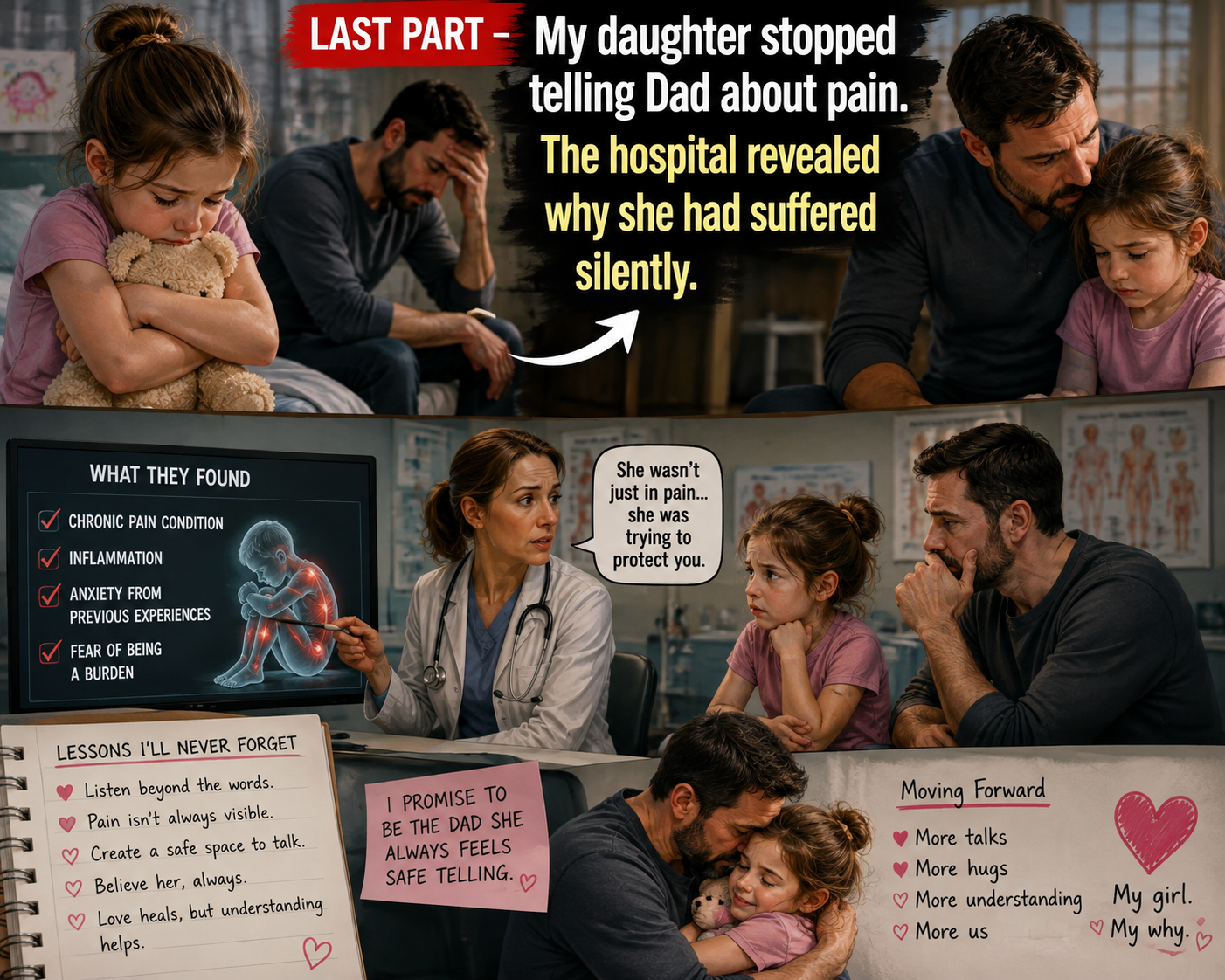
PART 2 – My daughter stopped telling Dad about pain. The hospital revealed why she had suffered silently.
PART 2 — THE SECRET HE MADE HER KEEP
For several seconds, nobody in the room moved.
My daughter’s small nod seemed to fill every inch of space between us.
The doctor lowered his eyes toward the chart, giving her a moment, but I couldn’t look away from her.
“What exactly did he say?” I asked.
My voice sounded calm.
I have no idea how.
Her chin trembled.
“He said not to tell you because you’d overreact.”
I felt something tighten in my chest.
“Overreact to what?”
She glanced at the doctor.
Then she whispered, “To them wanting more tests.”
The doctor gently closed the laptop.
“I’m going to step outside for a minute,” he said. “A nurse will be in shortly. We’re arranging the next imaging study now.”
He looked directly at me before leaving.
“We shouldn’t delay this again.”
The door clicked shut.
The second we were alone, I turned toward my daughter.
She immediately started crying.
Not loudly.
That somehow made it worse.
I pulled her against me.
“I’m sorry,” she kept saying.
“No.”
“I should’ve told you.”
“No, sweetheart.”
“I knew you would be mad.”
“At you?”
She nodded against my shoulder.
I held her tighter.
“I am not angry with you.”
“I don’t care what Dad said.”
The words came out sharper than I intended.
She flinched.
I forced myself to soften my voice.
“You were hurting. You told an adult. You went to a doctor. You did everything a fifteen-year-old girl should have had to do. None of this is your responsibility.”
She wiped her cheeks.
For the first time that afternoon, she looked directly at me.
There was something in her expression I hadn’t seen before.
Relief.
But underneath it was fear.
Not fear of the hospital.
Fear of going home.
That realization hit me harder than anything the doctor had said.
“Are you afraid of your father?”
Her eyes dropped immediately.
My heart sank.
“That’s not what I asked.”
She stared at her shoes.
“Sometimes.”
One word.
That was all it took.
I felt as though someone had quietly removed the floor beneath me.
My husband had never hit me.
He had never hit our daughter as far as I knew.
He could be impatient. Dismissive. Cold when things didn’t go according to plan.
But afraid?
I had never imagined my daughter was afraid of him.
“What happens when you tell him you’re hurting?”
She twisted the cuff of her sleeve.
“He gets irritated.”
“How irritated?”
“He says I ruin everything.”
My mouth went dry.
“What does that mean?”
She shrugged.
“He says there’s always something wrong with me. My stomach. My head. Being tired. He says other kids go to school and don’t complain all the time.”
I stared at her.
Months of memories rearranged themselves in my head.
Breakfasts she barely touched.
Mornings when she asked if she could stay home.
Evenings when my husband told her to stop being dramatic.
The time she vomited before school and he accused her of trying to avoid a math test.
The Saturday she stayed in bed until noon while he stood in the hallway telling her she was lazy.
I had defended her sometimes.
Other times, I had stayed quiet because I thought he was frustrated.
Because I thought parents disagreed.
Because I thought marriage required choosing which arguments mattered.
Now I wondered how many times my silence had sounded like agreement to my daughter.
I swallowed the guilt.
“What happened five weeks ago?”
She wiped her nose with a tissue.
“I woke up really early because it hurt so bad.”
“Why didn’t you wake me?”
“You were already at work.”
Of course.
I had covered an early shift that morning.
“Dad was home?”
She nodded.
“I told him I thought something was wrong. At first he said to take pain medicine.”
“And then?”
“I threw up.”
My fingers curled against my knees.
“He took you to the clinic after that?”
“Yes.”
“What did the doctor say?”
“They asked me questions and did some tests. Then they said they wanted another scan because they couldn’t tell exactly what was causing it.”
Her voice became quieter.
“Dad got weird after that.”
“Weird how?”
“He kept asking how much the scan would cost.”
I closed my eyes for half a second.
Money.
Of course money had been part of it.
My husband handled most of our insurance paperwork.
He complained about deductibles constantly.
But we were not destitute.
We had savings.
We had insurance.
We had options.
And even if we hadn’t, this was our child.
“What happened when you left?”
“He was angry in the car.”
“At you?”
She nodded.
“What did he say?”
“He said the doctor was covering themselves because hospitals order tests they don’t need so they can charge people.”
That sounded exactly like him.
I could hear his voice saying it.
Confident.
Annoyed.
Certain everyone else was incompetent.
“He said if I still hurt in a few days, we’d figure it out.”
“And did you still hurt?”
“Yes.”
“Did you tell him?”
“At first.”
My throat tightened.
“At first?”
“He told me I needed to stop thinking about it.”
I stared at my own hands.
“Then what?”
“After a while, I stopped telling him.”
The words from yesterday returned to me.
I stopped telling Dad when it hurts.
He says I’m just doing it for attention.
“How long have you been hiding the pain from me?”
She hesitated.
“Maybe two months.”
Two months.
Sixty days.
I had slept twenty feet away from my child while she hurt in silence.
I stood abruptly and walked toward the window because I was afraid she would see my face.
Cars moved through the hospital parking lot below.
People entered.
People left.
Everyone seemed to be living an ordinary afternoon.
Mine had stopped being ordinary.
“Mom?”
I turned.
She looked frightened again.
“I’m sorry.”
I crossed the room instantly.
“Stop apologizing.”
“I don’t want you and Dad to fight.”
“That is not something you need to worry about.”
“He’ll know I told you.”
That sentence changed everything.
Not “He’ll be mad.”
Not “He’ll argue.”
He’ll know I told you.
Like she had broken a rule.
A secret.
I sat beside her again.
“Has he asked you to keep other things from me?”
She went very still.
There it was.
A tiny change.
But I saw it.
“Sweetheart.”
“No.”
Too fast.
I took her hand.
“You don’t have to protect him.”
“I’m not.”
“You’re looking at the door.”
Her eyes filled again.
I waited.
I didn’t push.
After nearly a minute, she whispered, “Sometimes.”
My heartbeat accelerated.
“What things?”
“Just stuff.”
“What kind of stuff?”
She pulled her hand away.
“I don’t want to talk about it right now.”
Everything inside me wanted answers.
But the look on her face stopped me.
“Okay.”
She looked surprised.
“We don’t have to talk about it right now.”
“Really?”
“Really.”
Her shoulders relaxed slightly.
“But I need you to understand something.”
She looked at me.
“You never have to keep a secret because an adult tells you I’ll be upset. If something makes you scared, hurts you, or feels wrong, you tell me.”
Her lip trembled.
“Even if it’s Dad?”
“Especially if it’s Dad.”
The nurse entered before she could answer.
The next two hours became a blur of forms, bloodwork, waiting rooms, and machines.
I texted my supervisor that I wouldn’t be coming back to work.
Then I silenced my phone.
I didn’t contact my husband.
Not yet.
At 4:17 p.m., he texted me.
Where are you?
I stared at the message.
He usually didn’t get home until after six.
Why was he asking now?
Another message arrived.
School called. You signed her out.
My daughter saw my face.
“Is that Dad?”
“Yes.”
Her entire body tensed.
That reaction made my decision for me.
I locked the screen.
“You don’t have to talk to him.”
“He’ll keep calling.”
“He can call.”
Thirty seconds later, my phone rang.
My husband.
I let it ring.
He called again.
Then again.
On the fourth call, a text appeared.
What the hell is going on?
My daughter whispered, “He’s going to be furious.”
I looked at her.
“Let him.”
The words surprised both of us.
For fifteen years, my husband had been the person in our family who decided what constituted a problem.
A broken dishwasher was a problem.
A late credit card fee was a problem.
Our daughter crying because she didn’t feel well was drama.
I had adapted myself around his moods so gradually that I hadn’t noticed I was doing it.
Apparently, our daughter had too.
An hour later, the doctor returned.
This time, he wasn’t alone.
A woman wearing a hospital badge followed him inside.
She introduced herself as a patient advocate.
That frightened me immediately.
The doctor sat across from us.
“We have more information now.”
I reached for my daughter’s hand.
He explained that the imaging showed an abnormal mass in her abdomen.
The words that followed came slowly.
Location.
Inflammation.
Pressure.
Further testing.
Specialist.
Possible surgery.
I heard each word separately without being able to connect them.
My daughter squeezed my hand.
“Is it cancer?”
The doctor didn’t rush to reassure her.
“We don’t know yet.”
I hated him for that answer.
Then I respected him for it.
“We need additional testing before we can tell you exactly what we’re dealing with,” he continued. “But based on her symptoms and what we’re seeing, I want her admitted tonight.”
My daughter turned toward me.
“Tonight?”
“Yes.”
The doctor leaned forward.
“You did the right thing bringing her in.”
The sentence nearly broke me.
Because I hadn’t brought her in soon enough.
Someone else had.
Five weeks earlier.
Her father.
And then he had taken her home.
“Could five weeks have made a difference?” I asked.
The room became painfully quiet.
The doctor chose his words carefully.
“Earlier follow-up would have been preferable.”
My daughter looked down.
I knew what she heard.
Dad made this worse.
I squeezed her hand.
“This is not because of you.”
She nodded without looking up.
The patient advocate asked if she could speak with me privately.
My daughter immediately said, “I want Mom here.”
The woman smiled gently.
“That’s completely fine.”
Then she asked my daughter something I never expected.
“Do you feel safe going home with both of your parents?”
My husband had not touched us.
I wanted to say that.
I wanted to defend the version of my marriage I had believed in that morning.
Instead, I stayed silent.
My daughter stared at the floor.
“No.”
The word was barely audible.
But everyone heard it.
The woman nodded.
“Can you tell me why?”
My daughter looked at me.
“Mom’s going to hate me.”
I moved closer.
“There is nothing you can tell me that will make me hate you.”
Her face crumpled.
“Dad told me you’d leave us if you found out.”
I stopped breathing.
“Found out what?”
She started crying again.
“Sweetheart, what did he tell you I’d leave over?”
She shook her head violently.
“I can’t.”
“You can.”
“No.”
She pulled her knees toward her chest.
The patient advocate spoke softly.
“You’re not in trouble.”
My daughter stared at her.
Then she whispered something so quietly I almost missed it.
“He takes my medicine.”
I frowned.
“What medicine?”
“The pills.”
“What pills?”
“The ones the clinic gave me.”
The doctor’s expression changed.
“What pills were you prescribed?”
My daughter looked confused.
“I don’t know. Dad kept them.”
The doctor stood and walked to the computer.
He opened her previous visit.
I watched his face as he read.
“What?” I asked.
He didn’t answer immediately.
“What did they prescribe?”
He turned toward us.
“A limited prescription for pain control.”
My stomach twisted.
“Why would my husband keep her medication?”
My daughter wiped her cheeks.
“He said I didn’t need it.”
“And then what happened to it?”
She looked at me.
“He took it upstairs.”
Our bedroom was upstairs.
“What do you mean he took it upstairs?”
“I saw him with the bottle a few times.”
The patient advocate exchanged a look with the doctor.
My phone started vibrating again.
My husband.
I stared at his name glowing on the screen.
Suddenly, I didn’t recognize it.
The man calling me was the same man who had slept beside me every night.
The same man who had kissed me goodbye that morning.
The same man who had apparently known our daughter needed medical follow-up and had hidden it.
The same man who had convinced a sick fifteen-year-old girl that her mother would blame her for getting sick.
I declined the call.
Immediately, a message appeared.
I know where you are.
My blood turned cold.
A second message arrived.
Do not tell those doctors anything until I get there.
My daughter saw it.
Her face went white.
“He’s coming.”
The patient advocate stood.
“Would you like hospital security notified?”
Before I could answer, my daughter grabbed my wrist.
“Mom.”
I looked at her.
She was shaking.
“There’s something else.”
“What?”
She glanced at the door.
“I think Dad knew what the scan would show.”
The room went silent.
My mouth went dry.
“What are you talking about?”
“He kept asking the first doctor if it could be caused by medicine.”
The doctor leaned forward.
“What medicine?”
My daughter shook her head.
“I don’t know.”
“Did your father give you anything before your symptoms started?”
She hesitated.
And then I watched a memory surface across her face.
Her eyes widened.
“Oh.”
I felt my pulse pounding in my throat.
“What?”
“Those vitamins.”
“What vitamins?”
“The ones Dad started giving me.”
I stared at her.
“He gave you vitamins?”
“Every morning.”
“For how long?”
“Since winter.”
I knew nothing about vitamins.
I had never seen a bottle.
I had never watched her take them.
“Where did he keep them?”
“In his office.”
The one room in our house he always kept locked.
My daughter suddenly looked terrified.
“He told me they were for my skin.”
The doctor asked, “Do you remember what they looked like?”
“Little white capsules.”
“Any markings?”
“I don’t know.”
My phone buzzed again.
This time the message was longer.
I opened it.
Do not make this into something it isn’t. I handled it. She is fine. I’m coming upstairs and we are leaving.
My hands began trembling.
I looked at the doctor.
“She isn’t leaving.”
“No,” he said. “She isn’t.”
The patient advocate stepped into the hallway to call security.
My daughter clung to my hand.
We heard voices outside.
Footsteps.
Fast ones.
Then my husband’s voice.
“Where is my daughter?”
Every muscle in my daughter’s body tightened.
I stood between her and the door.
The handle moved.
Once.
Twice.
Then stopped.
Security must have intercepted him.
His voice rose in the hallway.
“I am her father!”
A guard answered, but I couldn’t make out the words.
My husband shouted my name.
I had heard him angry hundreds of times.
I had never heard him sound desperate.
Then he said something that made the doctor slowly turn toward me.
“You don’t understand what they’re going to find!”
Everything outside the room went quiet.
Even my husband seemed to realize what he had just said.
My daughter whispered, “Mom?”
I couldn’t answer.
The doctor crossed the room and opened the door only a few inches.
My husband was standing between two security officers.
His face was pale.
Not angry anymore.
Afraid.
The doctor stared at him.
“What exactly are we going to find?”
My husband looked past him.
Straight at me.
And for the first time in eighteen years of marriage, I saw a man who had run out of explanations.
He said my name softly.
“Please.”
That single word frightened me more than his shouting.
I stepped toward the doorway.
“Tell me.”
He shook his head.
“Not here.”
“Tell me what you gave her.”
His face changed.
My daughter began crying behind me.
My husband looked toward her.
“It wasn’t supposed to hurt her.”
Nobody moved.
I felt the blood drain from my face.
“What wasn’t supposed to hurt her?”
He opened his mouth.
But before he could answer, the doctor’s pager went off.
He glanced down.
Then his expression changed completely.
He looked at my daughter.
Then at me.
“We just received part of her bloodwork.”
My husband closed his eyes.
As if he already knew.
The doctor looked back at him.
“You need to tell me everything she’s been taking.”
My husband whispered, “I can explain.”
The doctor’s voice hardened.
“You need to explain now.”
And when my husband finally raised his eyes to mine, I understood something terrifying.
Whatever had been happening to my daughter had not started five weeks ago.
It had started inside our own house.
And my husband knew exactly why………….
TO BE CONTINUED IN PART 3…
PART 3 — WHAT HE HID IN THE LOCKED ROOM
My husband stood in the hallway between two security guards, staring at the doctor as though one wrong sentence might destroy his entire life.
Maybe it already had.
The doctor held the door open only a few inches.
“What has she been taking?”
My husband swallowed.
“They’re supplements.”
“What supplements?”
“I don’t remember the name.”
The doctor’s expression hardened.
“You gave your fifteen-year-old daughter capsules every morning for months, and you don’t remember what they were called?”
“They were safe.”
My daughter made a sound behind me.
Not quite a sob.
More like disbelief.
I turned toward her.
She was watching her father through the narrow opening in the door.
For years, she had trusted him because she was supposed to.
Children don’t begin by assuming their parents are lying.
They learn it slowly.
One broken promise at a time.
One secret at a time.
One frightened morning at a time.
“What did the bloodwork show?” I asked.
The doctor looked at me.
“There are abnormalities that suggest she may have been exposed to medication that wasn’t disclosed on her medical history.”
My husband immediately said, “That doesn’t mean anything.”
The doctor turned sharply.
“I wasn’t speaking to you.”
I had never seen anyone silence my husband that quickly.
He hated being corrected.
Especially publicly.
Normally, his jaw would tighten.
His voice would rise.
He would explain why everyone else was wrong.
This time, he said nothing.
Because he was scared.
The doctor continued.
“We need to identify exactly what she has been taking before we proceed.”
I looked at my husband.
“Tell him.”
He shook his head.
“They weren’t dangerous.”
“Then tell him what they were.”
Silence.
My daughter whispered from behind me.
“Dad.”
His eyes moved toward her.
“Sweetheart, I was trying to help you.”
She stared at him.
“With what?”
He looked away.
That was when I knew the vitamins had never been vitamins.
My daughter’s voice trembled.
“With what, Dad?”
“I didn’t want you worrying about this.”
“What?”
He rubbed both hands over his face.
“You were having problems.”
She blinked.
“What problems?”
“Your weight.”
The room went completely still.
I actually thought I had misunderstood him.
“What did you say?”
He looked at me.
“Don’t.”
“Her weight?”
“It wasn’t like that.”
My daughter’s face had gone blank.
My husband rushed to explain.
“She was complaining about feeling heavy. Bloated. Tired. She stopped wanting to go swimming. She wouldn’t wear half her clothes.”
I stared at him.
“She was sick.”
“We didn’t know that then.”
“You decided our fifteen-year-old daughter needed weight-loss pills?”
“They weren’t weight-loss pills.”
“What were they?”
“Metabolism support.”
The doctor closed his eyes for half a second.
“Where did you get them?”
My husband hesitated.
“Online.”
The doctor’s voice became very quiet.
“Do you still have the container?”
“Yes.”
“Where?”
“At home.”
My daughter spoke before anyone else could.
“In his office.”
My husband looked at her sharply.
And she flinched.
I saw it.
So did everyone else.
The patient advocate, who had returned to stand beside the door, stepped closer to my daughter.
My anger stopped feeling hot.
It became cold.
Precise.
Focused.
“You do not look at her like that.”
My husband’s eyes snapped toward me.
“What?”
“You heard me.”
“I’m not doing anything.”
“She is scared of you.”
His face changed.
“Oh, come on.”
That sentence.
That dismissive little sentence.
I had heard versions of it for eighteen years.
You’re overreacting.
You’re being dramatic.
Come on.
It was astonishing how powerful three words could become when you used them often enough.
Our whole family had learned to question ourselves before questioning him.
Not anymore.
The doctor interrupted.
“I need that container brought here.”
“I’ll go get it,” my husband said immediately.
“No.”
He stared at me.
“I said I’ll get it.”
“No.”
“Then how exactly do you expect—”
“I’ll have someone else retrieve it.”
His expression changed.
It lasted less than a second.
But I saw it.
Panic.
Real panic.
“You don’t need anyone going through my office.”
There it was.
Not our office.
Not the house.
My office.
The locked room.
The room our daughter knew the capsules came from.
The room he suddenly didn’t want anyone entering.
I stepped toward the doorway.
“What else is in there?”
“Nothing.”
“You answered too fast.”
“For God’s sake.”
“What else is in your office?”
“Work documents.”
“What else?”
“Personal things.”
“What else?”
His voice rose.
“Stop interrogating me!”
One of the security guards shifted closer.
My husband lowered his voice immediately.
The patient advocate leaned toward me.
“You don’t need to resolve this here.”
But I couldn’t stop.
For the first time, I was looking back through my marriage without the filter I had used to survive it.
The locked office.
The separate bank account.
The mail he always collected before anyone else.
The insurance statements he said were too complicated for me.
The clinic visit he had hidden.
The medicine he had taken from our daughter.
The pills he had given her.
None of these were isolated anymore.
They were connected.
And I suddenly wanted to know what the line looked like when all the dots were joined.
My husband said my name.
Softly this time.
“Please just come into the hallway and talk to me.”
“No.”
“Five minutes.”
“No.”
“We’re married.”
I almost laughed.
The words sounded absurd.
“We were married when you lied to me about her doctor’s appointment.”
“I didn’t lie.”
“You hid it.”
“She was fine.”
“She is being admitted to the hospital.”
“I didn’t know it was serious.”
“The doctor told you she needed more testing.”
“I thought they were being cautious.”
“And instead of telling me, you told our daughter to keep it secret.”
His jaw tightened.
“You were already overwhelmed.”
“That wasn’t your decision.”
“I was protecting you.”
I stared at him.
Then I looked at my daughter.
She was sitting on the edge of the bed with her arms wrapped around herself.
“You weren’t protecting me.”
He followed my gaze.
“You were protecting yourself.”
My husband said nothing.
And that silence was more honest than anything else he had said.
The doctor asked security to escort him to a nearby waiting area while the medical team continued evaluating our daughter.
My husband protested.
Of course he did.
But something had changed.
His voice no longer controlled the room.
People didn’t back away when he became angry.
They didn’t apologize.
They simply repeated the instruction.
Finally, he looked directly at me.
“Do not let strangers turn you against me.”
I didn’t answer.
The guards led him down the hallway.
My daughter waited until the sound of his voice disappeared.
Then she whispered, “Mom?”
I closed the door.
“What?”
“There are more bottles.”
I turned.
“What do you mean?”
“In his office.”
The doctor had remained beside the computer.
His attention sharpened.
“How do you know?”
My daughter pulled at the sleeves of her hoodie again.
“I went in once.”
“When?”
“Maybe three months ago.”
My husband kept his office locked whenever he wasn’t home.
But sometimes he forgot.
Apparently, one afternoon, he had left the door open while taking a shower.
My daughter had gone inside looking for the bottle of capsules because she wanted to read the label.
“What did you see?”
“A bunch of medicine.”
“How much?”
“I don’t know. Maybe twenty bottles.”
My stomach turned.
“Were they all yours?”
She shook her head.
“Some had other people’s names.”
The doctor’s expression changed.
“What names?”
“I don’t remember.”
“Were they prescription bottles?”
“I think so.”
I sat down.
My husband worked in commercial property management.
There was no legitimate reason for him to have twenty bottles of prescription medication belonging to different people.
The patient advocate asked, “Did you ever see him give medication to anyone else?”
My daughter hesitated.
“No.”
Then she changed her answer.
“Maybe.”
I looked at her.
“Maybe?”
“There was a man.”
“What man?”
“He came to the house a few times.”
“When?”
“When you worked Saturdays.”
I felt another piece fall into place.
For almost a year, I had been taking extra weekend shifts because my husband insisted we needed to rebuild our savings.
He had encouraged it.
Praised me for it.
Sometimes even packed my lunch.
And while I was gone, strangers had apparently been coming to our house.
“What did the man do?”
“I don’t know. Dad would take him into the office.”
“How many times?”
“Maybe four.”
“Did you recognize him?”
“No.”
The doctor and patient advocate exchanged another look.
I hated those looks.
Every professional in that hospital seemed to understand the seriousness of what my daughter was saying before I did.
My phone buzzed.
Another message from my husband.
Please don’t involve police.
I stared at it.
I hadn’t mentioned police.
Neither had the doctor.
Neither had the advocate.
I turned my phone toward her.
She read the message.
Then she looked at me.
“Has anyone contacted law enforcement?”
“Not that I’m aware of.”
My daughter whispered, “Why would Dad say that?”
I didn’t know.
But for the first time all afternoon, I wasn’t sure the worst secret had anything to do with her medical condition.
The doctor stepped out to speak with another specialist.
The advocate stayed with us.
My daughter was exhausted.
She lay back against the pillow.
I brushed her hair away from her forehead.
“Try to rest.”
She closed her eyes.
“I’m sorry I didn’t tell you.”
I hated hearing that sentence.
“You don’t ever need to apologize for being scared.”
“He said you wouldn’t believe me.”
The words stopped me.
“What?”
Her eyes opened.
“He said if I told you he was giving me the capsules, you’d say I was lying because you trust him more than me.”
I couldn’t breathe for a moment.
“Did you believe that?”
She didn’t answer.
Which meant yes.
I looked down at the floor because I couldn’t let her see what that did to me.
My husband hadn’t just hidden things from me.
He had studied our family carefully enough to know which fears to use against each of us.
To me, he said our daughter was dramatic.
To her, he said I wouldn’t believe her.
He had placed himself between us and convinced each of us the other was the problem.
I took her hand.
“You listen to me.”
She looked at me.
“If I have ever made you feel like I would choose anyone over you, I am sorry.”
Her eyes filled.
“I should have paid attention sooner.”
“You didn’t know.”
“I should have.”
“Mom.”
I shook my head.
“I’m going to do better now.”
Her fingers tightened around mine.
For the next hour, doctors came and went.
More blood was drawn.
Another specialist examined her.
The suspected mass, they explained, appeared to be associated with one of her ovaries.
It was large enough that surgery was increasingly likely.
But until additional tests were complete, they could not tell us exactly what it was.
My daughter asked whether she would lose her hair.
That broke something inside me.
“No one has said you need chemotherapy,” the doctor told her gently. “We’re nowhere near that conclusion.”
She nodded.
Then she asked, “Can I still have kids someday?”
The doctor paused.
“We’re going to do everything we can to protect your health and your future.”
Her lip trembled.
I climbed onto the edge of the bed beside her.
She leaned into me like she had when she was six.
For a few minutes, she wasn’t fifteen.
She was my little girl again.
At 7:42 p.m., my phone rang.
Unknown number.
Normally, I wouldn’t answer.
That night, I did.
“Hello?”
A woman said my name.
“Yes?”
“My name is Detective Mara Collins.”
My heart stopped.
I looked toward the patient advocate.
She was watching my face.
The detective continued.
“I’m at your residence.”
I stood so quickly the chair scraped against the floor.
“My residence?”
“Yes.”
My daughter sat up.
“What happened?”
I turned away slightly.
“Why are you at my house?”
“We received a request to assist with collecting medication relevant to your daughter’s treatment.”
I looked at the advocate.
She gave a small nod.
Apparently, arrangements had been made while I was focused on my daughter.
The detective continued.
“Your husband gave us permission to enter the residence.”
That surprised me.
Then came the sentence that changed everything.
“But he specifically refused consent to enter one room.”
The office.
I already knew.
“His office?”
“Yes.”
I closed my eyes.
“Is it locked?”
“Yes.”
“Did he tell you why?”
“He said it contains confidential business material.”
I almost laughed.
Of course he did.
“Detective, my daughter says the pills he gave her are inside that room.”
There was silence on the line.
“How certain is she?”
I looked at my daughter.
“Very.”
The detective’s voice changed.
“Okay.”
“What does that mean?”
“It means we’re not going to force entry without proper legal authority.”
I understood.
But I hated it.
“How long does that take?”
“I can’t give you an exact answer.”
I looked through the window at the hospital lights.
Then the detective asked something unexpected.
“Does anyone else have access to that room?”
“No.”
“Any spare key?”
“I don’t know.”
My daughter suddenly whispered, “I do.”
I turned toward her.
“What?”
She looked guilty.
“I know where he keeps one.”
The detective must have heard.
“Who said that?”
“My daughter.”
“Ask her where.”
I put the phone on speaker.
My daughter sat up.
“Dad keeps a spare key taped underneath the bottom drawer of the hallway table.”
I stared at her.
“How do you know that?”
“I saw him hide it.”
The detective said, “Do not direct anyone to enter the room right now. We’ll handle the legal side.”
My daughter nodded even though the detective couldn’t see her.
Then she added, “There’s another key.”
My heart began pounding.
“What other key?”
“In Dad’s car.”
The detective was silent.
“What does it open?”
“I don’t know.”
“What does it look like?”
“Silver. Really small.”
“Where is it kept?”
“In the center console under the rubber mat.”
I looked at her.
She seemed almost relieved to finally be telling someone everything.
The detective thanked her.
Then she asked me to stay available.
Before hanging up, she said, “One more thing.”
“Yes?”
“Your husband is not at the house.”
I frowned.
“He’s here at the hospital.”
“No.”
My stomach dropped.
“What do you mean no?”
“He left the hospital approximately twenty minutes ago.”
I turned toward the hallway.
The security guards were gone.
“When?”
“According to the information we received, he was escorted out of the patient area but was not detained.”
I stared at the closed hospital-room door.
“He left?”
“Yes.”
“Where did he go?”
“We don’t know.”
My daughter whispered, “Mom.”
She looked terrified again.
“He’s going home.”
The detective heard her.
“We have officers at the residence.”
I tried to calm my breathing.
Then she added something that didn’t help.
“But we need you to remain at the hospital.”
“I wasn’t planning to leave.”
“Good.”
The call ended.
I immediately checked my husband’s location through the family-sharing app on my phone.
Unavailable.
He had turned it off.
Another deliberate choice.
I called him.
No answer.
Again.
No answer.
On the third attempt, he declined the call.
Then a message appeared.
You made a huge mistake.
My hands went cold.
A second message followed.
Everything I did was for this family.
A third.
When you find out the truth, don’t pretend I didn’t warn you.
I showed the messages to the patient advocate.
She photographed the screen for documentation.
My daughter stared at them.
“What truth?”
“I don’t know.”
But my husband thought we were about to discover something.
Something he believed would change the meaning of everything.
At 8:16 p.m., Detective Collins called again.
This time her voice sounded different.
Controlled.
Careful.
“We found your husband.”
“Where?”
“Nearby.”
“Is he okay?”
“He’s fine.”
“Is he coming back here?”
“No.”
Something in the way she said it made me sit down.
“Detective.”
“Yes?”
“What happened?”
“We’re speaking with him now.”
“About what?”
There was a pause.
“We were able to secure the office.”
My stomach tightened.
“You went inside?”
“I can’t discuss every detail at this stage.”
“What did you find?”
Another pause.
I heard paper moving on her end.
Then she asked, “Does your husband have any medical training?”
“No.”
“Has he ever worked in a pharmacy?”
“No.”
“Hospital?”
“No.”
“Clinic?”
“No.”
“Does he have any legitimate reason to possess prescription medication belonging to multiple people?”
“No.”
My daughter was watching me.
I walked toward the bathroom door so she wouldn’t hear everything.
The detective continued.
“We located a significant quantity of medication.”
I closed my eyes.
“How much?”
“Enough that we’re going to need time to inventory it.”
“Were the capsules he gave my daughter there?”
“We found a container matching her description.”
My hand tightened around the phone.
“What was in it?”
“We don’t know yet.”
“The label?”
“There wasn’t one.”
Of course there wasn’t.
“Anything else?”
The detective went quiet.
That silence terrified me.
“Yes.”
“What?”
“We found medical paperwork.”
“For my daughter?”
“Some of it.”
Some.
“What does that mean?”
“There are records for several people.”
“What people?”
“I can’t identify them to you yet.”
My heartbeat accelerated.
“Why does my husband have other people’s medical records?”
“I don’t know.”
“Detective, please.”
“I’m telling you what I can.”
Then she asked a question I would remember for the rest of my life.
“Does the name Daniel Mercer mean anything to you?”
I froze.
It did.
Daniel Mercer had worked with my husband.
Years ago.
They had been close friends until Daniel suddenly disappeared from our lives.
My husband told me Daniel had moved to Arizona after being fired.
I hadn’t heard his name in nearly four years.
“Yes.”
“How do you know him?”
“He worked with my husband.”
“When did you last see him?”
“I don’t know. Four years ago.”
The detective was silent.
“What?”
“Nothing yet.”
“Why are you asking about Daniel?”
“We found paperwork with his name.”
“That’s it?”
Another pause.
“No.”
My stomach dropped.
“What else?”
“A photograph.”
I waited.
“What photograph?”
“It appears to show your husband and Mr. Mercer standing inside what looks like a storage facility.”
I frowned.
“So?”
“The photograph has a date printed on the back.”
I waited.
“Three months ago.”
I gripped the sink.
“That’s impossible.”
“Why?”
“Daniel moved away four years ago.”
The detective didn’t respond.
And immediately I understood.
I only knew Daniel had moved because my husband told me.
“What else did my husband tell you about Daniel?”
The detective asked.
I sank onto the closed toilet seat.
“That he was fired.”
“Why?”
“He said Daniel was stealing from the company.”
Another silence.
“Detective?”
“Yes?”
“Was that true?”
“I don’t know yet.”
She ended the call shortly afterward.
I walked back into the room.
My daughter looked exhausted.
“What happened?”
“Nothing you need to worry about tonight.”
Her expression told me she didn’t believe me.
I realized I was doing exactly what my husband had done.
Deciding what information she could handle.
So I corrected myself.
“The police found medication in Dad’s office.”
Her face fell.
“And other things they’re investigating.”
“Is Dad going to jail?”
“I don’t know.”
She looked down.
Then she whispered, “I think I know who the man was.”
My heartbeat jumped.
“What man?”
“The one who came to the house.”
I sat beside her.
“You said you didn’t recognize him.”
“I didn’t then.”
“What changed?”
“I saw a picture once.”
“Where?”
“Dad’s desk.”
She swallowed.
“It was Dad with another man.”
I already knew the answer before asking.
“Was the man Daniel?”
She looked confused.
“I don’t know his name.”
I pulled out my phone.
I still had an old company Christmas photo saved somewhere.
After searching for a minute, I found it.
My husband stood near the center.
Beside him was Daniel Mercer.
I turned the screen toward my daughter.
She stared at it.
Then her face went pale.
“That’s him.”
My stomach dropped.
“You’re sure?”
“Yes.”
“The man who came here when I worked Saturdays?”
She nodded.
“He came more than once.”
My husband had lied about Daniel for four years.
And Daniel had been secretly visiting our house.
I barely slept that night.
My daughter eventually did.
Around midnight, nurses dimmed the lights.
Machines hummed quietly.
Every few minutes, someone walked past our door.
I sat beside her bed scrolling through eighteen years of photographs on my phone.
Birthdays.
Christmases.
Vacations.
Graduations.
My husband smiling beside us.
How many secrets could exist inside one ordinary-looking family?
At 1:37 a.m., my daughter woke suddenly.
“Mom.”
“I’m here.”
“My stomach hurts.”
I called the nurse.
Within minutes, the pain intensified.
Doctors rushed in.
Her blood pressure changed.
She began vomiting.
The room transformed instantly from quiet to controlled urgency.
A surgeon arrived.
He examined her.
Then looked at me.
“We need to operate.”
My heart stopped.
“Now?”
“Now.”
“What happened?”
“We’re concerned the mass may have twisted.”
I didn’t understand all the medical words.
I understood one thing.
Waiting was no longer an option.
My daughter began crying.
“Mom, don’t leave.”
“I’m not leaving.”
They rolled her bed toward surgery.
I walked beside her until they stopped me at a set of double doors.
She held my hand until the last possible second.
“Mom.”
“What?”
“If something happens—”
“Nothing is happening.”
“But if—”
I bent over her.
“You are coming back through those doors.”
She cried.
“So don’t say goodbye to me.”
She nodded.
“I love you.”
“I love you more.”
The doors closed.
And I stood alone in the hallway.
For the first time all day, there was nothing left for me to do.
No doctors to question.
No daughter to comfort.
No husband to confront.
Just wait.
My phone rang.
Detective Collins.
I answered immediately.
“Please tell me you found out what was in those capsules.”
“We have preliminary information.”
My entire body went rigid.
“What were they?”
“They appear to contain prescription medication.”
“What kind?”
She told me.
I had never heard the name before.
“What does it do?”
“It can be used for several legitimate medical purposes.”
“Was it prescribed to my daughter?”
“No.”
“Who was it prescribed to?”
There was a pause.
“Daniel Mercer.”
I stopped breathing.
“What?”
“The original bottle we located was prescribed to Daniel Mercer.”
My mind struggled to make sense of it.
“Why would my husband give Daniel’s medication to my daughter?”
“We don’t know.”
I pressed my hand against the wall.
“But that isn’t the only problem.”
“What else?”
“The medication was dispensed more recently than you said Mr. Mercer supposedly moved away.”
I closed my eyes.
“How recently?”
“Five months ago.”
Daniel had supposedly been gone four years.
Yet prescriptions in his name had been filled five months ago.
He had visited my house three months ago.
And my husband had been giving something from Daniel’s prescription to our daughter.
None of it made sense.
Then Detective Collins said, “There’s something else you need to know.”
I almost laughed.
Every terrible sentence that day seemed to begin that way.
“What?”
“We contacted your husband’s employer.”
I waited.
“They say Daniel Mercer was never fired.”
My hand slipped against the wall.
“What?”
“He never stole from the company.”
“Then why did he leave?”
“He didn’t.”
I frowned.
“I don’t understand.”
“He still works there.”
My blood went cold.
“But my husband told me—”
“I know.”
I closed my eyes.
For four years, my husband had constructed an entire story about a man who had never actually disappeared.
“Why would he lie about that?”
“That’s what we’re trying to determine.”
The surgery doors remained closed in front of me.
I stared at them.
Then Detective Collins said something else.
“And your husband doesn’t work where you think he works either.”
My knees almost gave out.
“What?”
“He hasn’t been employed by that property-management company for more than three years.”
I sank into the nearest chair.
“That’s impossible.”
“According to the company, he resigned.”
“No.”
“He goes to work every morning.”
“I understand.”
“He has business cards.”
“I understand.”
“He gets calls.”
“I understand.”
“Then where has he been going?”
“We’re investigating that.”
I pressed my fingers against my forehead.
Three years.
For three years, my husband had put on a suit, kissed me goodbye, carried a briefcase out our front door, and pretended to go to a job he did not have.
Suddenly the Saturday shifts made sense.
The pressure about money.
The private office.
The locked door.
The mysterious visitors.
The bottles.
The secrets.
I whispered, “Who is my husband?”
Detective Collins didn’t answer.
Because she didn’t know.
And apparently neither did I.
At 3:06 a.m., the surgeon finally came through the double doors.
I stood.
“How is she?”
“She’s stable.”
My legs nearly collapsed with relief.
The surgeon continued.
“We were able to address the immediate problem.”
I covered my mouth.
“Is the mass cancer?”
“We’ve sent tissue for testing. We don’t have that answer yet.”
I nodded.
“Can I see her?”
“Soon.”
Then his expression changed slightly.
“There is something I need to ask you first.”
My heart began pounding again.
“What?”
“Has your daughter ever had abdominal surgery before?”
“No.”
“Are you certain?”
“Yes.”
He studied my face.
“Why?”
The surgeon looked toward another doctor standing behind him.
Then back at me.
“Because we found evidence suggesting a previous procedure.”
I stared at him.
“That’s impossible.”
“That’s why I’m asking.”
“She has never had surgery.”
Not while I knew about it.
The thought entered my mind before I could stop it.
Not while I knew about it.
“When?” I whispered.
“We can’t determine that precisely tonight.”
“What kind of procedure?”
“We need to review everything carefully before drawing conclusions.”
I suddenly felt sick.
“My husband took her to that clinic five weeks ago.”
The surgeon nodded.
“Yes.”
“But you think something happened before that?”
“It’s possible.”
I gripped the back of the chair.
Then my daughter’s earlier words returned.
Dad told me you’d leave us if you found out.
Found out what?
Not the vitamins.
Not the hidden doctor visit.
Something else.
Something she still hadn’t told me.
At 3:18 a.m., Detective Collins called again.
I almost ignored it.
But I answered.
“Mrs. Bennett?”
“Yes.”
“We opened a locked filing cabinet in your husband’s office.”
My mouth went dry.
“What was inside?”
“Financial records.”
I waited.
“Medical records.”
My heart pounded.
“And several photographs.”
“What photographs?”
She hesitated.
“Your daughter.”
My fingers went numb.
“What kind of photographs?”
“Mostly ordinary photographs.”
“Mostly?”
“School pictures. Family pictures. Some appear to have been taken without her knowing.”
The hallway seemed to tilt.
“What do you mean?”
“Nothing inappropriate.”
I breathed again.
“But they were organized chronologically.”
“For what?”
“We don’t know.”
Then she said, “There was also an envelope.”
“What envelope?”
“Your name was written on it.”
My heart stopped.
“My name?”
“Yes.”
“What was inside?”
She went silent.
“Detective.”
“A letter.”
“From my husband?”
“No.”
My pulse hammered.
“Then from who?”
She took a breath.
“Daniel Mercer.”
I could barely speak.
“What does it say?”
“I think you should read it yourself.”
“Why?”
“Because the first line is addressed directly to you.”
“What does it say?”
Another long pause.
Then Detective Collins read only the first sentence.
“If you are reading this, then Mark finally ran out of ways to keep you from learning what happened to your daughter.”
I stopped breathing.
The surgeon was still standing twenty feet away.
My daughter was still unconscious after emergency surgery.
My husband was being questioned somewhere across town.
And a man I had been told disappeared four years ago had left a letter inside my husband’s locked office.
A letter for me.
About my daughter.
I whispered into the phone.
“Bring it to me.”
Detective Collins answered carefully.
“We will.”
Then she added, “But there’s something handwritten on the outside of the envelope.”
“What?”
Three words.
Three words that made everything I thought I understood about the last four years collapse.
The detective read them slowly.
“ASK HER ABOUT MAY.”
I closed my eyes.
May.
My daughter’s name wasn’t May.
Mine wasn’t May.
No one in our family was named May.
Then I remembered.
Four years earlier, there had been one month my daughter barely remembered.
A month after she fell during a school field trip.
A month when my husband took over all of her medical appointments because I was away caring for my dying mother.
The month had been May.
And suddenly I knew exactly what I needed to ask my daughter when she woke up.
Not what Dad gave you.
Not what Dad hid.
But what happened to you in May?……………..
TO BE CONTINUED IN PART 4…
PART 4 — WHAT HAPPENED IN MAY
I stood outside the recovery unit with Detective Collins’s words burning through my head.
ASK HER ABOUT MAY.
Four years earlier, my daughter had been eleven.
I had spent almost three weeks in another state caring for my mother during the final stage of her illness.
My husband had stayed home with our daughter.
At the time, I had been grateful.
He sent me photographs.
He reminded her to call me every night.
He told me not to worry about anything at home.
“You take care of your mom,” he had said. “I’ve got everything here.”
For four years, I had remembered that sentence as kindness.
Now it sounded like an alibi.
I opened the photo app on my phone and searched by date.
May.
Hundreds of images appeared.
My mother in a hospital bed.
Flowers on a windowsill.
Airport coffee.
My daughter smiling during video calls.
Then something strange.
There were almost no pictures of her during the second half of the month.
My husband usually photographed everything.
Breakfast.
Soccer practice.
Movie night.
Even ridiculous things like a crooked pancake or a squirrel on the porch.
But between May 14 and May 26, there were only three photographs.
In all three, my daughter was lying down.
One showed her sleeping on the couch under a blanket.
Another showed her watching television with a heating pad over her stomach.
The last showed her sitting at the kitchen table wearing one of my husband’s oversized sweatshirts.
I zoomed in.
Her face looked pale.
I remembered asking about it.
He told me she had caught a stomach virus.
I had believed him.
Why wouldn’t I?
He was her father.
The recovery-room doors opened.
A nurse stepped toward me.
“Your daughter is awake.”
Everything else disappeared.
I followed her inside.
My daughter looked impossibly small against the hospital sheets.
There was an IV in her arm and exhaustion in her face, but when she saw me, she managed a weak smile.
“Mom.”
I nearly cried just hearing her voice.
I sat beside her and took her hand.
“How do you feel?”
“Like somebody kicked me.”
“That sounds about right.”
She gave the tiniest laugh.
Then her expression changed.
“Did they get it out?”
“The surgeon took care of the emergency problem. They’re testing everything else.”
“Am I okay?”
The question cut through me.
“You’re here.”
I brushed her hair back.
“You’re talking to me. We’re going to handle the rest one thing at a time.”
She nodded.
Then she looked toward the door.
“Is Dad here?”
“No.”
“Where is he?”
“The police are talking to him.”
She stared at me.
“Because of the pills?”
“Because of several things.”
Her eyes dropped.
I knew I needed to ask.
But I also knew she had just come out of surgery.
There was no good moment for a question like this.
Only necessary ones.
“Sweetheart.”
She looked at me.
“Do you remember when Grandma got sick four years ago?”
She nodded slowly.
“I went to stay with her.”
“Yeah.”
“You stayed home with Dad.”
Another nod.
“What happened that May?”
Her entire body went still.
Not confused.
Not curious.
Still.
I felt my heartbeat change.
“What do you mean?”
“I need you to tell me what you remember.”
“Why?”
“Someone told me to ask.”
Her eyes filled immediately.
That was my answer before she said a word.
“You remember something.”
She turned her face toward the window.
“I don’t want to.”
I squeezed her hand.
“You don’t have to tell me everything right this second.”
She swallowed.
“But I need to know if something happened to you.”
Her voice came out thin.
“I got sick.”
“Dad told me you had a stomach virus.”
“That’s what he said.”
“What do you remember?”
She closed her eyes.
“I fell.”
“On the field trip?”
Her eyes opened.
“How do you know?”
“You told me you fell.”
“I don’t remember telling you.”
My stomach tightened.
“Dad told me.”
She stared at me.
I continued carefully.
“He said you slipped near a creek during your school field trip and bruised your side.”
She shook her head.
“That’s not what happened.”
I stopped breathing.
“What happened?”
“I didn’t fall.”
The room seemed to shrink around us.
“Then why did Dad tell me you did?”
“I don’t know.”
“What happened to your stomach?”
She looked down at the hospital blanket.
“I woke up hurting.”
“Where?”
“At home.”
“When?”
“I don’t know.”
“Before or after the field trip?”
“I didn’t go on the field trip.”
I stared at her.
“Yes, you did.”
“No.”
“Sweetheart, Dad sent me a picture of you wearing your school shirt that morning.”
“I got dressed.”
“But?”
“He told the school I was sick.”
Every memory I had of that week began breaking apart.
“Why?”
She started twisting the blanket between her fingers.
“He said we had an appointment.”
“What appointment?”
“I don’t know.”
“Doctor?”
“I think.”
“Where?”
She shook her head.
“It wasn’t our normal doctor.”
I felt cold.
“What do you remember about the place?”
“Not much.”
“Try.”
She closed her eyes.
“A parking garage.”
“Okay.”
“A hallway.”
“Okay.”
“No windows.”
My pulse accelerated.
“Hospital?”
“I don’t think so.”
“Clinic?”
“Maybe.”
“Did you see a doctor?”
“There was a woman.”
“Did she wear scrubs?”
“Yes.”
“Anyone else?”
“A man.”
“What man?”
“I don’t know.”
“Was it Daniel?”
Her eyes opened.
“Who?”
“The man from Dad’s old work.”
I pulled up the photograph again.
She studied it.
“No.”
My stomach turned.
“Someone different?”
“Yes.”
“What happened at the appointment?”
She began breathing faster.
I immediately stopped.
“We can leave this.”
“No.”
“You don’t have to force yourself.”
“I want to remember.”
Those words frightened me almost as much as everything else.
She stared at the ceiling.
“They asked me questions.”
“What questions?”
“If I had started my period.”
I waited.
“If I had stomach pain.”
“What else?”
“If I had ever fainted.”
“Okay.”
“And then Dad left the room.”
That surprised me.
“What happened after he left?”
“The woman gave me something.”
“What?”
“A drink.”
“What kind?”
“I don’t remember.”
“Did she tell you what it was?”
“She said it would help me relax.”
My throat tightened.
“What happened after you drank it?”
“I got sleepy.”
My fingers went numb.
“Then?”
“I don’t know.”
“Nothing?”
“I remember waking up.”
“Where?”
“In another room.”
“Were you in pain?”
She nodded.
“Really bad.”
I felt tears pushing behind my eyes.
“Did anyone tell you what happened?”
“Dad said they did a test.”
“What test?”
“He never explained.”
“Did you have stitches?”
“I don’t know.”
“A bandage?”
She stared at me.
Then slowly, she nodded.
“Where?”
Her hand moved toward her lower abdomen.
Exactly where the surgeon had noticed evidence of an old procedure.
I covered my mouth.
My daughter started crying.
“I thought it was normal.”
“No.”
“He said they had to make a tiny cut to look inside because the scan wasn’t clear.”
“Did you tell me?”
“He told me you already knew.”
I stood because I suddenly couldn’t sit still.
“He told you I knew?”
“Yes.”
“He said you were upset because Grandma was dying and you didn’t want to talk about it.”
I turned away.
For years, I had carried guilt because I believed I had missed a simple stomach virus while my mother was dying.
Now I realized my husband had used the worst period of my life as cover.
I turned back.
“Did you speak to me afterward?”
“You called.”
“I called every night.”
“I know.”
“Why didn’t you say anything?”
“Dad said you didn’t want to hear about medical stuff because you were already dealing with Grandma.”
I closed my eyes.
There it was again.
He had told each of us what the other supposedly wanted.
And we had believed him.
“Do you remember how many days you were sick?”
“Maybe a week.”
“Did you go to school?”
“Not for a few days.”
“Dad told me school was closed for teacher training.”
She looked at me.
“No, it wasn’t.”
I almost laughed from sheer horror.
Lie after lie.
Small enough individually to sound harmless.
Together, they created an entire alternate reality.
The nurse entered to check her vitals.
I forced myself to stop asking questions.
My daughter needed rest.
But before the nurse left, my daughter touched my arm.
“There’s one more thing.”
I looked at her.
“What?”
“Dad made me sign something.”
My chest tightened.
“What?”
“At the clinic.”
“What did you sign?”
“I don’t know.”
“You were eleven.”
“I know.”
“What did the paper say?”
“I didn’t read it.”
“Why did you sign?”
“He told me it was just permission for the test.”
“Did anyone else sign?”
“Dad.”
The nurse looked at me.
Her expression said she was listening.
I asked, “Do you remember the clinic’s name?”
My daughter frowned.
“No.”
“Anything on the wall? A logo? A sign?”
She thought for several seconds.
“There was a blue bird.”
“A blue bird?”
“Like a little bird inside a circle.”
That was something.
I wrote it down.
Then my daughter whispered, “And there was a number.”
“What number?”
“Seven.”
I waited.
“That’s it?”
“It was on the door.”
Room seven.
Suite seven.
Floor seven.
It could mean anything.
But it was more than we had five minutes earlier.
The nurse gently suggested my daughter sleep.
I agreed.
Within fifteen minutes, the medication pulled her under.
I stepped into the hallway and called Detective Collins.
She answered immediately.
“I need to tell you something.”
“What happened?”
“My daughter remembers a medical procedure four years ago.”
The detective went quiet.
“What kind?”
“She doesn’t know.”
I explained everything.
The appointment.
The drink.
The sedation.
The pain.
The bandage.
The document she was told to sign.
The blue bird.
The number seven.
When I finished, Detective Collins said, “I need you to repeat one detail.”
“Which?”
“You said your husband told her you knew about the procedure?”
“Yes.”
“But you did not?”
“No.”
“And she was eleven?”
“Yes.”
Another pause.
“We’re going to check medical billing records.”
“My husband handled insurance.”
“I know.”
I pressed my hand against my forehead.
“What exactly are you thinking?”
“I’m trying not to think anything until we have evidence.”
I hated that answer.
“Did you read Daniel’s letter?”
“We’ve documented it.”
“And?”
“We need to speak in person.”
My stomach dropped.
“Why?”
“Because the letter names people.”
“What people?”
“One appears to be a physician.”
I gripped the phone.
“The man who performed the procedure?”
“Possibly.”
“What’s his name?”
“I’d rather tell you in person.”
“Detective, please.”
She hesitated.
“Dr. Elias Voss.”
I repeated the name silently.
It meant nothing to me.
“Do you know him?”
“No.”
“Are you certain?”
“Yes.”
“We’re checking him now.”
“What does Daniel’s letter say happened to my daughter?”
Another pause.
“He doesn’t say directly.”
I nearly shouted.
“Then what does he say?”
“He says your husband became involved with a private clinic through a man named Voss.”
“Involved how?”
“That’s part of what we’re trying to establish.”
“What does that have to do with Daniel?”
“According to the letter, Daniel discovered irregularities in medical billing and prescriptions connected to your husband.”
I leaned against the wall.
“Billing?”
“Yes.”
“Was my husband stealing medicine?”
“We don’t know yet.”
“But he had Daniel’s prescription.”
“Yes.”
“Did Daniel know?”
“According to the letter, eventually.”
“Eventually?”
“He believed your husband was using employee information to obtain medication.”
My stomach turned.
“From people he worked with?”
“That’s one possibility.”
“And my daughter?”
“The letter says Daniel confronted your husband after realizing your daughter had been brought to Voss’s clinic.”
I went completely still.
“He knew?”
“Yes.”
“When?”
“Four years ago.”
“Then why didn’t he tell me?”
The question came out harsher than I intended.
The detective sighed softly.
“According to the letter, he tried.”
My heart stopped.
“What?”
“He says he called you.”
“No.”
“He says your husband answered your phone.”
I remembered.
During my mother’s final week, I barely slept.
I often left my phone charging in the family waiting room while sitting beside her.
My husband knew my passcode.
“He says he emailed you too.”
“I never saw anything.”
“He believed your husband intercepted it.”
I closed my eyes.
“What did Daniel do after that?”
“He says your husband threatened him.”
“With what?”
“Professional consequences. Legal accusations. And something involving Daniel’s son.”
“What?”
“We’re still clarifying that.”
I suddenly remembered my husband telling me Daniel had stolen from work.
Perhaps the accusation had never existed.
Perhaps it had been leverage.
“Where is Daniel now?”
“We’re trying to locate him.”
“He still works at the company.”
“He does.”
“So call him.”
“We have.”
“And?”
“He hasn’t answered.”
That frightened me.
“When did anyone last see him?”
“We’re checking.”
I looked toward my daughter’s room.
“Detective, was Daniel the one who put the letter in my husband’s office?”
“We don’t know.”
“Then why would my husband keep it?”
“Good question.”
That was what bothered me too.
If the letter could expose him, why store it?
Unless my husband had never known it was there.
“Was the envelope opened?”
I asked.
The detective paused.
“No.”
My pulse quickened.
“So Mark never read it.”
“Possibly.”
“Where was it found?”
“Inside a folder in the locked cabinet.”
“What folder?”
Another pause.
“Your daughter’s name was on it.”
I closed my eyes.
Daniel may have hidden the letter there because he knew eventually someone would search the records.
Or perhaps someone else had.
Before I could ask more, Detective Collins said, “I’m heading back to the hospital.”
The call ended.
At 4:11 a.m., the hospital hallway was almost silent.
I sat in a plastic chair drinking coffee that tasted like warm cardboard.
I searched Dr. Elias Voss on my phone.
There were almost no recent results.
An old medical-directory listing.
A business registration.
A disciplinary notice from years earlier that I couldn’t fully access.
Then I found an archived article.
PRIVATE WELLNESS CLINIC CLOSES AFTER BILLING INVESTIGATION.
The article was six years old.
The clinic name was Meridian Wellness Center.
I clicked the cached image.
And froze.
Its logo was a blue bird inside a circle.
I nearly dropped my phone.
My daughter had remembered correctly.
Meridian Wellness Center.
I searched the address.
The old location was forty minutes from our house.
The building was now occupied by a dental office and two accounting firms.
I searched images.
One photograph showed the clinic’s hallway.
Doors lined each side.
Near the end was a small plaque.
SUITE 7.
My hands began shaking.
I called Detective Collins again.
“I found it.”
“What?”
“The clinic.”
I gave her the name.
She was silent for several seconds.
“How?”
“The logo. My daughter remembered a blue bird. Meridian had one.”
“I’m looking it up now.”
“There was a Suite 7.”
Another pause.
Then the detective said, “Do not contact anyone connected with that clinic.”
“I wasn’t planning to.”
“Do not visit the address.”
“I won’t.”
Her tone worried me.
“What did you find?”
“Voss worked there.”
My heart pounded.
“Then that’s where Mark took her.”
“It appears possible.”
“Why was the clinic investigated?”
“Billing irregularities.”
“Was Voss charged?”
“Not from what I can see immediately.”
I searched again.
“Why did it close?”
“We’ll determine that.”
Then Detective Collins said, “I need to call someone.”
She hung up.
I returned to my daughter’s bedside.
She was sleeping.
I watched her chest rise and fall.
Eleven years old.
Sedated in a clinic while I sat beside my dying mother believing her father was protecting her.
I felt rage so deep it became strangely quiet.
I didn’t want revenge.
I wanted truth.
All of it.
No matter what it did to my marriage.
No matter what it did to the life I thought we had.
At 5:03 a.m., Detective Collins arrived.
She carried a large evidence envelope.
I met her in a family consultation room.
She sat across from me.
“You look exhausted.”
“I’m fine.”
“You’re not.”
“I’ll fall apart later.”
She didn’t argue.
She placed the evidence envelope on the table.
Inside was a copy of Daniel’s letter.
My hands trembled when I unfolded it.
The first line was exactly what the detective had read.
If you are reading this, then Mark finally ran out of ways to keep you from learning what happened to your daughter.
I continued.
Daniel wrote that four years earlier, he had become suspicious after my husband repeatedly asked coworkers for copies of insurance cards under the excuse of updating company benefits.
Daniel later discovered prescriptions in his name that he did not recognize.
When he confronted my husband, Mark claimed it was an administrative error.
Daniel didn’t believe him.
He began keeping records.
Then one afternoon, he followed my husband.
Straight to Meridian Wellness Center.
My chest tightened.
Daniel had seen my daughter enter with him.
He recognized her.
Later, he asked Mark why he had taken her there.
My husband reportedly told him to mind his own business.
Daniel wrote that he became frightened when he learned Voss was performing procedures and writing prescriptions through channels that did not always appear in ordinary medical systems.
Then came a line I had to read three times.
I don’t know exactly what Voss did to her, but Mark was terrified afterward.
I stopped.
“Terrified?”
Detective Collins nodded.
“Keep reading.”
Daniel wrote that the day after the procedure, my husband called him.
Mark needed help.
He said there had been a complication.
Daniel refused to get involved.
Then Mark threatened him.
The letter described months of conflict.
Accusations.
Threats.
Money.
Medication.
And one sentence that made my stomach turn.
Mark said the procedure had been necessary because “the test proved she carried the same problem.”
I looked up.
“What problem?”
“That’s what we’re trying to determine,” Detective Collins said.
I kept reading.
Daniel wrote that he believed my husband had taken our daughter to Voss for testing because of something in Mark’s own medical history.
But Daniel didn’t know what.
He only knew that Mark repeatedly used one phrase.
“She can never know what she inherited.”
I felt cold from head to toe.
“Inherited?”
Detective Collins leaned forward.
“Does your husband have any known genetic condition?”
“No.”
“Any major childhood illness?”
“Not that he ever told me.”
“Family history?”
“His father died before we met. His mother died when our daughter was a baby.”
“Cause?”
“His father supposedly had a heart attack. His mother had cancer.”
“What kind?”
“I don’t remember.”
The detective wrote something down.
I returned to the letter.
Near the end, Daniel wrote that he had tried to collect enough proof to protect himself before confronting me directly.
Then Mark discovered what he was doing.
Daniel moved some documents.
He hid others.
The letter ended with an apology.
I should have told you sooner. I convinced myself I needed proof first. By the time I had proof, I was afraid of what Mark would do. If you ever find this, look at the May records. And do not believe anything Mark tells you about why she was taken there.
I lowered the paper.
My hands wouldn’t stop shaking.
“What May records?”
“We found a folder.”
Detective Collins pulled out several photocopies.
The first looked like an invoice.
Meridian Wellness Center.
Patient initials only.
But the date matched the week my daughter remembered.
The second was a laboratory report.
Most of the terminology meant nothing to me.
One phrase stood out.
GENETIC MARKER PANEL.
I stared at it.
“What were they testing her for?”
“We don’t know yet.”
“There has to be a name.”
“There are codes. We’re having someone review them.”
The next sheet was handwritten.
M.B. positive.
Repeat sample confirmed.
Discuss with father only.
My blood ran cold.
“Discuss with father only.”
Detective Collins nodded.
“Your daughter’s initials match.”
I could barely speak.
“What was positive?”
“We’re working on that.”
Then she showed me another page.
This one looked like a consent form.
At the bottom was my daughter’s childish signature.
And beneath it was another signature.
Mine.
Except I hadn’t signed it.
I knew my signature.
That wasn’t mine.
It was close.
Very close.
But the loop on the first letter was wrong.
The angle of the last stroke was wrong.
Someone had forged my name.
I looked at the detective.
“I didn’t sign this.”
“We suspected that.”
“Mark?”
“We’ll need handwriting comparison.”
“He forged my consent for a procedure on my eleven-year-old daughter.”
“We need to establish who signed it.”
“He did.”
“I understand why you believe that.”
I pushed the paper away.
“What kind of procedure?”
The detective turned over the next page.
There it was.
Laparoscopic tissue sampling.
I stared at the words.
“They cut into my child to take tissue?”
“According to this document.”
“Why?”
“The stated reason is diagnostic confirmation.”
“Confirmation of what?”
“The diagnosis field is coded.”
I felt like screaming.
“Can no one tell me what this means?”
“We have someone coming.”
“Who?”
“A physician familiar with these records.”
I looked toward the door.
“When?”
“He’s already on his way.”
At 5:46 a.m., a hospital specialist entered the consultation room.
His name was Dr. Shah.
He carried copies of the records.
He explained immediately that some of the old clinic’s methods and terminology were unusual.
Then he pointed toward the laboratory codes.
“These appear to reference hereditary tumor-risk markers.”
My stomach dropped.
“Cancer?”
“Risk markers. Not necessarily cancer itself.”
“What does that mean for my daughter?”
“We need proper testing through accredited labs before making any conclusion.”
“Why would someone take tissue from an eleven-year-old?”
His expression tightened.
“Based only on these papers, I can’t justify why this procedure was done the way it was.”
“Was it medically necessary?”
“I don’t have enough information to say.”
I leaned forward.
“What were they looking for?”
He studied the page.
“One possibility is a hereditary syndrome associated with certain tumors.”
My mind immediately went to the mass they had just removed.
“Her current mass?”
“We don’t know if they are related.”
“But they could be.”
“Yes.”
I closed my eyes.
My husband may have known for four years that our daughter had an elevated medical risk.
He may have hidden it.
Then he dismissed her symptoms when those symptoms appeared.
I opened my eyes.
“If Mark knew she had this risk, why would he ignore her pain?”
Nobody answered.
That was the question I couldn’t understand.
Even if he had done everything else wrong, why would a father who knew his daughter might be vulnerable refuse follow-up when she became sick?
Unless follow-up threatened to expose something.
I looked at Dr. Shah.
“Would a normal doctor be able to see that she had undergone this earlier test?”
“Not necessarily if the clinic didn’t properly share records.”
“And if she went through regular imaging now?”
“Depending on what was done previously, it might raise questions.”
That was it.
The five-week-old clinic visit.
The recommendation for imaging.
My husband hadn’t simply wanted to save money.
He had been terrified more testing would reveal evidence of the old procedure.
I felt sick.
“He didn’t ignore the scan because he thought it was unnecessary.”
Detective Collins watched me.
“He ignored it because he was afraid someone would discover what happened four years ago.”
Nobody contradicted me.
At 6:10 a.m., my phone buzzed.
A number I didn’t recognize.
I almost ignored it.
Then a text appeared.
You don’t know me. My name is Daniel Mercer. Detective Collins told me you were looking for me.
I stared at the screen.
“He contacted me.”
The detective stood immediately.
“Don’t answer yet.”
Another message arrived.
I’m sorry.
Then another.
I should have told you four years ago.
Detective Collins took out her phone.
“We’ve been trying to reach him.”
My phone rang.
Daniel.
The detective nodded.
“Answer. Put it on speaker.”
I did.
“Hello?”
A man’s voice came through.
Older than I remembered.
Tired.
“Is this Claire?”
“Yes.”
There was a long silence.
“Daniel?”
“Yes.”
“Where are you?”
“I’m safe.”
“That isn’t what I asked.”
“I’m at my sister’s house.”
Detective Collins leaned toward the phone.
“Mr. Mercer, this is Detective Collins.”
“I know.”
“We need to speak with you in person.”
“I will.”
“When?”
“Today.”
My anger exploded.
“No.”
Both of them went quiet.
“You’re going to talk to me now.”
“Claire—”
“My daughter just had emergency surgery.”
Silence.
“My husband lied to me about you for four years.”
“I know.”
“You wrote a letter telling me something happened to her.”
“I know.”
“What did he do?”
Daniel breathed heavily.
“I don’t know everything.”
“Tell me what you do know.”
“He found out something about himself.”
“What?”
“I never saw the original results.”
“What results?”
“A genetic test.”
My heartbeat pounded.
“When?”
“About five years ago.”
“Why was Mark tested?”
“I don’t know.”
Daniel sounded genuinely uncertain.
“He started meeting Voss around then.”
“Why?”
“Voss was helping him with prescriptions.”
“What prescriptions?”
“Pain medication at first.”
My mouth went dry.
My husband always complained about his back.
I had never known he had a serious prescription problem.
Daniel continued.
“Then it became other things.”
“Was Mark selling them?”
“I think so.”
Detective Collins interrupted.
“Think or know?”
“I saw money. I saw bottles. I saw people meeting him. I never watched a sale happen.”
“Continue,” I said.
Daniel sighed.
“Mark got a genetic test through Voss.”
“And?”
“After that, he changed.”
“How?”
“Obsessed.”
“With what?”
“Whether your daughter had the same thing.”
I felt the room tilt.
“What thing?”
“I don’t know the medical name.”
“Try.”
“He called it a mutation.”
Dr. Shah looked up sharply.
“What kind?”
Daniel hesitated.
“Something that could cause tumors.”
My stomach dropped.
Daniel continued.
“Mark was terrified it came from him.”
“Why would that matter?”
“He said if Claire found out, she’d blame him.”
I stared at the phone.
That sounded like my husband.
Not fear for his daughter.
Fear of being blamed.
“What did he do?”
“He had Voss test her secretly.”
“Why secretly?”
“Because Claire was out of town and Mark said she would never agree.”
My eyes filled with tears.
Daniel continued.
“The first test was positive.”
Dr. Shah leaned closer.
“For what?”
“I don’t know.”
“Then why the procedure?”
“Voss said they needed tissue to confirm something.”
“Did they?”
“I don’t know.”
I gripped the edge of the table.
“What happened afterward?”
Daniel’s voice became quieter.
“There was bleeding.”
My heart stopped.
“What?”
“Not severe enough for a hospital, according to Mark.”
“According to Mark?”
“He called me because he panicked.”
“Why did he call you?”
“I was the only person who knew he was involved with Voss.”
“What did he want?”
“Help getting supplies.”
“What supplies?”
“Medication. Bandages. Things like that.”
I felt physically ill.
“My daughter had a surgical complication at home?”
“I think so.”
“And instead of taking her to a hospital—”
“He was afraid.”
“Of what?”
“Questions.”
There it was.
Again.
My husband had repeatedly chosen secrecy over our daughter’s health.
Four years ago.
Five weeks ago.
Maybe every day in between.
Daniel continued.
“I told him to take her to the ER.”
“Did he?”
“No.”
“How do you know?”
“He called me the next day and said she was better.”
I covered my face.
Eleven years old.
Hurting in our house.
Her mother a thousand miles away.
Her father more frightened of being exposed than of losing her.
I wanted to hang up.
I wanted to scream.
Instead, I asked the only question that mattered.
“Why didn’t you tell me?”
Daniel was silent for a long time.
“Because I was a coward.”
I didn’t answer.
“He threatened to frame me for stealing medication.”
“That’s why he told me you were fired.”
“Yes.”
“You weren’t fired.”
“No.”
“He told me you moved to Arizona.”
“I know.”
“Why?”
“To keep you from contacting me.”
I closed my eyes.
Daniel continued.
“He said if I went near you, he would make sure I lost my job and my son.”
“What did your son have to do with it?”
“My son was going through a custody battle. Mark had documents. Messages. He knew enough to make trouble.”
“So you stayed quiet.”
“Yes.”
“For four years.”
“Yes.”
“And meanwhile my daughter—”
“I know.”
“No, you don’t.”
My voice cracked.
“You got to know the secret. She had to live inside it.”
Daniel said nothing.
Eventually, he whispered, “You’re right.”
The room fell silent.
Then Dr. Shah asked, “Mr. Mercer, did you ever hear Mark mention the exact genetic marker?”
Daniel hesitated.
“Maybe.”
“Think.”
“There was a number.”
My pulse jumped.
“What number?”
“Forty-seven?”
Dr. Shah shook his head.
“That doesn’t help.”
“No. Wait.”
Daniel inhaled sharply.
“TP.”
Dr. Shah went still.
“TP what?”
“TP fifty-three.”
The doctor’s expression changed completely.
Detective Collins noticed.
“What?”
Dr. Shah looked at me.
“TP53.”
“What is that?”
He chose his words carefully.
“It’s a gene involved in controlling cell growth.”
“And a mutation?”
“Certain inherited mutations can significantly increase the risk of several cancers.”
The room became very quiet.
I thought about my husband’s father dying young.
His mother developing cancer.
My daughter’s current mass.
“Could this be what they tested?”
“It’s possible.”
“Can we find out?”
“Yes. Properly.”
I looked at Detective Collins.
“Then test her.”
“We’ll coordinate with her medical team,” Dr. Shah said.
Daniel spoke from the phone.
“There’s more.”
Every nerve in my body tightened.
“What?”
“Mark wasn’t only worried she inherited it.”
“What else?”
“He thought proving she had it could help him.”
“Help him how?”
Daniel didn’t answer.
“Daniel.”
“Money.”
I stared at the phone.
“What money?”
“Insurance.”
Detective Collins leaned forward.
“What kind of insurance?”
Daniel’s breathing became audible.
“I don’t know everything.”
“Tell us what you know.”
“Mark took out a policy.”
My blood went cold.
“On who?”
Silence.
My voice became a whisper.
“Daniel.”
“Your daughter.”
Nobody moved.
I felt as if someone had punched me.
“A life insurance policy?”
“Yes.”
“When?”
“Around the time of the testing.”
“How much?”
“I don’t know.”
“Tell me.”
“I heard him say two million.”
I stood so quickly the chair fell backward.
“No.”
“Claire—”
“No.”
Detective Collins raised a hand.
“Mr. Mercer, do you have proof?”
“I saw paperwork once.”
“Where?”
“Mark’s office.”
“Was it among the records you hid?”
“No.”
“Do you know the insurance company?”
“I think Heritage Mutual.”
Detective Collins was already writing.
I walked toward the wall.
My daughter was eleven when my husband secretly had her tested for a potentially serious hereditary condition.
Then he took out a large insurance policy on her.
The thought was so ugly my mind rejected it.
“No.”
Daniel said my name.
“Don’t.”
“I’m sorry.”
“Don’t say that.”
I turned toward the phone.
“Did he hurt her on purpose?”
Daniel immediately answered.
“I don’t know.”
That was somehow worse.
“Did he give her those pills on purpose to make her sick?”
“I don’t know.”
“Did he know they could hurt her?”
“I don’t know.”
“Then what exactly do you know?”
“That Mark became obsessed with controlling everything connected to her medical history.”
“Why?”
“I think because once he took that policy out, every record mattered.”
Detective Collins interrupted.
“Why would an insurer issue a two-million-dollar policy on a child?”
“I don’t know the details. It may not be exactly what I thought.”
At least someone finally said that.
I forced myself to breathe.
We had fragments.
Terrible fragments.
But not yet the whole truth.
Detective Collins ended the call after arranging to meet Daniel.
Then she looked at me.
“We need to verify the insurance claim before assuming what it means.”
“I know.”
But my hands were shaking.
At 7:02 a.m., she received a call.
She stepped into the hallway.
Five minutes later, she returned.
Her face told me something had changed.
“What?”
“We located a policy.”
I stopped breathing.
“On my daughter?”
“Yes.”
“How much?”
“Three million dollars.”
My knees weakened.
“Beneficiary?”
“Your husband.”
I closed my eyes.
“Was I listed?”
“No.”
“Did I sign anything?”
“We haven’t seen the complete application.”
“When was it created?”
“Four years ago.”
“What month?”
She looked at me.
“June.”
One month after the secret procedure.
I sat down.
Detective Collins continued carefully.
“There’s also a rider.”
“What kind?”
“Additional payment under certain medical circumstances.”
I stared at her.
“What circumstances?”
“We’re reviewing the language.”
“Say it.”
She hesitated.
“Certain serious diagnoses.”
My stomach turned.
I suddenly understood why my husband had wanted control over the diagnosis.
Why he wanted private testing.
Why he cared what entered official medical records.
Why he had discouraged proper follow-up.
But the pieces still didn’t fit perfectly.
If he wanted a serious diagnosis for insurance purposes, why hide her condition?
Unless he wanted the diagnosis only at a specific time.
Under specific circumstances.
When he could control it.
I whispered, “He was waiting.”
Detective Collins frowned.
“For what?”
“I don’t know.”
Then something even worse occurred to me.
“The policy is four years old.”
“Yes.”
“Does it have a waiting period?”
Her expression changed.
“I’ll check.”
I stood.
“If Mark needed the policy active for a certain number of years before a claim—”
“Don’t jump ahead.”
But we were both thinking it.
My husband had dismissed our daughter’s symptoms for months.
What if he wasn’t simply trying to hide the old procedure?
What if timing mattered financially?
The door opened.
A nurse entered.
“Mrs. Bennett?”
“Yes.”
“Your daughter is asking for you.”
I rushed back to her room.
She looked more awake.
“Mom.”
“I’m here.”
She watched my face.
“You found out something.”
I sat beside her.
“A lot of things.”
“Bad?”
“Yes.”
She looked down.
“About Dad?”
“Yes.”
Silence.
Then she asked, “Did I do something wrong?”
I nearly broke.
“No.”
“Because of the pills?”
“No.”
“Because of what happened when I was eleven?”
“No.”
“Then why did Dad always say everything would fall apart if I told you?”
I took her face gently between my hands.
“Because secrets only work if the person carrying them thinks they’re responsible for what happens when the truth comes out.”
She began crying.
“You were never responsible.”
She leaned into me.
After a minute, she whispered, “There’s something I remembered.”
“What?”
“That clinic.”
My heart jumped.
“What about it?”
“I heard Dad arguing with the doctor.”
“What did they say?”
She closed her eyes.
“I was waking up.”
“After the procedure?”
“I think.”
“What did you hear?”
“Dad said, ‘That wasn’t the deal.’”
I felt cold.
“What did the doctor say?”
“I don’t remember.”
“Anything?”
She concentrated.
“He said something about a sample.”
“What sample?”
“I don’t know.”
“What else?”
She shook her head.
Then suddenly her eyes opened.
“He said, ‘You wanted proof. Now you have proof.’”
My heartbeat accelerated.
“Who said that?”
“The doctor.”
“And Dad?”
“He said, ‘I needed paperwork, not this.’”
I looked at her.
“Not what?”
“I don’t know.”
My daughter’s breathing quickened.
“I remember Dad being really angry.”
“Did you see anything?”
“A red folder.”
My pulse jumped.
“What?”
“Dad took a red folder from the doctor.”
Detective Collins had said the records in my husband’s office were organized.
“Did he bring it home?”
“I think so.”
“Have you seen it since?”
She nodded slowly.
“Where?”
“In Dad’s office.”
“When?”
“When I went looking for the vitamins.”
My entire body went rigid.
“What was inside?”
“I didn’t look.”
“Where did he keep it?”
“Behind the bookshelf.”
I stared at her.
“Behind the bookshelf?”
“There’s a little door.”
My heart began pounding.
A hidden compartment.
The police had searched the filing cabinet.
But had they checked behind the bookshelf?
I immediately called Detective Collins.
She answered.
“Claire?”
“There’s another place in the office.”
“What place?”
“A compartment behind the bookshelf.”
Silence.
“How do you know?”
“My daughter saw it.”
“What’s inside?”
“She remembers a red folder from the clinic.”
The detective’s tone changed instantly.
“Stay where you are.”
The call ended.
Twenty-three minutes later, she called back.
I answered before the first ring finished.
“Did you find it?”
“Yes.”
My mouth went dry.
“What’s in the folder?”
“We’re documenting it now.”
“Tell me.”
There was a pause.
“Original lab reports.”
“What do they say?”
“Your daughter tested positive for a TP53 mutation.”
My eyes closed.
“And?”
“Your husband tested positive too.”
I gripped the bed rail.
So it had come from him.
At least according to those old records.
“What else?”
“A copy of the insurance application.”
My stomach tightened.
“And?”
“Several letters between your husband and Voss.”
“What letters?”
“We’re reading them now.”
Then Detective Collins went silent.
“Detective?”
“One letter is dated shortly before the procedure.”
“What does it say?”
She hesitated.
“Your husband asks Voss whether the testing can be completed without being entered into your daughter’s normal medical record.”
I stared at the wall.
“Why?”
“He writes that he needs confirmation before the insurance application.”
There it was.
Proof.
Not suspicion.
Not inference.
His own words.
“What else?”
“There’s a response from Voss saying additional tissue testing would provide stronger documentation.”
My stomach turned.
“So they performed surgery on her to help my husband obtain insurance?”
“We need experts to review the full context.”
But that was what it looked like.
I felt tears on my face without remembering when they started.
Then Detective Collins said, “Claire, there is one final document.”
I didn’t want to hear it.
I had reached the point where every new fact seemed impossible until the next one arrived.
“What?”
“A handwritten note from your husband.”
“To who?”
“Voss.”
“What does it say?”
She took a breath.
“Once the policy clears the contestability window, we can deal with symptoms through normal channels.”
I stopped breathing.
“What does that mean?”
“The policy became fully contestable for a limited initial period.”
“How long?”
“Two years.”
“But that ended two years ago.”
“Yes.”
“Then why keep hiding everything?”
“That’s what we need to determine.”
I looked at my daughter.
She was watching me.
I turned away so she wouldn’t see my face.
Then Detective Collins said, “There’s another line.”
My skin went cold.
“What?”
“The handwriting says, ‘If she stays stable until fifteen, the rider becomes much more valuable.’”
My heart stopped.
My daughter was fifteen.
I could barely get the words out.
“What rider?”
“We’re still verifying it.”
“No. Tell me what you think it means.”
The detective was silent.
Then she answered.
“It appears the policy includes an age-based benefit increase.”
I looked at the calendar hanging beside the hospital bed.
My daughter had turned fifteen six months earlier.
Six months.
Almost exactly when my husband began giving her the mysterious capsules.
I suddenly couldn’t hear anything except the blood rushing in my ears.
The vitamins began after her fifteenth birthday.
The pain began months later.
He dismissed it.
He hid the first clinic visit.
He blocked the follow-up scan.
And now she had undergone emergency surgery.
I whispered, “Those pills.”
Detective Collins immediately said, “We do not yet know whether the capsules caused her current condition.”
“But he started giving them to her after she turned fifteen.”
“That timing matters. But we need toxicology and medical analysis.”
My daughter watched me.
“What pills?”
I ended the call.
“Mom?”
I sat beside her.
“Your father may have given you medication that wasn’t prescribed to you.”
“I know.”
“We’re trying to understand why.”
She stared at me.
Then she said something I wasn’t expecting.
“He didn’t start with the white pills.”
My heart stopped.
“What?”
“The first ones were blue.”
I leaned forward.
“What blue pills?”
“He gave me those before Christmas.”
“How long?”
“Maybe three weeks.”
“Then what?”
“He stopped.”
“Why?”
“I got really sick.”
I felt cold.
“What happened?”
“I threw up at school.”
“Why don’t I remember that?”
“Dad picked me up.”
I stared at her.
“You never called me.”
“He told me not to.”
“Why?”
“He said you had an important meeting.”
I hadn’t.
At least, I didn’t think I had.
“What did he do when you got home?”
“He gave me a lot of water.”
“What happened to the blue pills?”
“He threw them away.”
“Did he say why?”
“He said they were the wrong vitamins.”
My hands began shaking.
“Then he started the white capsules?”
“A few weeks later.”
I immediately called Detective Collins back.
She was silent as I explained.
“We didn’t find blue capsules in the office.”
“He threw them away.”
“We’ll search trash records if there’s anything recoverable, but after this much time—”
“I know.”
“Did your daughter ever photograph them?”
I looked at her.
“Did you?”
She frowned.
Then her eyes widened.
“Maybe.”
“What?”
“I sent a picture to Mia.”
“Who’s Mia?”
“My friend.”
“Why?”
“She asked why I wasn’t coming to her birthday sleepover.”
“When was this?”
“December.”
“What did you send?”
“A picture of the pills.”
My heart began pounding.
“Do you still have the message?”
“I don’t know.”
Her phone was at home.
Police had access to the house.
Detective Collins immediately arranged to retrieve it.
One hour later, the phone was brought to the hospital.
My daughter unlocked it.
She opened the conversation with Mia.
We scrolled backward.
January.
December.
Then we found it.
A photograph.
Three blue tablets sitting beside a glass of water.
Underneath, my daughter had written:
Dad says these make my stomach weird so I can’t come tonight.
Mia had replied:
Those don’t look like vitamins lol.
I enlarged the photograph.
The tablets had markings.
Detective Collins photographed the screen and sent the image to someone.
We waited.
Ten minutes.
Fifteen.
Twenty.
Then her phone rang.
She listened.
Said almost nothing.
Hung up.
Her face had changed.
“What?”
She looked at my daughter.
Then at me.
“The tablets appear to be prescription medication.”
“What kind?”
She hesitated.
“Medication commonly used in hormone-related treatment.”
Dr. Shah, who had returned, looked at the photograph.
His expression tightened.
“Depending on the exact medication and dose, it could affect several systems.”
“Could it cause her mass?”
“I can’t say that.”
“Could it make her sick?”
“Yes.”
“Why would Mark give it to her?”
No one answered.
My daughter whispered, “There was a box.”
“What box?”
“The blue pills came in a box.”
“Where?”
“Dad’s office.”
“What was on it?”
She closed her eyes.
“A woman’s name.”
Every adult in the room froze.
“What woman?”
“I don’t remember.”
“Try.”
“It started with A.”
“Anything else?”
My daughter squeezed her eyes shut.
“Amanda?”
“No.”
“Amy?”
“No.”
“Angela?”
Her eyes opened.
“Anna.”
My pulse jumped.
“Anna what?”
She shook her head.
“I don’t know.”
Detective Collins was already searching through her notes.
Then she stopped.
Her face went pale.
“What?”
She looked directly at me.
“One of the prescription bottles in your husband’s office had the name Anna Mercer.”
Daniel Mercer.
I stared at her.
“Who is Anna Mercer?”
“I don’t know yet.”
She called Daniel.
He answered immediately.
“Detective?”
“Who is Anna?”
Silence.
“Mr. Mercer?”
His voice changed.
“My wife.”
My stomach dropped.
Detective Collins asked, “What medication was she prescribed last year?”
Daniel went quiet.
Then he said, “Hormone medication.”
My hand tightened around the chair.
“Why?”
Daniel sounded confused.
“She had ovarian cancer.”
Nobody in the room moved.
“What?”
“She died eight months ago.”
My daughter grabbed my hand.
Detective Collins asked, “Did Mark know?”
“Of course he knew.”
“When did your wife begin treatment?”
“About two years ago.”
“Did Mark ever have access to her medication?”
“I don’t know.”
Then Daniel suddenly stopped talking.
“What?” the detective asked.
“After Anna died, I found prescriptions missing.”
My skin went cold.
“I thought I had misplaced them.”
“What kind?”
“The hormone medication. Pain medication. A few other things.”
Detective Collins looked at me.
My daughter’s white capsules had come from Daniel’s prescriptions.
The blue pills may have come from his dead wife’s treatment.
My husband had been giving our fifteen-year-old daughter medication belonging to people with serious illnesses.
But why?
Then Daniel’s voice came through the speaker.
“There’s something you need to understand about Mark.”
I stared at the phone.
“What?”
“He didn’t just want the insurance money.”
My entire body tensed.
“What did he want?”
Daniel hesitated.
“He wanted to prove something.”
“Prove what?”
“That the mutation would express.”
Dr. Shah went still.
“What do you mean?”
Daniel’s voice shook.
“Mark became obsessed with whether environmental factors could trigger symptoms faster.”
The room went silent.
I stared at the phone.
“You’re saying he experimented on her.”
“I’m saying that’s what I became afraid of.”
My daughter’s hand went limp inside mine.
“No.”
I covered the phone.
“You don’t need to hear this.”
She shook her head.
“No. I want to know.”
I looked back at Detective Collins.
“Did you find anything in his office about that?”
Her expression told me the answer.
“What?”
“We found notebooks.”
My stomach dropped.
“What notebooks?”
“Dates. Dosages. Symptoms.”
My daughter began crying.
I felt something inside me break permanently.
My husband hadn’t been guessing.
He had been recording.
Watching.
Measuring.
Every stomachache.
Every missed meal.
Every morning she couldn’t get out of bed.
He had called her dramatic while writing down the results.
I could barely whisper.
“Were the notes about her?”
Detective Collins nodded.
“How far back?”
“Four years.”
The room blurred.
“What is the last entry?”
The detective hesitated.
“Claire—”
“Read it.”
She opened a photograph on her phone.
Her eyes moved across the screen.
Then she read:
“August 19. Pain increasing. She told Claire again. Need to prevent imaging until after Friday. If symptoms accelerate, discontinue.”
I stared at her.
Friday.
Today was Friday.
“What happens today?”
Nobody knew.
Then Detective Collins looked back at the insurance paperwork.
Her expression changed.
She began scrolling.
“What?”
She didn’t answer.
“Detective?”
She looked at me.
“The rider anniversary.”
My chest tightened.
“What about it?”
“It activates today.”
I stopped breathing.
“What activates?”
She read silently.
Then slowly raised her eyes.
“If your daughter receives a qualifying diagnosis after today, the benefit increases significantly.”
“How much?”
Detective Collins swallowed.
“From three million to eight million dollars.”
The room went completely silent.
Eight million dollars.
My husband had needed to prevent official imaging until Friday.
The note said it.
In his handwriting.
The date had arrived.
My daughter had been admitted just hours before it.
And if I had waited one more day to take her to the hospital, he might have controlled what happened next.
My daughter whispered, “Mom.”
I turned toward her.
She was crying.
“Was Dad trying to kill me?”
The question destroyed me.
I wrapped my arms around her.
“I don’t know.”
I refused to lie to her again.
“I don’t know what he intended.”
She shook against me.
“But I know this.”
I pulled back enough to look into her eyes.
“He will never control your medicine, your doctors, or your life again.”
Detective Collins stepped quietly into the hallway.
A few minutes later, two officers entered.
One spoke to her.
She returned to me.
“We’ve made a decision.”
“What?”
“Your husband is being arrested.”
I closed my eyes.
For what, I didn’t even ask.
There were too many possibilities.
Fraud.
Medical abuse.
Prescription offenses.
Forged consent.
Whatever else the investigation uncovered.
But none of those words mattered to me in that moment.
Only one thing did.
He could not reach our daughter.
My phone buzzed.
A new message.
From my husband.
Apparently, he still had access to his phone for the moment.
You have no idea what you just destroyed.
I stared at it.
Then another message arrived.
Daniel is lying.
Another.
Voss is lying.
Then:
I SAVED HER FOUR YEARS AGO.
I showed Detective Collins.
Before either of us could react, another message came through.
Ask them what would have happened if I DIDN’T do the procedure.
Dr. Shah looked at the screen.
My heart began pounding.
“What does that mean?”
Nobody knew.
Then another message.
You think I hurt her. You don’t understand what they found.
And finally:
ASK VOSS WHY SHE WAS NEVER SUPPOSED TO LIVE PAST SIXTEEN.
My daughter would turn sixteen in six months.
I stared at the message until the words blurred.
Detective Collins immediately called one of her officers.
“Find Elias Voss.”
She listened.
Her expression hardened.
“What?”
She lowered the phone.
“Voss’s old address is empty.”
“Where is he?”
“We don’t know.”
Then an officer stepped into the room carrying a clear evidence sleeve.
Inside was a photograph.
Detective Collins stared at it.
“What is that?”
“Found behind the false panel in Bennett’s office.”
She took the sleeve.
The photograph showed three men standing outside Meridian Wellness Center.
My husband.
Dr. Elias Voss.
And Daniel Mercer.
But there was someone else in the photograph.
A little girl.
My daughter.
Eleven years old.
Standing beside Voss.
On the back, someone had written a date.
May 18.
And underneath it:
FIRST SAMPLE FAILED. SECOND PROCEDURE REQUIRED.
My hands went numb.
“Second?”
I looked at my daughter.
“You only remember one procedure.”
She stared at the photograph.
Her face slowly drained of color.
Then she whispered, “Mom.”
“What?”
“I remember another room.”
My heart stopped.
“What room?”
She began shaking.
“It was darker.”
“Sweetheart—”
“And Dad wasn’t there when I woke up.”
“What do you remember?”
She covered her mouth.
“A woman was crying.”
“What woman?”
“I don’t know.”
“What did she say?”
My daughter looked at me with pure terror.
“She kept saying they had the wrong girl.”
Nobody moved.
Detective Collins leaned forward.
“What else?”
My daughter squeezed her eyes shut.
“She said my name wasn’t supposed to be on the list.”
“What list?”
“I don’t know.”
Then she remembered something else.
Her eyes opened.
“There were two beds.”
My heartbeat hammered.
“Who was in the other bed?”
“I don’t know.”
“Another child?”
She nodded.
“A girl?”
“Yes.”
“Did you see her face?”
My daughter began crying harder.
“Only for a second.”
“What did she look like?”
“Like me.”
I froze.
“What do you mean like you?”
“Same hair.”
“Okay.”
“Same age.”
“That could be anyone.”
My daughter shook her head.
“No.”
“What?”
She looked at me.
“She had my bracelet.”
I stopped breathing.
“What bracelet?”
“The silver one Grandma gave me.”
I instinctively looked at her wrist.
She hadn’t worn that bracelet in years.
I remembered it disappearing around the time my mother died.
My husband told us she had lost it at school.
My daughter whispered, “I thought she stole it.”
Detective Collins slowly stood.
“Why would another girl have your bracelet?”
“I don’t know.”
Then my daughter whispered the sentence that changed the entire investigation again.
“Because Dad called her by my name.”……………
TO BE CONTINUED IN LAST PART…
PART 5 — THE GIRL WHO HAD MY DAUGHTER’S NAME
For several seconds, nobody in the hospital room spoke.
My daughter’s words hung in the air between us.
“Dad called her by my name.”
Detective Collins was the first to move.
She pulled a chair closer to the bed.
“Sweetheart, I need you to think very carefully. Are you certain?”
My daughter wiped her face.
“Yes.”
“Did your father call the other girl by your first name?”
She nodded.
“More than once?”
“I only remember once.”
“What exactly did he say?”
My daughter closed her eyes.
I watched her fighting through a memory she had buried for four years.
“He opened the door.”
Her breathing became shallow.
“I was awake, but I felt strange.”
“Take your time,” Detective Collins said.
“There was another bed across the room. The girl was lying there.”
“What happened?”
“Dad looked at her and said, ‘Claire, don’t touch that.’”
My heart stopped.
Claire.
My name.
“Wait.”
She looked confused.
“You said he called her by your name.”
“I thought he did.”
“What name did he say?”
She swallowed.
“Claire.”
Detective Collins slowly looked at me.
Claire wasn’t my daughter’s name.
It was mine.
The room changed.
Every person inside it understood the same thing at once.
My husband had not called the second child by our daughter’s name.
He had called her by mine.
“Why would he call an eleven-year-old girl Claire?” I whispered.
No one answered.
My daughter suddenly grabbed my hand.
“Mom.”
“What?”
“She looked like you.”
My skin went cold.
“What do you mean?”
“I don’t know.”
“The picture.”
She pointed toward the evidence sleeve.
“Can I see it again?”
Detective Collins hesitated, then handed me the photograph.
My daughter studied the eleven-year-old version of herself standing outside Meridian Wellness Center.
Then she pointed toward the edge of the picture.
“There.”
At first I saw nothing.
Then I noticed it.
A reflection in the clinic’s glass door.
A child.
Not clearly.
Not enough to identify a face.
But enough to see the shape of a small girl standing inside the lobby.
Detective Collins took the photograph back.
“We need the original digitally enhanced.”
My daughter whispered, “That’s her.”
My pulse hammered.
“How can you know?”
“The sweater.”
“What sweater?”
“She was wearing yellow.”
The reflected figure appeared light-colored, but the old photograph couldn’t prove yellow.
Detective Collins asked, “Do you remember anything else about the second girl?”
My daughter stared at the ceiling.
“She was crying.”
“Why?”
“I don’t know.”
“Did anyone say her name?”
“No.”
“Did she speak?”
My daughter frowned.
Then her eyes widened.
“She asked for her mom.”
My chest tightened.
“What did she say?”
“She said, ‘I want my mom.’”
Detective Collins leaned closer.
“Anything else?”
My daughter’s voice became almost inaudible.
“She said, ‘My mom doesn’t know I’m here.’”
I stood.
I couldn’t help it.
The sentence sounded too familiar.
My daughter’s mother hadn’t known she was there either.
Two little girls.
Two mothers kept in the dark.
One secret clinic.
One man willing to forge consent.
“Detective,” I said.
“There were other children.”
“That’s becoming a possibility.”
“No. There were.”
I pointed toward the photograph.
“My daughter was not the only one.”
Detective Collins called another investigator immediately.
Within fifteen minutes, the room filled with controlled activity.
Questions.
Phone calls.
Names.
Old clinic registrations.
Former employees.
Insurance records.
I barely understood half of it.
But the investigation was no longer only about what Mark had done to our daughter.
It was about Meridian.
Dr. Voss.
Daniel.
And possibly other families.
At 9:14 a.m., Detective Collins returned with new information.
“We located an old Meridian employee.”
“Who?”
“A nurse.”
“Does she remember my daughter?”
“We haven’t asked her yet.”
“Why not?”
“She agreed to meet us, but she sounds frightened.”
“Of Voss?”
“She didn’t say.”
“Of Mark?”
“She didn’t say.”
“Then what did she say?”
Detective Collins opened her notebook.
“She said, ‘If this is about the children, I knew somebody would eventually come.’”
Every hair on my arms stood up.
“The children?”
“Yes.”
“How many?”
“We don’t know.”
My daughter whispered, “I told you.”
I turned toward her.
“You did.”
And for once, I made sure she heard those two words without hesitation.
I believe you.
Dr. Shah returned later that morning with preliminary pathology information.
The mass they removed did not yet have a final classification.
But the emergency surgery had been successful.
The immediate danger had passed.
My daughter would need specialists.
Genetic counseling.
Long-term monitoring.
Possibly additional treatment depending on the final pathology.
But she was alive.
She was stable.
And for the first time since I signed her out of school, there was something solid beneath my fear.
Hope.
Real hope.
Not the kind that comes from pretending everything is fine.
The kind that comes from finally knowing the truth is being pursued.
I sat beside her bed.
“Do you want me to tell you what the doctor said?”
“All of it.”
So I did.
No hiding.
No soft lies.
No deciding she was too fragile to hear her own medical information.
She listened quietly.
When I finished, she asked, “Do I have that mutation?”
“They’re going to test you properly.”
“But the old record says I do.”
“Yes.”
“Does that mean I’m going to die?”
“No.”
I answered immediately.
Then I corrected myself.
“It means we don’t know your future from one old piece of paper.”
She looked at me.
“But if I have it?”
“Then we watch. We test. We treat things early. We listen when you say something hurts.”
Her eyes filled.
That last sentence mattered more than all the rest.
Around noon, Detective Collins asked me to step into the consultation room again.
Daniel was there.
In person.
I barely recognized him.
He had aged far more than four years.
Gray hair.
Deep lines around his mouth.
A face that looked permanently tired.
He stood when I entered.
“Claire.”
I stopped several feet away.
For a moment, I wanted to slap him.
Not because he had caused this.
Because he had known enough to be frightened and had still stayed silent.
He must have seen it in my face.
“I deserve whatever you think of me.”
“I don’t have time to think about you.”
He nodded.
“Fair.”
Detective Collins gestured for us to sit.
Daniel placed a thick envelope on the table.
“What’s that?” I asked.
“Everything I kept.”
“Everything?”
“Copies of texts. Insurance documents. Names. Dates.”
“Why didn’t the police already have this?”
“I hid it somewhere Mark couldn’t get to.”
“Where?”
“My wife’s sister had it.”
My anger returned.
“You had proof.”
“Pieces.”
“For four years.”
“Yes.”
“And my daughter was taking medication he gave her while you protected pieces of paper.”
Daniel looked down.
“I know.”
“No, Daniel. Stop saying that.”
He looked up.
“You don’t know what it was like watching your child apologize for being sick because her father trained her to believe pain was a character flaw.”
His eyes filled.
“I’m sorry.”
“Sorry is not useful to me.”
“No.”
“What is useful?”
He pushed the envelope closer.
“This.”
I didn’t touch it.
Detective Collins opened it.
Inside were printed emails between Daniel and Dr. Voss.
That surprised me.
“You communicated with Voss?”
“I contacted him after what happened to your daughter.”
“Why?”
“To find out what he had done.”
“And?”
“He denied everything at first.”
Daniel pointed to one email.
“Then he got scared.”
The messages became increasingly frantic.
Voss insisted that Mark had misrepresented the purpose of the procedure.
He claimed Mark brought paperwork suggesting both parents had agreed.
He claimed he believed my daughter’s mother knew.
I laughed bitterly.
“My forged signature.”
Daniel nodded.
Another email contained a sentence that made me stop.
The second minor was never supposed to be part of Bennett’s case.
I looked at Detective Collins.
“The other girl.”
She nodded.
“Possibly.”
“Who was she?”
Daniel leaned back.
“I think I know.”
My heartbeat changed.
“Who?”
“Her name was Lily.”
“Lily what?”
“Lily Cross.”
The name meant nothing to me.
“Who was she?”
Daniel looked at Detective Collins.
The detective answered.
“Her mother worked with Mark.”
My stomach dropped.
“At the property-management company?”
“Yes.”
“When?”
“Before Mark resigned.”
“Why would her daughter be at Voss’s clinic?”
“We’re still verifying.”
Daniel said, “Mark handled employee-benefit information.”
My mind returned to the insurance cards.
The copied records.
The prescriptions.
“Did he use Lily’s mother’s information too?”
Daniel nodded slowly.
“I think so.”
Detective Collins corrected him.
“We have evidence suggesting he accessed her information. We do not yet know everything he did with it.”
“What happened to Lily?”
Nobody answered quickly enough.
My stomach tightened.
“What happened to her?”
Detective Collins spoke carefully.
“She’s alive.”
I exhaled.
“Where?”
“She’s sixteen now.”
Almost the same age as my daughter.
“Does her mother know about Meridian?”
“No.”
“Not even now?”
“We contacted her this morning.”
I closed my eyes.
Another mother waking up to the destruction of a reality she thought she understood.
“What did she say?”
“She remembered Lily becoming ill around the same period.”
“Did Mark take her to the clinic?”
“We don’t know.”
Daniel looked sick.
“I think Voss mixed up two patient files.”
I stared at him.
“What?”
“Years ago, he told me there had been a labeling problem.”
“Sample labels?”
“Yes.”
My mind returned to the photograph.
FIRST SAMPLE FAILED. SECOND PROCEDURE REQUIRED.
“What did that have to do with my daughter?”
Daniel looked at Detective Collins as if asking permission.
She nodded.
He took a breath.
“The first tissue sample labeled with your daughter’s initials may not have belonged to her.”
The room went silent.
“What?”
“It may have belonged to Lily.”
I couldn’t process the sentence.
“Then the mutation result—”
“May have been unclear.”
Dr. Shah’s warning returned.
Proper testing.
Accredited labs.
Don’t assume.
I leaned forward.
“Are you telling me my husband may not even have known whether our daughter had the mutation?”
Daniel nodded.
“That’s what Voss later claimed.”
“Then why did Mark keep treating her as though she did?”
Daniel looked at me.
“Because he needed the policy.”
There it was.
Again.
Money.
Control.
Fear.
Not medicine.
“What about his own positive result?”
“That one appears real,” Detective Collins said.
“So Mark had the mutation.”
“According to the old documents, yes.”
“And he became obsessed with proving our daughter inherited it.”
“Yes.”
“But when the first test became uncertain—”
“He pushed for another procedure.”
Daniel looked down.
“He wanted certainty.”
I felt sick.
“He cut into an eleven-year-old child because he wanted paperwork.”
Detective Collins didn’t soften it.
“That is one allegation investigators will be examining.”
“What about Lily?”
Daniel said, “Voss believed Lily’s sample was accidentally associated with your daughter’s chart.”
“Then why was Lily there?”
He hesitated.
“Mark may have been doing the same thing with her mother’s insurance information.”
“What same thing?”
“Building policies. Using medical risks. Moving prescriptions.”
I stared at him.
“You’re saying my husband built a business out of sick people.”
Daniel didn’t answer.
He didn’t have to.
For three years after leaving his job, Mark had still dressed for work every morning.
Perhaps because he did have work.
Just not the work I believed.
He had access to insurance data.
Prescription information.
Medical histories.
Coworkers.
Families.
People who trusted him because he had once been the man who handled their benefits.
I whispered, “How many?”
Detective Collins said, “We don’t know yet.”
“How many people’s information was in his office?”
“More than twenty.”
I closed my eyes.
That was when the story became bigger than my marriage.
Bigger than my daughter.
Mark had not simply become a cruel father who made terrible decisions.
He had built a hidden system.
And somewhere along the way, our own child had become one of the names in his files.
At 1:32 p.m., police located Dr. Elias Voss.
He had not fled the state.
He had been staying at a small motel forty miles away.
Detective Collins received the call while sitting beside me.
“They have him.”
My heart pounded.
“Is he arrested?”
“He’s being questioned.”
“Can I talk to him?”
“No.”
“I want him to look at me.”
“I understand.”
“No. I want him to see the mother whose signature he accepted on a paper she never signed.”
“You may get that opportunity later through the legal process.”
That answer frustrated me.
But by then I understood something.
Justice does not happen at the speed of anger.
It happens at the speed of evidence.
And if I wanted Mark held accountable, evidence mattered more than screaming.
So I waited.
At 3:05 p.m., my daughter’s proper genetic testing was ordered.
The result would not come immediately.
For the first time in two days, uncertainty did not feel like an enemy.
Uncertainty meant the old records did not own her future.
That evening, she asked me a question.
“Are you going to divorce Dad?”
I looked at her.
“Yes.”
I did not hesitate.
She stared at the blanket.
“Because of me?”
“No.”
“Would you still leave if I wasn’t sick?”
I thought carefully.
“Yes.”
“Why?”
“Because I know who he is now.”
She swallowed.
“Do you still love him?”
That question hurt in a different way.
“I loved the person I thought he was.”
“Is that the same thing?”
“No.”
She nodded slowly.
Then whispered, “I think I still love him.”
I moved closer.
“You’re allowed.”
She looked shocked.
“Even after everything?”
“He’s your father.”
“But he hurt me.”
“Yes.”
“So shouldn’t I hate him?”
“No.”
“You don’t?”
“I don’t know what I feel yet.”
Her eyes filled.
“I’m angry.”
“You’re allowed.”
“I’m scared.”
“You’re allowed.”
“I miss him.”
“You’re allowed.”
“Does that make me stupid?”
“No.”
I took her hand.
“Love doesn’t disappear just because someone proves they were dangerous. Sometimes that’s what makes betrayal hurt so much.”
She cried quietly.
This time, she did not apologize.
That mattered.
Three days later, the pathology report came back.
The mass was serious.
But treatable.
The doctors explained everything slowly.
There would be more appointments.
More scans.
More specialists.
But it had been discovered before the worst-case scenario.
The emergency surgery had not only relieved the immediate danger.
It had forced the truth into the open.
My daughter looked at me after the doctor left.
“So you kidnapping me from school saved me?”
I laughed through tears.
“I legally signed you out.”
“You were definitely acting suspicious.”
“Very suspicious.”
She smiled.
It was the first real smile I had seen since the hospital visit began.
One week later, proper genetic testing confirmed she did carry a TP53 mutation.
That news terrified both of us.
But this time, nobody hid it.
Nobody treated it like shame.
Nobody used it to build an insurance policy behind her back.
A genetic counselor sat with us for nearly two hours.
She explained that a genetic mutation was not a death sentence.
It was information.
Information could guide screening.
Information could catch problems earlier.
Information could give my daughter choices.
For four years, Mark had treated knowledge as something dangerous because it might expose him.
We learned to treat knowledge as protection.
Two weeks later, I filed for divorce.
I also requested emergency orders preventing Mark from accessing our daughter’s medical records outside approved legal channels.
My attorney asked whether I wanted the house.
I looked around the living room where we had spent eighteen years pretending to be an ordinary family.
The couch.
The photographs.
The staircase.
The hallway table with the hidden spare key.
“I don’t care about the house.”
“You may later.”
“Then protect my rights. But right now, I care about my daughter.”
She nodded.
“Understood.”
The criminal investigation expanded.
Investigators found evidence of forged signatures.
Fraudulent insurance applications.
Improper access to medical information.
Unlawful possession of prescription medication.
Financial transactions tied to several families.
Some allegations were easier to prove than others.
Some would take months.
Some would take years.
Daniel became a cooperating witness.
Dr. Voss hired an attorney.
Several former Meridian employees came forward after hearing investigators were asking questions.
The nurse Detective Collins had located admitted that she had suspected something was wrong with the consent forms.
I asked why she hadn’t stopped it.
She cried.
She said Voss told her everything was legal.
She said Mark insisted I was aware.
She said she had been afraid of losing her job.
It was astonishing how many disasters were built out of adults telling themselves they had no choice.
Mark had choices.
Voss had choices.
The nurse had choices.
Daniel had choices.
I had choices too.
And from that point forward, I decided mine would not be ruled by fear.
Lily Cross and her mother eventually met us.
I will never forget the first time the girls saw each other.
They stood in a quiet room inside the district attorney’s office.
My daughter looked at Lily.
Lily looked back.
For a moment neither spoke.
Then Lily touched the silver bracelet around her wrist.
My daughter stopped breathing.
“That’s mine.”
Lily immediately removed it.
“I’m sorry.”
She looked terrified.
“My mom said a nurse gave it to me after I woke up.”
My daughter reached for it.
Then stopped.
“No.”
Lily stared at her.
“Keep it.”
“What?”
“You survived too.”
Lily began crying.
So did my daughter.
So did both mothers.
Later, investigators concluded that during the confusion surrounding the two girls’ procedures, personal items had been mixed.
Lily’s mother had also been deceived.
Mark had told her that her daughter qualified for a free wellness screening through an employee program.
She had signed a limited screening consent.
She had never agreed to surgery.
She had never known her daughter had been sedated.
Voss had documented the procedure under another code.
Two families had been manipulated using different lies.
And suddenly the second girl in the dark room was no longer a frightening mystery.
She had a name.
A mother.
A future.
Months passed.
My daughter recovered physically faster than I did emotionally.
Teenagers are strange that way.
One afternoon she could be discussing genetic counseling.
Ten minutes later she would be furious because I wouldn’t let her stay out until midnight.
I treasured every normal argument.
Every slammed bedroom door.
Every dramatic sigh.
Every complaint about homework.
Because after watching her disappear through operating-room doors, ordinary teenage problems felt like miracles.
Mark eventually asked to speak with me.
Not through text.
Not through an attorney.
He wanted one conversation.
My lawyer recommended against it.
I almost refused.
Then I realized I had one question left.
So I agreed to a supervised conversation.
We sat across from each other in a small interview room.
He looked older.
Smaller somehow.
Without his office.
Without his locked doors.
Without a family trained to adjust around his anger.
He looked like what he had always been.
A man.
Not a force of nature.
Not the person who decided what reality was.
Just a man who had made choices.
He said my name.
“Claire.”
I said nothing.
“I never wanted her to die.”
I looked at him.
“That’s your opening sentence?”
His eyes filled.
“I need you to understand.”
“No. You need me to forgive.”
“That’s not fair.”
I almost smiled.
“There he is.”
He looked confused.
“What?”
“The man who still thinks fairness is about how uncomfortable the consequences feel.”
He looked down.
“I was scared.”
“So was she.”
“I found out about the mutation and panicked.”
“So you had her tested without me.”
“I thought you’d say no.”
“I would have said we go to a legitimate doctor.”
“You don’t understand what I was dealing with.”
“There it is again.”
He pressed his palms against the table.
“My father died at thirty-nine.”
I went still.
“You told me he died of a heart attack.”
“He had cancer.”
Another lie.
“What kind?”
“Several.”
“And your mother?”
“Also cancer.”
“You knew there was a family pattern.”
“I suspected.”
“And instead of telling me, you went to Voss.”
“I didn’t want you looking at me differently.”
I stared at him.
“This started because you were ashamed.”
“I was afraid.”
“Of dying?”
“Of passing it to her.”
For one second, I almost saw the man I married.
A frightened father learning something terrible about his bloodline.
Then I remembered everything he did next.
“You could have come home and told me.”
“I know.”
“You could have taken her to a hospital.”
“I know.”
“You could have stopped when Voss suggested a procedure.”
“I know.”
“You could have told me when there was a complication.”
“I know.”
“You could have thrown away the insurance application.”
“I know.”
“You could have stopped giving her medication.”
He looked away.
My voice hardened.
“Look at me.”
He did.
“Why the pills?”
He swallowed.
“It wasn’t what you think.”
“What do I think?”
“That I was trying to kill her.”
“Were you?”
“No.”
The answer came immediately.
Too immediately.
“Then why?”
He rubbed his face.
“I wanted to know what symptoms were medication-related and what symptoms were the mutation.”
I stared at him.
“You experimented on our daughter.”
“No.”
“You wrote dosages.”
“I was tracking reactions.”
“That is experimenting.”
“I never gave her anything I thought would seriously hurt her.”
“You gave a fifteen-year-old medication prescribed to other people.”
“I researched everything.”
“You are not a doctor.”
“I know.”
“You watched her get sick.”
“I stopped the blue tablets.”
“And then started white capsules.”
“They were different.”
“Do you hear yourself?”
His eyes filled.
“I thought if I could understand how her body reacted, I could protect her.”
“From what?”
“Cancer.”
“You delayed her scan.”
He looked down.
“Because I panicked.”
“About the old procedure?”
“Yes.”
“And the insurance policy?”
His silence answered.
“Eight million dollars.”
“It wasn’t supposed to be about money.”
I laughed once.
Not because anything was funny.
“Then why was there a policy?”
“I thought if she ever became sick, she would need the money.”
“You made yourself beneficiary.”
“She was a minor.”
“You did not list me.”
“I thought you’d stop it.”
“You forged my signature.”
“I thought you’d stop everything.”
“Yes.”
I leaned forward.
“I would have.”
He closed his eyes.
“And that is exactly why you hid it.”
A tear ran down his face.
“I loved her.”
I believed him.
That was the worst part.
I believed Mark loved our daughter.
But love without respect, honesty, or restraint had become something poisonous.
“You loved controlling what happened to her more.”
He shook his head.
“No.”
“Yes.”
“You always had a reason.”
I counted them on my fingers.
“You hid the mutation because you were scared.”
“You forged consent because you thought I’d disagree.”
“You avoided the hospital because you were afraid of questions.”
“You lied about Daniel because he threatened your secret.”
“You took out insurance because you wanted security.”
“You gave her drugs because you wanted information.”
“You delayed imaging because you feared exposure.”
I looked directly into his eyes.
“Every decision made sense to you because every decision centered you.”
He said nothing.
“That was your real illness, Mark.”
His face tightened.
“You thought your fear was more important than everyone else’s safety.”
He started crying.
For eighteen years, I would have moved toward him.
Comforted him.
Explained away my own anger.
Not this time.
I stood.
“Claire.”
I turned toward the door.
“Please tell her I’m sorry.”
I looked back.
“No.”
His face collapsed.
“Why?”
“Because that apology is yours to carry until she decides whether she ever wants to hear it.”
I opened the door.
“And one more thing.”
He looked at me.
“She survived despite your secrets.”
I stepped into the hallway.
“Not because of them.”
That was the last private conversation I ever had with my husband.
Nearly a year after the first hospital visit, the legal cases were still unfolding.
Some charges had been resolved.
Others remained pending.
Civil lawsuits from several affected families followed.
Meridian’s old records were reviewed.
Licensing boards became involved.
Insurance companies reopened claims.
People I had never met began receiving phone calls that changed their understanding of years-old medical events.
The truth spread slowly.
But it spread.
Daniel testified.
Lily’s mother testified.
Former clinic employees testified.
So did I.
My daughter was never forced to testify publicly.
Her recorded statement and medical records were enough for several parts of the case.
That mattered to me.
She had spent years carrying adults’ secrets.
I would not let the truth become another burden placed entirely on her shoulders.
On her sixteenth birthday, we did something Mark’s message had once made me terrified she would never live to do.
We threw a party.
Not enormous.
Not dramatic.
Just family we trusted.
Friends.
Pizza.
A ridiculous chocolate cake she insisted had to be decorated with strawberries even though strawberries looked terrible on chocolate frosting.
Lily came.
So did her mother.
At one point, I stood in the kitchen watching the two girls laugh at something on a phone.
Sixteen.
Alive.
Planning college.
Arguing about music.
Complaining about boys.
Existing beyond the terrible predictions adults had written onto their bodies.
My daughter found me watching.
“What?”
“Nothing.”
“You’re doing the mom stare.”
“What mom stare?”
“The one where you look like you’re going to cry for no reason.”
“I have reasons.”
She rolled her eyes.
“Please don’t cry at my party.”
“I’ll cry wherever I want.”
“That is so embarrassing.”
I laughed.
She started walking away.
Then turned back.
“Mom?”
“Yes?”
“Thank you.”
“For what?”
She shrugged.
“For believing me.”
The room around me disappeared.
For months, I had carried guilt about how long it took me to understand.
The clues I missed.
The excuses I accepted.
The pain I normalized.
I walked toward her.
“I wish I had believed you sooner.”
She shook her head.
“But you did when it mattered.”
I hugged her.
“No.”
She looked at me.
“You mattered before I understood.”
Her eyes filled.
“That’s different.”
She hugged me again.
Later that night, after everyone left, I found her sitting on the porch steps.
I sat beside her.
The house was quiet.
Not the frightened quiet we used to live in.
A peaceful one.
She looked toward the street.
“Do you know what I hate most?”
“What?”
“That sometimes I still remember good things about Dad.”
“That isn’t something to hate.”
“He taught me to ride a bike.”
“I remember.”
“He built that terrible treehouse.”
“It leaned.”
“It leaned a lot.”
We laughed.
Then she became serious.
“Can somebody be good sometimes and still do terrible things?”
“Yes.”
“That’s confusing.”
“It is.”
“I wish people were either good or bad.”
“So do I.”
She rested her head on my shoulder.
“But maybe that would make life too easy.”
I smiled.
“When did you become philosophical?”
“After surgery.”
“Apparently anesthesia made you wise.”
She laughed.
Then she said, “I don’t want what happened to me to be the biggest thing about me.”
I looked at her.
“It won’t be.”
“How do you know?”
“Because you get to decide what comes next.”
She was quiet for a moment.
Then she nodded.
The following Monday, she returned to school full-time.
I watched her walk through the front doors wearing the same hoodie she had pulled over her hands in that hospital room one year earlier.
Back then, she had used those sleeves to disappear.
Now she pushed them up to her elbows.
Before entering, she turned.
“Mom!”
“What?”
“You can leave!”
“I know!”
“You’re staring!”
“That is my legal right!”
She laughed.
Then she disappeared inside.
I sat in the car for another minute.
One year earlier, I had signed her out of that building because I finally listened when she told me she hurt.
I thought I was taking her to a hospital for a scan.
I had no idea I was opening a locked door that stretched back years.
Behind that door was a forged signature.
A secret procedure.
A hidden genetic diagnosis.
Medication bottles.
An insurance policy.
A second little girl.
A corrupt clinic.
A frightened whistleblower.
And a husband I realized I had never truly known.
For a long time, I blamed myself for not seeing it earlier.
Then my daughter taught me something.
The person responsible for a lie is the person who tells it.
But once you see the truth, what you do next belongs to you.
So I changed what belonged to me.
I changed the locks.
I changed the bank accounts.
I changed the emergency contacts.
I changed doctors.
I changed lawyers.
I changed every document that once gave Mark control over our daughter.
But the most important thing I changed could not be written on a form.
I changed the rule our family had lived by.
For years, the rule had been:
Don’t upset Dad.
Don’t make problems.
Don’t overreact.
Don’t tell Mom.
Don’t ask questions.
Don’t make things worse.
Our new rule was much simpler.
If it hurts, you say it.
If something feels wrong, you say it.
If someone tells you to keep a secret because the truth will destroy the family, you tell the truth anyway.
Because healthy families are not destroyed by truth.
Only lies need silence to survive.
A few months after her sixteenth birthday, my daughter handed me a folded piece of paper.
“What’s this?”
“Something I wrote.”
“For school?”
“No.”
I opened it.
At the top she had written:
THINGS I WANT TO DO BEFORE I’M TWENTY.
I smiled.
There were thirty-seven items.
Learn to drive.
See the ocean from another country.
Get a tattoo I hate when I’m thirty.
Adopt a dog even though Mom says no.
I looked at her.
“I do say no.”
“You’ll change your mind.”
“Absolutely not.”
She grinned.
I continued reading.
Finish high school.
Go to college.
Learn French.
See Lily graduate.
Fall in love at least once.
Fall out of love if I need to.
Tell people when I’m hurting.
The last item stopped me.
Live like sixteen was the beginning, not the deadline.
I looked up.
She was watching me.
For months, Mark’s final message had haunted both of us.
Never supposed to live past sixteen.
Whether it came from his fear, Voss’s distorted interpretation of a genetic risk, or another lie he used to justify his choices no longer mattered.
She had turned sixteen.
And instead of reaching an ending, she had written a beginning.
I folded the paper carefully.
“I want a copy.”
“You can keep that one.”
“Really?”
“Yeah.”
She walked toward the stairs.
Then stopped.
“Mom?”
“Yes?”
“If I ever say something hurts again…”
I waited.
She smiled.
“You’re not going to secretly drag me to the hospital, right?”
I smiled back.
“No promises.”
She laughed.
Then she went upstairs.
I sat alone at the kitchen table with her list in my hands.
Through the window, afternoon sunlight fell across the yard.
For years, I thought protecting my family meant keeping the peace.
Avoiding arguments.
Explaining bad behavior.
Believing the person I married because doubt felt too dangerous.
I was wrong.
Protection is not silence.
Love is not obedience.
Peace built on fear is not peace.
And a family is not saved by hiding what hurts.
It is saved when someone finally has the courage to say:
I believe you.
My daughter had whispered the truth to me when she was fifteen.
It nearly came too late.
But I listened.
And that single decision saved more than her life.
It gave her back her voice.
It gave another girl back her story.
And it gave me something I had surrendered so gradually I didn’t know it was gone.
My own judgment.
My own courage.
My own life.
People sometimes ask me whether I regret what happened.
Of course I do.
I regret every day my daughter believed pain was something she had to hide.
I regret every excuse I made for Mark.
I regret that an eleven-year-old girl woke up frightened in a clinic and believed her mother already knew.
But I do not regret the afternoon I signed her out of school.
I do not regret refusing my husband’s calls.
I do not regret letting the truth destroy my marriage.
Because sometimes what the truth destroys was already broken.
The truth simply turns on the light.
And once I saw everything clearly, I never turned that light off again.
One year after the hospital, my daughter stood beside me on the porch before leaving for school.
She looked healthy.
Strong.
Impatient because I was taking too long to find my keys.
“Mom.”
“What?”
“We’re going to be late.”
“I’m coming.”
She reached for the door.
Then stopped.
“Hey.”
“What?”
She smiled.
“It doesn’t hurt today.”
Four simple words.
Once, those words would have sounded ordinary.
Now they sounded like victory.
I smiled back.
“Good.”
She opened the door.
Morning sunlight flooded the hallway.
And together, we walked out.
Not because everything behind us had been fixed.
Not because every wound had disappeared.
Not because the future had become certain.
We walked out because the future belonged to us again.
And this time, nobody else was going to decide what we were allowed to know.
Nobody else was going to tell my daughter when her pain was real.
Nobody else was going to teach her that love required silence.
She was sixteen.
She was alive.
She was believed.
And for the first time in years, that was enough.
THE END!!!