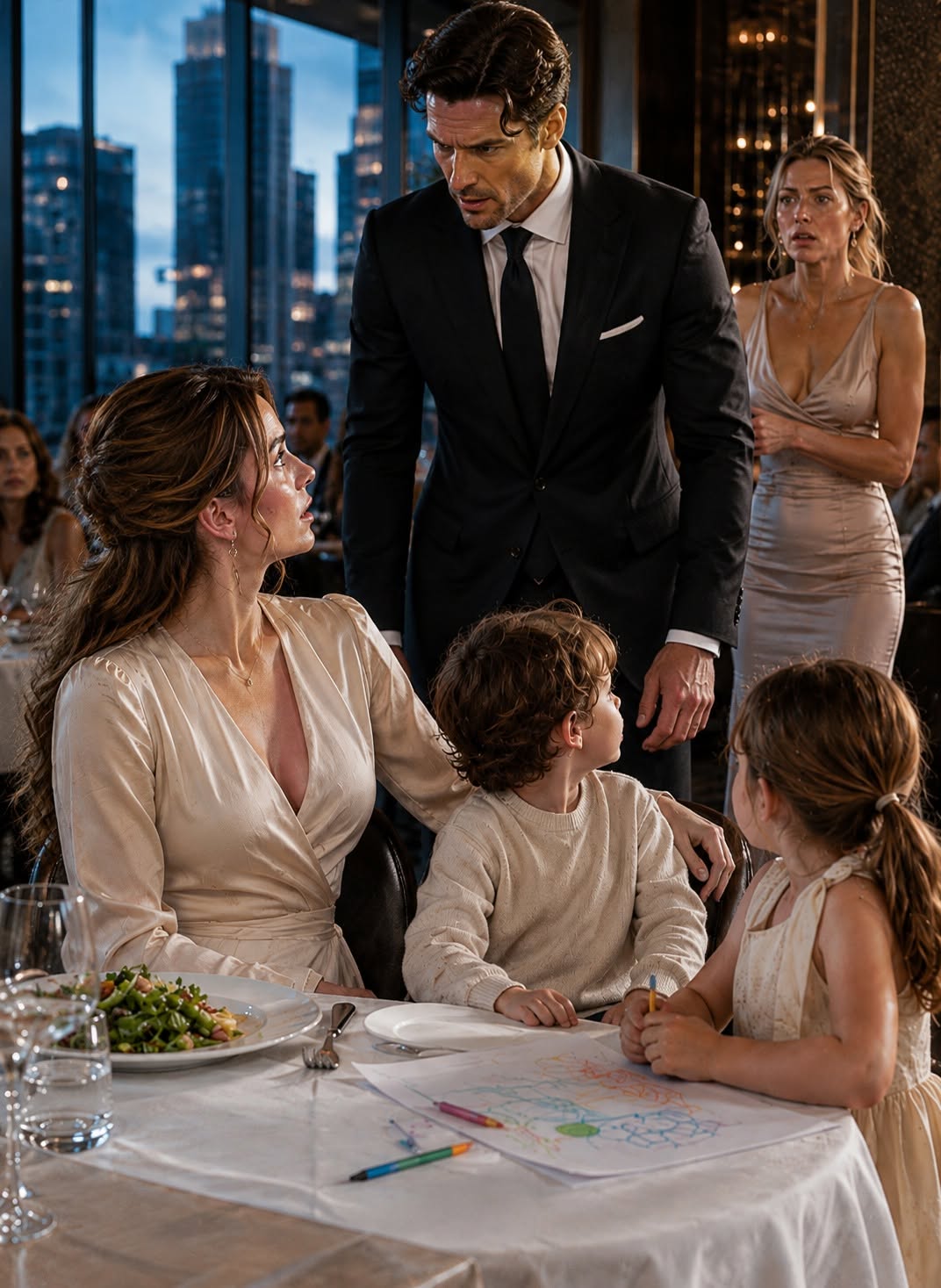
PART 3(END) – The Children He Never Knew: A Story of Hidden Truths, Second Chances, and the Family They Never Expected – 9!001
PART 3
That evening, I made grilled cheese sandwiches.
It seemed absurd.
My children’s understanding of their family was about to change, and I was standing in my kitchen spreading butter on bread.
But parenthood had taught me that some of the most important conversations happened beside ordinary things.
Laundry baskets.
School backpacks.
Half-empty glasses of milk.
Children rarely needed dramatic settings.
They needed somewhere safe enough to ask difficult questions.
Amara and Eli sat at the kitchen island.
My mother remained in the living room, close enough to help if needed but far enough to give us privacy.
I turned off the stove.
Then I sat across from them.
“You had questions earlier.”
Eli nodded immediately.
“Is Mr. Moretti our dad?”
Amara whispered, “Eli.”
“What?”
“You could let Mom start.”
“He asked exactly what I was going to talk about,” I said.
I folded my hands.
“Yes.”
Neither child spoke.
I had imagined tears.
Anger.
Confusion.
Instead, Amara looked down at her sandwich.
Eli’s forehead creased.
The same expression Luca made when numbers didn’t add up.
“Does he know?” Eli asked.
“He does now.”
“Did he know before yesterday?”
“No.”
That answer brought Amara’s head up.
“Why?”
There was no way to answer honestly without also admitting that adults sometimes failed one another.
But I would not burden them with the weight of our marriage.
“Your dad and I separated before I found out I was pregnant,” I said. “At the time, we were both sad and confused about many things. I made a decision not to tell him.”
Amara’s eyes widened.
“You didn’t tell him about us?”
“No.”
“Why?”
“Because I believed he had chosen a life without me and wouldn’t want to be pulled back into mine.”
“Did he say that?”
The question cut cleanly through eight years of rationalization.
“No.”
“So you guessed?”
Children.
Always mercilessly logical.
“Yes,” I said. “I guessed.”
Amara considered that.
“Were you wrong?”
“Yes.”
The word was difficult but strangely freeing.
“I was.”
Eli picked at the crust of his sandwich.
“Is he mad?”
“He’s hurt.”
“At us?”
“No.”
I answered before the question was fully finished.
“Never at you.”
Both of them looked relieved.
I wished that didn’t hurt as much as it did.
“What happens now?” Amara asked.
“That depends partly on you.”
Eli frowned.
“Kids don’t decide everything.”
“No,” I agreed. “But you deserve to have a voice.”
“Do we have to move?”
“No.”
“Change schools?”
“No.”
“Call him Dad?”
“No.”
Amara looked at me.
“Can we?”
I blinked.
“If you want to someday.”
She thought again.
“What does he want?”
The question surprised me.
“He wants to meet you properly.”
“He already met us.”
“Without thinking you were a famous person?” I asked Eli.
He grinned.
“That would probably be better.”
Amara smiled too.
And just like that, the tension loosened.
Not disappeared.
But loosened.
“Could we meet him somewhere?” she asked. “Not here.”
“Why not here?”
She shrugged.
“I don’t know. Home feels like ours.”
I understood immediately.
The house had always been their safe center.
Inviting Luca into it too soon might feel as if the ground beneath them were changing.
“How about the lakefront?” I suggested.
Eli said, “Can he play baseball?”
“I have no idea.”
“He looks like he can.”
“That is not evidence.”
“He’s tall.”
I laughed.
“We’ll ask.”
Luca arrived at Dawes Park two days later carrying a baseball glove in one hand and a paper bag in the other.
I had told him not to bring gifts.
Technically, he hadn’t.
The paper bag contained sandwiches and cookies from a neighborhood bakery.
“I panicked,” he admitted quietly while the children were still walking toward us with my mother.
“You negotiated a nine-billion-dollar merger last year.”
He looked at me.
“This is worse.”
Despite myself, I smiled.
“That might be the most human thing you’ve ever said.”
Then the twins reached us.
Luca stood.
He had dressed carefully without looking as though he had dressed carefully.
Jeans.
Navy sweater.
No watch worth more than someone’s house.
No driver hovering nearby.
He simply looked like a man meeting his children.
“Hi,” Amara said.
“Hi.”
Eli pointed at the glove.
“You do play.”
“A little.”
“What position?”
“Shortstop in high school.”
Eli considered this acceptable.
“Good.”
Amara looked at the bag.
“What’s in there?”
“Lunch.”
“Mom told you not to buy presents.”
Luca looked at me.
“She warned you too?”
Amara nodded.
He lowered his voice conspiratorially.
“Your mother is very strict.”
“I can hear you,” I said.
Eli smiled.
Within ten minutes, he and Luca were throwing a baseball across the grass.
Not gracefully at first.
Luca was trying too hard.
Every throw was careful.
Every compliment sounded rehearsed.
“Excellent catch.”
Eli frowned.
“You can just say nice catch.”
Luca looked at me.
I covered my mouth.
“All right,” Luca said. “Nice catch.”
“Thanks.”
Twenty feet away, Amara sat beside me on a blanket.
She was watching Luca more than the game.
“He looks like Eli.”
“Yes.”
“And me?”
“Yes.”
She touched her eyebrow.
“Here?”
“Especially there.”
She was quiet.
“Did you love him?”
I had wondered when that question would come.
“Yes.”
“A lot?”
“Yes.”
“Do you still?”
I looked at Luca.
He missed one of Eli’s throws and chased the ball down the slope while Eli laughed.
“Love changes,” I said.
“That’s not an answer.”
“You really are his daughter.”
She smiled slightly.
Then waited.
“I care about him,” I said. “But sometimes caring about someone and building a life with them are different things.”
“Because he has a wife?”
“That too.”
Amara nodded.
She accepted boundaries more easily than adults did.
After lunch, Luca sat with the children near the water while I remained within sight but far enough away not to hear every word.
Later, he told me what they had asked.
What was his favorite food?
Did he have pets?
Was he good at math?
Did he know how to make pancakes?
Had he ever broken a bone?
Then Eli asked the question Luca had dreaded.
“Why weren’t you here before?”
Luca did not blame me.
He told them simply, “I didn’t know about you. If I had known, I would have wanted to be here.”
Amara asked, “Would you have stayed married to Mom?”
He answered with equal care.
“I don’t know. Your mom and I had problems we didn’t understand well enough then. But I would have loved you.”
When he repeated that answer to me later, I felt something inside me shift.
Not forgiveness.
Not yet.
But respect.
He could have made himself the victim.
He didn’t.
The medical record stayed on my mind.
So did Daniel.
Luca wanted answers, but we agreed on one thing immediately: whatever we discovered would remain an adult matter.
The children had enough to process.
Luca contacted the clinic and formally requested its archival administrative notes.
Because more than eight years had passed, the process was slow and incomplete, but several documents remained.
One was a scanned authorization form.
Another was an internal message noting that a person listed as a representative of Moretti Family Holdings had requested confirmation of the treatment outcome for insurance reconciliation.
The signature was illegible.
But the email address attached to the request belonged to an administrative assistant who had worked directly for Daniel.
That was not proof of a conspiracy.
It was, however, enough for Luca to call him.
He asked me to be present.
We met in Luca’s office after business hours.
I had not been inside a Moretti Global building since the divorce.
The headquarters had changed.
The old offices occupied twenty floors on Michigan Avenue.
The new tower occupied nearly twice that.
The lobby smelled like polished stone and money.
Yet Luca’s office surprised me.
It contained photographs.
Not many.
His mother.
His late father.
A picture of Luca and Daniel as boys standing beside a fishing boat.
And, on the corner of a shelf, a newly printed photograph of Amara and Eli sitting beside the lake.
I stopped.
He followed my eyes.
“Amara sent it.”
“When?”
“Yesterday.”
I smiled despite myself.
“She took your number?”
“She asked.”
“She did not tell me that.”
“She said you would eventually find out.”
“That also sounds like her.”
Luca almost smiled.
Then his expression changed as he dialed Daniel.
The call went to voicemail.
He tried again.
This time Daniel answered.
“Luca?”
His voice sounded older than I remembered.
“Daniel.”
A pause.
“It’s been a while.”
“Yes.”
“What do you need?”
Luca glanced at me.
“I’m here with Nia.”
Silence.
Not surprise.
Silence.
The distinction mattered.
Daniel finally said, “Nia Carter?”
“You remember her.”
“Of course.”
“I have two children.”
Another silence.
This one lasted too long.
Luca leaned back slowly.
“You don’t sound surprised.”
Daniel exhaled.
“Luca—”
“You knew.”
Not a question.
“Let me explain.”
I felt no triumph.
Only a strange sadness.
Luca closed his eyes for a moment.
“How long?”
“I wasn’t certain.”
“How long, Daniel?”
“Eight years.”
Luca’s hand flattened on the desk.
I watched his face carefully.
He stayed controlled.
“Tell me.”
Daniel began slowly.
The explanation was smaller than the mystery we had built around it.
That made it more believable.
And somehow sadder.
Years earlier, Moretti Global’s executive health insurance program had been undergoing an internal audit after billing irregularities.
Daniel, as chief operating officer, had been reviewing large reimbursement claims involving senior executives.
Our fertility treatment had appeared in the records.
When the follow-up claim arrived after our separation, his office requested clarification.
The clinic provided only billing-level information, but the terminology indicated ongoing prenatal monitoring.
Daniel understood what it probably meant.
“Why didn’t you tell me?” Luca asked.
“I tried.”
“No, you didn’t.”
“I came to your apartment.”
“When?”
“The week after the divorce was finalized. You were leaving for Singapore.”
I remembered that trip.
Luca had been gone for nearly three weeks.
“You said you never wanted anyone mentioning Nia to you again,” Daniel continued.
Luca went still.
“I was angry.”
“I know.”
“So you decided that meant I shouldn’t know she was pregnant?”
“No. I called her.”
My head snapped up.
“What?”
Daniel hesitated.
“I called the number I had for you.”
“I never received a call.”
“A man answered.”
I frowned.
“What man?”
“He said you had asked not to receive messages from the Moretti family.”
“That makes no sense.”
Then I remembered.
During those first weeks after the divorce, I had stayed briefly at my brother Marcus’s apartment.
Marcus had been furious with Luca.
Protective.
Proud.
And absolutely capable of telling anyone with the surname Moretti not to contact me.
“Marcus,” I whispered.
Luca looked at me.
“Your brother?”
I nodded slowly.
Daniel continued.
“I didn’t know whether the pregnancy was Luca’s. I only knew the treatment records suggested one.”
“You could have asked me later,” Luca said.
“Yes.”
“Why didn’t you?”
The answer took longer.
“Because by then we were barely speaking.”
Luca’s face hardened slightly.
“Because of Carrow?”
“No.”
Daniel sighed.
“Because I thought you blamed Nia for everything that was going wrong in your life, and I encouraged it.”
My stomach tightened.
Luca said nothing.
Daniel continued.
“My marriage was ending too. Melissa had told me she didn’t want children. I was angry with her. Angry with everyone, really. When you and Nia were struggling, I projected my own situation onto yours.”
The room became very quiet.
“I told you she had hidden things,” Daniel said. “I had no evidence. I had overheard part of a conversation years earlier and turned it into something it wasn’t.”
Luca’s voice was restrained.
“You told me she knew she couldn’t have children.”
“I said I thought she knew pregnancy might be difficult.”
“You knew exactly what conclusion I would draw.”
“Yes.”
There was shame in Daniel’s voice now.
Not theatrical remorse.
Just recognition.
“I was wrong.”
Luca stared at the photograph of them as boys.
“Eight years.”
“I know.”
“No, you don’t.”
Daniel didn’t argue.
After a moment, he said, “I should have told you when I saw the insurance record. I convinced myself it wasn’t my place, especially after Nia never contacted you.”
I spoke for the first time.
“You assumed my silence was intentional.”
“Yes.”
“It was.”
Daniel paused.
“I’m sorry.”
I looked at Luca.
There it was.
The terrible symmetry of it.
Daniel had made assumptions.
Luca had made assumptions.
I had made assumptions.
Each of us had filled silence with whatever explanation best suited our hurt.
And two children had grown for eight years on the other side of all those conclusions.
Luca ended the call without shouting.
He simply said, “I need some time before we speak again.”
Daniel answered, “I understand.”
When the line went dead, Luca remained seated.
I walked toward the windows.
Below us, Chicago glittered across the evening.
“So that’s it,” I said.
“No conspiracy.”
“No.”
“No one deliberately hid them from you.”
He looked at me.
“You did.”
The words could have been cruel.
They weren’t.
They were simply true.
I nodded.
“Yes.”
“And Daniel knew enough that he should have spoken.”
“Yes.”
“And I listened to him instead of talking to my wife.”
I turned.
He looked exhausted.
“We were all very good at not saying what needed to be said.”
“That isn’t an excuse.”
“No.”
He stood and came toward the window, stopping several feet from me.
“I spent years thinking our marriage ended because something had disappeared between us.”
“What do you think now?”
He considered.
“I think trust disappeared first.”
I looked at him.
It was the closest either of us had come to naming the real reason.
Not infertility.
Not Daniel.
Not careers.
Trust.
We had stopped trusting each other enough to reveal fear.
Then we had mistaken silence for truth.
The months that followed were not simple.
They were, however, good.
Luca did not suddenly become Father of the Year.
He had no idea how school pickup lines worked.
He once sent Eli to baseball practice without his glove.
He bought Amara a telescope so advanced that neither of them could figure out how to assemble it.
When the three of us finally put it together on my back porch, Amara informed him, “Being rich does not make you good at instructions.”
Luca laughed so hard he had to sit down.
He learned.
Tuesday dinners became his.
Then every other Saturday.
He attended school events quietly.
No entourage.
No photographers.
The first time another parent recognized him at Eli’s science fair and asked for a photograph, Luca politely declined and returned immediately to Eli’s model bridge.
That mattered more to me than he knew.
The children gradually stopped calling him Mr. Moretti.
Eli moved first.
“Luca” became “Dad” almost accidentally during a baseball game.
“Dad, look!”
The word hung in the air.
Eli didn’t notice.
Luca did.
He turned toward me from across the bleachers.
His eyes filled.
I pretended to be deeply interested in the scoreboard.
Amara took longer.
She called him Luca for nearly six months.
He never corrected her.
Then one winter evening she fell asleep reading on his couch after dinner.
When I arrived to collect the children, Luca was sitting nearby working on his laptop.
Amara woke as I helped her into her coat.
“Dad, did you put my astronomy book in my backpack?”
Luca looked up.
“Yes.”
“Okay.”
She yawned.
“Thanks.”
That was all.
No dramatic music.
No announcement.
Just a child choosing a word when she was ready.
On the drive home, I cried quietly at a red light.
Amara noticed.
“You okay?”
“Yes.”
She gave me a suspicious look.
“You always say that.”
I laughed through my tears.
“I know.”
Evelyn remained the most difficult piece.
Not because she was unkind.
Because she was real.
For several months, our paths barely crossed.
When Luca had the twins, she was sometimes present and sometimes not.
The children described her as “nice but fancy.”
I tried not to laugh.
Then one spring afternoon, Evelyn called me.
I almost didn’t answer.
“Nia?”
“Yes.”
“It’s Evelyn.”
“I know.”
A pause.
“Could we have coffee?”
My first instinct was no.
My second was to ask why.
My third, finally, was to agree.
We met at a quiet café near Lincoln Park.
Evelyn arrived wearing a cream coat and no visible trace of the polished public figure I knew from magazines.
She looked tired.
“I owe you an apology,” she said.
That was not what I expected.
“For what?”
“For resenting you.”
I sat back.
“You barely know me.”
“Exactly.”
She stirred her coffee though she hadn’t added anything to it.
“The day Luca saw the children, I understood immediately.”
“You noticed the resemblance.”
“It was impossible not to.”
I nodded.
“For weeks afterward, I thought our marriage was being invaded by his past.”
I said nothing.
She looked embarrassed.
“That sounds terrible.”
“It sounds human.”
Her eyes lifted.
“I was angry because Luca and I had been discussing having children. Then suddenly he had two.”
“That must have been hard.”
“Yes.”
She looked toward the window.
“But eventually I realized something.”
“What?”
“The children weren’t taking anything from me.”
She smiled faintly.
“They were children. They needed their father. My discomfort was not their responsibility.”
I respected her for saying it.
“Luca told me you’ve been good with them.”
“I’m learning.”
She hesitated.
“There’s something else.”
I waited.
“Luca and I are separating.”
My chest tightened.
“I’m sorry.”
“Don’t be.”
“I don’t want you to think—”
“This isn’t because of you.”
She gave me a look almost amused by how quickly I had spoken.
“It isn’t because of the children either.”
“Then why?”
“Because seeing him with them made both of us admit something we had avoided.”
Her voice was gentle.
“Luca and I are very good partners in public.”
I understood before she finished.
“We have similar ambitions. Similar friends. Similar lives. But somewhere along the way, we confused compatibility with intimacy.”
I looked down.
“You love him?”
“Yes.”
The answer surprised me.
“But not every love is meant to stay a marriage.”
I thought of what I had told Amara months earlier.
Evelyn continued.
“And Luca has spent years trying to make himself into the person he thought he was supposed to become.”
“What does that mean?”
“You probably know better than I do.”
I did.
Young Luca had loved neighborhood restaurants, old jazz records, baseball, family dinners.
Later Luca loved targets.
Expansion.
Control.
Winning.
Perhaps because success was easier to measure than happiness.
Evelyn finished her coffee.
“I wanted you to hear it from me before it became public.”
“Thank you.”
She stood, then paused.
“For what it’s worth, Nia, he never spoke badly about you.”
I looked up.
“Never?”
“Not once.”
Something in my chest loosened.
Not because it repaired anything.
But because it changed the shape of my memory.
Luca and Evelyn divorced quietly six months later.
There were no scandalous headlines.
No public accusations.
Their joint statement was brief.
The children continued seeing Evelyn occasionally because Amara liked her and Evelyn, to her credit, did not disappear simply because her marriage had ended.
I admired that.
Life rarely divided itself neatly into villains and heroes.
Usually, people were only people.
Trying.
Failing.
Learning.
Sometimes too late.
Sometimes just in time.
A year after Luca first saw the twins in the restaurant, he came to my house carrying a cardboard box.
“What’s that?” I asked.
“Something I found.”
The children were at my mother’s house.
We had been slowly growing comfortable enough to spend time together without them.
At first, the conversations were practical.
School schedules.
Doctors.
Summer camps.
Then they became longer.
Old stories resurfaced.
Inside jokes returned without permission.
Trust did not return all at once.
It came in tiny pieces.
Luca showing up when he said he would.
Me telling him when I was worried instead of pretending I wasn’t.
Him listening without immediately solving.
Me asking instead of assuming.
He put the box on my kitchen table.
Inside were photographs.
Our photographs.
The ones I thought he had thrown away.
Our tiny first apartment.
A trip to Wisconsin.
Our wedding.
A photograph of us sitting on the floor of the penthouse eating pizza because the dining room furniture hadn’t arrived.
“You kept these?”
“Yes.”
“Why?”
He looked at me.
“Because ending something doesn’t erase that it mattered.”
I touched the edge of a photograph.
My younger self looked impossibly hopeful.
“What are you doing with them?”
“I thought the children might want them someday.”
That touched me more deeply than any expensive gesture could have.
“They should know we were happy once,” he said.
I swallowed.
“We were.”
“For a long time.”
“Yes.”
He leaned against the kitchen counter.
“Nia?”
I looked up.
“I’m not asking you for anything.”
Something in his voice made me nervous.
“All right.”
“But I need to tell you something.”
I waited.
“I’m still in love with you.”
The room became very still.
He did not move closer.
Did not reach for me.
Did not ask for an answer.
“I don’t expect that to fix what happened,” he said. “And I’m not asking you to forget it.”
“Luca…”
“I know.”
“No, you don’t.”
He gave me a faint smile.
“Probably not.”
That admission made me smile too.
He continued.
“I spent most of my life thinking decisions mattered more if they were permanent. Marriage. Divorce. Business. Everything.”
“And now?”
“Now I think people are allowed to discover they were wrong.”
I looked down at the photographs.
“I was wrong too.”
“Yes.”
The old Luca might have rushed to reassure me.
The man standing before me allowed the truth to exist.
That mattered.
“I don’t know if I can trust this,” I whispered.
“I understand.”
“I don’t want the children getting excited about something that might not work.”
“Then we don’t tell them anything.”
“I don’t even know what this would be.”
“It doesn’t need a name.”
He smiled.
“We could have dinner.”
“We already have dinner.”
“Without discussing orthodontists.”
“That removes approximately seventy percent of our current conversation.”
“I’m willing to take the risk.”
I laughed.
Then, after a long moment, I said, “Dinner.”
His face softened.
“Dinner.”
We did not remarry six months later.
Or even a year later.
That would have been too easy.
Instead, we dated.
Awkwardly at first.
Then happily.
We went to places we had loved before money changed our definition of an evening out.
A tiny Italian restaurant where Luca once proposed to me over tiramisu.
A jazz club where we danced badly.
A lakefront bench where he had told me, at twenty-six, that he wanted four children.
“You wanted four?” I asked.
“I was ambitious.”
“You had never changed a diaper.”
“That information might have adjusted the projection.”
We laughed.
That was what surprised me most.
Not the romance.
The laughter.
We had lost it before we lost anything else.
This time, when something bothered me, I said it.
When Luca became buried in work, I didn’t silently assume he was pulling away.
I asked.
When he worried I was keeping emotional distance, he told me.
Sometimes the conversation was uncomfortable.
Sometimes one of us became defensive.
But we stayed.
That was new.
Two years after the restaurant, Luca brought the twins and me to the same place for dinner.
Amara recognized it first.
“This is where you saw us!”
Eli looked around.
“Do they still have the chocolate cake?”
“Priorities,” I said.
“They matter.”
Luca seemed unusually quiet.
I suspected something.
I was wrong about what.
After dessert, he did not kneel.
There was no diamond hidden in champagne.
Instead, he placed an envelope beside my plate.
I stared at him.
“What is this?”
“Open it.”
Inside was a legal document.
I read the first page.
Then looked at him.
It was the paperwork formally transferring ownership of the Evanston house entirely into my name.
I frowned.
“Luca.”
“Keep reading.”
There was a letter.
Nia,
The first time we built a life together, I thought providing meant owning everything large enough to impress people.
I know better now.
Home is where people feel safe enough to tell the truth.
This house was that place for you, Amara, and Eli long before I returned.
I never want you to believe being with me requires giving up the life you built without me.
Whatever you decide about us, this remains yours.
I looked up.
My eyes blurred.
“This isn’t a proposal.”
“No.”
Amara whispered loudly to Eli, “I think Mom wanted a proposal.”
“I can hear you,” I said.
Both children dissolved into laughter.
Luca smiled.
Then his expression became serious.
“I am not asking you to erase the years we lost.”
His hand rested on the table.
“I’m asking whether you want to keep building the years ahead.”
I reached for his hand.
“Yes.”
He blinked.
“Yes?”
“Yes.”
Amara gasped.
“Does that mean you’re getting married?”
I looked at Luca.
He looked at me.
“Eventually,” I said.
Eli frowned.
“What does eventually mean?”
“Not tomorrow.”
“Before high school?”
Luca laughed.
“We’ll negotiate.”
“Dad says everything can be negotiated.”
“That explains too much,” I said.
And there, in the restaurant where one year had once divided our lives into before and after, we began again.
Not because the past had disappeared.
It hadn’t.
Daniel’s mistake remained a mistake.
Luca’s distrust remained part of our history.
My silence remained something I would always regret.
But forgiveness was not pretending those things had never happened.
It was deciding they would not be allowed to make every decision that came afterward.
We married again the following autumn.
Small ceremony.
Family only.
My mother cried before anyone else.
Marcus cried while claiming seasonal allergies.
Evelyn sent flowers and a handwritten note wishing us happiness.
Daniel did not attend.
He and Luca had slowly resumed occasional contact, but some relationships needed distance before they could become something healthier.
There were no television cameras.
No society reporters.
No magazine exclusives.
Just the people who mattered.
Amara carried flowers.
Eli carried the rings and checked his pocket approximately fourteen times.
When I reached Luca at the end of the aisle, he looked at me exactly the way he had during our first wedding.
And completely differently.
Older.
Humblr.
Certain for different reasons.
His vows were simple.
“I used to think love meant knowing someone completely.”
He looked at me.
“Now I think it means never deciding you know so much that you stop asking.”
My eyes filled.
When it was my turn, I squeezed his hands.
“I used to believe silence protected me.”
I smiled through tears.
“Now I know love needs truth more than it needs certainty.”
The twins stood beside us.
Safe.
Loved.
Surrounded by people who had learned, painfully and imperfectly, how to become a family.
Years earlier, I had believed my story with Luca ended in a penthouse kitchen on a snowy Chicago evening.
Then I believed it restarted in an elegant restaurant when he looked across a room and saw his own eyes in two children.
I had been wrong both times.
Stories like ours did not end or begin in single moments.
They changed through hundreds of choices.
To call.
To answer.
To apologize.
To listen.
To show up for Tuesday dinner.
To attend the baseball game.
To leave the door open.
To ask the question instead of assuming the answer.
And sometimes, after years of living with the consequences of choices made in pain, people were fortunate enough to be given another choice.
Not to return to what they had been.
But to build something wiser from what remained.
One evening, years later, I stood on our back porch watching Luca help Eli with a telescope while Amara argued that both of them were reading the instructions incorrectly.
“You’re skipping step seven,” she insisted.
“There is no step seven,” Eli said.
“There is absolutely a step seven.”
Luca studied the manual.
“She’s right.”
Amara folded her arms triumphantly.
“I usually am.”
Luca caught me watching.
“What?”
“Nothing.”
He raised an eyebrow.
The twins had inherited that too.
I smiled.
For years, I had thought the greatest loss of my life was the marriage Luca and I had failed to save.
It wasn’t.
The greater danger had been allowing that failure to teach us the wrong lesson.
We had both believed hurt meant closing doors.
Instead, the life waiting for us had required opening them carefully.
One at a time.
Luca walked over and slipped his hand into mine.
Behind him, our children continued debating stars.
Above us, the Chicago sky stretched clear and dark.
No perfect ending.
No erased mistakes.
Just family.
Trust rebuilt.
Love changed.
And the quiet certainty that this time, none of us were afraid to ask what came next.