BREAKING: A journalist is sounding the alarm after heavy construction equipment reportedly arrived in Big Bend National Park as work begins on expanding President Donald Trump’s border wall
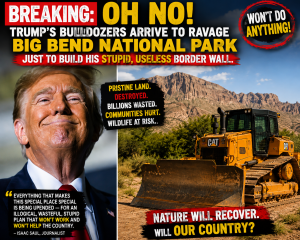
BREAKING: A journalist is sounding the alarm after heavy construction equipment reportedly arrived in Big Bend National Park as work begins on expanding President Donald Trump’s border wall.
According to Isaac Saul, founder of Tangle News and a resident of West Texas, bulldozers and other machinery have entered one of the most remote and untouched landscapes in the continental United States. He says local residents, park officials, landowners, business owners, and even Texas lawmakers have received little information from U.S. Customs and Border Protection about the project.
Saul claims the work includes building new access roads through areas that previously had none, surrounding those roads with fencing, and preparing for additional surveillance technology and Border Patrol operations. He argues that the region has historically seen very few illegal border crossings and questions the need for such extensive development.
He also contends that creating roads through the rugged terrain could unintentionally make travel across the area easier than before. Where the landscape once consisted mainly of deserts, cliffs, and dense cactus fields that naturally limited movement, he believes the new infrastructure could change that dynamic.
Saul points to nearby sections of the border where recently installed barriers were reportedly damaged by seasonal flooding. He argues that large sums of taxpayer money have already been lost after floodwaters washed away portions of the infrastructure, while razor wire and other debris have affected areas along the Rio Grande.
In his view, billions of dollars are being spent on a project that will permanently alter one of Texas’ most treasured natural landscapes without delivering meaningful improvements to border security. He notes that the Big Bend sector represents roughly a quarter of the patrolled southwestern border but accounts for only a small percentage of total border crossings.
Saul warns that local communities could face serious economic consequences, including impacts on tourism and small businesses. He also raises concerns about wildlife habitats, the use of eminent domain to acquire private property, and what he considers a missed opportunity to invest in more effective border security measures and community support.
Reflecting on his personal connection to the region, Saul says he dreamed of living in West Texas since childhood. After years of planning, he built a home there, hoping it would remain in his family for generations. He describes the area as one of the country’s most beautiful, peaceful, and unspoiled places.
Now, he says, everything that made the region unique is at risk because of what he views as an expensive and ineffective policy that will not achieve its intended goals.
Calling the situation “a genuine gut punch,” Saul expressed deep sadness over the changes taking place and fears that the environmental and community impacts could last for generations.
The article concludes with strong criticism of President Trump, arguing that the border wall project reflects a disregard for America’s natural landscapes and questioning whether the long-term consequences for both the environment and the nation can ever be fully reversed.