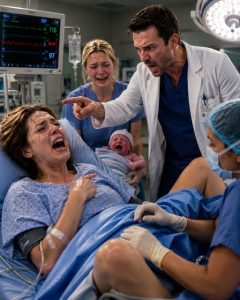
PART 2 – My Husband Chose Doubt Over Me in the Delivery Room – 2!001
PART 2
I heard the alarm before I understood it.
Not with my ears at first, but through the strange distance of a mind trying to pull away from pain. The sound stretched thin and endless, a single note slicing through the delivery room, and then even that began to fade.
Faces moved above me like figures behind frosted glass.
Someone shouted for a crash cart.
Someone else said my name.
Amelia.
Not Dr. Grant. Not Chief. Not wife. Just Amelia, spoken with the terror of people who suddenly remembered I was human.
Then there was nothing.
No pain. No ceiling lights. No grip of hands against my shoulders. No Cameron standing at the foot of the bed with his certainty crumbling too late.
Only quiet.
In that quiet, I thought of my son.
I had not seen his face.
That was the thought that pulled me back.
Not Cameron. Not anger. Not fear. My son.
A violent pressure struck my chest. Once. Twice. Again. A voice counted compressions. Another voice called out medications. The air seemed to return in splinters, harsh and burning, as if I were breathing broken glass.
“Come on, Amelia,” someone said. “Stay with us.”
The world flickered.
I saw Cameron above me, his surgical cap crooked, his eyes wide in a way I had never seen before. His hands were gloved and bloody, hovering uselessly near the bed while the code team worked around him.
For years, those hands had been steady enough to calm entire rooms.
Now they shook.
“Move back, Dr. Bennett,” a nurse ordered.
He did not answer.
“Move back.”
This time, someone physically guided him away.
I wanted to speak. I wanted to ask where my baby was. I wanted to tell him that he had been wrong, that every warning I had given him was real, that the woman he had dismissed as dramatic had nearly died under his care.
But my mouth would not obey me.
The last thing I saw before the darkness took me again was Cameron looking toward the corner of the room.
Sophie was gone.
When I woke, I did not know how much time had passed.
The room was dim, washed in the soft blue glow of machines. A breathing tube scratched at my throat, and heavy blankets pinned my body in place. My limbs felt distant, as if they belonged to someone else.
For several terrifying seconds, I did not know whether my son had survived.
A nurse noticed my eyes opening and leaned close.
“Dr. Grant? Amelia? You’re in the ICU. You’re safe.”
I tried to move my hand.
She understood immediately.
“Your baby is alive,” she said, her voice softening. “He’s in the neonatal unit for observation, but he’s breathing on his own. He’s strong.”
My eyes filled before I could stop them.
The nurse, Mara, squeezed my fingers. I recognized her from the obstetrics floor, though we had only spoken in passing before. She had kind eyes and the tired steadiness of someone who had survived many terrible nights without letting them make her cold.
“He weighs ten pounds, four ounces,” she said. “Big boy. They said he cried like he had an opinion about everything.”
A broken laugh tried to escape me and turned into a painful cough around the tube.
“Don’t try to talk yet,” Mara warned gently. “You lost a lot of blood. There were complications after delivery. You were taken into surgery.”
My eyes shifted toward the door.
Mara’s expression changed.
“He’s been outside,” she said, and I did not need to ask who. “But Dr. Patel said no visitors until you were stable.”
Dr. Leena Patel.
My friend. My colleague. The one person in the hospital who had never been impressed by Cameron Bennett’s charm or reputation.
Relief loosened something in my chest.
I closed my eyes again, not because I wanted to sleep, but because I was not ready to see my husband.
The next time I woke, the tube was gone.
My throat felt scraped raw, and every breath hurt, but at least the air was mine. Late afternoon sunlight slipped between the blinds, striping the floor with gold.
Leena sat beside my bed in wrinkled scrubs, her hair twisted into a loose knot. She was holding a paper cup of coffee with both hands, though from the untouched surface, I doubted she had drunk any.
When she saw me watching her, she set it down.
“Don’t you dare make a joke about my bedside manner,” she said, but her voice cracked halfway through.
I tried to smile. “Wouldn’t dream of it.”
The words came out as a rasp.
Leena’s eyes shone. “You scared the life out of me.”
“Baby?”
“Beautiful. Stubborn. Loud.” Her face softened. “They brought me to see him this morning. He has your mouth.”
“And Cameron’s?”
She hesitated.
That told me enough.
I looked away. “Has he held him?”
“No.”
The answer surprised me. “Why?”
“Because neonatal restricted access after the code, and because I had a conversation with security.”
Despite everything, I almost smiled. “That sounds like you.”
“It sounded louder in person.”
For a while, we sat in silence. The machines hummed around us. Somewhere outside the room, wheels squeaked across polished floors.
Finally, I asked, “What happened?”
Leena leaned forward, resting her elbows on her knees. “You went into cardiac arrest after delivery. Severe hemorrhage. Uterine rupture was confirmed in surgery. You were right, Amelia. The baby was too large, the stress was too much, and the delay made everything worse.”
I closed my eyes.
Knowing did not soften the blow.
“Who did the surgery?”
“Dr. Rhodes took over. Cameron was removed from the room.”
Removed.
The word was clinical, but I heard the story beneath it. Someone had finally done what should have been done earlier.
“Did he fight it?”
“No. I don’t think he could speak.”
My hand drifted over the blanket toward my abdomen. Pain flared, deep and hot. I stopped moving.
Leena noticed. “Easy.”
“Can I have more children?”
Her silence lasted only a second, but it was long enough.
“They repaired what they could,” she said carefully. “It’s too early to discuss long-term possibilities. Right now, your body needs to heal.”
That was the kind of answer doctors gave when hope existed but could not safely be promised.
I swallowed against the ache in my throat. “I need to see my son.”
“I know.”
“I need to know he’s real.”
Leena stood. “Then I’ll make it happen.”
Twenty minutes later, they wheeled me through quiet corridors under blankets that smelled faintly of hospital detergent. Every turn sent pain through me, but I held it in because I was done letting pain be used as evidence against me.
The neonatal unit was warmer than the ICU, full of low lights and small, determined sounds. A nurse led us to a clear bassinet near the window.
And there he was.
My son.
He was wrapped in a striped blanket, his cheeks full and rosy, one tiny fist pressed against his chin as though he were already deep in thought. Dark hair curled damply against his forehead. His mouth puckered, opened, then settled.
I had seen thousands of newborns in my career.
None of that prepared me.
A sob rose from somewhere deeper than injury.
Leena placed a hand on my shoulder. “Meet your mother, little man.”
The nurse lifted him carefully and settled him against my chest.
He was heavier than I expected, warm and solid, his small body fitting against me with a rightness so complete that my fear quieted for the first time since the labor room. His breath tickled my collarbone. His fingers opened against my gown.
“Hi,” I whispered.
His face scrunched.
I laughed and cried at the same time.
“I’m sorry,” I said, though I knew he could not understand. “I tried to protect you. I promise I tried.”
Leena turned away, pretending to examine a monitor.
I kissed his forehead.
“What’s his name?” the nurse asked gently.
Cameron and I had argued over names for months in the way couples do when they believe the future is safe enough for small disagreements. He had wanted James, after his grandfather. I had liked Noah because it meant rest, comfort, something carried through storms.
Before labor, we had agreed to decide when we saw him.
Now there was no question.
“Noah,” I said. “His name is Noah Grant.”
Leena looked back at me.
Not Bennett. She heard it. So did I.
The door to the unit opened behind us.
I did not turn, but the air changed.
“Noah,” Cameron whispered.
My arms tightened around the baby.
Leena stepped between us before he could come closer. “You were told to wait.”
“I’m his father.”
“And she is my patient.”
The silence that followed was sharp.
I looked at Cameron then.
He looked as if he had aged ten years overnight. His jaw was shadowed with stubble. His eyes were red-rimmed, his surgical confidence stripped away until all that remained was a frightened man in a white coat.
The coat angered me most.
He was still wearing authority like a shield.
“Amelia,” he said.
My name sounded different from his mouth now. Smaller. Fragile.
“Don’t,” I said.
He flinched.
The nurse quietly checked Noah’s blanket, then moved away, giving us privacy without abandoning us.
Cameron’s gaze fell to our son. His face softened with wonder, grief, and something like shame.
“He’s beautiful.”
“Yes.”
“I didn’t know it was that bad.”
The words landed badly.
Leena made a quiet sound of disbelief, but I raised my hand slightly. This answer had to be mine.
“You didn’t want to know,” I said.
His mouth opened, then closed.
“I told you,” I continued. Each word scraped my throat, but I forced them out. “The nurses told you. The monitors told you. My body told you. You chose not to listen.”
His eyes filled. “Sophie said—”
At the sound of her name, something cold moved through me.
“Sophie lied.”
Cameron looked down.
“You believed her,” I said. “Not because she had proof. Not because I had ever given you a reason to think I would hurt someone. You believed her because it was easier than looking at what was right in front of you.”
“I thought you were angry with her.”
“I was in labor.”
“I know.”
“No,” I said, my voice breaking. “You don’t.”
Noah stirred, his tiny forehead wrinkling. I lowered my voice.
“You were not my husband in that room. You were not even my doctor. You were a man punishing someone he had already decided was guilty.”
Cameron put a hand over his mouth. His shoulders bent inward.
For one second, I saw the man I had married—the brilliant resident who once stayed up all night beside an elderly patient because she was afraid to die alone, the man who brought soup to my apartment when I had flu and read journal articles aloud in ridiculous accents until I laughed.
That man had existed.
That was what made this unbearable.
“I’m sorry,” he whispered.
I looked at our son’s sleeping face.
“Sorry doesn’t get to be the first bridge back,” I said. “Truth does.”
Cameron looked at me.
“Tell me why you were so ready to believe Sophie.”
His expression changed. It was subtle, but I saw it. The physician’s mask slipped into place, then cracked when he realized I had noticed.
Leena noticed too.
“Amelia,” he said carefully, “this is not the time.”
A laugh escaped me, dry and painful. “You lost the right to decide that.”
Before he could answer, a hospital administrator appeared in the doorway with two members of risk management. Behind them stood Dr. Rhodes, still in scrubs, his gray hair flattened from a surgical cap.
“Dr. Bennett,” the administrator said, “we need you to come with us.”
Cameron’s face went blank. “Now?”
“Yes.”
His gaze returned to Noah. “Can I just—”
“No,” Leena said.
The word was quiet, but final.
Cameron looked at me one last time. There were a thousand things in his eyes—pleading, regret, fear—but none of them changed what had happened.
Then he left.
The official investigation began that evening.
Not that anyone called it that at first. Hospitals have softer names for hard truths. A review. A sequence analysis. A serious incident inquiry.
I had led enough of them to know the difference between process and protection.
This one would try to become protection unless someone kept it honest.
Leena became that someone.
While I recovered, she collected what she could legally access and urged the nurses to document everything while memory was fresh. Mara wrote a statement. So did the nurse who had questioned Cameron’s order. Dr. Rhodes documented the surgical findings with brutal clarity.
On the second day, my father arrived from Portland.
He was a retired high school history teacher with a soft voice and a stubborn spine. When he walked into my ICU room and saw the bruises on my arms, he stopped so suddenly that my stepmother nearly ran into him.
“Who did this?” he asked.
“Labor,” I said automatically.
His eyes lifted to mine.
I had been a doctor too long. I knew how to minimize injury with accurate but incomplete words.
“Not only labor,” I admitted.
He crossed the room and took my hand with exquisite care. “All right,” he said. “Then we will not minimize it.”
I turned my face toward the window.
That sentence undid me.
For the next hour, I let my father sit beside me without asking questions I was too tired to answer. My stepmother, Elaine, arranged Noah’s first photos on her phone and cried over every one. They did not mention Cameron until I did.
“He hasn’t met Noah properly,” I said.
My father’s hand tightened, then relaxed.
“What do you want?” he asked.
It would have been easier if he had told me what to want. Anger can become a shelter when other people build it around you.
“I don’t know,” I said.
It was the truest answer I had.
On the third day, I was moved to a private recovery room.
Noah came with me for short visits, bundled and sleepy, his entire life measured in ounces of milk and tiny sighs. I learned how to hold him without pulling at stitches. I learned that he calmed when I hummed the same song I used to play in the car during pregnancy. I learned that love could be immediate and still grow larger by the hour.
Cameron sent messages through Leena.
Could he see me?
Could he see Noah?
Would I let him explain?
Each time, I said no.
Not because I wanted revenge, but because my body still trembled when I remembered his voice saying, Hold her still.
On the fourth night, I woke to find an envelope on the table beside my bed.
My name was written across it in Cameron’s handwriting.
For several minutes, I stared at it.
Then I opened it.
The letter was three pages long.
He did not defend himself in the beginning, which surprised me. He wrote about the first time he saw me in the ER, standing on a chair to fix a broken ceiling vent because maintenance was taking too long and the trauma bay was overheating. He wrote that he had admired my certainty, then envied it, then resented it when my career began rising faster than his.
I read that line twice.
He admitted he had felt invisible beside me.
He admitted Sophie had made him feel needed.
The words blurred.
He insisted there had been no affair. He said she had come to him often with questions, praise, fears that she was not good enough. She had cried in his office three weeks earlier and told him I hated her. She claimed I undermined her, corrected her harshly, made her afraid to return to obstetrics.
My stomach turned.
I had barely interacted with Sophie before that day. Once, I had corrected a dosage calculation during a shared case. Firmly, yes, because the error mattered. Cruelly, no.
Cameron wrote that he should have checked. He should have known me. He should have noticed how Sophie repeated things he privately feared—that I thought he was weak, that I would always be more respected, that our son would grow up seeing me as the real doctor in the family.
I lowered the letter.
There it was.
Not love for Sophie.
Not even trust.
Wounded pride.
A door opened softly.
Leena stepped in, carrying a folder. She noticed the letter and said nothing.
“What’s in the folder?” I asked.
She looked reluctant.
“Leena.”
She closed the door behind her. “Security footage.”
I sat straighter, ignoring the pull in my abdomen. “From the delivery room?”
“No cameras inside. But there’s hallway footage from before you were admitted, after, and outside the medication room.”
My pulse quickened.
“And?”
Leena placed the folder on the bed. Inside were still images printed from video.
The first showed Sophie in the hallway an hour before my delivery, standing near a supply cart. She was looking over her shoulder.
The second showed her slipping something into the pocket of her scrub top.
The third image was blurrier, but clear enough.
Sophie was entering the restricted medication room using someone else’s badge.
I looked up. “Whose badge?”
Leena’s jaw tightened. “Cameron’s.”
The room seemed to tilt.
“He gave it to her?”
“We don’t know.”
“Where is she now?”
“On leave. She didn’t show up for her scheduled meeting with risk management.”
Of course she had not.
I stared at the photo until the edges softened.
“What did she take?”
“That’s what pharmacy is auditing.”
The answer came the next morning.
A vial was missing from the medication room. Not the epidural medication itself, but a fast-acting drug used in rare cases to manage severe blood pressure events. Dangerous if mishandled. Easy to misdocument during a chaotic shift.
My medical mind immediately began arranging possibilities, then rejecting them.
“Are you saying she drugged someone?” I asked Leena.
“I’m saying we don’t know what she did. We only know she accessed medication she had no authority to access, using Cameron’s badge, shortly before she accused you of knocking over her tray.”
“What was on the tray?”
“Mostly routine supplies. But one syringe was never accounted for.”
Cold spread beneath my skin.
“Was anything found in my labs?”
“They’re rechecking samples.”
The room went very still.
Noah slept in the bassinet beside me, his small chest rising and falling. I watched him until I could breathe normally again.
“Why?” I whispered.
Leena had no answer.
That afternoon, Cameron was allowed into my room for ten minutes under supervision.
He entered without his white coat.
I noticed that first.
He stood near the door as if afraid the floor might reject his weight.
“You heard about the badge,” I said.
He nodded. “I didn’t give it to her.”
“Then how did she get it?”
“I don’t know. I left it in my office during rounds. I thought it was clipped to my coat.”
“You thought.”
He accepted the blow without flinching. “Yes.”
The supervisor in the corner pretended to read from a tablet.
Cameron looked at Noah’s bassinet. His eyes filled again, but he did not step closer.
“They said I can’t practice until the review is complete,” he said.
I felt no triumph. Only exhaustion.
“What did Sophie want from you?”
His brow furrowed. “What do you mean?”
“She stole your badge. She lied about me. She may have taken medication. That is not a crush. That is a plan.”
He looked genuinely shaken.
“She told me she had no family nearby,” he said slowly. “That she had worked too hard to lose her place. That you were trying to ruin her.”
“And you never wondered why I would?”
“I should have.”
“Yes.”
He lowered his head.
For a moment, the room held only Noah’s faint breathing and the quiet tap of the supervisor’s stylus.
Then Cameron said, “There’s something else.”
I looked at him.
“The night before you went into labor, Sophie came to my office. She was upset. She said she had made a mistake in a patient file and needed help correcting it before anyone saw. I told her to report it properly.”
“And did she?”
“I don’t know. I got called away.”
“What patient file?”
He swallowed.
“Yours.”
The word landed like a dropped instrument in an operating room.
“My file?”
“She said your latest growth scan had been uploaded incorrectly. She said the estimated fetal weight looked wrong.”
My heart began to pound.
“The growth scan that said Noah was eight pounds?” I asked.
Cameron’s face went pale.
“Yes.”
Noah had been ten pounds, four ounces.
A difference that could change the entire delivery plan.
“Cameron,” I said, barely breathing, “who entered that measurement?”
He closed his eyes.
When he opened them, he looked not guilty now, but terrified.
“Sophie.”
The supervisor stopped pretending to read.
Leena, who had been standing silently near the window, turned toward him.
Outside the room, thunder rolled beyond the hospital glass, low and distant.
I looked at my sleeping son, then at the man who had believed a lie because part of him needed it to be true.
But this was bigger than jealousy. Bigger than pride. Bigger than one terrible delivery.
Someone had altered my chart before I ever entered that room.
And somewhere in the hospital records, Sophie had left a trail.
Before anyone could speak, my phone buzzed on the bedside table.
A blocked number.
Leena picked it up and glanced at the screen. “Don’t answer.”
But a voicemail appeared immediately.
My hand shook as I pressed play.
Sophie’s voice filled the room, soft and breathless.
“Dr. Grant, I’m sorry. I never meant for you to die. But Cameron wasn’t the one I was trying to punish.”
The message ended.
No one moved.
Then Noah opened his eyes for the first time since morning, staring past all of us toward the open door.
END OF PART 2 – LIKE, SHARE AND COMMENT “THE ENTIRE STORY” IF YOU WANT TO READ THE FULL STORY