PART 3
I raised an eyebrow.
“A map?”
“A survey recorded with the county is worth more than family stories.”
Those words stayed with me.
Worth more than family stories.
Because my family had always confused the two.
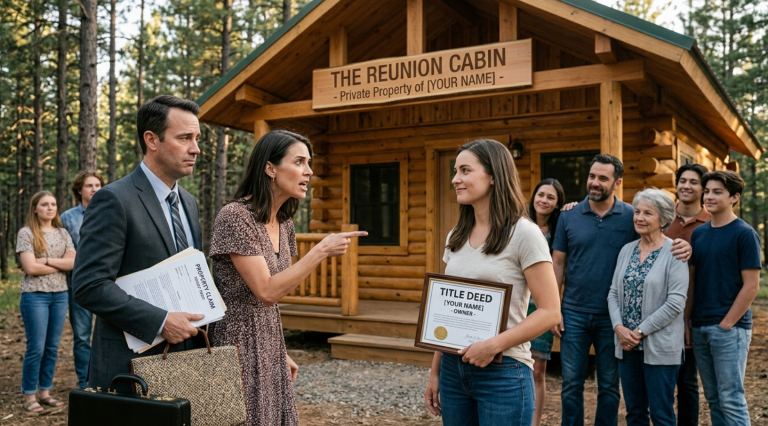
At exactly 10:57 a.m., two vehicles turned onto my gravel driveway.
The first was Dara’s white SUV.
The second was a dark blue sedan with county plates.
My stomach tightened.
“There they are,” I whispered.
Patricia didn’t even stand.
She calmly closed one binder and folded her hands.
“Remember,” she said. “Don’t argue. Let documents do the talking.”
The SUV door opened.
Dara climbed out wearing expensive hiking boots she’d probably never hiked in.
Behind her came a tall man in his sixties carrying a briefcase.
Gray hair.
Navy blazer.
Professional posture.
He introduced himself before anyone else could speak.
“Good morning. I’m Richard Holloway.”
Patricia stood.
“Patricia O’Day.”
The two attorneys shook hands with the polite stiffness of people measuring each other before a chess match.
Dara barely looked at me.
Instead, her eyes wandered across the porch, the rocking chairs, the flower boxes, and finally the mountains beyond the railing.
“So this is it,” she said quietly.
I nodded.
“My home.”
She smiled, but there wasn’t warmth in it.
“It’s beautiful.”
For a brief second, I almost believed she meant it.
We sat around the kitchen table.
Richard removed several photocopied documents from his briefcase.
Patricia waited.
No interruptions.
No dramatic speeches.
Richard cleared his throat.
“My client believes there may be an unrecorded historical interest connected to this parcel through the Whitmore family.”
Whitmore.
Our grandfather’s last name.
He slid an old yellowed photocopy across the table.
“This is an 1894 tax ledger.”
Patricia examined it.
“So?”
“It references approximately eighty acres owned by Elias Whitmore in this region.”
She nodded.
“It does.”
Richard looked encouraged.
Dara leaned forward.
“That proves Grandpa’s family owned this land.”
Patricia finally spoke.
“No. It proves someone named Elias Whitmore owned some land in this county in 1894.”
She pointed toward the survey map.
“This county contains more than three hundred thousand acres.”
Silence.
Richard adjusted his glasses.
“We’re still tracing the exact location.”
Patricia smiled politely.
“Then you don’t yet know whether it has anything to do with this parcel.”
Dara crossed her arms.
“We’re close.”
I couldn’t stay quiet anymore.
“Dara, did you really come here because of ‘close’?”
She looked directly at me.
“I came because Grandpa always said our land was stolen.”
I blinked.
“He told us that when we were kids.”
“You remember.”
“I remember him telling ghost stories after dinner.”
“That wasn’t a ghost story.”
“No,” I said carefully. “It was a story. There’s a difference.”
Richard asked whether we could walk the property.
Patricia agreed.
The four of us followed the creek toward the eastern boundary.
Leaves covered the trail in bright orange.
Water rushed gently over smooth stones.
Richard compared landmarks against an old topographic map.
Every few minutes he stopped to make notes.
Dara seemed increasingly confident.
“You see those stone piles?” she said.
“Grandpa talked about old field walls.”
Patricia answered before I could.
“Stone piles exist throughout Appalachia. Farmers cleared fields everywhere.”
Dara frowned.
“You have an explanation for everything.”
“I have evidence for everything.”
That landed harder than anyone expected.
Halfway through the walk, we reached the oldest part of the property.
An abandoned chimney stood alone where a farmhouse had disappeared decades earlier.
Only stacked stones remained.
Dara’s eyes widened.
“There.”
She hurried toward it.
“I knew it.”
She placed her hand on the weathered chimney.
“Grandpa described this exact fireplace.”
I looked at it.
It was beautiful.
Gray stone.
Covered in moss.
But beautiful didn’t mean familiar.
Richard examined the foundation carefully.
Then he surprised everyone.
“Dara…”
She turned hopefully.
“We should be careful.”
“What do you mean?”
“This structure appears to date from the early twentieth century, not the 1800s.”
Her expression changed.
“But Grandpa—”
“I’m saying we need proof before making that conclusion.”
For the first time all day, her own attorney corrected her instead of supporting her.
Back at the cabin, Patricia opened another binder.
“I have something you may find useful.”
She produced certified copies from the county archives.
“Here is the deed creating this parcel in 1958 after a subdivision.”
Another page.
“Here is the transfer in 1976.”
Another.
“1989.”
“2004.”
“2023—my client’s purchase.”
Each carried recording stamps.
Book numbers.
Page numbers.
Official seals.
Richard studied them carefully.
He spent nearly ten minutes comparing references.
Finally, he leaned back.
“These appear complete.”
Dara looked at him.
“What does that mean?”
“It means the chain of recorded ownership is uninterrupted.”
“But Grandpa—”
He raised a gentle hand.
“Recorded ownership and family history are different subjects.”
Her face flushed.
“You’re giving up already?”
“I didn’t say that.”
“You’re supposed to be representing me.”
“I am.”
He spoke calmly.
“And part of representing you is telling you when evidence does or does not support a legal claim.”
The room became so quiet I could hear the refrigerator humming.
I thought it was over.
I truly did.
Then Dara reached into her purse.
“There’s one more thing.”
She unfolded a faded letter.
“This was found in Grandma’s cedar chest after she died.”
The handwriting was almost impossible to read.
She handed it to me.
It was addressed to Elias.
The date was 1931.
Most of the ink had faded, but one sentence remained legible:
They forced us off the mountain before winter.
I swallowed.
It was real.
Old paper.
Real handwriting.
Real grief.
For the first time that day, I understood why Dara believed this so deeply.
She wasn’t inventing family pain.
She had inherited it.
Patricia read the letter quietly.
Then she returned it.
“This is historically meaningful,” she said gently.
“It may even describe a terrible injustice.”
Dara looked hopeful again.
“But,” Patricia continued, “it still does not identify this parcel.”
Hope disappeared from Dara’s face.
Richard nodded in agreement.
“I have to concur.”
The meeting ended without shouting.
Without slammed doors.
Without victory speeches.
Richard packed his briefcase.
“I’ll continue researching the historical records,” he said, “but I cannot recommend filing any ownership action based on what I’ve seen today.”
He looked at me.
“Your documentation is exceptionally thorough.”
After they drove away, I stood on the porch watching dust settle over the gravel road.
I expected relief.
Instead, I felt unexpectedly sad.
Because somewhere in our family’s past, someone probably had lost land.
Just not this land.
Patricia joined me outside with two mugs of fresh coffee.
“You did well,” she said.
“Did I?”
“You let facts stay separate from feelings.”
I stared across the ridge.
“I wish Dara could.”
Patricia was about to answer when her phone rang.
She glanced at the screen.
Her expression changed instantly.
She answered.
“Yes?”
She listened for nearly a minute without speaking.
Then she looked at me.
“Are you absolutely certain,” she asked slowly, “that no one besides you has ever had access to your original deed?”
A cold feeling settled in my chest.
“No… why?”
Patricia lowered the phone.
“The county recorder just called.”
She took a slow breath.
“Someone filed a document against your property yesterday morning.”