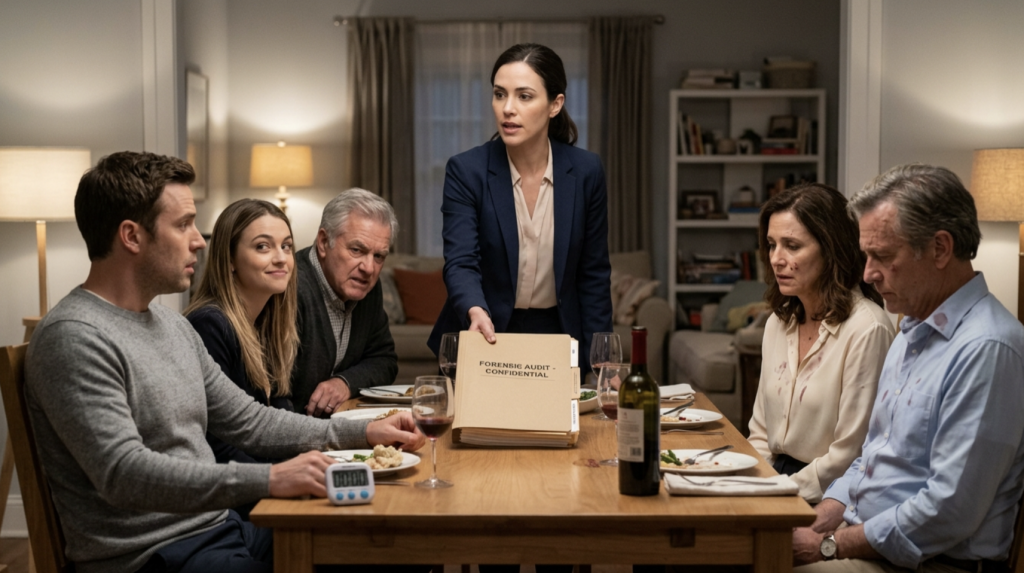
I opened the folder.
The first page was a single sheet.
At the top was the logo of Harrington Group.
Beneath it, in bold black letters:
PRELIMINARY FORENSIC ACCOUNTING REVIEW
Madison leaned forward.
“What is that?”
I slid the first page across the table.
She glanced at it.
Then her face changed.
Just slightly.
But I saw it.
Fear.
Not embarrassment.
Not anger.
Fear.
Charles noticed.
“What does it say?”
Madison quickly pulled the page toward herself.
“Nothing.”
I almost smiled.
“That’s interesting.”
“What?”
“You didn’t even read the second page.”
Madison’s fingers tightened around the paper.
Daniel looked at her.
“Madison?”
She didn’t answer.
Charles reached for the document.
She pulled it away.
“Dad, it’s nothing.”
I looked at Charles.
“Then you won’t mind reading it.”
He snatched the page from her hand.
His eyes moved down the first paragraph.
Then the second.
His face became increasingly rigid.
“What is this?”
“Exactly what it says.”
He looked at me.
“This isn’t authorized.”
“It doesn’t need to be.”
“I am the chairman of this company.”
“And I’m the person who signed the bank guarantee.”
Silence.
That sentence landed differently.
Daniel’s face went pale.
Charles slowly placed the document on the table.
“You wouldn’t.”
“I already did.”
I reached into the folder and removed another document.
Then another.
Then another.
The stack seemed endless.
Daniel finally whispered, “How long have you been doing this?”
“Six months.”
Madison shot up from her chair.
“You’ve been investigating me?”
“I’ve been investigating the company’s financial records.”
“You went through my personal expenses!”
“Expenses charged to a corporate account aren’t personal.”
“You had no right!”
“I had every right.”
I turned the page toward her.
“Especially after the board’s audit committee received three anonymous complaints regarding unexplained reimbursements.”
Madison froze.
Daniel looked at her.
“You never told me about that.”
She snapped back.
“Because they were ridiculous!”
“Were they?”
I pushed a second document forward.
“This is the Miami hotel invoice.”
Madison’s lips parted.
“You said you were in Milwaukee.”
“I changed plans.”
“You charged the hotel to Harrington Group.”
“It was business.”
“The hotel reservation lists you and a man named Grant Ellison.”
Her face drained.
Charles looked at Madison.
“Who is Grant?”
Nobody answered.
I watched Daniel.
He looked confused.
Genuinely confused.
That told me something.
There were still things even he didn’t know.
I continued.
“Grant Ellison is the vice president of Northstar Logistics.”
Charles stiffened.
“So?”
“So Northstar Logistics became one of Harrington Group’s largest vendors last year.”
I turned another page.
“Three months after Madison began charging personal expenses to the company card, Northstar’s contract increased by thirty-eight percent.”
Charles stared at me.
“Are you accusing my daughter of bribery?”
“No.”
I paused.
“I’m telling you what the documents show.”
I slid a spreadsheet across the table.
“Northstar paid Harrington Group for services that were never fully delivered. Harrington Group then paid a consulting company called Meridian Advisory.”
Charles looked at the name.
His eyebrows narrowed.
“What’s Meridian?”
“A company registered in Delaware.”
“So?”
“The registered agent is the same attorney who formed another company.”
I turned the page.
“Brightwell Holdings.”
Daniel’s eyes narrowed.
“Why does that matter?”
I looked at him.
“Because Brightwell Holdings owns a forty percent interest in a restaurant group.”
Madison’s face had gone completely white.
I continued.
“And that restaurant group owns the building where Madison’s new boutique is located.”
No one spoke.
My mother looked at me.
Dad stared at the documents.
Charles looked at Madison.
Madison finally whispered:
“This is insane.”
“Then explain it.”
“I don’t have to explain anything to you.”
“Correct.”
I closed the folder.
“You don’t have to explain anything to me.”
I looked around the table.
“But you will have to explain it to the people who are coming.”
Daniel frowned.
“Who?”
I reached into my purse and took out my phone.
“Outside this room are two attorneys, a forensic accountant, and Harrington Group’s lender’s representative.”
Charles stood so quickly that his chair scraped against the floor.
“You called the bank?”
“Yes.”
“You had no authority to do that.”
“I did.”
“You’re trying to destroy this family.”
I looked at him.
“No.”
My voice remained calm.
“I’m trying to stop the family from destroying itself.”
Charles pointed toward the door.
“Get out.”
I nodded.
“I will.”
Daniel stared at me.
“Claire.”
I turned toward him.
“But before I leave, you need to understand something.”
He said nothing.
“For four years, I have protected this company.”
I touched the folder.
“I protected your father’s reputation.”
I touched another stack.
“I protected your sister.”
Then I looked directly into his eyes.
“And I protected you.”
His face tightened.
“I never asked you to.”
“No.”
I swallowed.
“You just benefited from it.”
His expression faltered.
That was the first time that night he looked ashamed.
But it wasn’t enough.
I turned toward my parents.
“Mom, Dad, let’s go.”
My mother stood.
Dad followed.
Before we reached the door, Charles spoke.
“Arthur.”
Dad stopped.
Charles’s voice was colder now.
“If you walk out with her, don’t expect anything from this family again.”
Dad slowly turned.
He looked at Charles for several seconds.
Then he smiled.
It wasn’t a happy smile.
It was the smile of a man who had finally stopped caring what someone thought of him.
“Charles,” Dad said quietly, “your family stopped being my family a long time ago.”
Charles’s jaw tightened.
Dad continued.
“My daughter married your son. That does not give you ownership over her.”
Then he walked out.
My mother followed.
I was halfway through the doorway when Daniel called my name.
“Claire.”
I stopped.
He walked toward me.
His voice was low.
“Are you really filing for divorce?”
I looked at him.
“I already spoke with my attorney.”
His face changed.
“When?”
“Three weeks ago.”
He stared at me.
Three weeks.
He understood what that meant.
I hadn’t made the decision tonight.
Tonight had simply confirmed it.
“Why didn’t you tell me?”
I gave him a tired smile.
“Because every time I told you I was hurt, you asked me to wait.”
He looked down.
“I thought things would change.”
“So did I.”
I walked away.
But I didn’t know yet that leaving that dining room was only the beginning.
Because the next morning, at 7:14 a.m., my phone rang.
It was the chairman of Harrington Group’s board.
And the first thing he said was:
“Claire, don’t go to work today.”
I sat up in bed.
“Why?”
There was a long pause.
Then he said:
“Because someone has been deleting financial records.”
My stomach tightened.
“Who?”
“We don’t know.”
“What records?”
His voice dropped.
“Everything connected to the forensic review.”
I looked toward the folder sitting on my desk.
“What about the backups?”
“They’re gone too.”
I froze.
“That’s impossible.”
“No,” he said.
“It’s worse than impossible.”
“What do you mean?”
“We found the deletion logs.”
I held my breath.
“Whose credentials were used?”
Another silence.
Then he said the words that made my blood run cold.
“Yours.”
PART 4
For several seconds, I couldn’t speak.
My hand tightened around the phone.
“Mine?”
“Yes.”
“That can’t be right.”
“I know.”
The board chairman’s voice was unusually quiet.
“That’s why I’m calling you before anyone else.”
I got out of bed.
“Tell me exactly what happened.”
“At 6:42 this morning, our IT security system flagged unusual activity on the accounting server. Someone accessed the archived financial records using your credentials.”
“I was asleep.”
“I know.”
“Then someone stole my credentials.”
“That’s our assumption.”
“Who has access?”
“That’s what we’re trying to determine.”
I walked toward my desk.
The manila folder was exactly where I had left it.
Except something was wrong.
The folder was open.
I stopped.
I had closed it before leaving the restaurant.
I was certain.
Slowly, I walked closer.
The pages inside were still there.
But the top sheet was missing.
The preliminary forensic accounting review.
The one containing the summary of the transactions.
I touched the remaining papers.
“Someone has been in my house.”
The chairman went silent.
“What?”
“My folder.”
I looked around the room.
Nothing appeared disturbed.
No broken lock.
No open window.
No overturned furniture.
But that somehow made it worse.
Whoever had entered hadn’t come to steal jewelry.
They had come looking for paper.
“I need you to listen carefully,” the chairman said. “Do not go to the office. Do not access the company system from your home computer. And don’t contact Madison.”
“I wasn’t planning to.”
“Good.”
“What about Daniel?”
Another pause.
“I’d be careful with him too.”
My chest tightened.
“You think Daniel is involved?”
“I didn’t say that.”
“You implied it.”
“I said you should be careful.”
I sat on the edge of the bed.
“Why?”
“Because your credentials were used from a device registered to the executive suite.”
My breathing stopped.
“The executive suite?”
“Yes.”
“Whose computer?”
“We’re still checking.”
I already knew.
“Charles?”
“No.”
“Madison?”
“No.”
“Then who?”
The chairman hesitated.
“Daniel.”
I closed my eyes.
Of course.
For four years, I had built a wall between my professional life and my marriage.
I had never brought confidential company information home.
I never discussed private board matters with Daniel.
But he had always known my passwords for ordinary household accounts.
He knew where I kept my work laptop.
He knew my schedule.
He knew when I was at the office.
And he knew how much I trusted him.
Or, at least, how much I used to.
“Are you certain?” I asked.
“The device used was assigned to Daniel’s executive office.”
I stared at the wall.
“Can you prove he was physically there?”
“No.”
“Then don’t accuse him.”
The chairman sighed.
“I wasn’t going to.”
“Good.”
I ended the call.
For almost a minute, I sat completely still.
Then I opened my laptop.
I didn’t connect to the company network.
Instead, I opened a personal encrypted drive where I had kept copies of every document related to the investigation.
I had learned long ago that financial records could disappear.
People could lie.
Servers could fail.
Companies could suddenly discover that files had been “misplaced.”
Paper could burn.
But copies could survive.
I entered the password.
The folder opened.
Then I noticed something.
One file was missing.
My heart began pounding.
I had saved a copy of the transaction trail from Meridian Advisory.
It wasn’t there.
I checked the backup.
Nothing.
I checked the external drive.
Nothing.
I checked the cloud storage.
The file had been deleted there too.
Someone hadn’t just accessed the company.
Someone had systematically hunted the evidence.
I reached for my phone.
Before I could make a call, it rang.
Daniel.
I watched his name on the screen.
I didn’t answer.
He called again.
Then again.
Finally, a message appeared.
Please answer. We need to talk.
Another message followed.
Claire, I swear I didn’t know about any of this.
I stared at those words.
I hadn’t told him about the missing files.
I hadn’t told him the board had called.
I hadn’t told him his executive computer had been used.
Yet somehow he knew something was wrong.
I called him.
He answered immediately.
“Claire?”
“Why did you say you didn’t know?”
Silence.
“What?”
“You said you didn’t know about any of this.”
“I meant Madison’s expenses.”
“No.”
I kept my voice calm.
“You said, ‘I swear I didn’t know about any of this.’”
Another silence.
Then:
“Someone told me.”
“Who?”
“Dad.”
“When?”
“This morning.”
“What exactly did he tell you?”
Daniel exhaled.
“He said you had turned over financial records.”
“To whom?”
“I don’t know.”
“Daniel.”
“I don’t know!”
His voice cracked.
For the first time since the dinner, I heard genuine fear.
“What happened?” I asked.
“He said the company might be investigated.”
“It might be.”
“And that you’re responsible.”
I almost laughed.
“I’m responsible?”
“He said you violated company confidentiality.”
“Interesting.”
“What?”
“He didn’t tell you the company records were deleted?”
Daniel went quiet.
“How do you know?”
“The board contacted me.”
“What did they say?”
“That someone accessed the accounting system using my credentials.”
He didn’t answer.
“Daniel?”
“I didn’t do it.”
“I didn’t accuse you.”
“But you thought it.”
“I said your office computer was used.”
He breathed in sharply.
“My computer?”
“Yes.”
“That doesn’t make sense.”
“Where were you at 6:42 this morning?”
“At home.”
“With me?”
“No.”
I waited.
He understood the question.
“You left before I woke up,” I said.
“I couldn’t sleep.”
“Where did you go?”
“I went to the office.”
My stomach tightened.
“At what time?”
“Around six.”
“Why?”
“I needed to talk to Dad.”
“About what?”
“I don’t know.”
“You don’t know?”
“He called me.”
“What did he want?”
“I already told you. He said there was a problem.”
“Did you use your computer?”
“Yes.”
“Did you access the accounting system?”
“No.”
“Are you sure?”
“Yes.”
I believed his fear.
I wasn’t sure I believed his innocence.
“Daniel.”
“Yes?”
“Did you know Madison had been charging personal expenses to the company?”
Silence.
That silence was enough.
“You knew.”
“No.”
“Daniel.”
“I knew about some expenses.”
“How many?”
“I don’t know.”
“Did you know about the Miami hotel?”
“No.”
“Northstar?”
He didn’t answer.
“Daniel.”
“I knew Dad was giving Madison money.”
“That wasn’t my question.”
“I didn’t know where it came from.”
I stood.
“Did you know about Meridian Advisory?”
Nothing.
That was worse.
“Daniel?”
Finally he whispered:
“Yes.”
My throat tightened.
“How long?”
“I found out about it two months ago.”
“And you didn’t tell me.”
“I was going to.”
“When?”
“I don’t know.”
“After the company collapsed?”
“No.”
“After I signed another guarantee?”
“No.”
“After you let my parents be humiliated at dinner?”
“Claire—”
“You knew.”
“I was trying to fix it.”
“You were trying to protect your family.”
“Yes.”
“And I wasn’t part of your family?”
“That isn’t fair.”
I laughed bitterly.
“Fair?”
I looked at the wedding photograph sitting on my dresser.
Eight years.
Eight years of believing I had married a man who would stand beside me.
“I spent four years protecting your family’s company.”
“I know.”
“I risked my professional reputation.”
“I know.”
“I signed a personal guarantee.”
“I know.”
“And you knew your father was moving money through shell companies.”
“I didn’t know it was illegal.”
I stopped.
“What did you just say?”
“I didn’t know.”
“Who told you it was legitimate?”
“My father.”
Of course.
I sat back down.
“Daniel, listen to me carefully.”
“I’m listening.”
“If you are telling me the truth, you need your own lawyer.”
“I don’t want a lawyer.”
“You need one.”
“Claire—”
“You need someone who does not work for your father, your company, or your family.”
He was silent.
“Why are you helping me?” he finally asked.
“I’m not helping you.”
“Then why?”
“Because despite everything, I don’t want you going to prison for something you didn’t do.”
His voice softened.
“Claire.”
“I have to go.”
“Wait.”
“What?”
“I love you.”
My eyes closed.
That sentence used to be enough.
It wasn’t anymore.
“Love isn’t supposed to require this much forgiveness,” I said.
Then I ended the call.
I sat there for another minute.
Then my phone rang again.
This time it was an unknown number.
I answered.
“Hello?”
A man’s voice spoke.
“Mrs. Harrington?”
“Yes.”
“This is Grant Ellison.”
My entire body went still.
Madison’s hotel companion.
The Northstar executive.
The man whose name appeared in the forensic report.
“What do you want?”
“I need to meet you.”
“Why?”
“Because Madison lied to you.”
I said nothing.
“She wasn’t in Miami for a client meeting.”
“I know.”
“You don’t know the half of it.”
“Then tell me.”
“I can’t over the phone.”
“Why?”
“Because if they’re monitoring the company systems, they’re probably monitoring you too.”
My eyes moved toward the laptop.
“Who is ‘they’?”
“I don’t know.”
“Then why should I trust you?”
“You shouldn’t.”
That answer surprised me.
“But you should hear what I have.”
“When?”
“Today.”
“Where?”
“Somewhere public.”
I gave him a place.
He agreed.
Before hanging up, he said:
“And Claire?”
“Yes?”
“Bring the folder.”
My grip tightened around the phone.
“How do you know about the folder?”
He paused.
“Because I helped create it.”
The line went dead.
I stared at the phone.
Then I looked at the folder on my desk.
For the first time, I realized something.
The financial investigation hadn’t begun six months ago.
Not really.
I had only discovered it six months ago.
Someone else had been watching Harrington Group long before I was.
And whoever that person was had known exactly where the money was going.
Exactly who was receiving it.
And exactly how far my father-in-law was willing to go to protect it.
I opened the folder again.
At the very bottom was a document I had almost forgotten.
A photocopy of a bank transfer.
The sender:
Harrington Group Holdings.
The recipient:
Meridian Advisory LLC.
Amount:
$1,850,000.
Date:
Three years earlier.
The same month Daniel and I bought our house.
I stared at the date.
Then I noticed something I had never seen before.
The transfer description contained four words:
Settlement — D. Harrington.
Daniel Harrington.
My husband.
I felt the room tilt.
There was no way.
I checked the original.
Then the backup.
Then the scanned bank statement.
The information was real.
My husband’s name was attached to a payment of $1.85 million.
And suddenly, the question was no longer whether Daniel had known about his family’s financial crimes.
The question was much worse.
What had my husband received in return?
I reached for my coat.
I was going to meet Grant Ellison.
But before I could leave, someone knocked on my front door.
Three slow knocks.
I froze.
No one was supposed to be there.
I looked through the peephole.
And my blood ran cold.
Daniel was standing outside.
But he wasn’t alone.
Beside him was Charles.
And behind them stood two men I had never seen before.
One was holding a black briefcase.
The other was holding a thick envelope.
Daniel looked directly into the security camera.
Then he said through the door:
“Claire, please open the door.”
I didn’t move.
Charles stepped forward.
His voice came through the door.
“This is your last chance to handle this privately.”
I looked down at the folder in my hands.
Then at the deadbolt.
For the first time in my life, I understood exactly what my father had meant when he once told me:
“When powerful people become afraid, they stop asking.”
Another knock.
Harder this time.
Charles’s voice came again.
“Open the door, Claire.”
I stepped backward.
And quietly locked the second deadbolt.
Because whatever was inside that envelope…
I had a feeling it was going to change everything.
CONTINUE READING NEXT PART HERE
PART 5
I didn’t open the door.
Not immediately.
I stood in the hallway with my back against the wall, holding my phone in one hand and the forensic file in the other.
Three people stood outside my house.
Daniel.
Charles.
And two strangers.
I didn’t know who the strangers were.
But I knew one thing.
They hadn’t come to apologize.
My phone vibrated.
A message from Grant.
Don’t meet me at the place we discussed. Someone is following me.
A second message arrived.
Go somewhere safe. Then call this number.
Below it was a phone number I didn’t recognize.
I stared at it.
Then I heard Charles outside.
“Claire, this is becoming ridiculous.”
I didn’t answer.
“Open the door.”
Still nothing.
Daniel’s voice followed.
“Claire, please. I just want to talk.”
I almost laughed.
That sentence had become the soundtrack of my marriage.
I just want to talk.
It had meant let me explain why you shouldn’t be angry.
It had meant let me convince you to wait.
It had meant let me protect everyone except you.
But this time, I wasn’t going to open the door.
I called 911.
I didn’t mention everything.
I simply told the dispatcher that three men were outside my home and refusing to leave.
Within minutes, the atmosphere changed.
I heard Daniel whisper something.
Then Charles cursed.
A car door slammed.
When the police arrived, Daniel and Charles were still there.
The two strangers were gone.
I watched through the window as the officers spoke to them.
Daniel looked up toward the house.
Our eyes met through the glass.
He looked exhausted.
I almost felt sorry for him.
Almost.
Then I remembered my mother sitting beneath that chandelier with wine dripping from her hair.
I remembered my father cleaning his glasses.
I remembered Daniel looking down.
And the sympathy disappeared.
The officers eventually allowed Daniel to leave.
Charles was not so cooperative.
He argued.
He demanded to know why police were being called to “a family disagreement.”
One officer calmly told him that if he wanted to discuss family matters, he could do it somewhere else.
Charles finally left.
I locked the door behind them.
Then I sat on the floor.
For the first time that night, I let myself cry.
Not because I was afraid.
Because I was tired.
Tired of being strong.
Tired of proving I was right.
Tired of carrying a family that had spent years making me feel like an outsider.
My phone rang.
The number Grant had sent me.
I answered.
A woman spoke.
“Claire Morales?”
“Yes.”
“My name is Rebecca Lawson. I’m a federal financial crimes investigator.”
My heart stopped.
“Grant gave you my number?”
“He did.”
“Where is he?”
“He’s safe.”
I exhaled.
“Good.”
“He told me you’ve been reviewing Harrington Group’s financial records.”
“I have.”
“He also told me you may have evidence of unauthorized transfers.”
“I do.”
“Then you need to stop investigating on your own.”
I looked at the folder.
“Why?”
“Because you’re no longer dealing with corporate misconduct.”
“What am I dealing with?”
There was a pause.
“Potential financial fraud involving multiple entities.”
I closed my eyes.
“Is Daniel involved?”
“We don’t know.”
That answer somehow hurt more than a yes.
“Did he receive money?”
“We found a transfer with his name attached to it.”
My grip tightened around the phone.
“You know about the $1.85 million.”
“Yes.”
“How?”
“Grant gave us documents.”
I looked toward the window.
“Why would Daniel receive that money?”
“We don’t know yet.”
“Can you tell me what the payment was for?”
“No.”
She paused.
“But we found something else.”
“What?”
“The payment was reversed.”
I sat up.
“What?”
“Three days after the transfer, the same amount was sent back.”
“By Daniel?”
“No.”
“Then who?”
“Meridian Advisory.”
I frowned.
“That doesn’t make sense.”
“It does if the payment was being used as a temporary transfer.”
“For what?”
“We don’t know yet.”
She continued.
“But there’s something else you need to understand.”
“What?”
“The $1.85 million wasn’t the largest transfer.”
My stomach tightened.
“How much?”
“Over the last three years, approximately $14.7 million moved through related companies.”
I stared at the floor.
“Where did it go?”
“That’s what we’re tracing.”
I swallowed.
“Does Charles know?”
“We believe he does.”
“Madison?”
“We’re investigating.”
“Daniel?”
Another pause.
“We have no evidence yet that he knowingly participated.”
I closed my eyes.
That distinction mattered.
Not because it erased what he had done.
But because facts mattered.
I had spent my entire career working with numbers.
Numbers didn’t care who was guilty.
They only showed where the money went.
Rebecca told me to preserve everything.
Every email.
Every document.
Every message.
Every copy.
Then she said something I would never forget.
“Claire, don’t let anyone convince you that protecting yourself is betrayal.”
I thanked her.
After we hung up, I looked at my wedding ring.
I took it off.
For the first time in eight years, my finger felt strangely light.
The next morning, Daniel came to my lawyer’s office.
Not my house.
Not my workplace.
My lawyer’s office.
He came alone.
He looked different.
Smaller.
Like someone had finally taken away the protection he’d always had around him.
I sat across from him.
Neither of us spoke for several seconds.
Finally he said:
“I didn’t know.”
I looked at him.
“About what?”
“The money.”
“Which money?”
“All of it.”
I said nothing.
He rubbed his hands together.
“I knew Dad moved money around.”
“How much?”
“I don’t know.”
“You knew.”
“Yes.”
“When?”
“About two years ago.”
My chest tightened.
“And you said nothing.”
“I thought it was tax planning.”
“You never asked?”
“I did.”
“What did he say?”
“That it was temporary.”
“Did you believe him?”
“I wanted to.”
There it was.
The truth.
Not innocence.
Not guilt.
Something more painful.
Cowardice.
Daniel looked at me.
“I was scared.”
“So was I.”
“I thought if I confronted him, I’d lose everything.”
I stared at him.
“You were afraid of losing your inheritance.”
“No.”
“You were afraid of losing your father’s approval.”
He didn’t answer.
That was enough.
“I spent years thinking your father controlled you,” I said.
“He did.”
“No.”
Daniel looked up.
“You let him.”
His eyes filled.
“I know.”
That was the first honest thing he had said in years.
He pulled an envelope from his jacket.
“What is that?”
“My resignation.”
I didn’t touch it.
“From Harrington Group?”
“Yes.”
“Why?”
“Because I’m done.”
He placed it on the table.
“I’ve hired an attorney. I’m cooperating with the investigation.”
I studied him.
“Why now?”
“Because I finally realized something.”
“What?”
“If I keep protecting my family, I’ll lose the only person who ever actually stood beside me.”
My heart hurt.
But I didn’t reach for him.
“You already lost me.”
His eyes filled with tears.
“I know.”
He nodded slowly.
“I just wanted you to know that I understand why.”
For several minutes, neither of us spoke.
Then he said:
“I loved you.”
I looked at him.
“I believe you.”
His eyes lifted.
“But love isn’t enough.”
He nodded.
“I know.”
I slid a document across the table.
It was the first draft of our divorce agreement.
He looked at it.
Then signed.
No shouting.
No threats.
No dramatic scene.
Just a pen moving across paper.
Eight years of marriage ending in less than a minute.
When he stood, he hesitated.
“Claire?”
“Yes?”
“I am sorry.”
This time, I believed him.
But forgiveness didn’t mean returning.
I simply nodded.
“Goodbye, Daniel.”
He walked away.
I watched the door close.
And for the first time, I didn’t feel abandoned.
I felt free.
The investigation lasted eight months.
Eight months of subpoenas.
Audits.
Interviews.
Bank records.
Emails.
Corporate filings.
And thousands of pages of documents.
The forensic accountants eventually reconstructed what had happened.
Charles had created a network of related companies.
Money moved from Harrington Group to outside vendors.
Those vendors transferred portions of it to intermediary companies.
Some of those companies paid for personal expenses.
Some purchased property.
Some provided consulting agreements for services that never existed.
Madison had benefited from the arrangement.
Her luxury expenses were only the smallest visible part.
Charles had used company funds to support properties and investments that were never properly disclosed.
And the missing $14.7 million was not simply one act.
It was years of financial manipulation.
The evidence was overwhelming.
But there was one surprise.
Daniel had not designed the scheme.
He hadn’t created Meridian Advisory.
He hadn’t established the shell companies.
And he hadn’t knowingly participated in most of the transfers.
His biggest mistake had been knowing something was wrong and choosing silence.
That distinction mattered legally.
It also mattered personally.
Because I finally understood something about betrayal.
Sometimes betrayal isn’t what someone does.
Sometimes it’s what they refuse to do.
They refuse to speak.
They refuse to defend you.
They refuse to ask questions.
They refuse to stand beside you when standing beside you costs them something.
Daniel had spent years choosing silence.
And silence had consequences.
Madison eventually called me.
It was six months after the dinner.
I almost didn’t answer.
But I did.
“Hello?”
She was crying.
“I need to talk to you.”
“About what?”
“Everything.”
“I don’t think there’s anything left to discuss.”
“Please.”
I remained silent.
She continued.
“I know you hate me.”
“I don’t hate you.”
“Then why did you destroy my life?”
I took a breath.
“I didn’t.”
“You gave them the documents.”
“Yes.”
“You knew what would happen.”
“I knew the truth would come out.”
She began crying harder.
“I didn’t know Dad was doing all that.”
I believed she hadn’t known everything.
But I also remembered the Miami hotel.
The expense reports.
The lies.
“You knew enough to ask questions,” I said.
She was silent.
“I was stupid.”
“Maybe.”
“I was spoiled.”
“Yes.”
She sniffed.
“I was cruel to your parents.”
“Yes.”
“I thought they were beneath us.”
I said nothing.
“I was wrong.”
That was the first apology she had ever given me.
It wasn’t enough to erase what happened.
But I accepted it.
“Madison, I hope you learn from this.”
“I will.”
Then she whispered:
“Your mother never deserved that.”
“No.”
“She was always kind to me.”
I closed my eyes.
“She was.”
We ended the call.
I never spoke to her again.
My parents recovered.
Not financially.
Emotionally.
That took longer.
Mom still refused to wear white silk to formal dinners.
Dad stopped attending Harrington family events completely.
One afternoon, I found him sitting in his backyard reading a newspaper.
I sat beside him.
“Dad?”
“Hmm?”
“I’m sorry.”
He lowered the paper.
“For what?”
“For bringing you into that family.”
He smiled.
“You didn’t bring me anywhere.”
“What do you mean?”
“I came because I loved my daughter.”
My eyes filled.
He folded the newspaper.
“Claire, listen to me.”
I looked at him.
“You were never responsible for how other people treated us.”
“But—”
“No.”
He shook his head.
“You spent too much of your life trying to make other people behave.”
He put a hand over mine.
“You can’t control people’s character.”
I nodded.
“But you can control who gets access to you.”
That sentence stayed with me.
A year after the dinner, I opened my own financial consulting firm.
Nothing huge.
No marble lobby.
No family name above the door.
Just a small office downtown and three employees who cared about doing good work.
My first major client was a manufacturing company struggling with internal controls.
My second was a nonprofit.
My third was a family-owned business.
I almost laughed when they told me why they hired me.
“We heard you don’t tolerate financial nonsense.”
I smiled.
“I don’t.”
My parents helped me choose the office furniture.
Mom picked the curtains.
Dad assembled the bookshelves incorrectly and insisted they were supposed to lean.
I let him believe it.
For the first time in years, my life was quiet.
Then, one Friday afternoon, an envelope arrived.
No return address.
Inside was a photograph.
It was from the night of the anniversary dinner.
Someone had taken a picture of my mother and father immediately after the wine was thrown.
Mom was looking down.
Dad was cleaning his glasses.
And I was standing behind them.
My face was turned toward Daniel.
On the back of the photograph, someone had written:
You were right to leave.
I stared at the handwriting.
I recognized it.
Daniel.
There was no message from him.
No request.
No attempt to reopen anything.
Just the photograph.
I placed it inside a drawer.
Then I closed it.
Some memories don’t need to be destroyed.
They simply need to stop controlling you.
Two years later, I saw Daniel again.
It happened unexpectedly.
I was walking into a coffee shop when I saw him sitting near the window.
He looked older.
Not dramatically.
Just different.
He stood when he saw me.
“Claire.”
I smiled politely.
“Daniel.”
“How are you?”
“Good.”
He smiled.
“Really?”
“Really.”
We stood there for a moment.
He looked toward my left hand.
No wedding ring.
Then back at me.
“I heard about your company.”
“Congratulations.”
“Thank you.”
“I heard you left Harrington Group.”
“I did.”
“What do you do now?”
“I teach accounting at a community college.”
I smiled.
“That sounds like you.”
He laughed softly.
“I’m better at explaining numbers than I was at explaining myself.”
“That might be true.”
He looked down.
“I never remarried.”
I didn’t respond.
He quickly added:
“You don’t have to say anything.”
“I wasn’t going to.”
We both laughed.
It was the first time we had laughed together in years.
Then he became serious.
“I want you to know something.”
“What?”
“I finally understand what you meant that night.”
I waited.
“You weren’t asking me to choose between you and my family.”
His eyes met mine.
“You were asking me to choose whether I was going to stand beside you.”
I nodded.
“And I didn’t.”
“No.”
“I thought staying silent kept the peace.”
“It kept the peace for everyone except me.”
“I know.”
He swallowed.
“I wish I had understood sooner.”
“So do I.”
We stood silently.
Then he said:
“I hope you’re happy.”
“I am.”
He smiled.
“Good.”
I smiled back.
“Take care, Daniel.”
“You too.”
And that was it.
No reconciliation.
No dramatic embrace.
No second chance.
Just two people who had once loved each other finally accepting that love could end without becoming hatred.
I walked out of the coffee shop.
The afternoon sun was bright.
Cars moved through the street.
People hurried past me carrying coffee, groceries, briefcases, flowers.
Ordinary life.
Beautiful ordinary life.
I stopped on the sidewalk.
For years, I had thought my life would collapse if my marriage ended.
Instead, my life had finally begun.
Three months later, I invited my parents to dinner.
Nothing fancy.
Just a small restaurant with warm lighting and good food.
Mom wore a blue dress.
Dad wore the same expensive suit he had worn to the Harrington anniversary.
The stain was gone.
Mostly.
He had refused to throw it away.
When we sat down, Mom smiled.
“Why did you bring us here?”
“I wanted to celebrate.”
“Celebrate what?”
I reached into my purse.
Not a forensic file.
Not legal documents.
Not financial statements.
A photograph.
I placed it on the table.
It was the three of us outside my office.
Mom smiled.
Dad looked proud.
I looked happy.
Mom touched the photograph.
“You look different.”
“I feel different.”
Dad raised his glass.
“To new beginnings.”
Mom raised hers.
“To family.”
I lifted mine.
“To choosing people who choose you back.”
We touched glasses.
And I realized something.
That night at the Harringtons’ anniversary dinner, I had thought my five-minute timer was the end of my marriage.
I was wrong.
It was the beginning of my life.
The wine had stained my mother’s blouse.
It had stained my father’s suit.
It had stained a tablecloth that probably cost more than my first car.
But the stain that mattered most wasn’t on the fabric.
It was on the illusion I had carried for years.
The illusion that keeping quiet was the same as keeping peace.
It wasn’t.
Silence had protected people who didn’t deserve protection.
My voice had finally protected the people who did.
I had once walked into the Harrington family believing I needed their approval.
I left understanding that I never had.
And when I think about that night now, I don’t remember the chandelier.
I don’t remember the wine.
I don’t remember Madison’s laughter.
I don’t even remember the exact moment the timer hit zero.
I remember my father putting his glasses back on.
I remember my mother reaching for my hand.
And I remember realizing that sometimes the strongest thing a person can do isn’t to fight harder.
Sometimes it’s simply to stop standing where they are not respected.
So I chose my parents.
I chose my dignity.
I chose the truth.
And, finally, I chose myself.
That was the real consequence nobody at that table had expected.
Not the forensic file.
Not the investigation.
Not the divorce.
Not the collapse of the Harrington empire.
The real consequence was that I stopped asking people to love me correctly.
I simply walked away from those who wouldn’t.
And for the first time in my life…
I didn’t look back.
THE END