PART 3
She nodded slowly.
“Then you need to speak with a family-law attorney as soon as possible. Bring every financial document you have.”
I almost laughed.
“I don’t have access to the financial documents anymore.”
The clerk’s expression changed.
“Then start with whatever you can prove.”
Those words stayed with me.
Whatever you can prove.
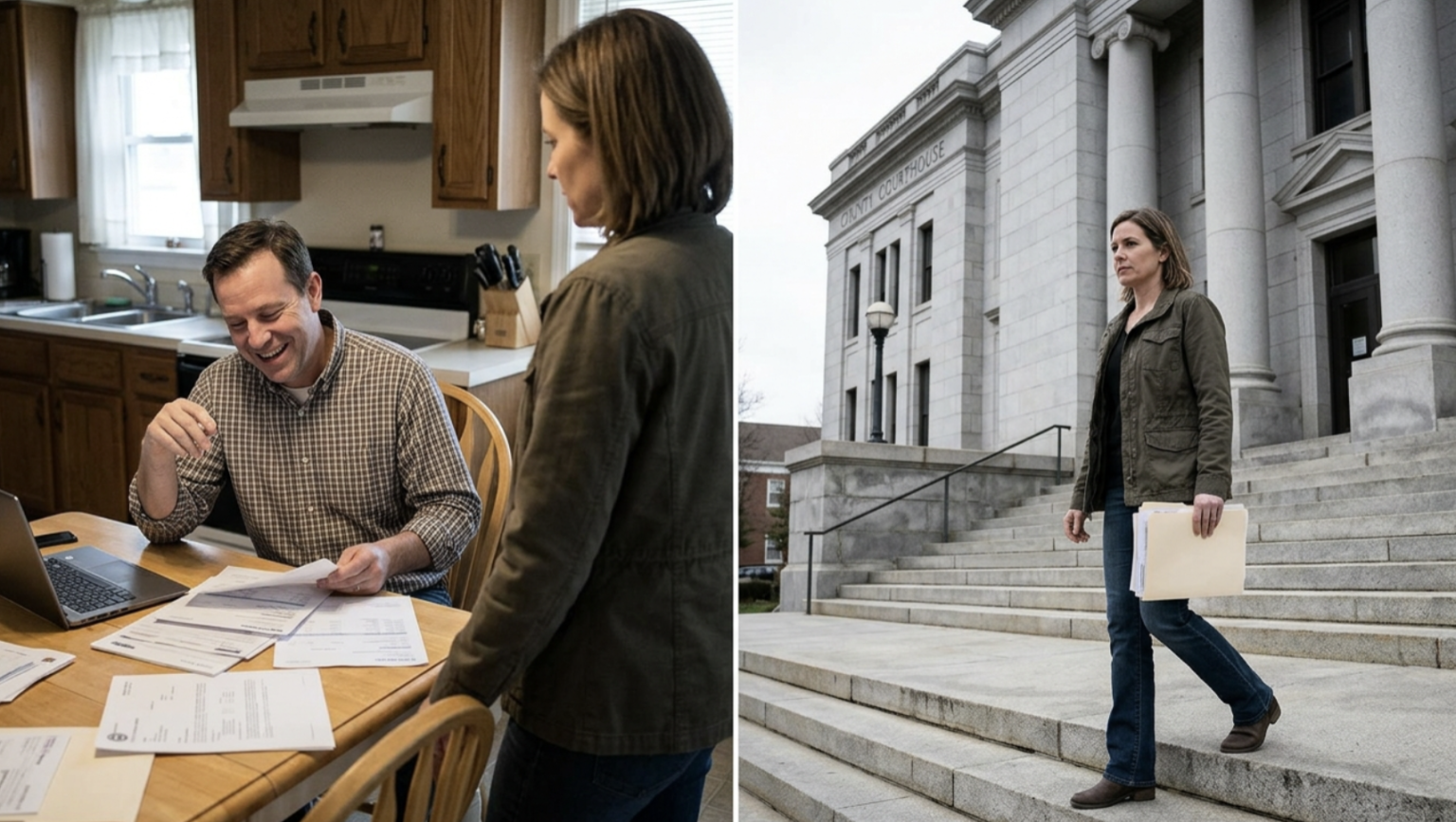
I walked out of the courthouse carrying a thin folder containing my father’s deed, my marriage certificate, an old property-tax receipt, and a copy of my father’s probate documents.
It didn’t look like much.
But for the first time in years, I realized something important.
I didn’t need to prove that I had sacrificed for Travis.
I needed to prove what actually belonged to whom.
And that was a very different question.
I drove to a small law office several blocks away.
The sign outside read:
MORGAN & REED — FAMILY LAW AND PROPERTY MATTERS
I almost turned around.
I had never been inside a lawyer’s office for anything other than signing paperwork.
My hands were shaking when I opened the door.
A receptionist asked if I had an appointment.
“No.”
She gave me a sympathetic smile.
“I’m afraid our attorneys are booked today.”
I placed the folder on the counter.
“My husband emptied our joint account, removed my access from our financial accounts, and may have transferred marital money somewhere I can’t access.”
The receptionist stopped typing.
“And you own the home?”
“Before the marriage.”
That changed everything.
She picked up the phone.
“Let me see if someone can speak with you.”
Twenty minutes later, I sat across from an attorney named Evelyn Morgan.
She was probably in her fifties, with silver streaks in her dark hair and the calmest expression I’d seen all day.
She opened my folder.
She read the deed.
Then the probate document.
Then the marriage certificate.
Then she looked at me.
“June, tell me exactly what happened.”
So I did.
I told her about the tax office.
The changed billing information.
The closed bank account.
The missing money.
The password.
The phone call.
And finally, I repeated the sentence Travis had laughed when he said.
“I earn it, June. I decide who touches it.”
Evelyn didn’t react.
She simply wrote something down.
Then she asked,
“How much money was in the joint account before he closed it?”
“I don’t know exactly.”
“Approximately?”
“Maybe forty thousand.”
Her pen stopped.
“Forty thousand?”
“Yes.”
“And you said there were other accounts?”
“Yes.”
“Do you know how many?”
“No.”
“Do you know where his paycheck was deposited?”
“Usually our joint checking account.”
“Usually?”
I thought about it.
“Yes.”
“Then the first thing we need to determine is where the money went.”
She leaned back.
“June, I’m going to tell you something important. Don’t call him again about the finances.”
“Why?”
“Because right now, you don’t know what he’s done. Every conversation gives him another opportunity to move money, destroy records, or change his story.”
My stomach tightened.
“You think he might have done something illegal?”
“I don’t know.”
She looked directly at me.
“And I’m not going to guess.”
She opened a blank legal pad.
“But I am going to assume that if someone suddenly removes a spouse from accounts after nine years of marriage, transfers money without explanation, and then tells that spouse they have no right to access the money, there may be more to investigate.”
I swallowed.
“There is something else.”
“What?”
“I don’t think this started four days ago.”
Evelyn waited.
“I think he’s been preparing for it.”
She raised an eyebrow.
“Why?”
“Because the tax billing profile was changed in February.”
“And?”
“He was offshore then.”
“Did you make the change?”
“No.”
“Did you authorize it?”
“No.”
“Then someone had your property information and deliberately redirected correspondence.”
My mouth went dry.
“Why would he do that?”
“I don’t know yet.”
That sentence scared me more than anything else.
Not knowing.
Because suddenly the missing bank access didn’t feel like an isolated act of arrogance.
It felt planned.
Evelyn asked me to list every account I knew about.
I named the joint checking account.
A savings account.
An emergency account.
A credit union account Travis had opened years earlier.
And an investment account.
“Was the investment account joint?”
“I don’t know.”
“You don’t know?”
“I never had access to it.”
Evelyn stared at me.
“June, how long has Travis controlled the household finances?”
“Almost nine years.”
“And you never saw statements?”
“He showed me summaries.”
“On paper?”
“Sometimes.”
“Online?”
“Sometimes.”
“Did you have passwords?”
“I used to.”
“Used to?”
“He changed them whenever he said the bank required it.”
Evelyn put down her pen.
“Did you ever question that?”
“Yes.”
“What did he say?”
I looked down.
“He said I didn’t understand financial security.”
Silence filled the room.
Then Evelyn asked quietly,
“What did you earn during the marriage?”
“I worked part-time from home for several years. Then I stopped when my mother got sick.”
“How much?”
“Not much. Maybe twenty thousand a year at most during the years I worked.”
“And who handled your earnings?”
“Travis.”
“All of them?”
“Yes.”
She nodded.
Then she asked a question that made something inside me crack.
“June, what do you believe you are entitled to?”
I opened my mouth.
Nothing came out.
I had spent so many years thinking in terms of what Travis allowed me to have that I couldn’t answer.
Evelyn waited.
Finally I whispered,
“I don’t know.”
She closed the folder.
“That is the first thing we’re going to change.”
I left her office just before five.
She had given me a list.
Bank statements.
Tax returns.
Mortgage records.
Insurance documents.
Retirement information.
Credit-card statements.
Property records.
Anything showing contributions I had made to the household.
I sat in my truck reading the list twice.
Then I laughed.
Not because anything was funny.
Because I suddenly understood how completely Travis had separated me from our financial life.
I had spent nine years maintaining the physical world while he maintained the financial one.
I knew every leak in the roof.
Every broken fence post.
Every contractor who had worked on the house.
Every tree that needed trimming.
Every insurance renewal date.
Every tax deadline.
But I didn’t know where our money was.
And Travis had counted on that.
I drove home.
The house looked exactly the same.
The porch.
The oak trees.
The pond.
The workshop my father had built.
The white mailbox beside the gravel drive.
Everything looked peaceful.
But I couldn’t look at it the same way.
For nine years, I had called it our home.
Now I understood why the deed mattered.
It wasn’t just a piece of paper.
It was the legal history of the place.
My father had left it to me.
And Travis had never owned it.
I walked inside.
The refrigerator was almost empty.
I hadn’t noticed before.
Travis had been taking groceries offshore with him for years because he said the food on the rig was terrible.
But now I realized he had also stopped leaving money in the account I used for household expenses.
He had planned this.
Maybe not the exact day.
Maybe not the exact argument.
But he had been preparing for a version of this.
I opened the kitchen drawer.
Inside were old receipts.
Contractor invoices.
Property-tax receipts.
Insurance renewal letters.
I began sorting them.
Then I found something.
A receipt from a roofing company dated three years earlier.
At the bottom, under payment information, was my name.
I had paid the entire $8,700 bill from my personal savings.
I remembered that day.
The roof had leaked during a storm.
Travis had said,
“We can’t afford that right now.”
I had used money I had inherited from my grandmother.
I had never mentioned it again.
I kept sorting.
Fence repair.
Pond maintenance.
Plumbing.
Electrical work.
Tree removal.
Property taxes.
Insurance.
Almost every year contained something I had paid for.
Not because Travis couldn’t afford it.
Because he told me money was tight.
I sat on the kitchen floor surrounded by receipts.
And for the first time, I wondered how much of our financial story had been true.
That night, Travis called.
His name appeared on my phone.
I stared at it.
Evelyn’s warning echoed in my mind.
Don’t call him again about the finances.
But he was calling me.
I answered.
“What?”
His voice sounded cheerful.
“You home?”
“Yes.”
“Good.”
There was a pause.
Then he said,
“I’ve been thinking about our conversation.”
I didn’t respond.
“You sounded upset.”
“I was.”
“June, you’re making this bigger than it is.”
I looked at the stack of receipts beside me.
“Are you sure?”
“Absolutely.”
He laughed softly.
“You know how dramatic you get when you’re stressed.”
I closed my eyes.
“What happened to the money?”
“What money?”
“The money from the joint account.”
Silence.
Then his voice changed.
“I already told you. I earn it.”
“That wasn’t my question.”
“You don’t need to worry about it.”
“I think I do.”
He exhaled.
“Look, I’m offshore. I don’t have time for this.”
“You had time to close the account.”
“That was financial planning.”
“You removed my access.”
“Because you spend without thinking.”
“I paid the property taxes.”
“You’re welcome.”
I almost laughed.
“For what?”
“For the money I’ve provided for nine years.”
I looked around the kitchen.
At the receipts.
At my father’s old house.
At the refrigerator that barely had food inside.
Then I asked,
“Travis, where is the forty thousand dollars?”
He didn’t answer.
“Travis?”
“It’s safe.”
“Where?”
“Somewhere you don’t have access to.”
My heart began pounding.
“Why?”
“Because I don’t trust you with money.”
I was quiet.
Then I asked,
“Did you move money from the other accounts too?”
Another silence.
That was my answer.
“How much?”
“Don’t worry about it.”
“How much?”
He snapped.
“Stop interrogating me!”
I held the phone away from my ear.
Then he said something that I would remember for the rest of my life.
“You’re going to regret making this difficult.”
I slowly brought the phone back.
“Is that a threat?”
“No.”
He laughed.
“It’s advice.”
Then he hung up.
I didn’t call him back.
Instead, I took a picture of my phone screen showing the call.
Then I wrote down the date.
September 20.
7:43 p.m.
I wrote his exact words underneath.
“You’re going to regret making this difficult.”
Then I opened a notebook.
At the top of the first page, I wrote:
EVERYTHING.
For the next four hours, I documented everything I could remember.
Every account.
Every bill.
Every major purchase.
Every time Travis told me money was tight.
Every time I paid for something myself.
Every property improvement.
Every conversation about finances.
Every password change.
Every time he told me I didn’t need to know something.
At 1:17 in the morning, I found another receipt.
This one was from a bank.
It was dated February.
The same month the property-tax profile had been changed.
The receipt wasn’t for a payment.
It was for a cashier’s check.
Amount:
$27,500.
Payee:
Hale Offshore Consulting LLC.
I stared at the paper.
Hale Offshore Consulting.
I had never heard of it.
I checked the date.
February 16.
Travis had been home that week.
I remembered because he had spent three days in the workshop and told me he was working on his fishing boat.
I picked up my phone.
My first instinct was to call him.
Then I remembered Evelyn.
Don’t call him.
So instead, I photographed the receipt.
I placed it inside the folder.
And I wrote one sentence beneath it:
I don’t think the forty thousand was the beginning.
The next morning, I went back to Evelyn’s office.
She was already there.
I handed her the folder.
She opened it.
She read the cashier’s check.
Then she looked at me.
“Where did you get this?”
“It was in an old folder.”
“Did Travis ever tell you about this company?”
“No.”
“Do you know what it does?”
“No.”
She typed something into her computer.
A few minutes passed.
Then she looked at the screen.
Her expression became very still.
“What?”
She turned the monitor slightly toward me.
The company was registered in Louisiana.
Hale Offshore Consulting LLC.
Registered agent:
Travis Hale.
Formation date:
January 28.
I felt cold.
January.
Only a few weeks before the property-tax information changed.
Only months before the bank account disappeared.
“Why would he create a company?”
Evelyn shook her head.
“We don’t know yet.”
She kept scrolling.
Then she stopped.
“June.”
“What?”
“There is something else.”
She turned the screen toward me.
The company had listed an address.
Not the house.
Not Travis’s offshore employer.
Not his parents’ address.
It was a small office suite in Lake Charles.
And beneath the business information was a filing date.
February 14.
Two days before the cashier’s check.
I stared at the screen.
“That’s Valentine’s Day.”
Evelyn nodded.
“Did he tell you he had a business?”
“No.”
“Did you sign anything?”
“No.”
“Did you authorize him to use marital funds to establish it?”
“No.”
She leaned back.
“Then we need to find out exactly where the money went.”
My phone vibrated.
A message from Travis.
I looked at it.
TRAVIS: We need to talk when I get home.
Another message arrived.
TRAVIS: Don’t involve anyone else in this.
I showed Evelyn.
She didn’t touch the phone.
She simply said,
“Keep every message.”
A third message appeared.
TRAVIS: I’m serious, June. This can still be fixed.
Then a fourth.
TRAVIS: If you make this ugly, you will lose everything.
I stared at the screen.
For nine years, I had been afraid of losing my marriage.
Now I was beginning to understand something.
Maybe Travis had spent nine years making me afraid of losing things that were never his to take.
I looked at Evelyn.
“What happens when he comes home?”
She closed the folder.
“That’s the question we’re going to prepare for.”
“How long until then?”
I checked his offshore schedule.
Seventeen days.
Seventeen days until Travis came home.
Seventeen days until he expected to walk through the front door, see me frightened and apologetic, and take control again.
He didn’t know I had already started building a file.
He didn’t know the property was still legally mine.
He didn’t know an attorney had begun examining the money.
And most importantly, he didn’t know that while he was offshore, I was finally learning how much of our life he had hidden from me.
I picked up the folder.
For nine years, Travis had believed he was the person holding all the cards.
But he had made one mistake.
He had confused having the passwords with owning everything.
And now I had seventeen days to find out exactly what he had been hiding.
Because when Travis Hale came home from the Gulf, I wasn’t going to be waiting for him with an apology.
I was going to be waiting with paperwork.
And somewhere inside that paperwork was the answer to the question I was almost afraid to ask:
Where had all our money really gone?
CLICK BELOW TO KEEP READING THE NEXT PART 👇