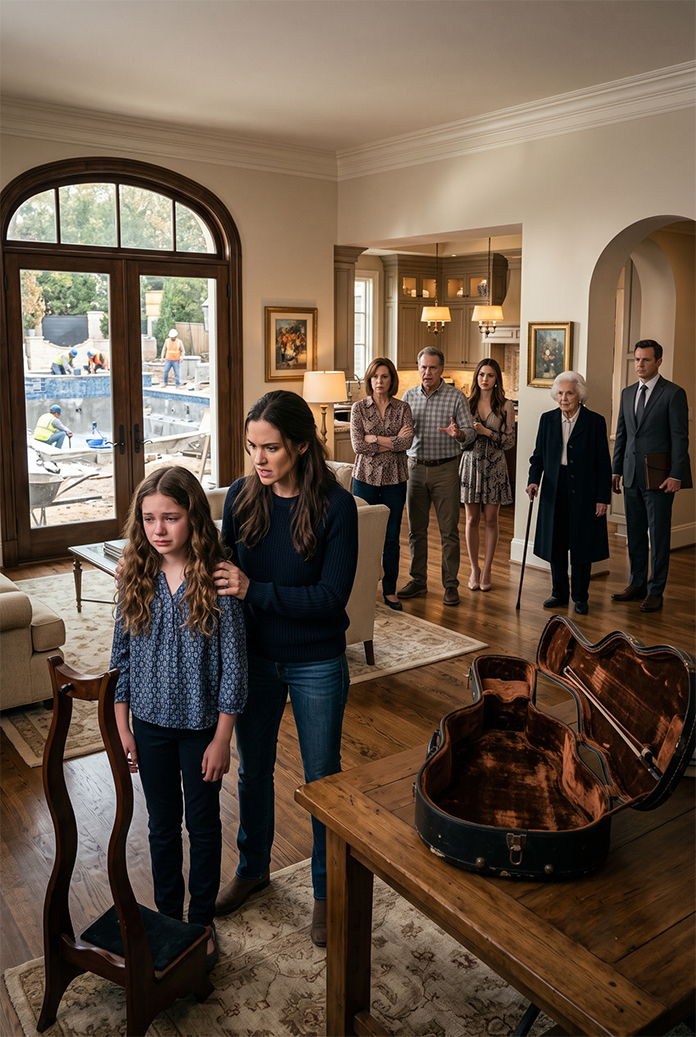
My parents sold my 11-year-old daughter’s $87,000 antique cello and turned it into a swimming pool for my sister’s kids. They thought the worst that could happen was an angry argument. Then my 92-year-old grandmother walked in, looked at the empty cello stand, and made a single phone call that changed everything.
“Where’s Ava’s cello?”
My mother, Patricia, looked up from her coffee.
My father, Richard, sat at the kitchen table with his tablet. My younger sister, Melissa, leaned against the counter while her 2 children chased each other through the hallway.
Outside, construction crews were finishing a large swimming pool.
But I barely noticed it.
I was staring into the music room.
For years, Grandma Evelyn’s antique cello had stood beside the tall windows there.
Grandma had formally given it to Ava on her 10th birthday. Because it was more than a century old and sensitive to humidity, we kept it in my parents’ climate-controlled music room, where Ava practiced twice a week.
Now the stand was empty.
Ava stood beside it.
Silent.
“Mom,” I asked again. “Where is the cello?”
Patricia glanced at my father.
Richard sighed.
“I sold it.”
I stared at him.
“You what?”
“It was worth far more than anyone expected.”
“That wasn’t yours to decide.”
Melissa rolled her eyes.
“Natalie, Ava is 11. She doesn’t need an $87,000 instrument.”
I froze.
“$87,000?”
Dad folded his arms.
“The dealer offered a fair price.”
I looked through the window.
At the pool.
Then back at him.
“You used Ava’s cello to pay for this?”
“The pool is for the whole family,” Melissa said.
“Your children spend half the summer here.”
“So does Ava.”
“No. Ava comes here to practice. Your children are getting a pool paid for with something that belonged to my daughter.”
Dad rubbed his forehead.
“She can use a student cello. Most kids her age rent instruments.”
Ava looked down.
My family had always expected her to be the easy one.
Ava will understand.
Ava will be fine.
Ava won’t mind.
I crossed the room and took her hand.
“Did Grandma give you permission to sell it?”
Dad didn’t answer.
That was enough.
Mom lowered her voice.
“Don’t call your grandmother.”
I turned.
“Excuse me?”
“She’s 92. She doesn’t need stress over a piece of furniture.”
“It’s not furniture.”
“Richard handled it.”
“How?”
Mom hesitated.
“He had the old appraisal and insurance documents.”
That made my stomach turn.
Grandma had left years of instrument records in the music room cabinet when she moved into assisted living.
Dad had taken them to a reputable antique-instrument dealer and signed paperwork stating that he had authority to sell the cello on behalf of the family.
He didn’t.
I took Ava home.
That evening, her teacher loaned her a student cello.
Ava played for 15 minutes before lowering the bow.
Then she asked quietly, “Did Great-Grandma change her mind?”
My chest tightened.
“No.”
“Then why did Grandpa sell it?”
I sat beside her.
“Sometimes adults convince themselves they have the right to take something just because they think nobody can stop them.”
“Was it really mine?”
“Yes.”
Grandma had prepared a deed of gift naming Ava as owner and me as custodian until she turned 18.
At the time, I had thought Grandma was being overly formal.
Now I was grateful.
The next morning, I drove to see her.
Grandma Evelyn was reading by the window when I arrived.
She took one look at me and closed the book.
“What did Richard do?”
I almost laughed.
“Why do you assume Dad did something?”
“Experience.”
I told her everything.
The missing cello.
The $87,000.
The pool.
The documents Dad had used.
My mother telling me not to call.
Grandma listened without interrupting.
When I finished, she asked, “What does Ava think?”
“She thinks you changed your mind.”
Grandma’s expression hardened.
She picked up her phone.
“Martin? It happened.”
A pause.
“The cello.”
Another pause.
“Yes. Contact the dealer. And open the other files.”
I frowned.
“What other files?”
Grandma ended the call.
Then she gave me a small, humorless smile.
“The cello was never your father’s to sell.”
“I know.”
“No, Natalie. You know the first problem.”
“What’s the second?”
“Your father has spent years confusing access with ownership.”
I stared at her.
“What does that mean?”
“One thing at a time.”
She squeezed my hand.
“First, we bring Ava’s cello home.”
The dealer moved quickly after Grandma’s attorney produced the deed of gift.
Because Dad never had legal title, the dealer initiated rescission of the sale.
The private buyer had purchased the cello in good faith, so the dealer guaranteed him a full refund and reimbursement of his related expenses. In return, he agreed to return the instrument.
My parents became responsible for reimbursing the dealer the full $87,000.
There was another problem for Dad.
He had signed a declaration stating that he was authorized to sell the cello.
Martin made it clear that fighting the rescission could expose him to a separate claim for misrepresentation.
Dad stopped arguing about whether the cello should come back.
But most of the money was already gone.
It was sitting in the backyard.
Six weeks later, my parents held a family gathering to show off the nearly finished pool.
Melissa’s children were already swimming.
A few close relatives stood around the patio.
Ava stayed beside me.
Then the side gate opened.
Grandma Evelyn walked in with Martin.
My mother’s smile vanished.
Dad stared at Martin’s folder.
“Mother, what is this?”
Grandma looked at the pool.
“An expensive misunderstanding.”
“Can we talk inside?”
“No.”
She handed him the deed of gift.
Dad read it.
His face lost color.
Grandma said, “The cello belonged to Ava.”
“She’s a minor.”
“And Natalie is the legal custodian of her property.”
She looked at him.
“You are not.”
Martin added, “The buyer is returning the cello. The dealer is refunding him. You are responsible for returning the $87,000.”
Dad looked toward the pool.
Grandma followed his gaze.
“Yes,” she said. “I imagine that complicates things.”
Melissa crossed her arms.
“This is ridiculous. It’s an instrument.”
Grandma turned toward her.
“My father played that cello. My husband played it. I played it for more than 60 years.”
She pointed toward the pool.
“That is concrete and tile.”
Then she looked at Ava.
“That cello is family history.”
Melissa looked away.
Dad exhaled sharply.
“Enough.”
Grandma nodded.
“Yes. Enough for today.”
Then she turned to leave.
Dad frowned.
“What does that mean?”
Grandma paused.
“Martin found something else.”
Dad went completely still.
“What?”
“We’ll discuss it privately.”
For the first time, he looked frightened.
The next morning, Grandma asked me to meet her at Martin’s office.
The conference table was covered with financial records.
“What is all this?”
Martin slid a document toward me.
“Your grandfather did not leave the family company directly to Richard.”
I frowned.
“Dad has run it for 20 years.”
“He has managed it for 20 years,” Grandma corrected.
The distinction mattered.
The company, several commercial properties and an investment portfolio were held by Grandma’s family trust.
Dad had been president of the operating company and had broad authority over ordinary contracts, loans and investments below certain approval thresholds.
That explained how he had been able to move money without asking Grandma every time.
Then Martin handed me another file.
“Your father abused that authority.”
Over several years, Dad had directed money toward businesses connected to Melissa.
Some of it was legitimate financing Grandma knew about.
But other payments had been disguised as consulting agreements, vendor contracts and small business investments spread across multiple subsidiaries.
Individually, many stayed below the level requiring trustee approval.
Together, the questionable transfers totaled nearly $3.8 million.
I stared at the number.
“Melissa knew?”
Grandma shook her head.
“She knew your father was funding her business.”
“So she knew she was receiving millions.”
“Yes.”
“But she believed he had authority?”
“As far as we can determine.”
Martin nodded.
“The paperwork was structured to look legitimate.”
I looked at Grandma.
“How did nobody catch this?”
For the first time, she looked ashamed.
“Because I trusted your father too long.”
She sighed.
“I should have ordered an independent audit years ago.”
That mattered to me.
Grandma wasn’t pretending she had seen everything coming.
“Why did the cello change things?”
“Because there was no gray area.”
She looked directly at me.
“No complicated contract. No business excuse. No accounting interpretation.”
Her voice softened.
“The cello belonged to an 11-year-old girl. Your father knew that and sold it anyway.”
I understood.
“The cello wasn’t a test.”
“No.”
Grandma shook her head.
“I would never use Ava as bait.”
She looked at the financial records.
“It simply made me stop making excuses for Richard.”
Then Martin handed me another document.
The estimated value of the trust’s businesses, properties and investments was approximately $31 million.
I stared at Grandma.
“Thirty-one million?”
She lifted one finger.
“You and Ava are not receiving a $31 million check.”
Despite everything, I laughed.
“The trust owns businesses and property,” she continued. “It has obligations and future beneficiaries.”
Then her expression softened.
“But you and Ava are protected under my estate plan.”
“Dad knew?”
“He knew you were beneficiaries.”
Suddenly I remembered something from years earlier.
I had been pregnant with Ava when Dad told me I would eventually come begging for money.
He said Melissa understood responsibility.
I didn’t.
Grandma had followed me outside after that argument and told me:
You won’t always need his permission.
Now I understood.
A week later, we all met privately in Martin’s office.
Dad brought his own attorney.
Mom sat beside him.
Melissa came alone.
Martin placed the transaction records on the table.
Melissa read silently.
Then her face changed.
“These are payments to my company.”
Dad said nothing.
“You told me these were approved.”
“They were investments.”
His attorney glanced at him.
Martin answered instead.
“Some were legitimate. Others were not properly authorized.”
Melissa flipped through the pages.
“How much?”
“Approximately $3.8 million.”
She stared at Dad.
“You told me this money was yours to invest.”
“I was helping you.”
“That isn’t what I asked.”
Dad’s jaw tightened.
“I’ve made that company millions over 20 years. I believed I had earned flexibility.”
Grandma stared at him.
“You were paid a salary and bonuses.”
“I built the business.”
“You managed it.”
“I gave my life to it.”
“And that never made trust assets yours.”
Dad pushed his chair back.
“You’re treating me like a cri:minal.”
“No,” Grandma said. “I’m requiring you to account for what you did.”
Mom finally spoke.
“He was trying to help Melissa.”
Grandma looked at her.
“Did you know these transfers were unauthorized?”
Mom hesitated.
“No.”
“Did you know the cello belonged to Ava?”
Silence.
“Yes.”
That was the difference.
Mom hadn’t known about the millions.
But she had knowingly defended taking from Ava.
Melissa wiped her eyes.
“I thought Dad believed in my business.”
Grandma’s expression softened.
“Your business may still be worth believing in.”
Melissa looked at her.
“But part of its funding came from money he had no authority to give.”
Melissa looked at me.
“I was horrible about Ava’s cello.”
I said nothing.
“I still thought she was just a kid and that the pool mattered more.”
Her voice broke.
“I didn’t know about the rest. But that part was me.”
I nodded.
“That part was.”
Dad refused to sign anything that day.
For several weeks, he fought the audit.
He claimed some payments were valid.
He argued that he was owed deferred compensation.
He threatened to challenge Grandma’s authority.
Then independent accountants reviewed the records.
His own lawyer reviewed them too.
Eventually, the threats stopped.
The documents were too clear.
The cello returned 5 days after the pool gathering.
The dealer delivered it himself.
When I opened the case, Ava touched the polished wood as if she were afraid it would disappear again.
Then she cried.
“I thought I’d lost it forever.”
“You didn’t.”
Grandma was there.
“Play something,” she said.
Ava laughed through her tears.
“Now?”
“Especially now.”
She sat down and raised the bow.
The first note filled the room.
Warm.
Deep.
Familiar.
Dad had come too.
He stood near the doorway until Ava finished.
Then he walked toward her.
“Ava.”
She looked at me first.
I nodded.
Dad crouched beside her.
“I sold something that belonged to you.”
Ava said nothing.
“I told myself you were too young to understand what you had.”
“I understood.”
He nodded.
“I know.”
“It wasn’t important because it cost $87,000.”
Dad swallowed.
“Why was it important?”
“Because Great-Grandma gave it to me.”
His eyes filled.
“That should have been enough.”
Ava nodded.
“Yes.”
He didn’t ask for forgiveness.
He simply said, “I’m sorry.”
Then he left.
Grandma watched him go.
“At least that was honest.”
The pool was never finished.
My parents needed the money.
They cancelled the remaining construction, sold their vacation property and liquidated investments.
Dad resigned from the family company.
Professional managers took over, with independent oversight so no relative could control trust assets alone again.
The improperly transferred money was repaid over time.
Melissa sold one property and refinanced her business to return funds she had received.
The review found no evidence that she had knowingly participated in the unauthorized transfers.
But she stopped pretending that meant she had nothing to make right.
My mother eventually admitted she had spent years protecting whoever had the most power.
Dad started counseling.
Nothing became perfect.
But the lying stopped.
And that was a beginning.
Several months later, Grandma handed Ava a small brass key.
“What does this open?” Ava asked.
“My old music studio.”
Grandma had restored the building where she had once taught music.
The property remained inside the trust, but Ava would be allowed to use it throughout her education and someday, if she wanted, teach there herself.
“This isn’t yours because you’re entitled to it,” Grandma told her.
Ava smiled.
“Good.”
“It’s here because dreams need somewhere safe to grow.”
Ava hugged her.
Four years later, Grandma was 96.
Ava was 15 and playing better than I ever imagined.
One afternoon, Grandma handed her several pages of handwritten music.
“What is this?”
“A piece I wrote when I was 17.”
Ava stared at her.
“You wrote music?”
“Once.”
“Did you ever perform it?”
Grandma shook her head.
“I was too afraid.”
Ava smiled.
“You?”
Grandma laughed.
“Especially me.”
A month later, Ava performed the piece in Grandma’s restored studio.
There were no judges or cameras.
Just family.
She played Grandma’s composition on the same cello my parents had once sold.
When the final note faded, Grandma stood slowly and hugged her.
Later, I asked Ava what she had whispered.
“She said the cello finally found the right hands.”
That night, Grandma Evelyn went to sleep.
She never woke up.
After the funeral, Martin handed me an envelope.
Grandma’s handwriting was on the front.
Inside was a short letter.
She wrote that the cello had never been a trap.
She had never planned for Dad to fail.
But when he took something that so obviously belonged to a child, she finally stopped believing that patience alone would change him.
Then came the line I read 3 times:
The greatest inheritance is knowing that love does not require you to surrender your boundaries.
At the end, she had written:
Tell Ava I never wanted her to play because the world was listening.
I wanted her to play because her voice deserved to exist.
Ava found me crying at the kitchen table.
She read the letter quietly.
Then she looked toward the cello.
“Do you think she can still hear me?”
I smiled.
“If anyone could find a way, it would be her.”
Ava picked up the cello.
“Stay?”
“Always.”
She raised the bow.
And as Grandma’s music filled the room, I thought about the empty stand that had started everything.
My parents believed they had sold an old cello for $87,000.
Instead, they exposed years of entitlement.
The cello led to the audit.
The audit exposed the unauthorized transfers.
And the transfers revealed the truth my father had spent years avoiding:
Managing something did not make it his.
Years later, when Ava became a professional cellist, an interviewer asked about the antique cello.
“Do you know what it’s worth now?”
“No.”
“You’ve never had it appraised again?”
Ava smiled.
“No need.”
“Why?”
She ran her fingers gently across the wood.
“Because I already know what it’s worth.”
The interviewer waited.
Ava looked down at the instrument.
“It belonged to my great-grandmother.”
Then she walked onto the stage.
The cello had once been worth $87,000.
But the lesson it brought home was worth far more.
Being young did not make Ava’s property less hers.
Being quiet did not make her feelings less important.
And being family never gave anyone the right to take what belonged to her.