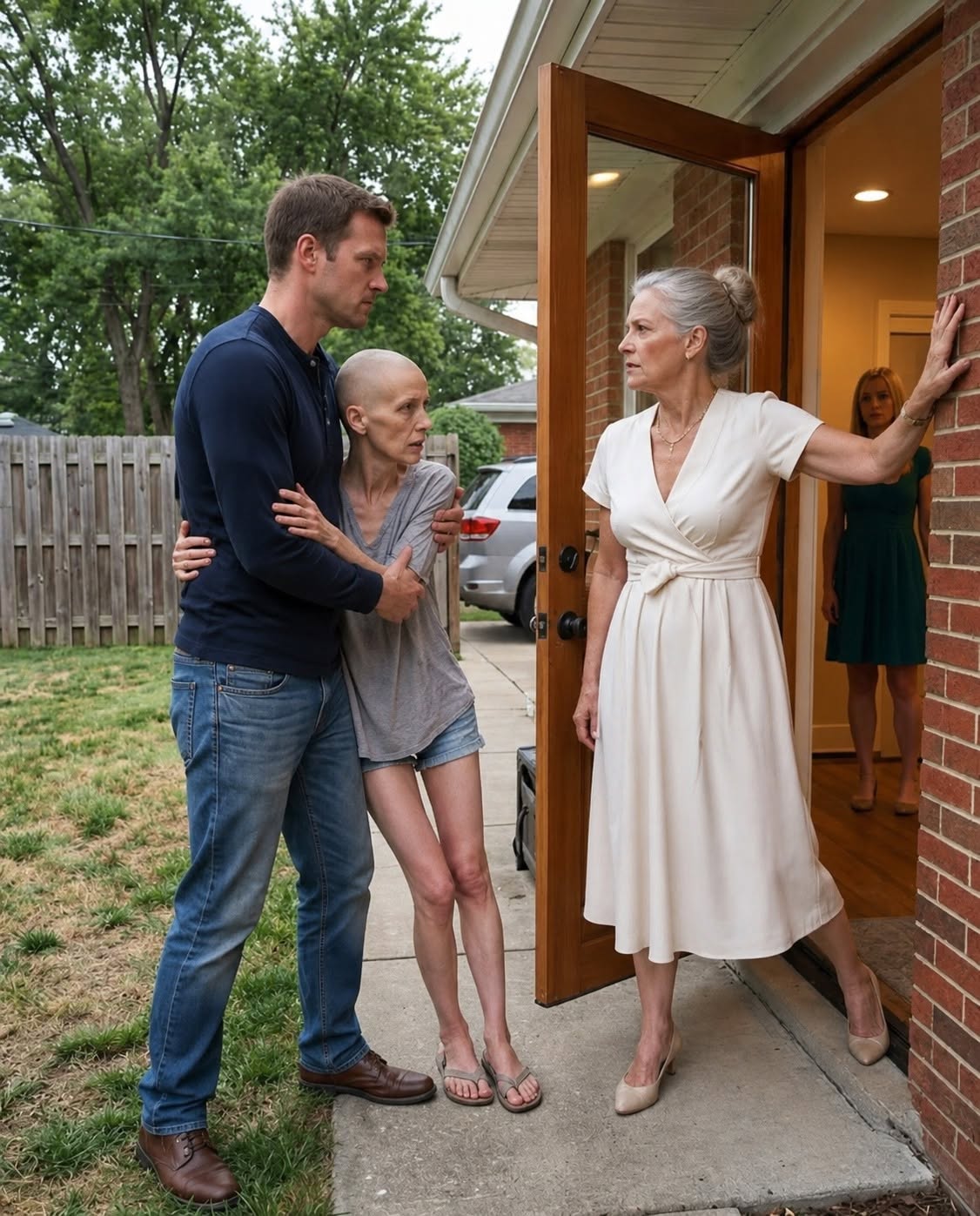
I Came Home Unannounced After Four Years Abroad and Found My Wife Starved and Shaved in the Backyard. My Mother Said She’d Brought It on Herself. I Didn’t Yell
Chapter 1 — The Voice Over the Fence
I heard my brother’s voice before I ever reached the door.
“That bald woman shouldn’t let herself be seen when we’ve got company.”
It was Godfrey — I would know that lazy, entitled drawl anywhere — carrying clear across the yard on the warm afternoon air, and I stopped where I stood on the far side of the fence with my suitcase still in my hand.
I had not told anyone I was coming.
That was the whole point.
A shutdown at the metalworking shop up in Calgary had handed all of us a few unexpected weeks off, and while my coworkers scattered to visit their own families, I had gone straight to the airport and bought a ticket on the next flight south, because after four years away the only thing I wanted in the world was to walk through my own door unannounced and see my wife’s face when she realized I was home.
So no one knew.
No one was performing for me yet.
Whatever was happening in that house was happening the way it always happened, with no thought that the man who paid for all of it was standing ten feet away, listening.
I did not know, in that first moment, how much that would come to matter.
I only knew that my brother had just called someone a bald woman, in a voice full of contempt, and that there was only one woman who should have been in that house, and that she had a full head of dark hair the last time I had seen her face.
I had pictured this homecoming a thousand times in four years.
That is not an exaggeration; it is close to a literal count.
On the worst nights up north, when the cold got into the bones and the shop noise still rang in my ears and the loneliness sat on my chest like a weight, I would build the scene in my head to get myself to sleep.
I would come home unannounced.
Phedra would be in the kitchen, or the garden, or curled on the couch, and she would turn and see me and not believe it for a second, and then she would believe it, and she would come across the room and put her arms around me, and four years of exile would dissolve in that one embrace.
I had polished that daydream until it shone.
It was the single most precious thing I owned.
And I want you to hold it in your mind as I tell the rest of this, because the distance between the homecoming I had spent four years dreaming and the one I actually walked into is the true measure of what my family did — not just to my wife, but to the whole future the two of us had been building, one wired paycheck at a time, in good faith, across an ocean of trust.
Chapter 2 — What I Saw in the Backyard
I set the suitcase down without a sound and looked through the gap in the fence, and what I saw stopped the breath in my chest.
There was a woman on her knees on the concrete of the backyard, gathering up the pieces of a broken plate with her bare hands.
Her head was shaved down to pale stubble.
Her shoulders were sharp under a thin, faded blouse, and her wrists, as she reached for the broken shards, were so thin I could have circled them with two fingers.
A bucket of gray, dirty water sat beside her feet.
It took me a moment — a long, terrible moment — to understand that I was looking at Phedra.
My wife.
The woman I had married, who used to laugh with her whole body, who I had been sending money home to care for every single month for four years.
“Pick those pieces up properly, Phedra.” My mother’s voice, Selina’s voice, floated out from inside the house, sharp and bored.
“If somebody cuts themselves on a piece you missed, I’m taking it out of your food.”
Out of your food. I did not move.
I will be honest about that, because I have gone over it a thousand times since — how I stood there and did not immediately tear the fence down.
Every cell in my body was screaming to cross that yard.
But something older than my rage held me still, and I will explain what it was, because it is the reason it all turned out the way it did.
For now it is enough to say that I stood behind that fence with my heart breaking, and I made myself watch, and I made myself listen, because I understood in some wordless way that I was seeing the truth of my life for the first time in four years, and that if I burst in now I would only ever get the version of it they wanted me to have.
Chapter 3 — Four Years of Burnt Metal
Let me tell you what those four years had been, so you understand what I was looking at.
For four years I had worked twelve-hour shifts in a metalworking shop that smelled permanently of scorched steel.
I ate reheated meals out of a shared microwave.
I slept in a rented room with four other men, our bunks close enough to touch, and I sent nearly every dollar I did not absolutely need back home.
The winters up there cracked my lips and split the skin of my knuckles, and I worked through them, because the whole arithmetic of my life in those years was simple: the more I endured, the more I could send, and the more I sent, the better the life that was waiting for me when I finally came home.
Every month I wired between two and three thousand dollars into my mother’s bank account.
Over four years it came to nearly a hundred thousand dollars, plus a bonus every December.
The money was meant to finish building our house, to set up a future for Phedra and me, and above all to take care of my wife while I was gone — her needs, her comfort, whatever she required.
I put it in Selina’s account because she was my mother, and you trust your mother, and it seemed the natural, responsible thing to do: let the family manage the household while I was away earning, and come home to find it all built and waiting.
I never questioned it.
Not once in four years.
I trusted my mother completely.
I trusted my brother.
And most of all, past any possibility of doubt, I trusted that my wife was safe and cared for and loved by the people I had left her with.
That trust was the beam I had built my whole exile on.
And I was standing behind a fence watching it rot in front of me, in real time, one broken plate at a time.
I need to explain what that trust was made of, because to a stranger it might look like foolishness, and it was not foolishness.
Where I come from, you do not put your family in a stranger’s hands, and you do not ask your wife to fend for herself alone in a half-built house while you are gone for years.
You keep the family together.
The son goes where the work is, and the mother holds the home, and the money flows to the center and is shared out by the one who raised you, because that is how it has always been done and it has always, more or less, worked.
When I put Selina’s name on that account, I was not being careless.
I was doing the most careful, most traditional, most trusting thing a man in my position could do — handing the fruit of my labor to my own mother, the woman who had fed me as a child, on the unspoken understanding that she would now help feed my wife.
There is no contract for that.
There has never needed to be a contract for that.
It runs on something older than contracts, something I would have told you, four years ago, could not be broken: that a mother does not starve her son’s wife.
That blood does not do that to blood.
I believed that the way I believed the sun would come up.
And the thing about a belief like that is that it does not occur to you to check it, precisely because checking it would be the first crack in it — and so the people who mean to betray you get years, uninterrupted, protected by the very depth of your faith in them.
My trust did not make me a fool.
It made me a mark.
There is a difference, though it took me four years and a shaved head in a backyard to learn it.
Chapter 4 — The Camera That Stopped Turning On
There had been signs.
I see that now.
At the time they looked like nothing.
For years Phedra and I had talked on video calls, and she was always the same — tired sometimes, but smiling, telling me not to worry.
“I’m fine, my love,” she would say.
“Everything’s fine here.
Just come home safe.” I lived on those calls.
They were the thing I worked toward, the face at the end of the tunnel.
And then, a few months back, the calls changed.
She stopped turning on her camera.
It was the internet, she said, the connection was bad.
It was her old phone.
She was tired, it was late, she’d rather just hear my voice.
And I — God forgive me — I believed her, because believing her was easier than the alternative, and because it did not once occur to me that my own family would give me a reason to need the camera off.
I had spent those months picturing her the way she used to be, curled up on our couch with her hair down, telling me about her day.
I had sent money into that picture.
I had endured Calgary winters for that picture.
And now I stood behind a fence and understood that for months, while I whispered goodnight to a dark screen, the reason the camera stayed off was crouched in a backyard with a shaved head and hollow cheeks, gathering broken glass with her bare hands so that no one would take her food.
Every gentle lie she had told me to keep me from worrying had been, I would learn, its own small act of love — and its own small act of survival, because the people standing over her had made very sure she understood what worrying me would cost her.
Chapter 5 — Listen Before You Touch It
Here is the thing that kept me behind that fence, and it is the most important thing I know.
Four years of working around old, overloaded, failing machines had taught me a lesson that turned out to apply to a great deal more than metal.
When a machine starts to break down — when something deep in it begins to go wrong — the worst thing you can do is grab it and start yanking at parts.
You will hurt yourself, and you will do more damage, and never find the real fault.
What you do instead, if you are any good, is you stop.
You go quiet.
And you listen.
Because the machine is telling you where the failure began.
The knock, the grind, the particular pitch of the wrongness — the noise tells you the truth if you can master yourself long enough to hear it, and only once you know where the break really is do you reach in and touch it.
Standing behind that fence, shaking with a rage I had never felt before in my life, I heard that lesson in my own head as clearly as if a foreman were saying it. Listen before you touch it. If I crashed through that door right now, roaring, I would get exactly what my mother wanted me to get: a chaotic scene, my own anger turned into evidence against me, and a story that everyone in that house had already rehearsed.
Phedra would be ushered out of sight.
Selina would weep and explain.
The truth would scatter like startled birds and I would never gather it whole again.
But if I could hold still — if I could master myself and simply listen — the house would tell me exactly where it had broken, and who had broken it, and I would know precisely where to reach when the time came.
So I did the hardest thing I have ever done.
I stayed behind the fence, and I listened.
I want to be honest about how it felt, because I do not want anyone to think it came easily, or that I am some cold man who can watch his wife suffer without moving.
It was agony.
Every second I stood there was a second she was still on her knees on that concrete, still hungry, still humiliated, and every second I did not go to her was a small betrayal of my own — I felt that, sharply, the whole time.
There is a voice in a man at a moment like that, a hot loud voice, and it was screaming at me that a real husband would already be through the door, that listening was cowardice dressed up as strategy, that I was standing safe behind a fence weighing tactics while the person I loved paid for my patience in real time.
I have never hated a voice more, or fought harder to keep from obeying it.
But I had learned something in four years of standing over machines that were failing in ways that could kill the man who grabbed them wrong, and it was this: the loud voice is almost always the wrong one.
The loud voice wants to feel like it is helping.
It wants the relief of action.
It does not care whether the action works.
And the difference between a man who feels like he is helping and a man who actually helps is the difference between a burst-through door and a shaved head sent quietly out of sight — between a satisfying scene and a saved life.
I loved my wife too much to settle for feeling like I was rescuing her.
I wanted to actually do it, all the way, so that it could never happen again.
And that meant mastering the loud voice, and staying still, and listening until the house had told me every single thing I needed to know.
Chapter 6 — What the Listening Told Me
And the house told me everything.
Godfrey came out into the yard in new designer clothes, a glass of good scotch in his hand, and stood over my kneeling wife like an overseer.
“Come on, hurry it up, we still need the dinner plates set.” Phedra tried to rise and her legs gave under her.
“I feel dizzy,” she said.
“I haven’t eaten since yesterday.” And my brother laughed — laughed out loud — and said, “With everything you stole from this family, you ought to be able to buy yourself a feast.”
Then my mother came out, and I saw, glinting at her throat in the afternoon sun, the gold hummingbird necklace I had given Phedra for our fifth anniversary.
It was on Selina’s neck.
Phedra was begging, quietly, to be allowed to call me — he has a right to know I’m sick — and Selina cut her off flat.
“You are not going to worry him.
He’s over there working to get this family ahead, not to carry the weight of your drama.” Phedra said the doctor wanted her to keep going with her treatment, and Selina waved the doctors away like flies, and then she said the sentence that turned my stomach to ice.
“My son sends the money to my account.
That means I decide how it gets used.”
Phedra, from her knees, pointed out the truth of where it had gone.
The new SUV in the driveway.
Godfrey’s freshly opened auto shop.
The remodeled house standing around them, all granite and leather and new floors.
And then she said, so quietly I almost missed it, that she had been sleeping in the storage shed.
“I just want to finish my treatment,” she whispered.
And my mother crossed her arms and looked down at my dying wife and said, “You should have thought about that before you got sick.”
That was the sound of where the machine had broken.
I had heard enough.
I reached down, and I picked up my suitcase, and I walked around to the door.
Chapter 7 — The Suitcase Hit the Floor
I pushed the door open, and I let the suitcase fall out of my hand, and it hit the floor with a crack like a gunshot.
Everything stopped.
Godfrey’s scotch glass slipped out of his fingers and shattered.
Selina’s hand flew to her chest.
And Phedra — Phedra turned from where she knelt on the concrete and looked at me as though I were a ghost risen out of the ground, her mouth working, no sound coming, until one word fell out of her.
“Damian…”
I did not look at my mother.
I did not look at my brother.
I crossed that yard in four strides and went down onto my knees beside my wife and gathered her into my arms, and I will never, as long as I live, forget how she felt.
She weighed nothing.
She weighed less than the suitcase I had just dropped.
Under my hands I could feel the architecture of her, the ribs and the sharp blades of her shoulders, and she smelled of bleach and medicine and damp, mildewed cloth — the smell of a shed, I would understand later, the smell of the place they had been keeping her.
She was shaking.
I held her as carefully as I have ever held anything.
“I’m back, honey,” I said into what was left of her hair.
“I’m back.
I’ve got you.”
She could not answer.
She only said my name, over and over, Damian, Damian, Damian, as if she had been saying it in the dark for months and could not stop now that I was finally there to hear it.
I will not dwell on the details of what they had done to her body, because she is a person and not a wound, and because she would not want to be remembered kneeling on that concrete.
But I will say one thing about holding her, because it is the thing that changed me.
My whole life I had thought of Phedra as strong — she was the strong one, the steady one, the one who laughed when I got frightened, the one who told me to go to Canada in the first place because she believed in the future we were building.
And here, in my arms, was that same woman, reduced to something I could have lifted with one hand, and still — this is the part that broke me and remade me in the same instant — still trying to protect me, even now.
Because the first full sentence she managed, once she could speak, was not help me or look what they did. It was, in a cracked whisper against my chest: “I didn’t want you to worry.” Eleven months of starving in a shed, and her first thought on being found was still my peace of mind.
But I will say one thing about holding her, because it is the thing that changed me.
My whole life I had thought of Phedra as strong — she was the strong one, the steady one, the one who laughed when I got frightened, the one who told me to go to Canada in the first place because she believed in the future we were building.
And here, in my arms, was that same woman, reduced to something I could have lifted with one hand, and still — this is the part that broke me and remade me in the same instant — still trying to protect me, even now.
Because the first full sentence she managed, once she could speak, was not help me or look what they did. It was, in a cracked whisper against my chest: “I didn’t want you to worry.” Eleven months of starving in a shed, and her first thought on being found was still my peace of mind.
That is who they had been grinding down out there in the yard.
Not a burden.
Not a complainer.
A woman so constitutionally loving that even at the bottom of her strength she was still guarding the man she loved from his own grief.
I held her, and I felt the last of my old life fall away, and I understood with total clarity that there was nothing on this earth I would not now do to make this right.
Chapter 8 — Not What It Looks Like
My mother was the first to recover.
They always are.
“Damian — oh, thank God you’re home, but sweetheart, this isn’t what it looks like.” The words came fast and smooth, a story she’d clearly told herself so many times she half believed it.
Phedra, she said, had become impossible after she got sick — demanding, ungrateful, always wanting money, breaking things around the house on purpose, even stealing.
Even stealing jewelry.
I let her talk.
And when she said the word jewelry, I lifted my eyes, slowly, and I looked at the gold hummingbird resting against my mother’s collarbone.
“You mean,” I said, “like that one?”
Selina’s hand came up and covered the pendant, as if she could make it disappear by hiding it, and for the first time something flickered behind her eyes that was not performance.
It was fear.
Phedra, still in my arms, spoke then, her voice thin as paper.
She had tried to sell that necklace, she told me — the one thing of any value she had left, my gift to her — to pay for a single visit to her doctor.
And Selina had caught her at it, and taken it off her, and put it around her own neck, and worn it in the house every day since, in front of the woman she had stolen it from.
I looked at the necklace, and I looked at my wife’s shaved head, and I felt something in me go very cold and very quiet — the stillness, I think, of a man who has at last stopped being confused about anything.
Chapter 9 — Eleven Months
“What illness does she have?” I asked the room.
My voice did not sound like my own.
Phedra’s hand came up and touched the center of her chest.
“Cancer,” she whispered.
Cancer.
And then the number came out, from one of them, I don’t even remember which: eleven months.
She had been sick for eleven months.
For eleven months I had been wiring money home, whispering goodnight to a dark phone screen, picturing my wife safe on our couch — and for all eleven of those months she had been sick with cancer in that house, and I had not been told.
I looked around me, really looked, and I saw my money everywhere.
It was in the new hardwood under my feet and the enormous television on the wall and the leather furniture and the granite in the kitchen and the SUV gleaming in the driveway and the top-of-the-line phone sticking out of my brother’s designer pocket.
My hundred thousand dollars had gone into every surface of that house.
And in the middle of all of it knelt my wife, in a blouse I recognized as being at least six years old, in sandals that were broken at the strap.
I stood in the center of that room and did a kind of terrible arithmetic.
Every beautiful thing in it was a doctor’s appointment my wife had not gone to.
The television was a round of scans.
The granite was a course of treatment.
The SUV in the driveway — that gleaming, pointless SUV — was months of the care that might have kept her from ever getting this thin, this weak, this close to the edge.
They had not simply spent my money on themselves instead of her.
That would have been ordinary theft, and ordinary theft I could almost comprehend.
What they had done was worse and stranger and colder: they had converted my wife’s survival, dollar by dollar, into comfort for themselves, and they had done it while she was in the house, while she was visibly dying in front of them, while she asked.
Every time they chose the granite over the doctor, they were choosing it over her, in full knowledge, to her face.
And they had made that choice, by my count, at least a hundred thousand dollars’ worth of times.
I looked at the six-year-old blouse and the broken sandal strap, and then I looked at the wall of new appliances behind my mother’s head, and something in me that had been trying, even now, to find an innocent explanation — some misunderstanding, some version where they were not quite this — went quiet at last, and did not speak again.
“How much of the money I sent,” I said, “went to her treatment?”
There was a silence.
Selina finally allowed that they had paid for a few visits.
A few.
And it was Phedra, quiet, exact, unwilling even now to let a lie stand, who corrected her.
“Two,” she said.
Two visits.
In eleven months.
I had sent a fortune home to save my wife’s life, and my family had spent it on countertops and let her go to the doctor twice.
Chapter 10 — The Scars I Showed Her
I got my arm under Phedra and helped her to her feet.
“We’re going to the hospital,” I said.
“Right now.”
Selina moved to block the door.
It was an astonishing thing to watch — a woman who had just been exposed, planting herself in a doorway as if she still held any authority in the situation at all.
“You,” she said, and now her voice had turned to attack, because attack was the only card she had left, “you disappear for four years, and you come marching back in here and treat your own mother, your own brother, like criminals?
You have no idea what we’ve dealt with.”
I did not shout.
I only rolled up my sleeve.
I showed her my forearm — the shining burn scars, the old cuts, the marks four years of failing machines and molten metal had left in my skin.
“I worked whole nights,” I said.
“I slept in a room with four other men.
I spent two Christmases completely alone in a cold country so that no one back here would go without a single thing.”
“And we didn’t,” Selina said.
“We went without nothing.”
I looked at Phedra — at her stubbled scalp and her hollow cheeks and her broken sandals — and then back at my mother.
“She did,” I said.
Godfrey found his voice from across the room, blustering that none of this would have happened if I hadn’t left in the first place, as if my leaving to earn the money they had stolen were the true crime here.
Selina fell back on the sentence she had clearly decided to die on: that Phedra had brought every bit of this on herself.
And through all of it, my wife stood pressed against my side, both her thin hands gripping a fistful of my shirt, and I could feel her bracing — waiting for me to erupt, to roar, to bring the whole house down in fury, the way any man would.
I didn’t.
I reached into my pocket instead, and I took out my phone.
Chapter 11 — Seventeen Missed Calls
The screen lit up, and there they were: seventeen missed calls from a Canadian number, stacked one on top of another, and beneath them a single email that had landed while I was somewhere over the middle of the continent, asleep against an airplane window with no idea what was waiting for me at home.
I opened the email slowly, standing there in that ruined living room with my wife clinging to my shirt.
I half knew already what it would say, because I knew what those seventeen calls had been chasing me about.
Two years earlier, a piece of poorly maintained equipment at the Calgary plant had failed and wrecked my shoulder — an injury the company had spent two years trying to argue was my own fault.
It was never my own fault.
And the email, from the lawyers who had taken my case, confirmed that the firm had finally stopped fighting.
They had settled, out of court, rather than face what the safety inspection would have shown.
One million dollars.
I stood very still and let that number sit beside the other numbers of my life.
A hundred thousand sent home and stolen.
Eleven months of a hidden illness.
Two doctor’s visits.
And now, one million dollars, landing in my hand at the exact moment I understood what my family had done with the trust I’d placed in them.
There is a strange thing that money does at a moment like that, and I felt it happen in my chest.
For years the money had been the whole point — the reason for the exile, the burnt hands, the empty Christmases.
I had thought of it as the thing that would fix everything, the reward at the end of the endurance.
And standing there, I understood, all at once, that money had never fixed anything at all.
My family had had a hundred thousand dollars, and it had not made them kind.
It had made them worse.
It had bought them the SUV and the granite and the shop, and it had bought Phedra a shed and a shaved head, because money does not change what a person is — it only gives them more room to be it.
The greedy become greedier.
The cruel find their cruelty better funded.
And now here was a million more, and for one vertiginous second I saw two futures fork in front of me.
In one, I let the million become the same kind of thing the hundred thousand had been — a prize to fight over, a poison to hand around a table.
In the other, I used it, coldly and precisely, as a tool: not to reward anyone, not even to punish anyone, but to buy back the one thing that actually mattered, which was my wife’s life and her safety and a future with her in it.
The money was never going to make me happy.
I knew that now.
But used correctly, it might undo some of the damage that other money had done, and that — not revenge, not even justice, just repair — was the only thing I found I wanted from it.
The plan that built itself in me over the next few minutes was cold, yes.
But at its center it was not cold at all.
At its center it was the warmest thing I have ever done.
I want to say clearly: I had not come home planning any of what came next.
I had come home to surprise my wife.
Right up until the moment I looked through that fence, I still believed the money I sent had kept her safe — that I was walking back into the good life I had bought with four years of my body.
I had no plan.
I had no trap.
What I had, standing in that living room, was a sudden and total understanding of what greed had already cost the woman I loved the woman I loved — and one million dollars that my family did not yet know the shape of.
And somewhere in the cold quiet place I had gone to, a plan began, all on its own, to build itself.
Chapter 12 — One Detail, Left Incomplete
I made a decision in the space of about three seconds.
I would tell my family about the settlement.
I would give them one true detail about it — the amount, the shine, the thing that would make their eyes light up.
And I would leave out the single fact that mattered most, and I would let their own greed do the rest of the work for me.
I let the anger drop out of my face.
I made my voice tired, reasonable, almost gentle.
“You know what — you’re right,” I said to my mother.
“Me coming in here yelling isn’t going to fix anything.
That’s not how we solve things.” Phedra went rigid against my side, and I pressed her hand once, hard, a silent trust me she could not yet understand.
“We can talk about this like a family.
And actually — there’s something I was going to tell you all tomorrow anyway.
Some news.”
It was like watching a compass swing.
My mother’s whole attention lifted off Phedra — off the sick, inconvenient, expensive wife — and fixed itself, bright and hungry, on the phone in my hand and the word news.
Godfrey, who had been edging toward the hallway, stopped edging.
The temperature of the room changed.
Two seconds earlier I had been a threat; now I was a man with news, and news, in that family, had only ever meant one thing.
Money.
Chapter 13 — The Escrow and the Consolidation
“The company in Canada settled,” I said, keeping my arm around Phedra, keeping my voice low and confiding, the way you’d share good fortune with people you loved.
“A safety violation — the thing that hurt my shoulder two years ago.
They settled out of court rather than fight it.
One million dollars.”
I watched the number land.
I watched my mother’s eyes go, to dollar signs, and I watched my brother’s whole posture change, the sneer melting off him and something oily and eager sliding into its place.
“But it’s complicated,” I went on, before either of them could speak.
“Because of tax rules and international wire holds, the money doesn’t just land in my account.
The main lump sum has to sit in a temporary, revocable escrow — linked to my banking file — for seventy-two hours before it clears.” I let that word, revocable, hang in the air, a little door left open.
“And here’s the thing the bank told me.
To release funds that size clean, without triggering an international audit, I have to show a clean, consolidated local financial history.
Which means every asset that was bought with the money I sent over these four years — the SUV, the deed to this house, Godfrey’s shop inventory, all of it — has to be formally brought together under one family holding agreement.
One document.
Everything in one place.”
I saw the look pass between my mother and my brother — that quick, greedy, knowing glance of two people who think they have just understood something to their advantage.
They believed that consolidating everything into one family holding meant they’d be inside the structure when the million dollars flowed in.
They thought they were being cut in.
It worked because greed makes a person deaf.
I had counted on that, standing in the backyard, and I watched it prove true in real time.
A cautious person, a person not blinded by the shine of a number, would have heard everything wrong with what I was saying.
They would have asked why a Canadian settlement required consolidating a house deed in another country.
They would have wondered why the bank cared about their SUV and their shop inventory.
They would have said, let me have my own lawyer look at this before I sign anything.
Any of those ordinary, sensible reactions would have saved them.
But greed does not ask questions, because questions might delay the payout, and to a greedy mind a delayed payout is a kind of pain.
All my mother and my brother could hear, under everything I said, was the single word million, repeating like a heartbeat, drowning out every warning the details were trying to give them.
I was not even lying to them, not really — I told them the money was real, and it was; I told them it was going into a trust, and it was; I simply let them assume it was a trust that included them, and they wanted so badly for that to be true that they built the assumption themselves and defended it against their own better judgment.
That is the thing about a trap baited with greed.
You do not have to force anyone into it.
You only have to hold the bait steady and let them run at it, and the running is entirely their own.
I held it steady.
And they ran.
“We’ll sign whatever you need, Damian,” my mother said, fast, reaching out to touch my arm, all warmth now.
“Whatever it takes.
We’ll go to the notary first thing tomorrow.”
“Good,” I said.
“I appreciate that.” And then I bent and lifted my wife up into my arms, because she could not walk any farther on her own.
“Because tonight, I’m taking Phedra to a private hospital.”
I carried her out the door and down the drive and put her gently into the back of a waiting taxi, and I left my mother and my brother standing in the driveway in the last of the daylight — not frightened, not sorry, but already, I could hear it as the taxi pulled away, beginning to argue in low excited voices about how they were going to split a million dollars that was never, ever going to touch their hands.
Chapter 14 — Arthur Vance
An hour later, Phedra was in a bed in a top-tier oncology pavilion, and for the first time in eleven months, someone was actually taking care of her.
The staff moved fast.
They got her onto an IV, got fluids and real nutrition into her, ordered a full battery of scans for the morning.
I stood in the doorway and watched competent, gentle hands do for my wife the things that a hundred thousand dollars was supposed to have paid for all along, and I had to step out into the hall so she would not see my face.
When I had myself in hand again, I went to a small consultation room down the corridor, where a man was waiting for me — an estate and corporate litigation attorney I had called from the airport the moment I’d landed and read that email, before I even knew what I would need him for.
His name was Arthur Vance.
I laid it all out on the table in front of him: four years of bank wire receipts, my tax filings, the original power-of-attorney documents I’d signed before leaving, and the video I had recorded on my phone from behind the fence — every word of it, the scotch and the shed and you should have thought about that before you got sick.
Vance went through it page by page, his face growing harder as he read.
When he finally looked up, his voice was quiet and precise.
“Mr.
Sterling,” he said, “your mother and your brother haven’t merely abused and neglected your wife — though they’ve certainly done that, and we will be documenting all of it.
By moving the deed to this house, the title to that vehicle, and the business assets into your mother’s name, while spending funds you sent under a specific understanding that they were for your wife’s care and your property, they have committed grand larceny.
Embezzlement.
Fraud.
This ledger,” he tapped the wire receipts, “is one of the cleanest evidentiary trails I have ever been handed.”
Chapter 15 — What the Agreement Actually Did
“And the settlement?” I asked him.
“The million.
Can they touch it?”
Arthur Vance almost smiled.
“The settlement is held in a private, independent Canadian trust.
It is completely beyond their reach.
It was never in the slightest danger, and it never will be.” He set down the papers.
“But that ‘consolidation agreement’ you had them agree to sign tomorrow — the one they think brings them in on the money?”
“Tell me what it actually does.”
“What it actually does,” he said, “is transfer legal ownership of the house, the land it sits on, the SUV, and the entire inventory of your brother’s business directly to you — as restitution for the funds they misappropriated.
Sole ownership.
Yours.
And at once, it makes your mother and brother personally liable for every debt, every back tax, every lien that has accrued against those properties.
They are not signing themselves into a share of your million dollars, Mr.
Sterling.
They are signing over everything they stole, and keeping only the bill.”
I sat with that for a moment, and a cold, clean satisfaction moved through me — not joy, exactly.
Something quieter and more final than joy.
They thought they were signing a document to get their hands on my fortune.
What they were actually going to sign, of their own free and greedy will, in front of a notary, was a full confession dressed up as a windfall: a legal instrument handing back every single thing they had taken from my dying wife, and chaining themselves to the debts they had run up in the taking.
They were going to build the trap themselves, and walk into it smiling, because they could not see past the shine of a number to the shape of the thing underneath.
Greed had made them stupid.
It usually does.
“Draw it up,” I said.
Chapter 16 — The Trap Snaps Shut
The next morning, my mother and my brother arrived at the hospital dressed in their very best.
I have thought about that detail many times since — that they put on their finest clothes to come and collect their share of a million dollars, on the same morning, in the same building, where my wife lay recovering from the starvation they had inflicted on her.
They came expecting a bank representative and a payout.
They walked into a private conference room, and the door opened behind them, and it was not a banker who came in.
It was two uniformed police officers, and a state prosecutor, and Arthur Vance, and me.
Selina went white.
“Damian… what is this?”
“This,” I said, “is the accounting.”
Vance stepped forward with a thick dossier under his arm and spoke in a flat, official voice.
“Selina Sterling.
Godfrey Sterling.
You are being served with an immediate asset seizure order and an emergency restraining order.
Local law enforcement is opening a formal criminal investigation into adult medical neglect, theft by deception, and grand larceny.”
Godfrey’s face drained to the color of paper.
“What — you tricked us!
You said the settlement money — you said we were consolidating for the —”
“The settlement money is in my wife’s private medical trust,” I said.
“Every dollar of it is going to make her well.
You never had the slightest claim to a cent of it, and you never will.” I stood up.
“And as of eight o’clock this morning, the sheriff’s office executed an eviction notice on the house — my house now.
The SUV has been repossessed.
Godfrey’s shop is locked under a court injunction.
Everything you bought with the money meant to save Phedra’s life is gone.”
Selina’s legs went out from under her, and she sank down onto the polished floor, clutching her chest, staring up at me.
“You would throw your own mother out onto the street?” she cried.
“For her?”
I looked down at the woman who had raised me, and I felt no cruelty and no triumph, only a great and final clarity.
“I sent you a hundred thousand dollars to take care of my wife,” I said.
“You put her in a storage shed.
You shaved her head.
You let her go hungry while you ate off new granite.
You took the necklace off her neck while she was fighting for her life and you wore it in front of her.” I reached into my pocket and drew out the gold hummingbird, which I had recovered from Selina’s nightstand at dawn with a police officer standing beside me, and I held it in my open palm where she could see it.
“You treated my wife like she was trash to be swept up off the yard.
Now you’re going to find out what it feels like to have nothing.”
People have asked me, since, whether it was hard to watch my own mother go down on that floor.
Whether some part of me wanted to reach for her, to soften it, to be the good son one last time.
And the honest answer is no, and I have made my peace with what that says about me, because I finally understand where the line is.
I would have forgiven her almost anything.
That is the truth.
If she had merely wasted the money, if she had been selfish, if she had been a poor manager of what I sent — I would have been angry, and I would have gotten over it, because she was my mother and the bond runs deep and I am not a man who cuts easily.
But she had not merely been selfish.
She had looked at a sick, frightened, defenseless woman — her own son’s wife, a person under her roof and her protection — and she had chosen, day after day for eleven months, to be cruel to her on purpose, to starve and humiliate and endanger her, not out of desperation but out of pure convenience, so that the money could go to granite instead.
That is not a lapse a person forgives.
That is a revelation of what someone actually is underneath.
My mother had shown me, over eleven months, exactly who she was when she thought no one who mattered was watching.
All I did, kneeling in that conference room, was finally believe her.
The clarity I felt was not coldness.
It was the simple, terrible relief of no longer having to argue with the evidence of my own eyes.
Chapter 17 — The Reckoning Settled
The fallout, when it came, was total.
Faced with a mountain of evidence — the four-year wire trail, the property records, the tax filings, and above all the video I had recorded from behind the fence, in which they condemned themselves in their own voices — my mother and my brother had almost nothing to stand on.
Their lawyers advised them of exactly how little.
In the end both were convicted of grand larceny and criminal medical neglect.
Selina was sentenced to three years.
Godfrey was sentenced to two, along with the complete forfeiture of his business assets to help satisfy the court-ordered restitution.
The house — the house I had bled four Calgary winters to build, the house they had filled with stolen granite and leather while my wife slept in the shed behind it — was sold.
The money from that sale, together with the funds from the repossessed vehicle, went into an untouchable trust for Phedra’s future care.
There was a rightness to that I could not have designed if I’d tried: every stolen surface of that house, converted at last into exactly what the money had been meant for all along.
I let the house go without a second thought, and that surprised the lawyers, who kept asking whether I was sure, whether I wanted to keep it, whether there wasn’t sentiment there worth preserving.
There was not.
Somewhere in those eleven months the house had stopped being the future I’d dreamed of on cold nights in Calgary and become something else — a monument to what had been done in it, its beautiful rooms built on my wife’s hunger.
I did not want to live inside that.
I did not want Phedra to ever have to walk back through a door she’d been dragged out of and made to sleep behind.
A house is only wood and stone; it holds whatever you put into it, and too much had been put into that one.
So I sold it, and I felt nothing but relief as it went, and I watched the numbers from the sale flow into the one account that could never be reached or ruined — the account with her name on it, the one that would pay for her scans and her medicines and her long healthy life.
The granite became chemotherapy.
The leather furniture became clean sheets in a good hospital.
The SUV became the years she would get to keep.
That was the only inheritance I ever wanted out of any of it, and in the end it was the only one that came to anything.
I did not go to the sentencing to gloat.
I did not go at all, in the end.
I had a wife to sit beside, and scans to wait on, and a future to rebuild, and I found that I simply had no attention left over to spend on the two people who had spent four years assuming my patience was weakness.
They had made that assumption for a long time — that because I was quiet, because I was far away, because I put my head down and worked and did not make noise, I must be a fool who could be milked forever without consequence.
It is a very old mistake, and people who make it never seem to see it coming.
A man can be patient for a long, long time.
But patience is not the same thing as blindness, and it is surely not weakness.
Patience is just a man waiting until he knows exactly where the machine has broken — and exactly where to put his hand.
Chapter 18 — We’re Finally Home
Six months later, the spring sun came pouring through the tall windows of a recovery villa on the California coast, and the whole place smelled of clean salt air off the ocean.
Phedra sat on the sunlit terrace with a soft silk scarf wrapped around her head, and there was color in her cheeks again — real color, the flush of a living body doing well — and her eyes were bright and clear and fully, gloriously alive.
Six months of world-class targeted therapy, funded start to finish by the Canadian settlement, had done what two doctor’s visits in eleven months could never have done.
Her cancer was in complete remission.
The word still stops my breath a little every time I let myself think it. Remission. She was going to live.
She was going to grow old.
I came out onto the terrace with two cups of herbal tea and set one down beside her, and she reached up and took my hand, and her grip was strong now — warm and strong, nothing like the paper-light thing I had gathered off a backyard floor half a year before.
“How was your call with Arthur Vance?” she asked.
“Finished,” I said, sitting down beside her.
“All of it.
The proceedings are completely closed.
It’s over.”
She nodded, and looked at the water, and let it be over.
We did not talk about them much, then or after.
There was not much left to say.
They had looked at a hardworking man and a sick, vulnerable woman and seen two people too weak and too far away to matter — and they had been wrong about both of us, and the being-wrong had cost them everything, and there was nothing more in it worth turning over.
What mattered was here, on this terrace, in the salt air.
It has taken me a long time to be at peace with the shape of it, and I am mostly there now.
For a while I carried a guilt that surprised me — not guilt over what I did to them, which was only the law finding them at last, but guilt over the four years themselves.
I would lie awake and torture myself with it: I left.
I put an ocean and a border between myself and my wife, I handed her wellbeing to people who turned out to be wolves, and I did not see it, and she paid for my blindness with eleven months of hell.
What kind of husband does that?
It was Phedra, of course, who took that away from me, the way she has taken every heavy thing off my shoulders since the day I met her.
She told me, on this same terrace, one evening early in her recovery, that I had to stop.
That I had gone to Canada because we had dreamed a future together and someone had to go build it, and that I had gone out of love, and worked out of love, and sent every dollar home out of love — and that the fact that my love had been fed into a machine that betrayed it was not my crime but theirs.
“You didn’t do this to me, Damian,” she said.
“You’re the one who ended it.” And slowly, over months of clean ocean air and returning strength, I have come to believe her.
I did not cause the years of harm.
But I did cross the fence.
I did listen.
I did, in the end, come home.
And a man does not get to save everyone from everything — but he does, if he is patient and if he loves enough, sometimes get to be the one who finally makes it stop.
That is the peace I have made.
It is enough.
It is, on this terrace, in this light, with her hand warm in mine, more than enough.
Phedra leaned her head against my shoulder, the silk scarf soft against my neck, and watched the waves come in.
“Thank you for coming home, Damian,” she said quietly.
I put my arm around her and pressed a kiss to her temple, and under my hand I could feel it — the steady, strong, healthy rhythm of her breathing, the thing I had once crossed a fence and been afraid I would never feel again.
“I’m never leaving again, honey,” I told her, looking out at the wide bright horizon.
“Not ever.
We’re finally home.”