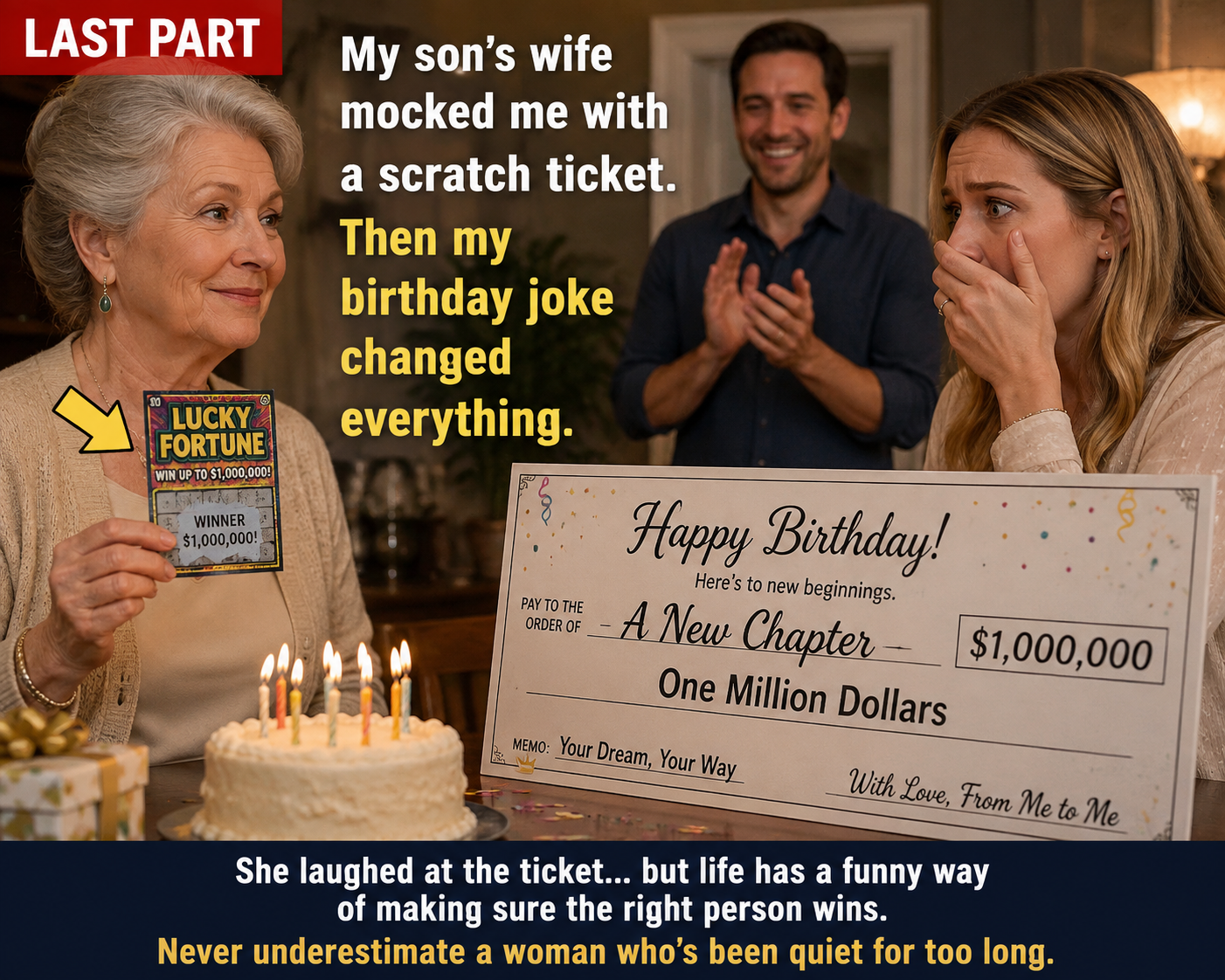
PART 2 – My son’s wife mocked me with a scratch ticket. Then my birthday joke changed everything.
PART 2 — THE NAME AT THE BOTTOM OF THE LETTER
“Ten months,” I said.
Daniel stood by the front door with the envelope trembling between his fingers.
Renata was still sitting at the kitchen table, but she was no longer drinking her coffee.
Neither of them spoke.
I took one last sip from my cup.
“For ten months,” I repeated, “I have been waiting for you to look at me the way you are looking at me right now.”
Daniel swallowed.
“Mom… what is this?”
I glanced at the letter.
“You can read.”
His eyes dropped back to the page.
I watched them move over the words again, slower this time, as if reading them twice might change them.
NOTICE OF CHANGE IN TENANCY TERMS.
PROPERTY OWNER: H AND D BAIT AND TACKLE LLC.
AUTHORIZED BENEFICIARY: DOLORES FENN FAMILY TRUST.
There were several other paragraphs underneath, but Daniel had stopped reading after my name.
Renata stood so fast her chair scraped across the floor.
“This is some kind of mistake.”
“No,” I said. “Actually, your landlord made fewer mistakes than you thought.”
She stared at me.
Daniel stared at me.
I reached beside my chair and pulled my suitcase into view.
That was when Renata’s face changed.
Until then, she had believed there was an explanation that would restore the world to its proper order.
Maybe I had forged the letter.
Maybe I had misunderstood something.
Maybe an elderly woman had gotten confused.
But the suitcase told her I was not confused.
“You bought this house?” Daniel whispered.
“Yes.”
“When?”
“March.”
April.
May.
June.
Every rent check.
Every complaint about the mysterious new landlord.
Every time he had sat across from me and said the owner was greedy because the plumbing repair had taken three days.
Every time I had passed him the potatoes.
“You’ve been collecting our rent?”
“My trust has.”
His face went pale.
“But why?”
That question nearly broke my heart.
Not because I did not have an answer.
Because he truly did not know.
I looked at my son, the baby I had once rocked through pneumonia, the boy whose school lunches I packed in brown paper sacks with little jokes written on the napkins, the teenager Harold and I had helped through college after he changed majors twice.
And somehow, at fifty-one years old, he was sitting across from me asking why his mother might have prepared an escape after he arranged to put her in the budget wing of Sunrise Pines without asking.
“Daniel,” I said quietly, “what day is it?”
“The first.”
“And what happens January first?”
His eyes shifted toward Renata.
Neither answered.
So I answered for them.
“You were going to remove me from this house.”
“Mom, that’s not fair.”
I leaned back.
“That is exactly what you were going to do.”
“We found you a nice place.”
“You found me the cheapest room you thought you could call nice without laughing.”
Renata crossed her arms.
“That is insulting.”
“Is it inaccurate?”
Her lips tightened.
Daniel rubbed both hands over his face.
“We were trying to help.”
“No. You were solving a problem.”
“You’re not a problem.”
I looked at him.
He could not hold my eyes.
There are moments when a mother knows exactly how much truth her child can survive.
And there are moments when protecting him from it would only continue the lie.
So I opened my purse.
I took out a folded piece of paper.
Then another.
Then another.
I placed them on the table one by one.
Sunrise Pines brochure.
Deposit receipt.
A handwritten list I had found beside their printer.
MOM MOVE-OUT.
Cancel extra phone line.
Move sewing boxes to garage.
Convert bedroom to home office.
Ask facility about furniture restrictions.
Sell old dresser?
Renata’s handwriting.
She turned white.
Daniel looked at her.
“Where did you get that?”
“It was sitting on the printer.”
“You went through our things?”
“No. You left your plans for my life beside the grocery coupons.”
Daniel picked up the page.
His jaw tightened as he read it.
Something passed between him and his wife.
That interested me.
“What?” I asked.
“Nothing,” Renata said quickly.
Daniel kept staring at the list.
“You told me Mom wanted to get rid of the dresser.”
Renata’s eyes flashed.
“Oh, for God’s sake, Daniel.”
I said nothing.
Sometimes silence does more work than questions.
Daniel looked at me.
“Did you?”
“No.”
He looked at his wife again.
Renata threw up her hands.
“So I misunderstood. Is that really what we’re discussing right now? She secretly bought our house!”
“Your house?” I asked.
Renata stopped.
I reached into my cardigan pocket.
The keys made a soft metallic sound when I placed them on the table.
“Those aren’t for this house,” I said. “I have another one.”
Daniel looked at the keys.
“Another what?”
“House.”
Silence.
“Where?”
“Savannah.”
“My sister Eileen lives fifteen minutes away.”
Daniel blinked.
“You bought a house in Georgia?”
“In June.”
“With what money?”
There it was.
Not Are you happy?
Not Why didn’t you tell me?
Not Will I ever see you?
With what money?
I smiled.
“Mine.”
Renata laughed once.
It was sharp and ugly.
“Dolores, you barely have Social Security.”
“I have enough.”
“How much is enough?”
“That is not your concern.”
“It absolutely is our concern if you’ve been making financial decisions while living under our roof.”
That sentence hung in the kitchen.
Under our roof.
I looked up at the ceiling.
Then I looked back at her.
“No,” I said. “You have been living under mine.”
Daniel closed his eyes.
Renata’s face flushed crimson.
I stood.
Outside, I heard the cab pull up.
Right on time.
The driver gave one polite tap of the horn.
Daniel looked toward the window.
“Mom, you’re seriously leaving?”
“Yes.”
“Today?”
“Yes.”
“You planned all this?”
“For ten months.”
His expression collapsed.
“Ten months?”
“Ten peaceful months.”
“How could you hide something like this from me?”
I lifted my suitcase.
“The same way you hid Sunrise Pines from me until the deposit was nonrefundable.”
He had no answer.
I walked toward the doorway.
“Wait.”
Daniel’s voice sounded different.
Small.
Exactly as I had imagined.
I stopped.
He came closer.
“What happens to us?”
Renata turned sharply.
“Daniel!”
But he ignored her.
I watched my son look around the kitchen as if the walls had suddenly started counting down.
“What do you mean?”
“The letter. The new terms.”
“You have ninety days.”
“Ninety days for what?”
“To decide whether you want to remain tenants under the new lease.”
Renata grabbed the paper again.
“What new lease?”
“The one attached.”
She flipped to the second page.
Her eyes widened.
“The rent is going up nine hundred dollars?”
“To market rate.”
“That’s insane!”
“It is comparable to three houses on this street.”
“You can’t do this to family!”
The words came so quickly I almost admired them.
Family.
What a miraculous word.
People can forget it for years and remember it the moment money enters the room.
I tilted my head.
“I thought I was a cost.”
Renata froze.
Daniel looked at her.
I continued.
“I thought groceries had become too expensive because I drank too much coffee. I thought the electricity bill was high because I occasionally watched television after nine. I thought I needed to move into Sunrise Pines because this household could no longer afford the burden.”
“Dolores—”
“Now I am family?”
Renata opened her mouth.
Nothing came out.
I walked to the door.
Daniel followed me onto the porch.
The morning air was cool.
My cab driver stepped out and reached for my suitcase.
“Mom, please.”
I handed the driver the bag.
Then I turned.
Daniel stood barefoot on the porch in his work shirt.
For a moment, I saw my little boy again.
That was the worst part.
Anger would have been easier if I had stopped loving him.
But mothers do not stop loving children simply because those children disappoint them.
Sometimes we just stop allowing love to be used as a leash.
“Did I do something?” he asked.
I stared at him.
“You really need to ask?”
“I know the retirement home thing upset you.”
“It did not upset me.”
He frowned.
“It clarified you.”
He flinched.
Behind him, Renata appeared in the doorway holding the landlord letter.
“Daniel, stop begging her. She’s enjoying this.”
I looked at my daughter-in-law.
“You think this is revenge.”
“What else would you call it?”
“Departure.”
She laughed.
“You expect us to believe you suddenly have enough money to buy two houses?”
Daniel looked at me again.
I could see the question in his face.
There was no reason to tell them.
My attorneys had advised me repeatedly not to disclose the lottery winnings.
Not yet.
Maybe never.
Money makes people curious.
Large money makes them creative.
But something about Renata’s expression made me think of the dollar-store birthday card.
The two-dollar ticket.
The laughter.
Maybe you will win your bus fare, Dolores.
I reached into my purse.
For ten months, I had kept one thing.
Not the ticket.
That was locked away in legal records.
I kept the card.
Cheap paper.
Purple balloons.
A joke printed inside about getting older.
I opened it.
The little scratch-ticket sleeve was still glued to the right-hand side.
I held it toward Renata.
“Do you remember this?”
Her expression shifted.
“My birthday card?”
“The one we gave you?”
“Yes.”
Daniel frowned.
“What about it?”
“I kept it.”
Renata rolled her eyes.
“Okay?”
I slipped it back into my purse.
“Best present anyone ever gave me.”
She stared at me.
For one second, I thought she understood.
Then the cab driver closed the trunk.
I walked down the steps.
Daniel followed.
“Mom, when are you coming back?”
I opened the passenger door.
“I’m not.”
His face changed.
“Ever?”
“I didn’t say that.”
“You said—”
“I said I am not coming back to live here.”
He looked suddenly desperate.
“What about Christmas?”
I almost smiled.
Christmas.
Three weeks away.
Every year I had cooked turkey.
Every year I had wrapped presents.
Every year I had slipped money into the grandchildren’s cards.
Every year I had washed dishes while Renata’s relatives sat in the living room.
“This year,” I said, “I think I’ll sit down.”
The cab driver tried very hard not to smile.
Daniel touched the top of the open car door.
“Mom, can we talk about this tonight?”
“I’ll be in Georgia tonight.”
“Then tomorrow.”
“I have plans.”
“The next day?”
“Daniel.”
He stopped.
“You have had four years to talk to me.”
That landed.
I got into the cab.
He stood outside staring at me.
Then Renata called from the porch.
“Dolores!”
I looked past him.
She held up the letter.
“What exactly are you trying to accomplish?”
I answered with the truth.
“Nothing.”
She shook the paper.
“This is nothing?”
“No. For the first time in years, I am no longer trying to accomplish anything with either of you.”
I closed the door.
The cab pulled away.
I did not look back immediately.
I thought I would.
For months I had imagined that moment and pictured myself watching the house disappear.
Instead I watched my hands.
They were shaking.
Not from fear.
From grief.
Freedom and grief are cousins.
Nobody tells you that.
You can know you are doing the right thing and still mourn everything that made it necessary.
At the corner, I finally looked back.
Daniel was still standing in the street.
Renata had gone inside.
I faced forward.
“Airport?” the driver asked.
“Yes.”
Then my phone rang.
Daniel.
I silenced it.
Thirty seconds later, it rang again.
Renata.
Silenced.
Then Daniel.
Then Renata.
By the time we reached the interstate, I had eleven missed calls.
Eleven.
I looked at that number and laughed.
The driver glanced in the mirror.
“Everything okay back there?”
“For the first time in a while,” I said, “I think it might be.”
My flight left at eleven twenty.
By three, I was standing on the porch of my yellow house outside Savannah while Eileen hugged me so tightly my glasses went crooked.
My sister is seventy-six and five feet two inches tall, but she has always hugged like a professional wrestler.
“You actually did it,” she said.
“I actually did.”
“Did Daniel faint?”
“No.”
“Renata?”
“Not yet.”
Eileen grinned.
“I’ll put champagne in the refrigerator just in case.”
The house smelled like fresh paint and lemon polish.
Sunlight came through the front windows.
My boxes had arrived the week before.
My books were on the shelves.
Harold’s fishing photograph sat on the mantel.
And in my bedroom, beside the window, was the dresser Renata had planned to sell.
I touched its wooden top.
Harold had refinished that dresser in 1987.
He had complained about it for three weekends.
Then he had spent another weekend making the drawers glide perfectly because, as he said, “If I’m going to complain that much, the thing better end up beautiful.”
I laughed aloud remembering him.
Then I cried.
Only for a minute.
Eileen did not ask why.
She just stood beside me until I was done.
That evening, we ate shrimp on the porch.
My phone stayed face down.
At 7:14, Daniel left a voicemail.
At 7:26, another.
At 8:03, one from my granddaughter Sophie.
That one I listened to.
“Grandma? Dad says you moved. Are you okay? He and Mom are fighting. Mom says you’re trying to make us homeless. Dad says she needs to stop talking. Can you call me?”
I closed my eyes.
There it was.
The first weapon.
The grandchildren.
I called Sophie.
“Sweetheart.”
“Grandma!”
Her voice broke.
“Are you okay?”
“I’m wonderful.”
“Are you mad at us?”
“No.”
“Mom said—”
“Your mother and your father are upset. That is between adults.”
“Are we losing the house?”
“You are not losing anything today.”
“Dad said the rent is going up.”
“That is also between adults.”
She was quiet.
Then she whispered, “Why didn’t you tell me you were leaving?”
That hurt.
“Because I was afraid someone would make you feel responsible for stopping me.”
“I would’ve missed you.”
“You’re allowed to miss me.”
“Can I visit?”
I smiled.
“Anytime your parents agree.”
Then she said something I was not expecting.
“Grandma?”
“Yes?”
“Mom went into your room after you left.”
My smile disappeared.
“What do you mean?”
“She was looking for something.”
I sat straighter.
“What?”
“I don’t know. She kept opening your drawers and saying, ‘It has to be here somewhere.’”
The porch suddenly felt colder.
“What drawers?”
“All of them. And then she asked Dad where you keep your bank papers.”
Eileen looked at my face.
I raised one finger.
“What did your father say?”
“He told her to stop.”
“And did she?”
Sophie hesitated.
“No.”
My pulse slowed instead of speeding up.
That is something age has given me.
When danger arrives, I get quieter.
“What happened next?”
“She called somebody.”
“Who?”
“I don’t know. She went into the garage.”
“What did she say?”
“I only heard a little.”
“Sophie, tell me exactly.”
Another pause.
Then my granddaughter said seven words that changed the entire shape of my plan.
“She said, ‘The old woman has money.’”
I did not move.
Eileen had stopped eating.
“And then?”
“She said, ‘Find out how much.’”
I looked out at the rose bushes swaying in the Georgia darkness.
For ten months, I had believed I was the only person keeping a financial secret.
Apparently, I was wrong.
I thanked Sophie, told her I loved her, and ended the call.
Eileen leaned forward.
“What happened?”
I picked up my phone.
“Renata is looking for my bank records.”
“So?”
“So she suspects something.”
“You think she knows about the lottery?”
“No.”
At least, I hoped she didn’t.
I opened my contacts and called my lawyer.
He answered on the fourth ring.
“Mrs. Fenn?”
“Sorry to bother you tonight.”
“What happened?”
“My daughter-in-law is searching for information about my finances.”
There was a pause.
Then his voice became professional.
“Has she accessed any account?”
“Not that I know.”
“Any mail? Tax records? Trust documents?”
“Not that I know.”
“Did you leave anything behind?”
“No.”
Another pause.
“Then don’t communicate financial details to anyone. I’ll alert the bank and trust administrator in the morning.”
“Thank you.”
“Mrs. Fenn?”
“Yes?”
“You should also know we received a call this afternoon.”
My fingers tightened around the phone.
“From whom?”
“A man who identified himself as your son.”
I went completely still.
“Daniel called you?”
“He didn’t know he was calling my office specifically. He called the number listed on the ownership notice.”
“What did he ask?”
My lawyer hesitated.
“He wanted to know whether H and D Bait and Tackle LLC would consider selling the property.”
That surprised me.
“Selling it?”
“Yes.”
“To him?”
“No.”
My stomach tightened.
“Then to whom?”
“He said he had an interested investor.”
I looked across the porch at Eileen.
“Did he give you a name?”
“No. But he said the investor was prepared to move quickly.”
Something did not fit.
Daniel could not afford the new rent easily, much less purchase the property.
And he had learned that morning that I owned it.
Why would he already be trying to arrange a sale?
Unless the idea had not begun that morning.
“Did you tell him anything?”
“Only that all offers must be submitted in writing.”
“And?”
“He said one would arrive tomorrow.”
I stood.
Eileen stood too.
“What?” she whispered.
I held up my hand.
My lawyer continued.
“There’s something else.”
Of course there was.
“What?”
“Daniel asked a very specific question.”
I stared into the darkness beyond my porch.
“What question?”
“He asked whether the property owner had recently come into a substantial amount of money.”
My mouth went dry.
Eileen watched me.
I could hear insects buzzing in the yard.
For ten months, I had guarded the secret carefully.
The lottery office.
The lawyers.
The trust.
The property company.
No social media.
No new car.
No jewelry.
Nothing connected my name publicly to eleven million dollars.
Nothing except one thing.
A two-dollar scratch ticket.
Inside a cheap birthday card.
Given to me by my own family.
I slowly sat back down.
“Did he say why he was asking?”
“No.”
I thanked him and ended the call.
Eileen stared at me.
“Dolores?”
I did not answer.
I was remembering my birthday.
Renata laughing.
Daniel laughing.
The children laughing.
And then something else.
Something I had forgotten because it had seemed meaningless at the time.
After I folded the winning ticket into my cardigan pocket, Renata had reached across the table.
“Let me see.”
I had pulled away.
“No, honey. Nothing exciting.”
She had laughed and gone back to cutting cake.
But Daniel had watched me.
Just for a second.
He had watched my hand go into my pocket.
I looked at Eileen.
“I think Daniel knows.”
Her eyes widened.
“How?”
“I don’t know.”
My phone buzzed.
A text.
From Daniel.
MOM, PLEASE CALL ME. THERE’S SOMETHING I NEED TO TELL YOU ABOUT THE BIRTHDAY TICKET.
I read it twice.
Then a second message appeared.
RENATA KNOWS.
And before I could answer, a third message came through.
SHE HAS KNOWN FOR MONTHS.
I felt every sound on the porch disappear.
Eileen leaned over my shoulder.
“Oh, Lord.”
My phone rang.
Daniel.
This time I answered.
I said nothing.
Neither did he for several seconds.
Then my son whispered, “Mom, please don’t hang up.”
“I’m listening.”
He took a shaky breath.
“Renata found out about the ticket six months ago.”
“How?”
“She saw something.”
“What?”
“A letter.”
I closed my eyes.
“What letter?”
“One from the lottery attorney.”
I gripped the phone.
“There has never been a lottery letter sent to your house.”
“I know.”
His next words were barely audible.
“Because it wasn’t sent to our house.”
I opened my eyes.
“Then where did she see it?”
Silence.
“Daniel.”
“At your lawyer’s office.”
My heart stopped.
“What was Renata doing at my lawyer’s office?”
Another silence.
Longer.
Then my son said the sentence that made eleven million dollars feel like the least important secret in the world.
“She wasn’t there for you, Mom.”
“Then who was she there for?”
Daniel began to cry.
“For Dad.”
Harold.
My dead husband.
I could not breathe.
“Daniel,” I whispered. “Your father has been dead for four years.”
“I know.”
“Then what are you talking about?”
His voice cracked.
“Mom… there’s something about Dad’s death that Renata and I never told you.”
And suddenly, the house in Savannah, the lottery money, the landlord letter, Sunrise Pines—none of it mattered.
Because the secret my family had been hiding did not begin ten months ago.
It began four years ago, on the night my husband died.
And Daniel had just told me I had never been given the whole story…………
TO BE CONTINUED IN PART 3…
PART 3 — THE SECRET HAROLD TOOK TO HIS GRAVE
“Tell me,” I said.
Daniel’s breathing filled the phone.
I could hear him trying to decide which lie to abandon first.
“Mom, Dad didn’t die the way you think he did.”
My hand tightened around the porch railing.
For four years, I had lived with one version of Harold’s final night.
He had gone downstairs because he could not sleep.
He had collapsed beside the kitchen island.
Daniel and Renata had found him early the next morning when they stopped by unexpectedly.
The paramedics had said his heart had given out.
Harold was seventy-four.
I had been visiting Eileen in Savannah that weekend.
I had blamed myself for years because I was not home.
“What do you mean?” I asked.
Daniel began crying harder.
“Dad called me that night.”
My chest tightened.
“What time?”
“A little after eleven.”
“You told me you hadn’t spoken to him that day.”
“I lied.”
Eileen reached for my hand.
I let her hold it.
“What did your father say?”
“He was angry.”
“About what?”
Daniel went quiet.
“Renata.”
I looked toward the dark yard.
“What about Renata?”
“He found something.”
“What?”
“Bank statements.”
For one ridiculous second, I thought he meant mine.
Then Daniel continued.
“Dad discovered money missing from one of your retirement accounts.”
My stomach turned.
“What money?”
“Mom—”
“How much?”
“About eighty-six thousand dollars.”
I stopped breathing.
Eileen whispered, “Dolores?”
I raised my hand.
“Daniel, Harold handled our retirement accounts. I would have known if eighty-six thousand dollars disappeared.”
“That’s why Dad noticed. He was doing the quarterly statements.”
“And Renata took it?”
“She says borrowed.”
A laugh came out of me.
It sounded unfamiliar.
“Borrowed.”
“She was in trouble.”
“What kind of trouble?”
“Credit cards. Loans. Some online investments. I don’t know everything.”
“You knew?”
“Not at first.”
“Daniel.”
“I found out later.”
“How much later?”
His silence answered before he did.
“Three days before Dad died.”
I closed my eyes.
Three days.
My son had known.
My daughter-in-law had stolen nearly ninety thousand dollars from us.
And three days later my husband was dead.
“What happened that night?”
“Dad called me and said he wanted us both at the house.”
“Both?”
“Me and Renata.”
“Why?”
“He said Renata had until midnight to explain what she had done or he was calling the police.”
My knees suddenly felt weak.
I sat.
Eileen sat beside me.
“And you went?”
“Yes.”
“What happened?”
“We argued.”
“Who?”
“All of us.”
“What did Harold say?”
Daniel’s voice dropped.
“He said Renata had forged your signature.”
My blood turned cold.
“On what?”
“Withdrawal forms.”
I stared at the dark roses.
Harold had always teased me because my signature looked like a doctor’s.
Long loop.
Hard underline.
He could recognize it anywhere.
Apparently, so could Renata.
“She forged my name?”
“Yes.”
“And the bank allowed it?”
“She had copies of your identification.”
“How?”
“She had access to your filing cabinet.”
I remembered.
Four years ago, Daniel and Renata had been living ten minutes away.
Renata sometimes helped me organize paperwork.
She had offered.
I had thanked her.
I felt sick.
“What did Harold do?”
“He printed everything.”
“Everything?”
“Bank records. Transfers. Emails.”
“Emails between whom?”
Another pause.
“Renata and somebody at the bank.”
I stood so quickly the porch chair tipped backward.
Eileen caught it.
“There was someone at the bank helping her?”
“I think so.”
“You think?”
“Dad thought so.”
“Who?”
“I don’t know.”
“Daniel, stop protecting people.”
“I’m not!”
“You have been protecting them for four years!”
My voice echoed across the yard.
A neighbor’s porch light turned on two houses down.
I lowered my voice.
“Who helped Renata steal our money?”
“I only heard a first name.”
“What name?”
“Caleb.”
I froze.
Caleb.
I knew one Caleb.
Caleb Mercer.
Assistant branch manager at our bank.
And Renata’s cousin.
A man who had sat at my Thanksgiving table twice.
I whispered, “Caleb Mercer?”
Daniel did not answer.
He did not need to.
I felt something inside me settle into place.
Not peace.
Something colder.
“What happened after the argument?”
“Dad told Renata he had copied the evidence.”
“Where?”
“I don’t know.”
“And then?”
“He told her to leave.”
“Did she?”
“No.”
“Why?”
“She started begging.”
I could picture it.
Renata crying.
Renata promising.
Renata making herself small when being large stopped working.
“What did she say?”
“That she would repay everything.”
“With what?”
“She didn’t have it.”
“Then what?”
“Dad said he didn’t care. He was calling the police in the morning.”
The porch seemed to tilt.
“And then?”
“Dad went into the kitchen.”
“Why?”
“To get water.”
I waited.
Daniel stopped.
“Daniel.”
“I need you to understand something.”
“No. I need you to tell me what happened.”
“He was already angry. His blood pressure was high.”
“Tell me.”
“Renata followed him.”
My fingers went numb.
“Why?”
“She wanted the papers.”
“What papers?”
“The copies he had printed.”
“Did he give them to her?”
“No.”
“What did she do?”
Daniel’s voice cracked.
“She grabbed for them.”
I stopped breathing.
“And?”
“Dad pulled away.”
“And?”
“They struggled.”
The darkness around me seemed suddenly enormous.
“What do you mean by struggled?”
“Mom, please.”
“Say it.”
“She grabbed his arm.”
“Then what?”
“He shoved her away.”
“And?”
“She pushed him back.”
I shut my eyes.
The kitchen island.
The marble edge.
The place where I had found a faint scrape weeks after Harold died and assumed the paramedics made it.
“What happened?”
Daniel whispered, “Dad fell.”
Eileen covered her mouth.
I could hear my own heartbeat.
“Where?”
“Against the island.”
“Did he hit his head?”
“Yes.”
The word barely came through.
I stood perfectly still.
“Was he conscious?”
“At first.”
At first.
Those two words destroyed the last four years of my life.
“What do you mean, at first?”
“He was breathing.”
“Was he talking?”
Daniel sobbed.
“He said my name.”
I gripped the phone so hard my fingers hurt.
“And what did you do?”
“I went to him.”
“Did you call 911?”
Silence.
“Daniel.”
“No.”
The word was almost inaudible.
I felt Eileen’s hand tighten around mine.
“Why not?”
“Renata said we needed to think.”
“Think?”
“She said if we called immediately, Dad would tell them she pushed him.”
My vision blurred.
“So you waited?”
“It wasn’t like that.”
“How long?”
“I don’t know.”
“How long?”
“Maybe twelve minutes.”
Twelve minutes.
Seven hundred and twenty seconds.
My husband had been on the floor breathing while my son and his wife discussed consequences.
“What happened during those twelve minutes?”
“Dad stopped responding.”
My mouth opened.
No sound came out.
“Then we called.”
“We?”
“I called.”
“And what did Renata do?”
“She cleaned.”
I turned away from Eileen.
“What did she clean?”
“The papers.”
“What does that mean?”
“She took them.”
“All of them?”
“The ones we could find.”
I suddenly understood why the kitchen had looked so strangely neat when I came home.
Too neat.
The counters cleared.
Harold’s desk drawer empty.
His reading glasses missing for three days until Daniel claimed he found them under the sofa.
“What else?”
“Mom—”
“What else did she do?”
“She wiped the island.”
I pressed my knuckles against my mouth.
The scrape.
The spotless marble.
The missing paperwork.
“And you let her?”
“I was panicking.”
“You let her.”
“Yes.”
The word broke something in me.
My son had not killed Harold.
But he had chosen himself while his father lay on the floor.
And then he had chosen the lie every day afterward.
“What did you tell the paramedics?”
“That we found him.”
“Who invented that?”
“Renata.”
“Of course.”
“They believed it because of Dad’s medical history.”
“And the head injury?”
“Renata said he must have fallen when he collapsed.”
I could barely feel my hands.
“Was there an autopsy?”
“No.”
I knew why.
Harold’s doctor had signed the death certificate.
Cardiac arrest.
Natural causes.
There had been no reason for me to question it.
Because my son had looked me in the face at the funeral and held me while I cried.
“Did Harold die from the fall?”
“I don’t know.”
“That is not an answer.”
“The doctor said his heart stopped. He could have had a cardiac event before he fell.”
“But you don’t know.”
“No.”
“And neither does Renata.”
“No.”
I sat again.
For several seconds, neither of us spoke.
Then I asked the question I had been afraid to ask.
“Why are you telling me now?”
Daniel inhaled sharply.
“Because Renata is scared.”
“Of what?”
“The money.”
“My money?”
“She thinks if you have enough money, you’ll start digging.”
“She is right.”
“Mom—”
“No. She is absolutely right.”
“Please don’t do anything tonight.”
I laughed once.
“You spent four years asking me to do nothing without ever telling me.”
“She knows I’m talking to you.”
“Good.”
“No, Mom. You don’t understand.”
“What don’t I understand?”
“She’s not alone.”
I went still.
“Caleb?”
“Not just Caleb.”
“Who else?”
“I don’t know all the names.”
“What does that mean?”
“After Dad died, Renata told me the money wasn’t just for debt.”
“Then what was it for?”
“She and Caleb were putting money into something.”
“What?”
“Property.”
My mind moved quickly.
“What kind of property?”
“Foreclosures. Tax sales. Houses bought through companies.”
Companies.
The word struck me.
H and D Bait and Tackle LLC.
A company.
A hidden ownership structure.
A familiar strategy.
“Whose companies?”
“I don’t know.”
“Daniel.”
“I really don’t.”
“Then why did you call my lawyer today asking whether I would sell the house to an investor?”
Silence.
That was the moment I knew he had not told me everything.
My voice hardened.
“You already know about the offer.”
“I was going to tell you.”
“You are telling me now.”
“Renata contacted someone.”
“Who?”
“A man named Victor Hale.”
I had never heard the name.
“What does Victor Hale want with my house?”
“He wants to buy it.”
“Why?”
“I don’t know.”
“Try again.”
“Renata says he owns several properties in the area.”
“So?”
“She told him you bought ours.”
“And why would that interest him?”
“I don’t know.”
“Daniel.”
“He asked how you paid for it.”
My skin prickled.
“How does he know I paid cash?”
“I don’t know.”
“Who told him about the lottery?”
“I don’t know that he knows.”
“But Renata knows I have money.”
“Yes.”
“How much does she know?”
“She thinks it’s millions.”
My stomach tightened.
“Why?”
“Because of the letter she saw.”
“You said the letter came from my lawyer.”
“Yes.”
“What exactly did it say?”
“She only saw part of it.”
“Daniel, where did she see that letter?”
“At the office.”
“Why was she there?”
He hesitated.
Then I heard a sound in the background.
A door.
A woman’s voice.
“Daniel?”
Renata.
Daniel whispered, “I have to go.”
“No.”
“Mom—”
“Put her on.”
“I can’t.”
“Put your wife on this phone.”
There was movement.
Then Renata’s voice came through, sharper and closer.
“Are you happy now?”
I stared into the darkness.
“Renata.”
“You’ve been waiting all day for this, haven’t you?”
“For what?”
“To tear apart my marriage.”
I almost admired the speed with which she made herself the victim.
“You pushed my husband.”
“It was an accident.”
“You stole from us.”
“I borrowed money.”
“You forged my name.”
“I was desperate.”
“You watched Harold lying on the floor and delayed calling an ambulance.”
Silence.
Then she said, “Daniel exaggerates when he’s emotional.”
I closed my eyes.
There it was.
The first crack in their alliance.
“Did Harold speak after he fell?”
Another pause.
“Yes.”
“What did he say?”
“I don’t remember.”
“Daniel remembers.”
“Daniel was hysterical.”
“Did Harold ask for help?”
“He was confused.”
“Did he ask you to call an ambulance?”
Silence.
My entire body became cold.
“He did, didn’t he?”
“He was barely coherent.”
“He asked.”
“He said a lot of things.”
I stood.
“What things?”
“Dolores—”
“What did my husband say?”
Her voice changed.
Less anger.
More fear.
“He said he had proof.”
“Proof of what?”
“You already know.”
“No. I know about eighty-six thousand dollars.”
She said nothing.
I stared at the darkness.
“That wasn’t all, was it?”
Silence.
“How much did you take?”
“Dolores.”
“How much?”
“It wasn’t just your account.”
I felt my pulse jump.
“What else?”
“Harold had another account.”
I frowned.
“No, he didn’t.”
“Yes.”
“What account?”
“One you didn’t know about.”
I almost laughed.
“Harold and I were married fifty-one years.”
“And he still had secrets.”
The sentence hurt because it was designed to.
But underneath the cruelty was information.
“What account?”
“An investment account.”
“How much?”
“I don’t know exactly.”
“You stole from something without knowing how much it contained?”
“I didn’t steal from that one.”
“Who did?”
She stopped.
And then I understood.
“Caleb.”
Silence.
My voice dropped.
“Caleb stole from Harold?”
“It’s complicated.”
“Nothing about theft is complicated.”
“You have no idea what Harold was involved in.”
I almost shouted.
“Do not talk about him as if he was the criminal.”
“I’m telling you he had money you knew nothing about.”
“How much?”
“He said there was more than three million.”
Everything stopped.
Even Eileen looked at me in shock.
“Three million dollars?”
“Yes.”
“That’s impossible.”
“No, it isn’t.”
“Where did it come from?”
“I don’t know.”
“Did Daniel know?”
“No.”
“Did Caleb?”
“Yes.”
“How?”
“Because Harold asked him to help move it.”
I stood frozen.
That did not sound like Harold.
Harold trusted slowly.
He disliked Renata’s cousin.
He had once called Caleb “a smile with shoes.”
“Why would Harold ask Caleb?”
“I don’t know.”
“You’re lying.”
“I’m not.”
“Then give me something verifiable.”
She laughed bitterly.
“You want proof?”
“Yes.”
“Check the blue tackle box.”
I stopped.
“What?”
“The blue tackle box.”
My heart thudded.
Harold had owned dozens of tackle boxes.
Red.
Green.
Silver.
But there had been one old blue box that never went fishing.
He kept receipts in it.
Warranty cards.
Old photographs.
I had not seen it since his death.
“What about it?”
“That’s what he kept asking Daniel for after he fell.”
My throat tightened.
“What did he say?”
“He said, ‘Blue box. Dolores. Blue box.’”
The porch blurred.
Harold had said my name.
He had tried to leave me something.
“Where is it?”
“I don’t know.”
“You were there.”
“It wasn’t in the kitchen.”
“Did you search for it?”
“Yes.”
The honesty surprised me.
“Did you find it?”
“No.”
“Then who has it?”
“I assumed you did.”
“I haven’t seen it in four years.”
Renata breathed out.
“Then someone else got there first.”
“Who?”
“I don’t know.”
“But you have an idea.”
She was silent.
I could practically hear her thinking.
Then she said, “Ask your sister.”
I looked slowly at Eileen.
She saw my expression.
“What?” she whispered.
My voice came out thin.
“Why Eileen?”
“Because Harold called her that night too.”
My head snapped toward my sister.
Eileen’s face changed.
Not confusion.
Recognition.
I lowered the phone.
“Did Harold call you the night he died?”
Eileen did not answer.
“Eileen.”
Her eyes filled.
“I was going to tell you.”
The words hit harder than anything Daniel had said.
“You knew?”
“No.”
“Then what did Harold say?”
“He called around ten thirty.”
“Before Daniel arrived?”
“Yes.”
“Why didn’t you tell me?”
“He made me promise.”
My legs weakened.
I sat down.
“Promise what?”
Eileen looked toward my phone.
“Is Renata still there?”
I lifted it.
The line was dead.
She had hung up.
Eileen sat across from me.
For the first time since I arrived in Georgia, my own sister looked like a stranger.
“Dolores, Harold told me he was worried.”
“About what?”
“He said he had discovered Daniel was in trouble.”
“Daniel?”
“Yes.”
“Not Renata?”
“He said both of them.”
I leaned forward.
“What kind of trouble?”
“He didn’t explain everything. He said money had been taken, people had lied, and someone at the bank was involved.”
“Caleb.”
“He didn’t give me a name.”
“What else?”
“He asked me something strange.”
“What?”
“He asked whether you could stay with me if anything happened to him.”
My eyes filled.
“What did you say?”
“I said of course.”
“And then?”
“He told me he had put something away for you.”
“The blue tackle box?”
Eileen looked startled.
“You know about it?”
“Renata just told me.”
“Yes. The blue box.”
My heart hammered.
“Where is it?”
“I don’t know.”
“You just said—”
“He didn’t give it to me.”
“Then what did he say?”
“He said, ‘If Dolores ever needs the truth, tell her to look where Daniel learned patience.’”
I stared at her.
“What does that mean?”
“I never knew.”
But I did.
Not immediately.
Then an image came back so clearly that I could smell lake water.
Daniel at eight years old.
Sitting beside Harold on a wooden dock.
Complaining because the fish were not biting.
Harold laughing and telling him, “Fishing teaches patience.”
Where Daniel learned patience.
The lake.
Our old fishing cabin.
I stood.
Eileen stared at me.
“What?”
“The cabin.”
“What cabin?”
“Lake Arlen.”
Harold and I had owned a tiny fishing cabin for almost thirty years.
We sold it after his death.
Or at least, I thought we had.
Daniel handled the paperwork because I could barely get out of bed.
I suddenly remembered signing documents without reading them.
Trusting my son.
Trusting everyone.
“Who bought the cabin?” I whispered.
“I don’t know.”
I grabbed my phone and called Daniel.
No answer.
Again.
No answer.
A third time.
Straight to voicemail.
Then a text arrived from Renata.
STOP CALLING.
Another message.
YOU HAVE YOUR MONEY. LEAVE THE PAST ALONE.
I stared at it.
Then a third message appeared.
HAROLD SHOULD HAVE.
Eileen read it over my shoulder.
“Oh my God.”
I did not respond.
Instead, I called my lawyer.
He answered quickly this time.
“Mrs. Fenn?”
“I need you to look up a property.”
“What property?”
I gave him the address of the Lake Arlen cabin.
“I want to know who owns it now.”
“I can check the county records.”
“Tonight.”
There was a pause.
“Give me a moment.”
I heard typing.
Eileen and I waited without speaking.
Then my lawyer made a small sound.
“What?”
“Mrs. Fenn, according to the property database, the cabin wasn’t sold after your husband died.”
My heart slammed.
“What?”
“It was transferred.”
“To whom?”
“An LLC.”
My stomach tightened.
“What LLC?”
More typing.
Then he said, “Mercer Land Holdings.”
Caleb.
Eileen whispered his name.
My lawyer continued.
“The transfer occurred eleven days after Harold Fenn’s death.”
I closed my eyes.
Eleven days.
I could barely remember those days.
Food appearing.
Flowers dying.
People hugging me.
Daniel bringing papers and saying, “Mom, just sign here. I’ll handle everything.”
“What is the transfer value?”
“One dollar.”
I felt sick.
“Who signed it?”
There was a pause.
“Dolores Fenn.”
I nearly dropped the phone.
“No.”
“Your signature appears on the deed.”
“I never signed a deed giving Caleb Mercer our cabin.”
“Then we may have a serious problem.”
A laugh came out of me.
“May?”
“I’ll pull the recorded document in the morning.”
“No. Pull everything.”
“Everything?”
“Every property transfer. Every account record we can legally obtain. Every document connected to Harold’s estate.”
“Understood.”
“And one more thing.”
“Yes?”
“I want someone at Lake Arlen tomorrow.”
“Mrs. Fenn—”
“That cabin may contain evidence.”
“Then do not go yourself.”
I looked toward Eileen.
“I wasn’t planning to.”
That was a lie.
At dawn, Eileen and I were in her car.
She drove.
I sat beside her holding coffee I never drank.
Lake Arlen was five hours away.
My lawyer had objected.
Then he arranged for a private investigator named Marcus Bell to meet us there.
“Do not enter if anyone is present,” he had said.
“Do not confront anyone.”
I promised.
At seventy-three, I have learned promises made to lawyers sometimes require flexible interpretation.
The cabin looked smaller than I remembered.
Same crooked porch.
Same rusted tin roof.
Same maple tree Harold had once threatened to cut down every autumn because its leaves clogged the gutters.
A black SUV was parked beside it.
Eileen slowed.
“That isn’t Marcus.”
I checked my phone.
Marcus was still fifteen minutes away.
“Keep driving.”
We passed the cabin without stopping.
As we went by, the front door opened.
A man stepped outside.
I had not seen him in years.
But I recognized him instantly.
Caleb Mercer.
He watched our car.
Even from fifty yards away, I saw his posture stiffen.
“Keep going,” I whispered.
Eileen drove another quarter mile.
Then my phone rang.
Unknown number.
I answered.
“Hello?”
A man’s voice.
“Dolores.”
Caleb.
I looked at Eileen.
“How did you get this number?”
“I think you know.”
“No. I don’t.”
“You shouldn’t be here.”
I almost smiled.
“Interesting. I was about to say the same thing.”
“The cabin belongs to me.”
“According to a deed carrying a signature I never wrote.”
Silence.
Then Caleb said, “Go home.”
“I am home.”
“Dolores.”
“What happened to Harold?”
He said nothing.
“What happened to my husband?”
“You need to talk to your son.”
“I did.”
“Then you know enough.”
“No.”
I looked back through the rear window.
Caleb stood in the road now, phone to his ear.
“What is in the blue tackle box?”
His silence changed.
It became heavy.
“Where did you hear about that?”
My pulse jumped.
So he knew.
“Harold told me.”
It was a lie.
But Caleb believed it.
I knew because he whispered something I was not supposed to hear.
“That’s impossible.”
I sat straighter.
“Why?”
“He never got the chance.”
My blood went cold.
“Chance to do what?”
Caleb hung up.
“Turn around,” I told Eileen.
“What?”
“Turn around.”
“Dolores—”
“Please.”
She made a U-turn.
By the time we returned, Caleb’s SUV was gone.
The cabin door stood open.
Marcus Bell’s sedan pulled in behind us thirty seconds later.
He got out quickly.
“Please tell me you didn’t go inside.”
“We didn’t.”
He looked at the open door.
“That wasn’t open before?”
“No.”
Marcus pulled out his phone.
“Stay in the car.”
He walked toward the cabin.
Two minutes later, he waved us over.
The interior had been torn apart.
Cabinets open.
Mattress flipped.
Floorboards pulled loose.
Someone had searched it in a hurry.
Marcus photographed everything.
“Do not touch anything.”
I barely heard him.
I was looking at the wall.
Harold’s old fishing rods were gone.
The table was overturned.
But beside the fireplace, one wooden panel sat slightly crooked.
I remembered Harold installing that panel himself.
He had built a tiny storage compartment behind it because he liked hiding emergency cash.
“Marcus.”
He followed my gaze.
“What?”
“Behind that wall.”
He carefully removed the loose panel.
Nothing.
Then he shone a flashlight downward.
“There’s something inside.”
He reached in with gloved hands.
Not a tackle box.
An envelope.
Brown.
Water-stained.
My name written across the front.
DOLORES.
My knees nearly gave out.
Marcus photographed it before opening it.
Inside were three things.
A small brass key.
A bank deposit receipt.
And a handwritten note.
Harold’s handwriting.
I recognized every letter.
Marcus read it silently first.
Then handed it to me.
Dolores,
If you are reading this, then I was right not to trust what was happening around us.
The blue box is not here.
I moved it after I discovered the transfers.
The key opens a locker at Central Union Station.
Locker 318.
Do not tell Daniel.
Do not tell Renata.
Do not trust Caleb Mercer.
And Dolores, if they tell you my heart simply gave out, ask why nobody called for help while I was still talking.
I stopped reading.
Eileen began crying.
Marcus’s face hardened.
There was one final line.
I forced myself to continue.
Everything you need is in the blue box, including the recording.
The recording.
I stared at Marcus.
“What recording?”
He shook his head.
“We need to find that locker.”
Central Union Station was downtown.
Forty-two miles away.
We drove there with Marcus following.
Locker 318 was in an older section near the bus platforms.
I inserted Harold’s brass key.
It fit.
My hand shook as I turned it.
The lock clicked.
I opened the metal door.
Empty.
For several seconds, none of us moved.
The blue box was gone.
Then Marcus leaned closer.
“There’s something taped inside.”
A white envelope.
Recent.
Not Harold’s.
My name was printed on it in block letters.
I tore it open.
Inside was a photograph.
The blue tackle box sitting on a kitchen counter.
I recognized the counter immediately.
Daniel’s house.
My house.
The photograph had been taken that morning.
On the back, five words had been written.
STOP DIGGING OR DANIEL PAYS.
My phone buzzed.
A video message.
Unknown number.
I opened it.
The screen showed Daniel sitting in his kitchen.
His face was bruised.
His lip was bleeding.
Someone stood behind the camera.
Daniel looked directly into the lens.
“Mom, don’t come back.”
A man’s voice said, “Tell her the rest.”
Daniel swallowed.
“Forget the blue box.”
The camera moved closer.
“Tell her why.”
Daniel closed his eyes.
Then he whispered, “Because Dad recorded everything that night.”
My heart stopped.
The voice behind the camera spoke again.
“And what happens if Dolores gets that recording?”
Daniel looked terrified.
He answered, “Someone goes to prison.”
The video ended.
Then another message appeared.
One sentence.
YOU HAVE UNTIL MIDNIGHT TO TRADE HAROLD’S KEY FOR YOUR SON.
I looked at the brass key in my palm.
Marcus looked at me.
“That key already opened the locker.”
“Yes.”
“So why do they want it?”
I stared at the empty locker.
Then I remembered the bank deposit receipt from Harold’s envelope.
I pulled it from my purse.
There was a handwritten number on the back.
318.
But underneath it was another number I had assumed was an old account reference.
742.
Marcus saw it too.
“That may be a second locker.”
“No,” I whispered.
“Then what?”
I looked at the name printed across the top of the receipt.
First National Safe Storage.
Not a bank.
Not Union Station.
A private vault company.
Locker 318 had never been the final hiding place.
It had only contained Harold’s directions.
The key in my hand must open something else.
Vault 742.
Which meant whoever emptied the station locker had found the photograph location but not the real box.
Caleb did not have Harold’s recording.
Renata did not have it.
Daniel did not have it.
They were all still looking.
And now, so was I.
I closed my fist around the key.
“Marcus.”
“Yes?”
“Call my lawyer.”
“What are you going to do?”
I looked at Daniel’s bruised face frozen on my phone.
“For four years, everyone has believed Dolores Fenn was the easiest person in the family to fool.”
I slipped Harold’s note into my purse.
“They are about to discover how expensive that mistake was.”
Because my eleven million dollars could buy houses.
It could hire lawyers.
It could hire investigators.
It could rebuild my life.
But Harold had left me something worth even more.
The truth.
And somewhere behind the steel door of Vault 742 was the voice of my dead husband waiting four years to tell me exactly who had let him die………….
TO BE CONTINUED IN PART 4…
CLICK HERE CONTINUE TO READ PART 4 – My son’s wife mocked me with a scratch ticket. Then my birthday joke changed everything.
PART 4 — THE VOICE INSIDE VAULT 742
The first thing my lawyer said was, “Do not go to First National Safe Storage.”
The second thing he said was, “Especially not alone.”
I looked at Marcus Bell.
He was already shaking his head.
“I’m not alone,” I said.
“That is not what I meant, Mrs. Fenn.”
“I know.”
My lawyer sighed through the phone.
“Daniel may be in immediate danger. We need law enforcement involved.”
“And what exactly do I tell them?”
“That your son appears to have been assaulted and possibly coerced in a video.”
“And then?”
“We give them the video, Harold’s note, the forged deed, and everything we know.”
“And while we do that, whoever has Daniel learns we went to the police.”
“That is a possibility.”
I closed my eyes.
Midnight.
The message had given me until midnight.
It was barely noon.
For the first time since Harold died, I wished desperately that he were beside me.
Not because I needed him to save me.
Because Harold always knew when to move and when to wait.
He used to say fishing was ninety percent sitting still and ten percent knowing exactly when to pull.
I looked at the brass key in my palm.
Maybe that was why he had hidden everything behind a clue about patience.
He had been teaching me from the grave.
“Marcus,” I said, “how far is First National Safe Storage?”
“Twenty minutes.”
My lawyer immediately said, “Dolores—”
“I’m not opening anything without witnesses.”
“That is better.”
“And you’re meeting us there.”
Silence.
Then he said, “I’m forty minutes away.”
“We’ll give you forty.”
Marcus stared at me.
“You really are seventy-three?”
“Unfortunately, yes.”
Eileen muttered, “She’s been like this since she was twelve.”
We drove to First National Safe Storage.
It was not what I expected.
No polished bank lobby.
No marble.
No guards in uniforms.
Just a low brick building tucked behind an insurance office and a dentist.
A discreet brass sign beside the door read:
PRIVATE DOCUMENT STORAGE — ACCESS BY APPOINTMENT.
Marcus stayed beside me while Eileen remained in the car.
The receptionist behind the glass asked for identification.
I handed over my license.
Then the brass key.
Her expression changed immediately.
“Where did you get this?”
“My husband.”
“Name?”
“Harold Fenn.”
She typed.
Then stopped.
“Mr. Fenn is deceased?”
“Four years.”
Her eyes lifted.
“I’m sorry.”
“Thank you.”
More typing.
Then she frowned.
“There is a special access instruction.”
My pulse jumped.
“What instruction?”
“I need to call our manager.”
She disappeared through a door.
Marcus leaned closer.
“That could be good.”
“Or terrible.”
“Probably both.”
The manager arrived five minutes later carrying a folder.
His name was Mr. Weaver.
He was perhaps sixty, gray-haired, careful.
He asked Marcus to wait outside the secure room.
Marcus objected.
Mr. Weaver refused.
I looked at Marcus.
“It’s all right.”
“It may not be.”
“Then stand by the door and listen for me yelling.”
He did not smile.
Mr. Weaver took me into a small office.
He placed the folder on the desk.
“Mrs. Fenn, your husband rented a private storage compartment here approximately five years ago.”
“So before he died.”
“Yes.”
“Vault 742?”
The manager looked surprised.
“You know the number.”
“I found it today.”
He nodded.
“Your husband instructed us that the compartment could be accessed by either him or you.”
“Then why didn’t anyone contact me after his death?”
“Because he specifically instructed us not to.”
I stared at him.
“What?”
Mr. Weaver opened the folder.
“He prepaid ten years of storage fees. His written instructions state that the company was not to contact you under any circumstance. You were to come voluntarily with the key.”
My throat tightened.
Harold had known.
Or feared.
Something.
“He wanted me to discover it myself.”
“That appears to be the case.”
“Why?”
“I don’t know.”
Mr. Weaver turned a paper toward me.
Harold’s signature.
Below it, one handwritten sentence.
IF DOLORES ARRIVES WITH THE ORIGINAL KEY, GIVE HER EVERYTHING. IF ANYONE ELSE ARRIVES WITH IT, CALL THE NUMBER IN THE SEALED INSTRUCTION ENVELOPE.
I looked up.
“Has anyone else tried?”
Mr. Weaver hesitated.
“Yes.”
My blood chilled.
“When?”
“Twice.”
“Who?”
“The first attempt was approximately four months after your husband died.”
“Name.”
“They identified themselves as Daniel Fenn.”
My stomach dropped.
“My son?”
“They presented identification.”
“Did he have the key?”
“No.”
“What did he want?”
“He claimed he was executor of Mr. Fenn’s estate and asked whether your husband had rented any storage.”
“What did you tell him?”
“That we could neither confirm nor deny client records without proper authorization.”
“And the second attempt?”
“Six months ago.”
Exactly when Daniel said Renata had discovered the lottery attorney’s letter.
“Who came?”
“A woman.”
“Renata?”
“I don’t know that name.”
He pulled another sheet from the folder.
Security report.
VISITOR: KAREN MERCER.
I stared.
“Mercer?”
“Yes.”
“Description?”
He read it.
“Female, approximately fifty, blond hair, five foot six.”
Renata was fifty-two.
Blond.
Five foot six.
“She used a false name.”
“You recognize the description?”
“Yes.”
“What did she ask?”
“She claimed Mr. Fenn had left her a storage key and that she had misplaced it.”
“Did you show her anything?”
“No.”
“What happened?”
“She became agitated. She asked specifically whether the storage compartment contained a blue metal tackle box.”
My breath caught.
“How could she know?”
“I assumed she had seen it before.”
Mr. Weaver continued.
“She also offered our employee cash to let her inspect the storage area.”
“How much?”
“Five thousand dollars.”
I laughed once.
Not because it was funny.
Because suddenly eighty-six thousand dollars seemed like the tip of a much larger iceberg.
“She was escorted out.”
“Was anyone notified?”
“Yes.”
“Who?”
“The number your husband provided.”
I leaned forward.
“What number?”
“That is part of the sealed instruction.”
“Can I see it?”
“Now that you’ve arrived with the key, yes.”
He opened a second envelope.
Inside was a business card.
I recognized the name.
My lawyer.
Not the lawyer I used now.
An older one.
James Calloway.
Harold’s attorney from nearly twenty years ago.
“He died three years ago,” I said.
Mr. Weaver nodded.
“The file notes that his office confirmed receipt of our report.”
My thoughts raced.
“Did Mr. Calloway ever contact me?”
“Not through us.”
He stood.
“Would you like to access the compartment?”
“Yes.”
We passed through two locked doors.
There were no traditional safety deposit boxes.
Instead, narrow metal lockers lined a climate-controlled room.
742 was near the back.
I inserted Harold’s key.
Turned it.
The door opened.
And there it was.
The blue tackle box.
I put one hand against the wall.
For four years, that battered blue box had been waiting twenty minutes from our old home.
Harold’s initials were scratched into the lid.
H.F.
Same box he had owned since Daniel was a child.
Mr. Weaver said quietly, “Would you like privacy?”
“No.”
I surprised both of us.
“I want a witness.”
I carried the box to a table.
It was heavier than I expected.
There was a tiny padlock on the front.
“Did your husband leave another key?” Mr. Weaver asked.
“No.”
I touched the lock.
Then I smiled.
Harold.
He had never trusted tiny keys.
He used the same four-digit combination on almost everything that did not matter.
Our anniversary.
June 14.
0614.
I turned the wheels.
Zero.
Six.
One.
Four.
Click.
I nearly cried.
Inside were folders.
A small digital recorder.
Three USB drives.
A sealed envelope marked DOLORES ONLY.
And something wrapped in an old dish towel.
I unwrapped it.
Cash.
Stacks of hundred-dollar bills.
I stared.
Mr. Weaver stepped back.
“I recommend you leave that untouched until your attorney arrives.”
“Agreed.”
I opened the envelope.
Harold’s handwriting covered three pages.
Dolores,
If you found this, then something happened that prevented me from explaining it to you myself.
First: I am sorry.
Second: do not blame yourself for anything you discover here.
Third: Daniel is not innocent, but I do not believe he understands the whole thing.
Renata does.
Caleb certainly does.
My hands shook.
I kept reading.
For almost two years I have been tracking unauthorized withdrawals from our accounts. At first I believed Renata was stealing to cover debt. That is partly true.
The larger truth is that Caleb has been using elderly customers’ accounts to finance property purchases through shell companies.
My breath stopped.
Not just us.
Other elderly people.
Harold had discovered something much larger than our missing eighty-six thousand dollars.
The next paragraph was worse.
Renata helped him identify vulnerable clients through family connections, church contacts, neighborhood groups, and people she knew would not closely review financial statements.
In return, she received money and ownership interests in several properties.
I felt physically ill.
All those times Renata had volunteered at senior events.
All those older women she brought casseroles to.
All those stories about helping somebody organize paperwork.
My fingers tightened.
Harold continued:
I believe Daniel knows she has taken money, but I do not believe he knows the extent of the scheme. He has covered for her because she convinced him the original money came from our account only.
If I cannot persuade Daniel to help me stop her, I will take this to investigators myself.
The audio recorder contains my conversations with Caleb and Renata.
One recording is especially important.
June 7.
The night before Harold died.
I stared at the recorder.
Mr. Weaver looked at me.
“Are you all right?”
“No.”
It was the first completely truthful answer I had given all day.
I pressed the recorder’s power button.
Battery dead.
Of course.
After four years, I should not have expected anything else.
“Do you have a charger?”
“What kind?”
He examined it.
“Mini USB. We may.”
He called someone.
I returned to Harold’s letter.
The three USB drives contain copies of the records.
One stays with Dolores.
One goes to law enforcement.
One goes to the press if necessary.
I almost smiled.
That was Harold.
Suspicious enough to make three copies.
Stubborn enough to label them.
Then I reached the final paragraph.
And my heart stopped.
There is something else you need to know.
The three million dollars is real.
I stared at the sentence.
Renata had told the truth.
At least about that.
But it is not mine.
It belongs to the people Caleb stole from.
I have been moving recovered funds into a protected account while documenting ownership. If I die before this is resolved, do not spend one dollar. Give the records to authorities.
I sank into the chair.
Harold had not hidden a fortune from me.
He had been trying to return stolen money.
He had been investigating the thieves quietly.
And one of those thieves had been sitting at our family dinners.
I continued.
I fear Caleb knows I have the account records.
I fear Renata knows I have recordings.
I fear most of all that Daniel will choose his wife over the truth.
If that happens, Dolores, remember this:
Loving our son does not require trusting him.
Tears finally rolled down my face.
That sentence could only have come from Harold.
He had always understood Daniel better than I wanted to.
At the bottom was one final instruction.
Listen to June 7 first.
Then listen to the file marked D-ONLY.
D.
Daniel.
The door opened.
Marcus entered with my lawyer, Andrew Pike.
Mr. Weaver must have decided the witness restriction had been satisfied.
Andrew saw the box.
“You found it.”
“Yes.”
“Anything important?”
“Everything.”
I handed him Harold’s letter.
He read quickly.
His expression grew more serious with every paragraph.
“This changes things.”
“How?”
“This may involve bank fraud, identity theft, conspiracy, elder financial exploitation, forgery, possibly obstruction.”
“And Harold?”
He looked at me.
“If the recording supports what Daniel told you, potentially much more.”
A staff member brought a charger.
We plugged the recorder in.
The screen flickered.
For one horrible second, nothing happened.
Then a battery symbol appeared.
Six percent.
Enough.
There were dozens of audio files.
Dates.
Times.
Initials.
I found JUNE 7.
Andrew stopped me.
“We should make a forensic copy before playing anything.”
“I have waited four years.”
“Dolores.”
“Make your copy quickly.”
He did.
Marcus copied the files to a secured laptop.
Then we played June 7.
At first, static.
Then Harold’s voice.
My dead husband filled the room.
I covered my mouth.
Four years disappeared.
His voice was lower than I remembered.
Tired.
But unmistakably Harold.
“I’m asking you one final time, Caleb. Where is the rest of the money?”
A man answered.
Caleb.
“You’re confused.”
“Don’t insult me.”
“You’re seventy-four years old.”
“And apparently still better at arithmetic than you.”
Even now, Harold could make me smile.
Caleb’s voice hardened.
“You don’t know what you’re looking at.”
“I know exactly what I’m looking at. Thirty-seven accounts. Twelve properties. Four LLCs. And three signatures belonging to dead people.”
Andrew looked at Marcus.
Marcus began taking notes.
Harold continued.
“You used my wife’s account as a bridge because Renata gave you access.”
“She borrowed money.”
“She forged Dolores’s signature.”
“You can’t prove that.”
“I already did.”
Silence.
Then Caleb asked, “Who else has copies?”
Harold laughed.
“That’s the question keeping you awake, isn’t it?”
My heart pounded.
Caleb said, “You need to think about Daniel.”
“I am thinking about Daniel.”
“You ruin Renata, you ruin him too.”
“Then she should have thought about that before stealing from old women.”
“You’re one of those old people, Harold.”
“And yet here you are scared of me.”
The recording ended abruptly.
No goodbye.
No explanation.
The next file was twenty minutes later.
Renata.
Her voice.
“I need you to stop this.”
Harold answered, “Return the money.”
“You don’t understand.”
“I understand theft.”
“It’s not that simple.”
“Funny how criminals always say that.”
“You’re going to destroy Daniel.”
“No. You did that.”
“Please.”
“Tomorrow morning I’m turning everything over.”
“To who?”
“Someone you cannot charm.”
“What does that mean?”
“It means tonight is your last chance to tell Daniel yourself.”
Renata began crying.
I had heard that cry before.
At Harold’s funeral.
At the hospital.
At Christmas when she told everyone she missed him.
On the recording she whispered, “Harold, if this gets out, Caleb will come after us.”
“Then help me stop him.”
“He knows where we live.”
“So do I.”
“He has people.”
“Then call the police.”
“You don’t understand.”
“Make me understand.”
A long silence.
Then Renata said something that made Andrew stop typing.
“Caleb isn’t the person in charge.”
Harold’s voice changed.
“Who is?”
“I can’t tell you.”
“Then tomorrow I will find out without your help.”
The recording ended.
Marcus leaned forward.
“There’s someone above Caleb.”
“Yes,” I whispered.
That explained Victor Hale.
Maybe.
Andrew looked at the list of files.
“D-ONLY.”
I found it.
Recorded three days before Harold died.
Daniel’s voice.
My son.
“Dad, I came because you said it was urgent.”
“It is.”
“What did Renata do?”
“You already know.”
“I know she borrowed money.”
“She stole it.”
“Dad—”
“She forged your mother’s name.”
“She said Mom agreed.”
“Did your mother tell you that?”
“No.”
“Then why would you believe Renata?”
Silence.
Daniel finally said, “Because she’s my wife.”
“And Dolores is your mother.”
“That isn’t fair.”
“It is exactly fair.”
Another silence.
Harold said, “Look at me, son.”
There was a muffled sound.
Then:
“I need you to choose.”
“Between my wife and you?”
“Between a lie and the truth.”
My throat tightened.
Daniel sounded angry.
“You’ve always disliked her.”
“No. I disliked watching her teach you that loyalty means helping someone hide wrongdoing.”
“She made a mistake.”
“Thirty-seven elderly people do not become a mistake.”
Silence.
Then Daniel whispered, “Thirty-seven?”
He truly had not known.
My eyes closed.
Harold explained the account transfers.
The properties.
The forged signatures.
I heard Daniel breathing harder.
Then he said, “Oh God.”
Harold said, “You help me tomorrow.”
“What happens to Renata?”
“If she cooperates, maybe the authorities consider that.”
“She could go to prison.”
“Yes.”
“She’s the mother of my children.”
“And the people she stole from are somebody’s mothers too.”
Daniel began crying.
“I can’t do this.”
“You can.”
“No.”
“Yes.”
“I love her.”
“So tell her to stop.”
The recording paused.
Then Daniel whispered, “What if she won’t?”
Harold answered quietly.
“Then you learn whether you love Renata or whether you love the version of her you invented.”
The file ended.
I sat completely still.
Daniel had known more than he admitted.
But he had also learned the full scale only days before Harold died.
Andrew said, “There’s another file recorded the night Harold died.”
My entire body went rigid.
The timestamp.
11:18 p.m.
Harold had called Daniel a little after eleven.
Marcus clicked it.
The first voices were indistinct.
A door closing.
Then Daniel.
“Dad, we’re here.”
Harold.
“Sit down.”
Renata.
“I don’t want to do this again.”
“You won’t need to.”
Caleb’s voice was not there.
Only the three of them.
Harold said, “Daniel knows everything now.”
Renata’s voice sharpened.
“You told him?”
“He deserved the truth.”
“You promised me time.”
“I gave you three days.”
Daniel said, “Renata, just tell me one thing. Is Dad lying?”
She did not answer.
“Renata.”
“No.”
Daniel began crying.
Even through an old recording, I could hear his heart breaking.
“How many people?”
“I don’t know.”
“Dad says thirty-seven.”
“Caleb handled most of it.”
“You helped him.”
“He’s my cousin.”
“That’s not an answer!”
Harold interrupted.
“Daniel.”
“No, Dad!”
A chair scraped.
Daniel shouted, “You told me it was eighty-six thousand dollars! You said you got behind on cards!”
“I was protecting you.”
“From what?”
“From this!”
Harold said, “Enough.”
Renata’s voice dropped.
“Where are the files?”
“Safe.”
“Where?”
“Somewhere you’ll never find them.”
“Harold, please.”
“Tomorrow morning I’m going to the authorities.”
“You can’t.”
“I can.”
“You have no idea what they’ll do.”
“Who?”
Silence.
Harold again.
“Who, Renata?”
She whispered, “Victor.”
Marcus and Andrew looked at each other.
Victor Hale.
The investor now trying to buy my house.
Harold asked, “Victor Hale?”
Renata gasped.
“How do you know that name?”
“I know more than you think.”
There was sudden movement.
A crash.
Renata shouted.
Daniel yelled, “Stop!”
Harold’s voice came through, strained.
“Give me that.”
Another crash.
Then a heavy impact.
My hand flew to my mouth.
Daniel screamed, “Dad!”
Silence.
Then movement.
Fast breathing.
Daniel’s voice.
“Oh God. Dad? Dad!”
Renata said, “Don’t touch him.”
“What?”
“Wait.”
“Call 911!”
“Wait!”
“Renata!”
“If he wakes up, he’ll tell them.”
I felt the room disappear.
Harold groaned.
He was alive.
Then his voice.
Weak.
“Daniel.”
“I’m here, Dad.”
“Phone.”
“I’m calling.”
Renata shouted, “No!”
There was a scuffle.
Daniel yelled, “Give it back!”
Then Harold again.
“Blue box.”
My tears came freely now.
“Dolores.”
Another weak breath.
“Blue box.”
Daniel said, “Dad, stay with me.”
Harold whispered something.
Marcus increased the volume.
We listened again.
Three words.
“Don’t trust her.”
Renata began sobbing.
Daniel shouted, “Give me the phone!”
Then another voice appeared.
A man.
Not Caleb.
Not Daniel.
Not Harold.
The room went still.
The man said, “Nobody calls anybody yet.”
Marcus froze the recording.
Andrew stared at him.
“Who is that?”
“I don’t know.”
I whispered, “There was a fourth person.”
Daniel had never told me.
Renata had never told me.
Someone else had been in my kitchen the night Harold died.
Marcus restarted the audio.
Daniel said, “What are you doing here?”
The unknown man replied, “Cleaning up your wife’s mess.”
Renata whispered, “Victor, please.”
Victor Hale.
My skin crawled.
The man said, “Where are the files, Harold?”
Harold laughed weakly.
“Go to hell.”
A sharp sound.
Daniel shouted, “Don’t touch him!”
Victor said calmly, “Your father is dying, Daniel.”
“Call an ambulance!”
“We will.”
“When?”
“When I know where the evidence is.”
My stomach turned.
For twelve minutes, Daniel had not simply waited because Renata begged him.
Victor Hale had been there.
Interrogating my injured husband.
The recording continued.
Victor asked, “Where is the blue box?”
Harold said nothing.
“Where?”
Nothing.
Then Victor said something that made me understand everything.
“Check the cabin.”
Footsteps.
Renata asked, “What cabin?”
Victor ignored her.
Daniel said, “Dad needs help.”
Victor said, “You want your wife arrested tonight?”
“I don’t care!”
“Your children do.”
Silence.
Victor continued.
“You call now, Renata tells police Harold attacked her. She says he fell during the struggle. Daniel, you confirm it. Everybody goes home.”
Daniel whispered, “And if I don’t?”
Victor’s voice became almost gentle.
“Then your wife goes to prison for financial crimes, and when the rest of this comes out, you may join her.”
“For what?”
“Your signature is on three companies.”
Daniel gasped.
“What companies?”
“You should read paperwork before you sign it.”
Renata cried, “Victor, you said Daniel wasn’t involved.”
“He wasn’t. Until you needed his name.”
I covered my mouth.
Daniel had been used.
Not innocently.
Not completely.
But Renata had put shell companies in his name.
Victor said, “So here’s what happens. We wait. We find the files. Then we call for help.”
Daniel said, “No.”
A struggle.
Then a loud crash.
The recorder moved.
Harold gasped.
And Daniel screamed, “Dad!”
After that, the audio became muffled.
But forty-three seconds later, someone dialed 911.
The recording continued until paramedics entered.
Then ended.
Nobody spoke.
Nobody in the storage room even moved.
Finally Andrew said, “Dolores, this is evidence in a homicide investigation.”
I looked at him.
“Is it murder?”
“I can’t determine that.”
“But they withheld emergency care while trying to obtain evidence.”
“Yes.”
“And Victor was there.”
“Yes.”
“And Daniel lied about him.”
“Yes.”
I reached for my phone.
“I’m calling the police.”
Marcus stopped me.
“Before you do, there’s something else.”
“What?”
“The video of Daniel.”
He opened it again.
“Look at the background.”
I watched.
Daniel sat in the kitchen.
My kitchen.
His face bruised.
Behind him was the refrigerator.
The calendar.
A fruit bowl.
“What?”
Marcus zoomed in.
On the counter behind Daniel sat the blue tackle box.
I frowned.
“But the blue box was here.”
“Exactly.”
The box in the video was not Harold’s.
It was bait.
Someone wanted me to believe they had the evidence.
“Why?”
“To make you bring the key.”
“But the key is useless to them now.”
Marcus shook his head.
“Unless they don’t know you already opened the real vault.”
My phone rang.
Daniel.
Everyone looked at it.
I answered.
“Daniel?”
Nothing.
Then breathing.
“Daniel?”
A whisper.
“Mom.”
My knees weakened.
“Where are you?”
“I got out.”
“What?”
“I’m outside.”
“Outside where?”
“The house.”
“Are you alone?”
“Yes.”
“Listen to me. Get in your car and drive to a police station.”
“I can’t.”
“Why?”
“They took my keys.”
“Then go to a neighbor.”
Silence.
“Daniel.”
“Mom, I need to tell you something before they find me.”
My blood chilled.
“What?”
“Victor knows about Savannah.”
I looked at Eileen.
“How?”
“Renata told him about Aunt Eileen years ago.”
“Does he know my address?”
“I think so.”
I turned immediately.
“Eileen.”
She already understood.
She grabbed her phone.
Daniel continued.
“Mom, Victor said if you didn’t bring the key, he’d stop asking me and go directly to you.”
“He won’t get the key.”
“Then you need to leave Georgia.”
“I’m not in Georgia.”
Silence.
“Where are you?”
“I found the blue box.”
Daniel began crying.
“You opened it?”
“Yes.”
“Oh God.”
“Daniel, what are you not telling me?”
His breathing became ragged.
“I lied about one thing.”
“Only one?”
“I knew Victor was there that night.”
“We know.”
He stopped.
“What?”
“Harold recorded everything.”
Silence.
Absolute silence.
Then Daniel whispered, “You heard it?”
“Yes.”
“You heard Dad?”
“Yes.”
He broke.
For several seconds, my fifty-one-year-old son sobbed like a child.
“I’m sorry.”
I closed my eyes.
“I know.”
“I should have called.”
“Yes.”
“I tried.”
“You waited.”
“I was scared.”
“So was your father.”
“I know.”
Those two words carried four years of guilt.
Then Daniel said, “Mom, listen to me. The recording isn’t the worst thing.”
I looked at Marcus.
“What do you mean?”
“Dad discovered who Victor was working for.”
Andrew moved closer.
“Who?”
Daniel hesitated.
“He told me the morning before he died.”
“Name.”
“I don’t know the real name.”
“What do you know?”
“A title.”
“What title?”
Daniel whispered, “The Chairman.”
Marcus frowned.
“Chairman of what?”
“I don’t know.”
Daniel continued.
“Victor handled the properties. Caleb handled the accounts. Renata brought them names. But Dad said all the money eventually moved upward.”
“To the Chairman?”
“Yes.”
“How much?”
“Millions.”
“Whose money?”
“Old people. Estates. Unclaimed accounts. Properties.”
My mind raced.
This was no family theft anymore.
It was organized.
“How did Dad find out?”
“He followed one transfer.”
“To where?”
“A company.”
“What company?”
Daniel inhaled.
“Hale Meridian Development.”
Andrew typed it into his laptop.
Then stopped.
His face changed.
“What?”
He turned the screen toward us.
Hale Meridian Development owned dozens of properties.
Including one I recognized immediately.
SUNRISE PINES SENIOR LIVING.
Nobody spoke.
The same retirement facility Daniel and Renata had arranged for me.
The budget wing.
Deposit already paid.
January first.
I felt cold all over.
“Daniel.”
“Yes?”
“Why Sunrise Pines?”
“I thought Renata found it.”
“Thought?”
“She handled everything.”
“Did you ever tour it?”
“No.”
“Did you speak to anyone there?”
“No.”
“Who paid the deposit?”
“She did.”
“With whose money?”
“I don’t know.”
My lawyer looked at me.
We both understood.
Putting me in Sunrise Pines might never have been about getting me out of the house.
It might have been about getting me somewhere Victor controlled.
Somewhere an elderly woman with eleven million dollars could be described as confused.
Vulnerable.
Unable to manage her own affairs.
“Daniel,” I said, “when did Renata first suggest Sunrise Pines?”
“Maybe seven months ago.”
Seven months.
Renata learned about my lottery money six months ago.
Close enough to make every hair on my arms rise.
“Did she ever talk about my memory?”
“What?”
“Did she tell anyone I was becoming forgetful?”
Silence.
“Daniel.”
“Yes.”
My stomach dropped.
“She said you were repeating yourself sometimes.”
“I don’t.”
“I know.”
“Who did she tell?”
“Me. The kids. Your doctor once.”
“My doctor?”
“She called his office.”
“Why?”
“She said she was concerned.”
Andrew swore under his breath.
I stared at him.
“What?”
He said, “Building a record.”
A chill passed through me.
Renata had not simply planned to move me.
She had been building a story.
Dolores is old.
Dolores is forgetful.
Dolores cannot handle money.
Dolores needs assisted living.
And once I was inside a facility owned by Victor’s company?
I looked at the blue tackle box.
Eleven million dollars had not just made me rich.
It had painted a target on my back.
Daniel suddenly whispered, “Mom, someone’s coming.”
“Where are you?”
“I’m behind the garage.”
“Run.”
“I can’t leave without Sophie.”
My heart stopped.
“What about Sophie?”
“She’s inside.”
I stood.
“Your children are there?”
“The younger two are at school. Sophie stayed home sick.”
“And Victor is inside the house?”
“Yes.”
“Renata?”
“Yes.”
“Daniel, do not go back inside.”
“I can’t leave my daughter.”
“Daniel—”
A door slammed through the phone.
Then Renata’s voice.
Faint.
“Daniel?”
He whispered, “I have to go.”
“No.”
“Mom, I’m sorry.”
The line went dead.
I called back.
Nothing.
Again.
Nothing.
Marcus was already dialing emergency services.
I looked at Andrew.
“Give them the recording.”
“We will.”
“All of it.”
“Yes.”
“And send copies somewhere Victor cannot reach.”
“Already happening.”
Eileen rushed into the room.
“I just spoke to my neighbor in Savannah.”
“What did she say?”
“A black SUV drove past my house twice this morning.”
My skin went cold.
Victor was not waiting until midnight.
He had already sent someone.
Andrew said, “Nobody returns to that house.”
“I agree.”
He looked surprised.
“Finally.”
I ignored him.
Marcus finished his call.
“Police are being dispatched to Daniel’s address. We need to hand over the evidence immediately.”
I nodded.
But one question remained.
Why did Victor want the brass key so desperately?
If he thought it opened the Union Station locker, maybe he did not know about Vault 742.
But someone had emptied that first locker.
Someone had left the photograph.
Someone had been close enough to know Harold’s clues.
I looked inside the tackle box again.
Folders.
Cash.
USB drives.
Recorder.
Then I noticed the bottom.
The felt lining sat slightly higher on one side.
Harold loved false bottoms.
Fishing box.
Tool chest.
Desk drawer.
He had been doing it for fifty years.
I pulled gently.
The lining lifted.
Underneath was a single photograph.
I stared at it.
Harold stood beside another man at a charity dinner.
The picture was dated six years ago.
The other man looked familiar.
It took me several seconds to place him.
Then I remembered.
I had met him at Harold’s funeral.
He had hugged me.
He had told me what a wonderful man Harold was.
He had even sent flowers.
On the back, Harold had written:
THE CHAIRMAN.
Below it was a name.
I read it aloud.
Andrew’s face drained of color.
Marcus said, “You know him?”
Andrew nodded slowly.
“Yes.”
“Who is he?”
My lawyer looked at me.
“Dolores, this man isn’t some property investor.”
“Then what is he?”
“He’s one of the largest donors to senior-care charities in the state.”
My stomach turned.
He had built his public reputation protecting elderly people.
While Victor and Caleb apparently stole from them.
I looked again at the photograph.
Then my phone buzzed.
A message from Sophie.
GRANDMA PLEASE HELP.
A second message.
DAD CAME BACK INSIDE.
A third.
MOM IS SCREAMING.
Then:
THERE’S A MAN HERE.
Then nothing.
I called.
No answer.
Marcus grabbed his jacket.
“Police should be there any second.”
My phone rang.
Sophie.
I answered immediately.
“Sophie?”
No one spoke.
I heard breathing.
Then a man’s voice.
Calm.
Older.
Not Victor.
“Mrs. Fenn.”
Every person in the room went still.
“Who is this?”
“You’re holding something that belongs to me.”
I looked at the photograph in my hand.
“The money?”
“No.”
“The recordings?”
“No.”
“Then what?”
“The photograph.”
My blood froze.
He knew.
Somehow he knew exactly what we had found.
“Why do you care about a picture?”
“Because Harold made the same mistake you are making.”
“What mistake?”
“He believed evidence matters more than power.”
I glanced at Marcus.
He was writing something down.
Tracing the call perhaps.
I kept the man talking.
“Where is Sophie?”
“Safe.”
“Put her on.”
“No.”
“If you hurt her—”
“I have spent forty years making certain people understand that I do not need to hurt anyone unless they force me to.”
I stared at Harold’s handwriting.
THE CHAIRMAN.
“You killed my husband.”
A pause.
Then the man laughed softly.
“No, Mrs. Fenn.”
“Victor did.”
“No.”
“Renata?”
“No.”
“Then who?”
His answer came quietly.
“Your son.”
My knees nearly gave out.
“That is a lie.”
“Is it?”
“I heard the recording.”
“You heard the recording Harold wanted you to hear.”
I stopped.
“What does that mean?”
“Ask yourself why the recorder survived.”
My heart pounded.
“Because Harold hid it.”
“Did he?”
I looked at Marcus.
The Chairman continued.
“Your husband was very good at collecting evidence. Unfortunately, he did not understand that evidence can also be curated.”
Andrew whispered, “Keep him talking.”
The man said, “Daniel has lied to you for four years.”
“I know.”
“He has lied to you today.”
“I know.”
“He lied about why your husband fell.”
My mouth went dry.
“What happened?”
“I think you should ask Daniel yourself.”
“Put him on.”
A pause.
Then I heard movement.
Daniel’s voice.
Weak.
“Mom.”
“Daniel.”
“I’m here.”
“Are you hurt?”
“I’m okay.”
“Where is Sophie?”
“With me.”
“Tell me what happened to your father.”
Silence.
“Daniel.”
The Chairman’s voice came in the background.
“Tell her.”
Daniel began crying.
“Dad and Renata were fighting.”
“I know.”
“Victor was there.”
“I know.”
“Dad fell.”
“I heard it.”
“No.”
Daniel sobbed.
“That wasn’t when he got hurt.”
My entire body went cold.
“What?”
“The first crash you heard… that was the recorder falling.”
I could barely breathe.
“Then when did Harold fall?”
Silence.
Daniel whispered, “After.”
“After what?”
“After Dad tried to get to the phone.”
My grip tightened.
“Who stopped him?”
Daniel cried harder.
“Me.”
I closed my eyes.
“What did you do?”
“I grabbed him.”
“And?”
“He fought me.”
“And?”
“I pushed him.”
The room disappeared.
My son whispered, “I pushed Dad into the kitchen island.”
I heard Eileen gasp.
My knees buckled.
Marcus caught my arm.
The Chairman’s voice returned.
“Now you understand.”
No.
I understood only one thing.
The recording had not told me everything.
And Harold had known that too.
Because under the photograph, hidden beneath the false bottom, there was one more object.
A tiny memory card.
On it, in Harold’s handwriting, were three words:
FINAL RECORDING — DOLORES.
I looked at Marcus.
He saw it.
The Chairman said, “Bring me the photograph and the key by midnight.”
I picked up the memory card.
He did not know about it.
“Where?”
“I’ll send instructions.”
“And if I refuse?”
“You will lose what remains of your family.”
The call ended.
For several seconds, I could not speak.
Then Marcus reached for the memory card.
“Dolores.”
I handed it to him.
“Play it.”
Andrew said, “We should copy it first.”
“Copy it.”
They did.
The file contained video.
Not audio.
Harold had hidden a tiny camera in the kitchen.
The image appeared on Marcus’s laptop.
My kitchen.
The night Harold died.
11:41 p.m.
Renata near the island.
Victor beside the refrigerator.
Daniel crying.
Harold holding the counter.
I watched my husband alive.
My heart shattered.
Then Harold reached for the phone.
Daniel stepped between them.
“Dad, stop.”
“Move.”
“Please.”
“Move, Daniel.”
“No.”
Harold tried to pass.
Daniel grabbed his arm.
Harold pulled free.
“Get out of my way.”
Daniel shoved him.
Harold stumbled backward.
His head struck the marble island.
He collapsed.
My hand covered my mouth.
Daniel dropped beside him.
“Dad?”
Renata screamed.
Victor did not move.
He simply watched.
Daniel grabbed the phone.
Victor took it from him.
Then came the twelve minutes.
Twelve unforgivable minutes.
But at minute eight, something happened.
Harold opened his eyes.
Daniel leaned over him.
“Dad?”
Harold whispered something.
Daniel lowered his ear.
“What?”
Harold spoke again.
Daniel’s face changed.
He looked at Renata.
Then at Victor.
Then he slipped something from Harold’s hand into his own pocket.
A small object.
A key.
Not the brass key I possessed.
Another key.
Victor never saw it.
Neither did Renata.
But the camera did.
My pulse jumped.
“What did Harold give him?” Andrew whispered.
We continued watching.
When the ambulance finally arrived, Daniel still had that key in his pocket.
The video ended.
I immediately called Daniel.
No answer.
Again.
Nothing.
Then I remembered something from the video he had sent earlier.
Daniel sitting bruised in my kitchen.
Behind him.
On the refrigerator.
A child’s drawing held by a magnet.
Sophie’s drawing.
At the bottom she had written:
DAD + SOPHIE SECRET PLACE.
I knew that phrase.
When Sophie was little, Daniel had built a hiding space beneath the stairs for her toys.
Their secret place.
Inside my house.
The house I owned.
I looked at Marcus.
“Police are going to Daniel’s house?”
“Yes.”
“Tell them to check beneath the staircase.”
“For what?”
“I don’t know.”
But I did know one thing.
Daniel had kept Harold’s second key for four years.
And if he had hidden it anywhere, it would be somewhere Renata never thought to look.
Thirty minutes later, Marcus’s phone rang.
He listened.
His expression changed.
Then he handed the phone to me.
“Mrs. Fenn?”
A police officer.
“Yes.”
“We located your granddaughter. She is safe.”
I nearly collapsed.
“And Daniel?”
“Also safe. He has injuries but is conscious.”
“Renata?”
“Detained.”
“Victor?”
“Not at the residence.”
“And the man who called me?”
“No one else was found.”
My relief lasted exactly two seconds.
Then the officer continued.
“We searched beneath the staircase at your request.”
My heart pounded.
“And?”
“We found a locked metal case.”
“Was there a key?”
“Your son gave us one.”
Harold’s second key.
“What’s inside?”
There was a pause.
“Mrs. Fenn, I think you should hear this from your son.”
“Tell me.”
The officer hesitated.
“Documents.”
“What kind?”
“Names. Account numbers. Property records.”
I closed my eyes.
Harold’s master evidence.
“And?”
“Also a sealed letter addressed to you.”
“What does it say?”
“We have not opened it.”
“What is written on the outside?”
The officer read it slowly.
DOLORES — IF DANIEL GIVES YOU THIS, THEN OUR SON FINALLY CHOSE THE TRUTH.
I started crying.
Not quietly this time.
Harold had known Daniel might fail him.
But he had also believed our son might someday find his way back.
Then the officer said, “There is one more thing.”
“What?”
“Inside the case was a list of names.”
“How many?”
“Thirty-seven victims.”
Exactly what Harold had said.
“And at the bottom?”
The officer paused.
“Your name.”
My tears stopped.
“What?”
“Dolores Fenn.”
I looked at Andrew.
“Why am I listed with the victims?”
The officer continued.
“There’s an amount beside your name.”
My heart hammered.
“How much?”
“Eleven million dollars.”
Nobody moved.
Nobody breathed.
My lottery winnings.
On a list Harold had created four years before I ever bought the ticket.
Impossible.
“That cannot be right.”
“That is what the document says.”
“What else is beside my name?”
Another pause.
“A date.”
“What date?”
The officer read it.
My seventy-third birthday.
The exact day Renata gave me the scratch ticket.
Ten months ago.
I stared at the dollar-store card still tucked inside my purse.
The card I thought had been a joke.
The scratch ticket I thought had been random.
Eleven million dollars.
A winning ticket placed into my hand by Renata.
And somehow Harold’s four-year-old evidence had predicted the exact amount.
My lawyer whispered, “Dolores…”
I could barely hear him.
The officer continued.
“There’s a handwritten note beside your name.”
“What does it say?”
He read six words.
THE TICKET IS NOT A COINCIDENCE.
I slowly sat down.
For ten months, I had believed I had won eleven million dollars because my daughter-in-law gave me a cruel birthday joke.
Now I understood something far more frightening.
Renata had not accidentally made me rich.
Someone had wanted that winning ticket in my hands.
And Harold had known four years before it happened.
Which meant the lottery had never been the beginning of my story.
It was bait.
And I had spent ten months believing I was the woman holding the hook.
When all along, I was the fish……………
TO BE CONTINUED IN LAST PART…
PART 5 — THE LAST GIFT HAROLD LEFT ME
“The ticket is not a coincidence.”
I repeated the words until they stopped sounding like English.
Eleven million dollars.
My seventy-third birthday.
A scratch ticket inside a dollar-store card.
Renata laughing while I scratched it.
And my name appearing beside that exact amount in the metal case hidden beneath my son’s staircase.
“No,” I said.
Andrew looked at me.
“No what?”
“Harold could not have written that.”
The room went quiet.
I wiped my face.
“My husband was stubborn. Suspicious. Occasionally impossible. But he was not psychic.”
Marcus nodded slowly.
“You’re right.”
I pointed toward the phone.
“That list was not completed four years ago.”
Andrew understood first.
“Someone added to it.”
“Yes.”
“Daniel?”
“There’s only one way to find out.”
We drove straight to the police station.
Daniel was sitting in an interview room when I arrived.
His left eye was swollen.
His lip had been split.
Sophie was wrapped in a blanket in another room with an officer and a social worker.
When she saw me, she ran into my arms.
I held her so tightly she laughed through her tears.
“Grandma, I can’t breathe.”
“Good,” I said. “That means you’re here.”
I kissed her hair.
“You did exactly the right thing.”
“I was scared.”
“So was I.”
“Is Dad going to jail?”
The question nearly broke me.
“I don’t know, sweetheart.”
“Is Mom?”
“I don’t know that either.”
She looked toward the hallway.
“Mom kept saying she did everything for us.”
I stroked her cheek.
Sophie nodded, though I do not know if she understood.
I barely understood myself.
Then I went to see Daniel.
He stood when I entered.
“Mom.”
I closed the door.
Neither of us hugged.
That was important.
Love does not erase consequences simply because two people are hurting.
I placed a photocopy of the victim list on the table.
He looked at it.
Then at me.
“Did you write this?”
His eyes dropped.
“Yes.”
The answer came so quickly that I almost laughed from relief.
Not because anything was funny.
Because for one terrible hour I had believed my dead husband had somehow predicted a lottery ticket four years before it existed.
“When?”
“Six months ago.”
“After Renata learned I had won.”
“Yes.”
“Why did you put it inside Harold’s case?”
Daniel sat.
“Because Dad told me to keep adding names.”
I frowned.
“What?”
“The night before he died, he gave me a copy of the original list. Thirty-seven people. He told me if anything happened to him, I was supposed to keep watching.”
“And did you?”
His shame answered.
“Not at first.”
“How long?”
“Years.”
I looked away.
“I was scared, Mom.”
“I know.”
“Renata kept telling me it was over. Caleb left the bank. Victor stopped calling. She said if I kept quiet, we could protect the kids.”
“So you protected the lie.”
“Yes.”
“And then?”
“When you won.”
I turned back.
“Tell me everything about that ticket.”
Daniel covered his face with both hands.
“I didn’t know until after your birthday.”
“Know what?”
“That Renata already knew it was a winner.”
My stomach dropped.
“She knew?”
“Yes.”
“How?”
“She got it from Caleb.”
I stared at him.
“Caleb gave her an eleven-million-dollar winning ticket?”
Daniel nodded.
“Why?”
“I didn’t know at first.”
“Daniel.”
“I’m telling you the truth now.”
“Then tell it faster.”
He swallowed.
“Caleb had been working with lottery retailers too.”
That was not what I expected.
“What does that mean?”
“Not controlling winners. Nothing like that.”
At least one impossible thing disappeared.
“He couldn’t make a ticket win.”
“No.”
“Then how did he know?”
“One of Victor’s businesses owned several convenience stores through shell companies.”
I sat slowly.
Daniel continued.
“They had a system. Employees were supposed to scan certain high-value tickets after customers left them behind or threw them away.”
“That makes no sense.”
“It wasn’t only thrown-away tickets. Sometimes people would scratch them but misunderstand what they won. Sometimes damaged tickets were turned in. Sometimes customers handed tickets to clerks and asked them to check.”
I felt sick.
“And the clerks lied.”
“Sometimes.”
“How did Renata get mine?”
“A woman brought the ticket into one of Victor’s stores.”
“Who?”
“I don’t know her name.”
“What happened?”
“She thought she had won a small amount.”
“How small?”
“Twenty dollars.”
My mouth opened.
“The clerk scanned it?”
“Yes.”
“And discovered it was worth eleven million.”
“Yes.”
“What happened to the woman?”
Daniel looked at the table.
“The clerk told her it wasn’t a winner.”
My stomach turned.
“And gave her nothing?”
“Apparently.”
“So my eleven million dollars belonged to someone else.”
“No.”
I stared at him.
“How can you say no?”
“Because the ticket wasn’t hers either.”
“What?”
Daniel took a shaky breath.
“This is where it gets worse.”
Of course it did.
“The woman worked for Sunrise Pines.”
I froze.
“She had taken the ticket from a resident.”
I felt cold from my scalp to my toes.
“What resident?”
“An eighty-six-year-old woman named Margaret Bell.”
The room seemed to shrink.
“What happened to Margaret?”
“She died seven months before your birthday.”
“Then how did her ticket end up at the store after she died?”
“She didn’t buy it right before she died. She had kept a bundle of unscratched tickets in a drawer. Birthday gifts. Christmas gifts. Things like that.”
I remembered my own dollar-store card.
My own stupid little scratch ticket.
Daniel continued.
“After Margaret died, her personal belongings were supposed to go to her niece. Some never did.”
“Someone stole them.”
“Yes.”
“At Sunrise Pines.”
“Yes.”
“And eventually one of the tickets reached Victor’s store.”
“Yes.”
I leaned back.
The story was uglier than I had imagined.
The ticket had not been manufactured as bait.
It had been stolen twice.
First from a dead woman’s belongings.
Then from the person who unknowingly carried it into the convenience store.
“What did Victor plan to do with it?”
Daniel hesitated.
“Claim it through someone else.”
“Who?”
“Someone disposable.”
I stared at him.
“Me?”
“No.”
“Renata?”
“No.”
“Then why did she give it to me?”
Daniel’s face crumpled.
“Because she panicked.”
I said nothing.
He continued.
“Caleb gave it to her temporarily. He told her not to scratch it, not to lose it, and definitely not to give it to anyone.”
“And she put it inside my birthday card.”
“Yes.”
“Why?”
“She thought it was funny.”
I could not believe what I was hearing.
“She gave me an eleven-million-dollar ticket as a joke?”
“She didn’t know how much it was worth.”
I stopped.
“You just said Caleb knew.”
“He knew. Renata didn’t.”
That finally made sense.
Not kindness.
Not a brilliant criminal plan.
Carelessness.
Cruelty.
Caleb had trusted Renata to hold a valuable ticket without telling her exactly what it was.
And Renata, believing it was ordinary, had tossed it into my cheap birthday card to make everyone laugh.
My fortune had come from the one thing none of them could plan.
Contempt.
I looked at Daniel.
“When did Renata discover what she had given me?”
“About four months later.”
“How?”
“Caleb asked for the ticket back.”
“And?”
“She told him what she had done.”
My heart started pounding.
“He checked lottery records.”
“Yes.”
“And saw it had been claimed.”
“Yes.”
“By my trust.”
Daniel nodded.
“That’s when everything changed.”
Six months ago.
Exactly when Renata began asking questions.
Exactly when she visited the private storage company under a false name.
Exactly when Sunrise Pines became urgent.
“She told Caleb I had the money.”
“Yes.”
“And Caleb told Victor.”
“Yes.”
“And Victor told the Chairman.”
“Yes.”
“Who is he?”
Daniel looked toward the one-way glass.
“The man in Dad’s photograph.”
“I know that. I want his name.”
Daniel whispered, “Graham Weller.”
I remembered him.
Graham Weller.
Silver hair.
Soft voice.
Perfect suit.
He had spoken at Harold’s funeral.
He had shaken my hand with both of his.
He had said, “Harold was a man of rare integrity.”
Now I understood why he knew.
He had been measuring the threat even while Harold was being buried.
“What does Weller do?”
“Officially?”
“Yes.”
“He runs the Weller Foundation.”
I knew the name.
Everyone did.
Senior meal programs.
Memory-care grants.
Elder-abuse awareness campaigns.
His face appeared on charity billboards beside smiling gray-haired couples.
“And unofficially?”
Daniel looked sick.
“He finds old people with assets and nobody paying close attention.”
The sentence landed harder than shouting.
“How?”
“Facilities. Banks. Caregivers. Churches. Estate lawyers sometimes. Anyone who can identify vulnerable people.”
“And then?”
“They drain small amounts first.”
“Small enough not to be noticed.”
“Yes.”
“If nobody reacts?”
“They take more.”
“And property?”
“Forged deeds. Fake loans. liens. Companies.”
I thought of my cabin transferred for one dollar.
“What about Sunrise Pines?”
Daniel stared at me.
“That was the center of it.”
I felt my hands go cold.
“Explain.”
“Residents with money were easier.”
“Easier how?”
“Medication. Diagnoses. Guardianships.”
My stomach turned.
“They made people look incompetent.”
“Sometimes.”
“And then took control of their assets.”
“Yes.”
I remembered Renata calling my doctor.
Telling people I repeated myself.
Arranging my move.
Building a story around me.
“Was I supposed to be declared incompetent?”
Daniel began crying.
“I didn’t know.”
“Was I?”
“I found paperwork two days ago.”
“What paperwork?”
“A draft guardianship petition.”
I stopped breathing.
“Who filed it?”
“Nobody yet.”
“Who prepared it?”
“A lawyer tied to Weller.”
“What did it say?”
“That you had worsening memory loss.”
I laughed.
“They were going to steal eleven million dollars from me by calling me confused.”
“Yes.”
“After putting me in a facility they controlled.”
“Yes.”
“And you were going to sign it?”
“No.”
His answer was immediate.
I stared at him.
“No?”
“That’s why Renata and I fought.”
“When?”
“The night you left.”
“What happened?”
“She showed me the petition.”
“Why?”
“She said it was the only way to keep you from making bad decisions.”
“Bad decisions such as owning your house?”
His face tightened.
“She said you were unstable.”
“And you believed her?”
“For about five minutes.”
That hurt less than it should have.
Maybe because five minutes was progress.
“Then what?”
“I saw the amount.”
“What amount?”
“Eleven million dollars.”
He looked at me.
“That’s when I knew.”
“Knew what?”
“The lottery ticket was connected.”
“And you finally opened Harold’s case.”
“Yes.”
“Why had you kept the key four years without opening it?”
“Because Dad’s last words to me were not what you heard on the recording.”
I leaned closer.
“What did he say?”
Daniel’s voice broke.
“He said, ‘When you’re ready to stop being afraid, use the key.’”
Tears filled my eyes.
Harold had known our son.
Even dying, he had known him.
“And you waited four years.”
“Yes.”
“Were you ready?”
“No.”
“Then why open it?”
Daniel looked at me.
“Because this time they were coming for you.”
Silence filled the room.
I wish I could tell you those words repaired us.
They did not.
A bridge does not rebuild because someone finally admits they burned it.
But for the first time in four years, I saw my son standing on the correct side of the fire.
I reached across the table.
He stared at my hand.
Then took it.
“I love you,” I said.
He cried harder.
“But you are going to tell the police everything.”
His fingers tightened around mine.
“I know.”
“Everything, Daniel.”
“Yes.”
“You will not protect Renata.”
“No.”
“You will not protect yourself.”
He hesitated.
Then whispered, “No.”
“And whatever happens after that, you accept it.”
He nodded.
I squeezed his hand once.
“That is the first decent thing you have done for your father in four years.”
He bowed his head.
I left him there.
The next seventy-two hours moved faster than the previous four years.
Once Harold’s recordings, the hidden video, the victim list, the forged deed, the financial records, and Daniel’s testimony reached investigators, the case stopped being a family secret.
State investigators arrived.
Then federal agents.
Then financial-crimes specialists.
The bank froze accounts connected to Caleb.
Search warrants were executed at several properties.
Sunrise Pines was raided before dawn.
Employees came out carrying boxes.
Residents were interviewed with independent advocates present.
Victor Hale disappeared for thirty-six hours.
They found him at a private airfield with two passports and nearly eighty thousand dollars in cash.
Caleb Mercer was arrested leaving his girlfriend’s apartment.
Renata spent her first night in custody insisting she had been manipulated by everybody else.
By the second night, her attorney apparently explained the difference between a believable defense and a fantasy.
She began talking.
And once Renata talked, Graham Weller’s beautiful public life began coming apart.
The television called him a philanthropist.
Investigators called him something else.
The government alleged that businesses tied to his network had exploited elderly people for years through fraudulent transfers, forged documents, manipulated guardianship proceedings, and property schemes.
Harold had found thirty-seven victims.
Investigators eventually identified more.
A lot more.
Some were dead.
Some had lost homes.
Some had spent their final years believing they had simply forgotten where their money went.
That part haunted me most.
Imagine stealing from someone and then convincing them their own mind is the thief.
I gave a statement.
Then another.
Then another.
They asked about the ticket.
The lottery commission opened its own investigation.
The ticket had been valid.
The prize had been legitimate.
But the path into my hands had not been.
For several weeks, I did not know whether I would keep the money.
I was prepared to return every dollar if it belonged legally to Margaret Bell’s estate.
That mattered to me.
I did not want my freedom built from another elderly woman’s theft.
The lawyers traced the chain.
Margaret’s niece was located.
Records showed the ticket had been purchased as part of a book of scratch cards Margaret herself had bought months before her death.
It should have passed with her personal property to her estate.
Eventually, there was a settlement.
I will not tell you the exact legal details because lawyers can turn one sentence into seventy pages.
But Margaret’s family received a substantial share.
So did another claimant connected to the store fraud.
Taxes took what taxes take.
And I still remained a wealthy woman.
Not eleven-million-dollars wealthy anymore.
But far wealthier than Dolores Fenn had ever expected to be.
I was relieved.
That surprised people.
“You lost millions,” Eileen told me while we sat on my Savannah porch.
“No,” I said.
“I kept enough.”
“Enough for what?”
I looked at the yellow kitchen through the screen door.
“For my life.”
That was all I wanted.
Not a yacht.
Not diamonds.
Not revenge money.
A life nobody else could budget, move, diagnose, or control.
The criminal cases took more than a year.
Caleb pleaded guilty first.
He traded names for years off his sentence.
Victor held out longer.
Renata eventually pleaded guilty to multiple financial crimes and obstruction-related charges.
Her lawyer argued she had been frightened of Victor.
I believed that.
Fear can explain choices.
It does not erase them.
Daniel was charged too.
That hurt.
He had concealed evidence.
He had lied about the circumstances surrounding Harold’s death.
He had participated in the delay before emergency services were called.
But his cooperation mattered.
So did the recordings showing Victor coercing him.
So did the fact that he eventually preserved Harold’s case instead of destroying it.
His punishment was far less than it could have been.
Still, there were consequences.
There should have been.
He never complained to me about them.
Not once.
The day Graham Weller entered court, reporters filled the steps.
I watched from the back.
He looked smaller without the charity banners.
No smiling seniors behind him.
No foundation logo.
Just an old man in an expensive suit who had spent decades assuming age made other people invisible.
He saw me.
Our eyes met.
He smiled.
That same funeral smile.
I walked closer.
His attorney immediately stepped between us.
I did not care.
Graham said, “Mrs. Fenn.”
“Mr. Weller.”
“You’ve caused quite a mess.”
I nearly laughed.
“No. Harold did.”
His smile disappeared.
That pleased me more than shouting ever could.
“You underestimated my husband.”
He said nothing.
“And then you underestimated me.”
He leaned slightly forward.
“You got lucky.”
I thought about the dollar-store card.
The stolen ticket.
The hidden recorder.
The brass key.
The yellow house.
My son finally opening the case beneath his stairs.
“Yes,” I said.
“I did.”
Then I smiled.
“But here’s the thing about luck, Graham.”
He waited.
“It only opened the door.”
I looked toward the courtroom.
“I’m the one who walked through it.”
I left him standing there.
Months later, Weller was convicted on enough charges that nobody needed me to memorize the number.
I cared about one thing.
His network was broken.
Not perfectly.
Nothing is perfect.
But dozens of families recovered property or money.
Several questionable guardianships were reopened.
Sunrise Pines changed ownership under court supervision.
And one afternoon, an investigator called to tell me Harold’s name had been added to a state recognition ceremony for people whose evidence had helped expose financial exploitation of seniors.
I sat at my kitchen table and cried for twenty minutes.
Not because Harold needed a plaque.
He would have hated the plaque.
He would have complained about parking at the ceremony and whispered that the coffee was terrible.
I cried because after four years of being remembered as an old man whose heart simply gave out, the world finally knew what I knew.
Harold had fought.
My son came to Savannah six months after his case ended.
Alone.
He looked older.
Guilt ages people faster than years.
He stood on my porch holding a grocery-store bouquet.
“Can I come in?”
“Yes.”
I made coffee.
He sat at my kitchen table.
For a while we talked about Sophie.
College.
Her grades.
Her new obsession with photography.
Then Daniel looked around.
“This is a nice house.”
“I know.”
“Better than Sunrise Pines?”
I stared at him.
He smiled weakly.
I surprised myself by laughing.
“Marginally.”
He laughed too.
Then stopped.
“I’m sorry, Mom.”
“I know.”
“I don’t expect you to forgive me.”
“That is probably wise.”
He nodded.
“I keep thinking about those twelve minutes.”
“So do I.”
“If I had called sooner—”
“Daniel.”
He looked at me.
“We will never know whether your father would have lived.”
His eyes filled.
“But I know I failed him.”
“Yes.”
He flinched.
I did not soften it.
Then I added, “And you finally stopped failing him.”
He stared at me.
“That does not erase the first thing.”
“No.”
“But it matters.”
He cried.
So did I.
Eventually, I reached across the table.
He took my hand.
Forgiveness did not arrive like lightning.
It came like sunrise.
Slow.
Uneven.
A little more visible each time we chose truth instead of pretending.
I never let Daniel manage my money.
He never asked.
He rented a small apartment.
He got a new job.
He rebuilt his relationship with his children.
Renata remained their mother, and I never asked them to hate her.
Children should not be required to carry adult punishment.
Sophie visited me every summer.
The first time she came to Savannah, she stood in my yellow kitchen and said, “Grandma, you really bought this because Mom tried to send you away?”
“No.”
She frowned.
“I bought it because she reminded me I could leave.”
That answer became more true every year.
As for my son’s old house, I kept it.
For a while.
Daniel moved out before the lease changed.
I returned his deposit in full.
Renata’s attorney once suggested that I had purchased the property as revenge.
He was wrong.
Revenge wants people to suffer.
I wanted them to stop deciding where I belonged.
Two years later, I sold the house.
The profit went into a fund Harold would have loved.
We called it the Fenn Independence Project.
It pays for independent financial reviews, legal help, and emergency relocation assistance for older adults whose relatives or caregivers are trying to control their money or property.
Eileen said the name sounded boring.
“Good,” I told her.
“Boring organizations survive longer.”
She wanted me to call it Dolores’s Revenge Fund.
I refused.
Mostly.
She had coffee mugs made anyway.
On my seventy-fifth birthday, my family came to Savannah.
Daniel.
Sophie.
The younger grandchildren.
Eileen.
We ate too much.
Nobody made me bake my own cake.
That was a rule now.
After dinner, Sophie handed me a birthday card.
I stared at it.
Everyone went quiet.
“Relax, Grandma,” she said. “It’s not from the dollar store.”
I laughed.
Inside was a two-dollar scratch ticket.
Daniel nearly choked.
“Sophie.”
“What?”
I looked at my granddaughter.
She grinned.
“Tradition.”
I took a coin from my pocket.
Scratched.
Nothing.
Not one dollar.
Not even bus fare.
I laughed so hard I cried.
“Best ticket I ever got,” I said.
Sophie frowned.
“But you lost.”
“No, sweetheart.”
I looked around that table.
At the family that remained.
At the empty chair I still sometimes imagined Harold sitting in.
At my own keys beside my own coffee cup in my own house.
“No,” I said again.
“I won a long time ago.”
That night, after everyone went to bed, I sat alone on the porch.
Harold’s old photograph rested in my lap.
The one from before everything.
He was standing beside Lake Arlen holding a fish much smaller than he claimed it was.
On the back, years ago, he had written:
DOLORES, PATIENCE.
I used to think patience meant tolerating things.
Waiting.
Enduring.
Keeping peace.
At seventy-three, I learned something different.
Patience is not permission.
Love is not obedience.
Family is not ownership.
And gratitude does not mean accepting whatever someone gives you simply because they gave you something.
Sometimes the smallest gift exposes the biggest truth.
Mine cost two dollars.
It came inside a cheap birthday card from a woman who thought I was a burden.
For ten months, I believed the greatest surprise was that the ticket had made me rich.
I was wrong.
The real prize was what happened afterward.
I learned how much my silence had cost me.
I learned that my husband had trusted me even when everyone else underestimated me.
I learned my son could fail me terribly and still choose, eventually, to become better than his worst decision.
And I learned that seventy-three is not too old to pack a suitcase.
Not too old to buy a yellow house.
Not too old to demand the truth.
Not too old to begin again.
Before I went inside, I looked toward the dark roses beside the porch.
The night was warm.
The house was quiet.
My house.
My life.
Nobody had arranged it for me.
Nobody had paid a deposit and announced where I would spend my remaining years.
Nobody was waiting behind a door to call me a cost.
I touched the keys in my cardigan pocket.
The same pocket where the winning ticket had once rested.
Then I thought of Daniel standing in that kitchen years ago, reading the landlord letter and asking what happened to them.
At the time, I thought I wanted him to understand what it felt like to be powerless.
I do not anymore.
Powerlessness is not a lesson I want to pass down.
So if Daniel ever asks what I wanted that morning, I finally know the answer.
I did not want revenge.
I wanted my name back.
Not Mom.
Not Grandma.
Not burden.
Not tenant.
Not patient.
Not victim.
Dolores Fenn.
Seventy-five now.
Widow.
Mother.
Grandmother.
Homeowner.
Founder.
A woman who once received a two-dollar birthday joke and accidentally uncovered a crime powerful men had spent years hiding.
A woman who lost her husband, nearly lost her son, and still refused to lose herself.
People sometimes ask what I bought first with my share of the lottery money.
They expect me to say the Savannah house.
They are wrong.
The first thing I bought was a taxi ride to a lawyer’s office.
The second was privacy.
The third was time.
Everything else was decoration.
And if there is one thing Harold taught me, it is this:
When people mistake your kindness for weakness, you do not have to convince them otherwise.
You simply stop giving them access to the parts of you they never respected.
Then you pick up your suitcase.
You close the door.
And you build a life so peaceful that their laughter becomes something you can barely remember.
That is what I did.
And on quiet mornings, when sunlight fills my butter-yellow kitchen and the roses move outside the window, I pour one cup of coffee for myself.
Only one.
No casserole dishes waiting.
No coupons beside my plate.
No one counting how much electricity I use.
Sometimes I raise the cup toward Harold’s photograph.
“Not bad for bus fare,” I tell him.
And I swear, every time, I can almost hear him laugh.
THE END!!!