
Part 3
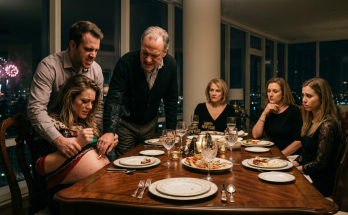
I stared at the photograph until the faces blurred.
Seventeen years earlier.
My father.
Julian Mercer.
Dominic.
And somewhere outside the frame, apparently, me.
Victor reached for the coffee he had made and forgotten to drink.
“You remember the luncheon?”
“Barely.”
“What do you remember?”
I closed my eyes.
It had been spring.
I was twenty-seven.
Still working under the shortened name Viv Lane at a nonprofit arts foundation because I was desperate to prove I could build a life without the Sterling name announcing me first.
Dad had asked me to attend a business charity luncheon.
I resisted.
He bribed me with the promise that if I came, he would stop introducing me to eligible sons of bankers for six months.
I remembered flowers.
White tablecloths.
A tedious speech about regional development.
Then—
A laugh.
A man near the windows.
Dark hair.
Tall.
His brother beside him.
I opened my eyes.
“I saw Dominic.”
Victor nodded.
“I think so.”
“But we didn’t speak.”
“No.”
“Then how did Julian know there was any chance we’d meet?”
“That’s the piece I don’t understand.”
I took Julian’s letter again.
The language was careful.
Not predictive.
Not mysterious.
If your daughter ever meets my brother…
Maybe it was coincidence.
Maybe Julian had simply known my father had a daughter roughly Dominic’s age.
But the photograph suggested our families’ paths had crossed before either Dominic or I understood it.
“Where did you get this?”
“Dad’s private archive.”
“You went through Dad’s files?”
“After he died, yes.”
“And you never showed me.”
Victor looked ashamed.
“No.”
“Why?”
“Because Dad marked this material confidential.”
“Victor, he was dead.”
“I know.”
“That doesn’t make promises immortal.”
“No.”
He rubbed his jaw.
“I understand that now.”
I almost laughed.
Apparently everyone in my life had spent the evening discovering the same lesson.
“Does Marcus know about this?”
“Some of it.”
“Adrian?”
“Probably less.”
“Does Dominic?”
“I doubt it.”
I looked toward the hallway.
Sophia’s night-light cast a small yellow rectangle across the floor.
For years, I believed my life had split neatly into two parts.
Before Dominic.
After Dominic.
Now even the beginning seemed uncertain.
“I need sleep.”
Victor nodded.
“I’ll stay downstairs.”
“You don’t have to.”
“I know.”
He looked toward Sophia’s room.
“I want to.”
That was Victor.
He would never say he was worried.
He would simply remain in the house until morning and pretend the guest room had always been his plan.
I stood.
“Don’t investigate anything else tonight.”
He raised an eyebrow.
“That request goes against my nature.”
“I’m serious.”
“So am I.”
“Victor.”
He smiled faintly.
“Fine.”
The next morning, Sophia woke at six-thirty and asked whether Daddy had turned into a hotel person.
I sat on the edge of her bed.
“A hotel person?”
“You said he wasn’t sleeping here.”
“Just for a little while.”
“Because you’re mad?”
“Because Mommy and Daddy need time to talk.”
She thought about this.
“Can I still call him?”
“Of course.”
“Can he still take me to dance Saturday?”
“Yes.”
I had not asked Dominic.
I realized that immediately.
But I also knew I did not want our conflict to turn Sophia’s relationship with him into a bargaining chip.
He was her father.
That remained separate.
Sophia accepted the answer.
Then she asked whether Uncle Victor could make pancakes.
“He’s terrible at pancakes.”
“I know.”
She smiled.
“I like the funny ones.”
Apparently Victor’s misshapen breakfasts had become a tradition without my noticing.
Twenty minutes later, I found my brother in the kitchen trying to make a rabbit-shaped pancake that looked more like a map of South America.
“Don’t say anything,” he warned.
“I said nothing.”
“Your face did.”
Sophia climbed onto a stool.
“It looks like a potato.”
“Thank you for your support.”
She giggled.
The ordinary sound steadied me.
After breakfast, Dominic called.
I let Sophia answer first.
“Daddy!”
She immediately began explaining Victor’s pancake failure in great detail.
Dominic listened.
He laughed.
He promised to pick her up Saturday.
Then she handed me the phone.
“Mommy’s turn.”
I took it and stepped onto the back porch.
“Hi.”
“Hi.”
“How are you?”
“Not good.”
At least he was honest.
“Where are you?”
“Hotel near the office.”
“Did you sleep?”
“About two hours.”
“Same.”
A silence.
Then he said, “Celeste called me.”
“What did she say?”
“That she’s furious.”
“She should be.”
“She said I used her as part of a lie without giving her any choice.”
“That sounds familiar.”
“Yes.”
He did not defend himself.
I was beginning to understand how exhausting accountability could be.
There was nowhere for anger to bounce.
“I found something last night,” I said.
“What?”
“A letter from Julian.”
Dominic went silent.
“To whom?”
“My father.”
Another silence.
“That’s impossible.”
“That phrase is getting overused.”
“What did it say?”
“I want to show you in person.”
“Today?”
“Yes.”
“Where?”
I thought about having him come home.
I wasn’t ready.
“Sterling Foundation offices.”
The nonprofit my mother had established years ago occupied a quiet building near the river.
Neutral ground.
“I’ll be there.”
At ten, Dominic entered the conference room.
He wore yesterday’s suit trousers and a white shirt with the sleeves rolled up.
The glitter necklace was gone.
For some reason, I noticed immediately.
He saw me looking.
“It’s in my briefcase.”
I looked away.
Victor was already there.
So was Marcus.
Dominic stopped.
“This is going to be enjoyable.”
“No,” I said. “It probably won’t.”
He sat.
I placed Julian’s letter in front of him.
Dominic recognized the handwriting before reading a word.
His face changed.
“Where did you get this?”
“Dad’s records.”
He picked it up carefully.
As he read, grief moved across his face.
Seven years had passed.
But grief apparently did not understand calendars.
When he finished, he stayed silent.
“Did you know Julian knew my father?”
“No.”
“Did he ever mention Sterling Continental?”
Dominic frowned.
“He worked for a bank in New York briefly.”
“What bank?”
“He never said.”
“Did you ask?”
“No.”
“Why not?”
“He hated the job.”
Marcus slid a personnel record across the table.
Dominic read it.
“Sterling Continental.”
“Yes,” Marcus said.
Dominic leaned back.
“I had no idea.”
Victor looked at him.
“Did Julian know you were going to the charity luncheon in that photograph?”
“Yes.”
“Why were you there?”
“Julian invited me.”
“What did he say?”
“That he wanted me to meet some people.”
“Did he mention Vivienne?”
“No.”
I studied his face.
“What do you remember from that day?”
Dominic looked at me.
“Honestly?”
“Yes.”
“You.”
The room became very quiet.
I blinked.
“You remember seeing me?”
“Yes.”
“Why didn’t you tell me?”
“I didn’t realize it was you until years later.”
“When?”
“After we were married.”
“How?”
“Your father had the luncheon photograph framed in his office.”
I remembered that photograph.
I had walked past it hundreds of times.
Dominic continued.
“I noticed you in the background.”
Victor picked up another print.
“You’re not visible here.”
“There were several photographs.”
Marcus looked thoughtful.
“Dad’s archive may have the others.”
I stared at Dominic.
“You knew we had been in the same room before we met.”
“Yes.”
“And you never mentioned it.”
He closed his eyes.
“When you phrase everything I’ve done that way, I realize I may have a serious problem.”
Victor muttered, “That is encouragingly self-aware.”
I gave him a look.
He stopped.
Dominic continued.
“I thought it was a funny coincidence.”
“Then why not tell me?”
“Because by then I knew your father had investigated me.”
I froze.
“You knew?”
“Not the details. But I suspected.”
“How?”
“Your father asked oddly specific questions about Julian once.”
“When?”
“About a year after we married.”
Marcus looked surprised.
“He never told me that.”
Dominic leaned forward.
“He asked whether I thought loyalty to family justified keeping secrets from a spouse.”
My chest tightened.
Of course Dad had.
He had been testing Dominic without admitting he was testing him.
“What did you say?”
“That it depended on the secret.”
“And?”
“He said, ‘That answer will cost you someday.’”
I almost laughed despite myself.
That sounded painfully like my father.
“So Dad knew you still hadn’t told me.”
“Probably.”
“And instead of telling me, he gave you riddles.”
“Yes.”
Victor sighed.
“Father was exhausting.”
Marcus nodded.
“Historically exhausting.”
For the first time since the gala, the four of us nearly smiled.
Then I looked at Julian’s letter again.
“Why would Julian write this?”
Dominic rubbed his thumb across his brother’s signature.
“He knew Raymond.”
“Your father.”
“Yes.”
“He knew I was ashamed of where we came from.”
“You keep saying ashamed.”
Dominic looked at me.
“Because I was.”
There was no drama in the words.
Just admission.
“Julian always thought I was too determined to erase the past. He said I acted like becoming successful required proving I had never needed anyone.”
Victor glanced toward me.
I noticed.
“Don’t.”
“I said nothing.”
“You were about to.”
“I was thinking that you married someone with familiar habits.”
I hated that he was right.
Dominic continued.
“Julian probably knew your father through the bank. Maybe he knew about you. Maybe he thought we would cross paths because we were moving in similar circles.”
“So our meeting was coincidence?”
“Probably.”
Marcus spoke carefully.
“Not entirely.”
We all turned toward him.
“What does that mean?” I asked.
He looked uncomfortable.
“Dad invited Julian to the luncheon because of Dominic.”
Dominic’s expression hardened.
“How do you know?”
“I found a note in the event planning file years later.”
Marcus opened his briefcase.
Apparently my request that no one investigate overnight had been interpreted creatively.
He placed a copy on the table.
Dad’s handwriting appeared in the margin.
Invite J. Mercer. Young brother has interesting company. Possible future partner.
Dominic read it.
“Partner?”
Marcus nodded.
“Business partner. Dad had been watching your company before it officially launched.”
“Why?”
“Julian pitched it to him.”
Dominic looked stunned.
“My brother pitched my company to Sterling?”
“Unofficially.”
Victor took over.
“Julian apparently believed you would refuse direct Sterling investment.”
“He was right.”
Marcus continued.
“So he spoke to Dad privately.”
I looked between them.
“And Dad became interested.”
“Yes.”
“In the company.”
“Yes.”
“Not in Dominic as a husband.”
“Not at first.”
That distinction mattered.
The story was becoming less conspiratorial with every fact.
Julian had not arranged our romance.
Dad had not selected my husband.
Two ambitious families had simply crossed paths through business.
Later, when I happened to meet Dominic socially through friends, Dad recognized the name.
Then he investigated.
The coincidence had been amplified by secrecy until it looked like design.
I sat back.
“So no one arranged us.”
“No,” Marcus said.
Dominic looked almost offended.
“I would hope not.”
Victor raised an eyebrow.
“You did marry a Sterling while pretending not to care about Sterlings.”
“I married Vivienne Lane.”
“That sounds like a romance novel.”
“Victor.”
He lifted both hands.
“Stopping.”
I looked at Dominic.
“Tell me everything.”
He inhaled slowly.
“Everything about what?”
“Your family.”
His face tightened.
“Now?”
“Yes.”
“No edited version. No deciding what I need. No protecting me.”
He nodded.
And for the next two hours, my husband told me the story of his life.
Not the polished version.
The real one.
His mother, Clara, had been a music teacher.
She sang while cooking.
She left notes in lunch boxes.
She died after a short illness when Dominic was eleven.
His father did not become monstrous.
That would have been simpler.
Raymond became distant.
Practical.
Emotionally unavailable.
He handled grief by working more.
Julian responded by becoming responsible.
Dominic responded by becoming ambitious.
One brother learned to hold the family together.
The other learned to outrun it.
When Dominic earned a scholarship, Julian drove him to college.
When Dominic failed his first economics exam, Julian drove four hours to take him to dinner.
When Dominic wanted to start a company, Julian told him his idea was terrible.
Then invested anyway.
“He said if I was going to fail, I should at least fail with enough money to learn something.”
I smiled faintly.
“I would’ve liked him.”
“Yes.”
Dominic’s eyes softened.
“You would have.”
Then came Julian’s accident.
Dominic had been on the phone with him that afternoon.
They argued.
About the company.
About Raymond.
About money.
The last thing Dominic said to his brother was, “I’m tired of owing everybody.”
Julian responded, “Then stop keeping score.”
They never spoke again.
That sentence had followed Dominic for seven years.
Suddenly much of my husband made sense.
His refusal to accept help.
His complicated relationship with obligation.
His insistence on supporting Celeste without letting her thank him publicly.
His need to prove everything had been earned alone.
“You thought telling me about Julian meant admitting you hadn’t built everything yourself.”
Dominic looked down.
“Yes.”
“That’s ridiculous.”
“Yes.”
“You’re aware of that now.”
“Very.”
I thought of my own hidden surname.
“And I thought telling you I was a Sterling meant I’d never know whether you loved me.”
Dominic looked at me.
“That was ridiculous too.”
I almost objected.
Then stopped.
“Yes.”
For a moment, neither of us spoke.
We had found one another while both trying to hide the parts of ourselves we feared would define us.
Perhaps that had made the beginning possible.
It had not made the secrecy healthy.
Marcus eventually left for a board meeting.
Victor lingered.
I looked at him.
“You can go.”
“I know.”
“Victor.”
He looked at Dominic.
“If she cries, I’ll know.”
Dominic almost smiled.
“I believe you.”
“Good.”
“Go.”
Victor left.
The conference room became quiet.
Dominic and I sat across from each other.
For sixteen years, silence between us had usually been comfortable.
This one required work.
“I’m sorry,” he said.
“I know.”
He almost smiled at my use of the phrase.
I didn’t.
“Do you understand what I’m angry about?”
“The lies.”
“Not exactly.”
He waited.
“I’m angry that you decided what version of you I was allowed to love.”
His face changed.
I continued.
“You let me love the confident founder. The husband with no family except me. The self-made man.”
“I know.”
“But you hid the brother who helped you. The nephew you loved. The grief. The shame. The fear.”
My voice broke.
“You didn’t trust me with the person underneath.”
Dominic’s eyes filled.
“I was afraid you’d see me differently.”
“I do.”
He flinched.
I let the words remain.
Then I said, “But different isn’t necessarily worse.”
He looked up.
“I’m angrier than I’ve ever been with you.”
“I understand.”
“I may be angry for a long time.”
“I understand.”
“But Celeste isn’t your other wife.”
“No.”
“Evan isn’t your son.”
“No.”
“You haven’t been unfaithful.”
“No.”
“Have you ever?”
His answer came immediately.
“No.”
I believed him.
That did not repair everything.
But it mattered.
“What do you want?” he asked.
“I don’t know.”
“Do you want me to leave permanently?”
“I don’t know.”
He nodded.
“I can wait.”
“No.”
He looked confused.
“I don’t want waiting.”
“What do you want?”
“Work.”
He listened.
“If we try to stay married, I don’t want you sitting in a hotel hoping time fixes this.”
“Okay.”
“I want counseling.”
“Yes.”
“I want transparency.”
“Yes.”
“I want to meet Celeste properly.”
“Yes.”
“I want Sophia to know Evan if they both want that.”
Dominic’s face softened.
“Yes.”
“And I want you to stop accepting my brothers’ money anonymously.”
He almost laughed.
“I didn’t know it was theirs.”
“You do now.”
“Fair.”
I folded my hands.
“And I have things to fix too.”
“You don’t owe me an equal confession just because I lied more.”
“I know.”
“But?”
“But I hid my family too.”
“That’s different.”
“Not entirely.”
I looked at him.
“I built a test you didn’t know you were taking. I wanted proof you loved me without the Sterling name.”
“You got it.”
“Maybe. But that doesn’t make the test fair.”
Dominic looked down.
“Your father’s letter was right.”
“Unfortunately, yes. He would’ve enjoyed that.”
Dominic laughed quietly.
For the first time, the sound didn’t hurt.
We did not reconcile that day.
That mattered.
I did not want our marriage repaired in one dramatic conversation because real trust does not return on command.
Dominic stayed at the hotel for eleven days.
He came home every afternoon to see Sophia.
Sometimes I joined them.
Sometimes I didn’t.
He took her to dance.
Helped her with reading.
Made dinner twice.
On the fifth day, Sophia asked why Daddy kept leaving after dessert.
We told her together.
“Mommy and Daddy are working on some grown-up things.”
“Are you getting divorced?”
The word startled me.
Apparently six-year-olds heard more than adults imagined.
Dominic looked at me.
I answered.
“We don’t know.”
Sophia became quiet.
Then Dominic said gently, “Whatever Mommy and I decide, we both love you. You won’t have to choose sides. You won’t lose either of us.”
I looked at him.
That was exactly right.
Sophia considered it.
“Can we still go to the zoo next month?”
“Yes,” I said.
“Both?”
Dominic looked at me again.
“Yes,” I answered.
She nodded.
“Okay.”
That became our standard.
No dramatic promises.
No making Sophia responsible for our reconciliation.
Just stability.
Consistency.
Honesty appropriate for her age.
Two weeks after the gala, I met Celeste for lunch.
Alone.
She chose a quiet café far from Dominic’s office.
When I arrived, she was already seated.
“I almost canceled,” she admitted.
“Why?”
“I wasn’t sure whether you’d want to see me.”
“I wasn’t sure either.”
That honesty helped.
For the first twenty minutes, we discussed safe things.
Sophia.
Evan.
Schools.
Then Celeste said, “You can ask me anything.”
So I did.
“Did you ever tell Dominic he should tell me?”
“Yes.”
“When?”
“Many times.”
That hurt.
“What did he say?”
“That he would.”
“Did you believe him?”
“For the first few years.”
“And after?”
Celeste looked ashamed.
“I stopped asking.”
“Why?”
“Because I needed him.”
Financially?
Partly.
But mostly emotionally.
Dominic was Evan’s uncle.
The remaining connection to Julian.
Celeste feared that pushing too hard might damage the relationship.
“So you participated in it.”
“Yes.”
I appreciated that she did not hide behind Dominic’s choices.
“I’m sorry,” she said. “Not because I think Julian’s family was something shameful. The opposite. I’m sorry because I allowed Dominic’s embarrassment to turn us into a secret.”
I nodded.
“Thank you.”
Then she smiled slightly.
“For what it’s worth, Julian would’ve hated all of this.”
“I’m beginning to like Julian.”
“You would have adored him.”
“Dominic said the same thing.”
“He also would’ve told Dominic he was an idiot.”
“That seems useful.”
Celeste laughed.
By the end of lunch, we had made a decision.
The children would meet again.
Not as part of repairing the marriage.
Because they were family.
A month later, Evan came to our house for a Saturday afternoon.
Sophia showed him her room.
He showed her how to solve a puzzle cube.
They argued about which pizza topping was best.
At one point I found Dominic standing in the kitchen doorway watching them.
His eyes were wet.
“What?”
“I wasted seven years.”
I knew what he meant.
“You can’t give them back.”
“No.”
“But you can stop wasting the next seven.”
He nodded.
That became one of the central choices of our new life.
Stop trying to repair the past by controlling the future.
Use the future differently.
Counseling began badly.
Our first therapist, Dr. Patel, asked Dominic why he hid his family.
He gave a twelve-minute explanation involving childhood, business, grief, his father, Julian’s estate, and my family’s wealth.
Dr. Patel listened.
Then said, “That was very articulate.”
Dominic looked relieved.
She continued.
“And almost none of it answered the question.”
I laughed before I could stop myself.
Dominic looked at me.
“That seems unfair.”
“It seems accurate.”
Eventually, he learned to answer simply.
“I was ashamed.”
Then:
“I was afraid.”
Then:
“I did not trust Vivienne to decide what the truth meant.”
Those answers hurt.
But they also gave us somewhere to work.
I had my own uncomfortable discoveries.
I liked control more than I admitted.
I had used anonymity as a shield.
I believed withholding my family name was justified because my motives were pure.
Dr. Patel challenged that.
“Intent matters,” she said. “But so does consent. Neither of you allowed the other person to decide whether these hidden facts mattered.”
I hated that session.
Which probably meant I needed it.
Three months passed.
Then six.
Dominic moved home gradually.
First one night.
Then weekends.
Eventually full time.
Not because I had forgotten.
Because his behavior changed.
He stopped compartmentalizing.
When Celeste called, he answered in front of me.
When company finances came up, he explained them.
He met with Marcus openly.
He even accepted one piece of advice from Victor, then complained about it for three weeks.
“That’s how you know he’s family now,” I told him.
Victor heard about that and sent Dominic a framed card reading:
YOU’RE WELCOME.
Dominic put it in a drawer.
Sophia found it and placed it on his desk.
Life regained humor before it regained complete trust.
Perhaps that was part of healing too.
The company changed as well.
Dominic revised its founding history.
Not publicly as a dramatic confession.
Accurately.
Julian Mercer’s original investment became part of the official company story.
At the next annual meeting, Dominic spoke about his brother.
He did not turn Julian into a saint.
He simply said:
“My brother made the first financial bet on this company when nobody else had reason to. For years, I allowed pride to reduce that fact to a footnote. It should never have been one.”
Celeste attended.
Evan sat beside her.
Sophia sat beside me.
When Dominic finished, Evan looked up at Celeste.
“That was about Dad.”
“Yes.”
He smiled.
That alone seemed worth something.
My brothers also had apologies to make.
Marcus took me to dinner.
No lawyers.
No assistants.
No confidential files.
Just my brother.
“I should’ve told you,” he said.
“Yes.”
“I thought obeying Dad was loyalty.”
“I know.”
“It became easier after he died because I could tell myself I was honoring his wishes.”
“Were you?”
Marcus thought about it.
“No.”
That answer mattered.
Adrian called from Washington.
He knew less than I had feared, but enough.
He apologized.
Then spent twenty minutes explaining why fathers from our generation were emotionally strange.
I told him he was eleven years older than me and therefore belonged dangerously close to “that generation.”
He hung up on me.
Then sent flowers.
Victor apologized too.
Not for investigating.
Victor believed investigation was practically a love language.
He apologized for saying he would take everything Dominic owned.
“I wanted you to know I was on your side.”
“You can be on my side without becoming my weapon.”
He nodded.
“That was Marcus’s exact phrase.”
“I may have underestimated Marcus.”
“We all did. He wears boring ties.”
My father’s old letter remained in my desk.
I read it often.
One line changed meaning over time.
One day, you may have to decide whether a secret kept out of fear is different from a lie kept for advantage.
At first, I thought Dad was telling me to forgive Dominic.
Later, I understood he was doing something harder.
He was refusing to decide for me.
A secret kept from fear could still wound.
Understanding the reason did not erase the consequence.
But motive mattered when deciding what could be rebuilt.
Dominic had not hidden Celeste to pursue another life.
He had hidden her because she belonged to a life he was ashamed to reveal.
That hurt.
But it was repairable.
A year after the gala, we returned to the same hotel.
Not for another company event.
The Sterling Foundation was hosting a literacy fundraiser.
Sophia was now seven.
She insisted on attending because there would be “fancy cupcakes.”
We entered the same lobby.
I noticed Dominic looking toward the reception desk.
Chloe no longer worked for the company.
Not because I demanded she be fired.
I specifically asked Dominic not to retaliate.
A month after the gala, he met with her and HR.
Her behavior in the lobby had crossed professional lines, but rather than make a spectacle of it, the company gave her a formal warning and reassigned some responsibilities.
Three months later, Chloe resigned for another position.
Before leaving, she sent me an email.
I almost deleted it.
Instead, I read it.
She apologized.
Not elegantly.
Not perfectly.
She admitted she had made assumptions about me because she had seen me at a few casual company events and concluded I was disconnected from Dominic’s professional life.
She believed Celeste was his “real” partner in that world.
She liked feeling as though she knew something I didn’t.
It made her cruel.
I never replied.
Not every apology required a relationship.
But I appreciated the honesty.
At the gala one year later, there was no confrontation.
No secretary guarding the elevator.
No hidden family.
Celeste arrived with Evan.
Marcus came with his wife.
Victor came alone and claimed this was because “relationships are operationally inefficient.”
Sophia informed him that was why he was lonely.
He stared at her.
“You have become dangerously observant.”
She smiled.
Dominic wore a new tuxedo.
Before we went upstairs, Sophia reached into her little purse.
“I brought something.”
Dominic looked alarmed.
She produced another necklace.
This one was less chaotic.
Still paper.
Still glitter.
But the letters were neat.
DAD
Then another strand.
She handed it to me.
MOM
I laughed.
“We match.”
“You have to wear them.”
Dominic looked at me.
“Rules are rules.”
We put them on.
At the elevator, Sophia pressed the button.
The doors opened.
For a moment, the memory of the previous year returned.
Chloe’s voice.
His wife and son are already upstairs.
My own humiliation.
Victor’s promise.
The sense that my entire life had just become unfamiliar.
Dominic noticed.
“You okay?”
I looked at him.
“Yes.”
And I meant it.
Not because everything had returned to what it was.
It never would.
Because we had built something different.
Something less polished.
More accurate.
Inside the elevator, Sophia stood between us holding both our hands.
“Daddy?”
“Yes?”
“Do you still have the old necklace?”
Dominic smiled.
“It’s in my desk.”
“The glitter one?”
“Yes.”
“You didn’t throw it away?”
“No.”
“Why?”
He looked toward me.
“Because it reminds me of an important night.”
Sophia grinned.
“The party?”
“Something like that.”
The elevator rose.
At the ballroom level, the doors opened.
Celeste and Evan were waiting.
Evan waved.
Sophia ran toward him.
For years, Dominic had believed family was something that could be divided into separate rooms.
One room for the past.
One for marriage.
One for grief.
One for pride.
One for the people he loved but could not explain.
Eventually, all those doors opened.
The result was messy.
There were difficult conversations.
Anger.
Embarrassment.
Counseling appointments.
Awkward lunches.
Questions without easy answers.
But there was also something none of us had expected.
More family.
Not less.
At dinner, Evan told a story about Julian that made Dominic laugh until he had tears in his eyes.
Celeste corrected half the details.
Marcus argued with Victor about interest rates.
Sophia stole icing from my cupcake.
Dominic reached beneath the table and took my hand.
I looked at him.
He did not ask whether I had forgiven everything.
He had learned better than that.
Forgiveness was not a certificate awarded at the end of good behavior.
It was something quieter.
A willingness to keep discovering who another person really was.
And a willingness to let them discover you too.
I squeezed his hand.
That was enough.
Later, we stood near the ballroom windows looking over the city.
“Do you ever think about that night?” Dominic asked.
“The gala?”
“Yes.”
“Sometimes.”
“Do you wish you hadn’t come?”
I looked toward Sophia.
She and Evan were building a tower from folded place cards.
“No.”
Dominic seemed surprised.
“Why?”
“Because I would rather have been hurt by the truth than comforted by something incomplete.”
He nodded.
“I wish I had understood that sooner.”
“So do I.”
He smiled slightly.
Then I added, “But you understand it now.”
“I’m trying.”
“That’s different.”
“Good different?”
“Ask me in another sixteen years.”
He laughed.
I leaned against him.
The glitter letters on our paper necklaces brushed together.
There had been no second wife.
No secret son.
No hidden affair waiting upstairs.
The misunderstanding had been smaller than that.
And, in another way, larger.
Because the real question had never been whether Dominic belonged to another family.
It was whether he had trusted me enough to let me see the family he already had.
For years, he had not.
Now Celeste was laughing across the room.
Evan was teaching Sophia another puzzle.
My brothers were arguing near the dessert table.
And Dominic stood beside me with the whole imperfect truth visible.
I had once believed love was safest when stripped of names, money, history, and expectation.
Dominic had believed love was safest when grief, shame, and dependence were hidden away.
We had both been wrong.
Love was not proved by removing everything complicated.
It was proved by allowing the complication to be seen and choosing, freely, what to do with it.
That was the choice my father had finally left to me.
Not whether Dominic deserved punishment.
Not whether our marriage deserved saving.
Whether the man who had lied out of fear was willing to live differently once the lie was gone.
And whether I was willing to stop testing love by hiding parts of myself too.
The answer had not come that night in the lobby.
It had taken a year.
Dozens of conversations.
A few terrible counseling sessions.
Several good ones.
A child’s paper necklace.
A dead brother’s letter.
And the slow discovery that rebuilding trust was not dramatic.
It was mostly ordinary.
Coming home when you said you would.
Answering difficult questions.
Introducing people instead of hiding them.
Saying, “I’m afraid,” before fear became another secret.
Dominic touched the necklace Sophia had made.
“She’s getting better at these.”
“Don’t tell her that. She’ll start charging.”
“She’s a Sterling.”
“She’s also a Hale.”
He smiled.
“Both?”
I looked across the room at our daughter.
“Yes.”
Both.
No hidden names.
No edited history.
No choosing which half was acceptable.
Just the whole story.
And this time, everyone who mattered was finally upstairs together.