
PART 2 – THE MORTGAGE THAT DIDN’T EXIST
“No,” I said. “The real question is what you think I still owe after this, because if we’re counting everything tonight, then you haven’t even seen the part that proves your mortgage was paid off six years ago.”
My father stopped breathing.
Not literally, but close enough that I heard the small click in his throat.
He looked at the paper in my hand, then at my mother.
“What did she say?”
My mother did not move.
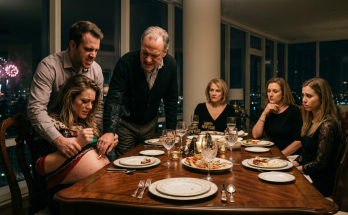
The kitchen lights shone against the gold necklace at her throat. Her thumb remained pressed against one of my bank statements, covering a transfer from July as though hiding a few numbers could change the total.
I placed the mortgage satisfaction letter on the table.
The document was dated March 14, six years earlier.
The words PAID IN FULL appeared near the top.
My father picked it up with both hands.
“No,” he said. “That can’t be right.”
“It is.”
“We refinanced after my surgery.”
“You did,” I said. “And that loan was paid off six years ago.”
He looked at my mother again.
“Patty?”
She finally moved.
She reached for the letter, but my father pulled it away before she could touch it.
“Richard, you don’t understand how these things work.”
“I understand ‘paid in full.’”
Her face hardened.
“There were other expenses.”
“I know,” I said. “That’s why I brought the other pages.”
I laid three more sheets beside the mortgage letter.
They showed my monthly transfers entering the family account on the first business day of every month.
Then, beginning the month after the mortgage had been paid, they showed most of the money leaving again.
Always within twenty-four hours.
Always transferred to the same destination.
Account ending in 7714.
My father stared at it.
“What account is that?”
My mother folded her arms.
“It was for household expenses.”
“No,” I said. “The electric company doesn’t use a brokerage routing number.”
Sandra lowered the napkin she was still holding.
“A brokerage account?”
My mother looked at her so sharply that Sandra took a step backward.
I continued laying out the pages.
January.
Four thousand dollars deposited by me.
Three thousand five hundred transferred to account 7714.
February.
Four thousand deposited.
Three thousand seven hundred transferred.
March.
The same.
Month after month.
Year after year.
My mother had never been spending all the money.
She had been collecting it.
My father turned the pages faster.
“How much?”
“I could only trace the transfers from the account I had access to,” I said. “The total moved into that brokerage account was just over three hundred and twelve thousand dollars.”
The paper slipped from his fingers.
Sandra covered her mouth.
My mother gave a short, humorless laugh.
“You’re making it sound criminal to save money.”
I looked at my torn coat sleeve.
Then I looked at my bank balance sitting on the table.
Six hundred eleven dollars and eighty-three cents.
“You told me Dad’s prescriptions would be cut off.”
“They could have been.”
“You told me the property taxes were overdue.”
“They were due.”
“You told me the bank was threatening foreclosure.”
“We needed security.”
“You told me you couldn’t afford groceries.”
“Things are expensive.”
“You told me Dad needed a new medical procedure.”
“He might.”
My father’s head snapped toward her.
“What procedure?”
My mother paused.
It lasted only a second, but it was long enough.
He understood.
“There was no procedure,” he said.
She lifted her chin. “Not yet.”
The silence afterward felt heavier than shouting.
My father lowered himself into a dining chair.
He looked suddenly older than he had an hour earlier. His shoulders curved beneath his sweater, and the lines around his mouth deepened as he stared at the mountain of paper.
“I thought she was helping with the mortgage,” he whispered.
“I was,” I said. “Until there wasn’t one.”
He pressed his fingertips against his forehead.
“How much did you tell her we needed every month?”
My mother did not answer.
“Patty.”
“I handled the finances.”
“How much?”
“Richard, this is not the time.”
He struck the table with his palm.
The appetizer trays jumped.
A glass tipped over, spilling red wine across the white tablecloth. It spread beneath the statements like a dark stain no napkin could absorb quickly enough.
“How much did you tell my daughter we needed?”
“Four thousand.”
He stared at her.
“Every month?”
“Yes.”
“For fifteen years?”
“We raised her!”
The words exploded out of my mother with such force that even she seemed surprised by them.
She pointed at me.
“We fed her. We clothed her. We drove her to school. We paid for braces. We kept a roof over her head when she had nowhere else to go.”
“I was nine,” I said quietly.
Her hand dropped.
“What?”
“When you keep reminding everyone that I had nowhere else to go, I was nine years old. Children usually live with their parents.”
Sandra looked down.
My father closed his eyes.
My mother’s voice became cold.
“You always were ungrateful.”
There it was.
The word she used whenever gratitude stopped looking like obedience.
I had heard it when I wanted to attend a college outside Pennsylvania.
I had heard it when I moved to Boston.
I had heard it when I missed Easter because I was working two jobs.
I had heard it when I asked why my name was never included on the Christmas cards attached to gifts I had paid for.
Ungrateful.
A small word that had cost me fifteen years.
“I’m not asking you to thank me,” I said. “I’m telling you the payments are over.”
My mother smiled.
It was not a kind smile.
“You’ll change your mind.”
“No.”
“You always do.”
“Not this time.”
“What happens when your father’s insurance payment is due?”
“He can show me the bill.”
Her smile disappeared.
“What?”
“From now on, if Dad needs medicine, he can send me the pharmacy invoice. If the property taxes are due, I’ll see the county statement. If the furnace breaks, I’ll speak to the repair company.”
“You expect us to beg you for every dollar?”
“I expect you to stop lying for it.”
Her face flushed.
My father lifted the mortgage letter again.
“What happened to the brokerage money?”
She turned away.
“Patty.”
“It’s invested.”
“All of it?”
“Most of it.”
“For what?”
“Our future.”
He stared at her in disbelief.
“Our future? Emily has six hundred dollars.”
“She has a career.”
“I was laid off in March,” I said.
My father looked at me.
The expression on his face changed so quickly that I almost looked away.
“You lost your job?”
“Yes.”
“When?”
“March nineteenth.”
“Why didn’t you tell us?”
“I tried.”
My mother’s shoulders stiffened.
I looked directly at her.
“I called the next morning. Mom answered.”
My father slowly turned.
“What did she say?”
I remembered sitting at my kitchen table with the termination letter beside my coffee. I had barely slept. My eyes were swollen, and I had spent the entire morning calculating how many months I could survive before my savings disappeared.
“I told her the firm had eliminated my position,” I said. “She said she was sorry. Then she reminded me that your transfer was due in eleven days.”
My father looked as if I had struck him.
My mother shook her head.
“That is not how the conversation happened.”
“It is exactly how it happened.”
“You said you would get severance.”
“I received six weeks.”
“And you found contract work.”
“Three months later.”
“So you were fine.”
“I sold my grandmother’s earrings.”
Sandra inhaled sharply.
My mother’s face went still.
My grandmother had left me a pair of small diamond earrings when she died. They were not worth a fortune, but they were the only valuable thing anyone in the family had ever given me without asking for something in return.
I had sold them in April to make my transfer.
My father’s voice broke.
“You sold Mom’s earrings to send us money?”
“Yes.”
“Why?”
“Because Patricia told me the bank was going to take the house.”
He did not call her Patty this time.
My mother reached for the wine bottle.
Her hand trembled as she poured.
“The house was our only asset. I was protecting us.”
“From what?” I asked. “Retirement? Dad? Me?”
“From being dependent on a daughter who could walk away whenever she wanted.”
The answer landed differently from everything else she had said.
Not because it was louder.
Because it was honest.
She had never trusted my love.
Only my payments.
My father stared at her.
“She didn’t walk away.”
“She moved six hundred miles away.”
“She sent us almost three-quarters of a million dollars.”
“Because she was supposed to!”
My mother’s voice cracked through the room.
“She left us. She built a life somewhere else. She got a fancy job and an apartment in Boston and started acting like she was better than the people who raised her.”
“I lived in a studio apartment for eight years.”
“You chose that.”
“To afford your house.”
“Nobody forced you.”
The room went completely still.
My father whispered, “Patty, stop.”
But I raised my hand.
“No. Let her finish.”
My mother looked at me with fifteen years of confidence.
She had said the sentence because she believed it protected her.
Nobody forced you.
Technically, she was right.
She had never held a weapon to me.
She had used something far more effective.
My father’s health.
Their mortgage.
Their age.
My fear of being a bad daughter.
Every crisis had arrived wrapped in the same message: If you loved us, you would fix this.
“I chose to help you,” I said. “I did not choose to be deceived.”
“You knew we needed support.”
“I believed you.”
“That was your decision.”
My father stood so suddenly that his chair scraped backward.
“Enough.”
My mother flinched.
In thirty-eight years, I had rarely heard him raise his voice at her.
He held up the mortgage letter.
“You told me the money Emily sent barely covered the house.”
“It covered our lifestyle.”
“What lifestyle?”
She gestured around the kitchen.
The granite counters.
The stainless-steel appliances.
The expensive backsplash.
The wine.
The catered food.
The new SUV sitting in the driveway.
For years, I had thought those things were exceptions.
A few comforts purchased between emergencies.
Now I understood.
I had not been rescuing my parents from poverty.
I had been financing my mother’s performance of prosperity.
My phone vibrated in my coat pocket.
Once.
Then again.
I ignored it.
My mother noticed.
“Is that your financial woman?”
“Her name is Claire.”
“Did she tell you to do this?”
“No. You did.”
Sandra quietly placed her napkin on the counter.
“I should go.”
My mother spun toward her.
“You’re staying.”
“Patricia—”
“You sat in this kitchen and listened to her accuse me of stealing.”
Sandra’s expression changed.
“She didn’t accuse you. She showed us statements.”
“You think you’re innocent?”
Sandra’s face drained.
I looked between them.
“What does that mean?”
“Nothing,” Sandra said quickly.
My mother smiled again.
This time the smile was aimed at her sister.
“Tell Emily about Lily’s wedding.”
Sandra gripped the edge of the counter.
My cousin Lily had gotten married four years earlier at a vineyard outside Charlottesville. There had been white roses, a string quartet, and nearly two hundred guests.
My parents had claimed they could not afford to attend.
I had paid for their flights, hotel, clothes, and gift.
“What about the wedding?” I asked.
Sandra’s eyes filled with shame.
“Patricia, don’t.”
“Tell her who paid the deposit.”
I looked at the transfer records.
One payment stood out.
Twenty-five thousand dollars transferred from my parents’ family account three months before the wedding.
The transaction had been labeled HOME REPAIR.
I had believed the basement flooded that year.
“There was no flood,” I said.
Nobody answered.
I turned toward Sandra.
“The twenty-five thousand dollars was for Lily’s wedding?”
Sandra’s lips parted, but no sound came out.
My mother answered for her.
“She needed help.”
I laughed.
The sound frightened me because it contained no humor.
“You told me mold had spread through the basement walls.”
“We couldn’t tell you the truth.”
“Why?”
“Because you would have said no.”
I looked at Sandra.
“Did you know where the money came from?”
She wiped beneath one eye.
“Your mother said it was family savings.”
“Whose family?”
“Emily—”
“Did you know I was sending four thousand dollars every month?”
Sandra looked toward the floor.
That was my answer.
“You knew.”
“I didn’t know how much.”
“You sat in this kitchen on Christmas Day and laughed when she said I owed you.”
“I wasn’t laughing at you.”
“You certainly weren’t defending me.”
She began to cry.
I felt nothing.
That scared me more than anger.
My phone vibrated again.
This time I pulled it out.
Three missed calls from Claire.
One text.
CALL ME NOW. DO NOT LET YOUR MOTHER MOVE ANY MONEY.
I read it twice.
My mother was watching my face.
“What is it?”
I stepped into the hallway and called Claire.
She answered before the first ring finished.
“Emily, are you with your parents?”
“Yes.”
“Is your mother there?”
I looked through the doorway.
Patricia Bennett stood at the dining table with her wineglass in one hand and three hundred pages of my obedience spread before her.
“Yes.”
“Did you confront her?”
“Yes.”
Claire exhaled sharply.
“Listen carefully. When we froze the family account, the bank’s fraud system flagged an attempted transfer.”
“How much?”
“Forty-eight thousand dollars.”
I gripped the phone.
“Where was it going?”
“To the brokerage account we identified.”
I turned toward the dining room.
My mother was no longer looking at me.
She was looking at her purse.
“Was the transfer stopped?”
“Yes, but that isn’t the problem.”
“What is?”
“The bank reviewed the account ownership documents.”
The Steelers game ended in the den.
The sudden silence from the television made Claire’s voice sound unnaturally loud.
“The brokerage account isn’t solely in Patricia’s name,” she said.
My mouth went dry.
“Whose name is on it?”
“Yours.”
I could not speak.
Claire continued.
“The account was opened eleven years ago using your name, your date of birth, and your Social Security number.”
I leaned against the hallway wall.
“That’s impossible.”
“There’s more.”
Of course there was.
There was always more.
“The bank sent me a copy of the signature card because I’m listed as your authorized adviser. Emily, the signature looks like yours, but I assume you didn’t sign it.”
“No.”
“Then someone forged your name.”
I looked at my mother.
She had one hand inside her purse.
“Mom,” I said.
She froze.
My father and Sandra both turned.
“Take your hand out of the purse.”
Her eyes narrowed.
“Don’t speak to me like that.”
“Take your hand out.”
She pulled out her phone.
The screen was already unlocked.
A banking application was open.
My father walked toward her.
“What are you doing?”
“Protecting what belongs to us.”
“It’s in Emily’s name.”
My mother’s face changed.
Only slightly.
But enough.
She knew.
I returned to the dining room with Claire still on the line.
“You opened an investment account using my identity.”
My father looked at her.
Sandra stopped crying.
My mother placed her phone facedown on the table.
“I did what was necessary.”
“You forged my signature.”
“You gave me permission to manage the money.”
“I gave you permission to use one checking account for household bills.”
“You sent the money willingly.”
“I did not give you my Social Security number to open investments.”
“You’re my daughter. I already had it.”
“That does not make it yours.”
She looked around the room as though waiting for someone to support her.
Nobody did.
Then she straightened her shoulders.
“You should be thanking me.”
I stared at her.
“For committing identity fraud?”
“For building something you would never have had the discipline to build yourself.”
“I sent you seven hundred and twenty thousand dollars.”
“And I saved part of it.”
“While I sold Grandma’s earrings.”
“You were always dramatic about money.”
My father made a wounded sound.
She ignored him.
I put the phone on speaker.
“Claire, what is the current balance?”
My mother lunged for the phone.
I pulled it back.
Claire hesitated.
“The most recent balance is approximately five hundred eighty-six thousand dollars.”
Sandra sank into a chair.
My father gripped the back of another.
My mother stared at me defiantly.
“There,” she said. “Now do you understand? I turned your little monthly payments into something substantial.”
“My little monthly payments?”
“You would have wasted the money.”
“On what? Food? Rent? A coat without a hole in it?”
“You never knew how to think long-term.”
“I gave away my entire future to fund yours.”
“And now there is money waiting for you.”
Claire interrupted.
“Emily, that may not be true.”
My mother’s face tightened.
“What do you mean?” I asked.
“There was a beneficiary change submitted nine days ago.”
I looked at my mother.
The room tilted.
“A beneficiary change?”
“Yes.”
“To whom?”
“I don’t have the complete file yet. The bank is reviewing it.”
My mother reached for her purse.
My father blocked her.
“Where are you going?”
“I’m not staying here to be interrogated.”
“You’re not leaving,” he said.
“You cannot keep me in my own house.”
“Our house,” he replied. “Unless there’s something else you changed without telling me.”
For the first time that night, fear appeared in my mother’s eyes.
It vanished quickly, but I saw it.
So did my father.
“What did you do?” he asked.
She said nothing.
He stepped closer.
“Patty, whose name is on this house?”
She lifted her wineglass and took a slow drink.
My stomach dropped.
“Mom,” I said, “whose name is on the deed?”
Her silence answered before her mouth did.
My father walked into the den.
A drawer opened.
Then another.
We heard papers being moved, cabinet doors striking wood, his breathing becoming louder and more desperate.
He returned holding a thin folder.
Empty.
“The deed was in my desk,” he said.
My mother placed the wineglass down.
“You lose things.”
“I did not lose the deed.”
“It needed to be updated.”
“Updated how?”
She looked at me.
Not at him.
At me.
That was when I understood the investment account was only part of it.
My mother had been preparing for something.
The beneficiary change.
The attempted transfer.
The missing deed.
The constant pressure for money even after the mortgage was gone.
None of it had been random.
“Claire,” I said into the phone, “can you check whether my credit report shows property records?”
“I can contact the attorney we discussed, but the county recorder may have an online database.”
My father was already reaching for his laptop.
His hands shook so badly that he entered the password incorrectly twice.
My mother walked toward the kitchen.
Sandra stood in her way.
“Move,” my mother said.
“No.”
“Sandra.”
“I covered for you because you said you were saving for emergencies. You never said anything about forging Emily’s name.”
My mother laughed bitterly.
“You were happy to take the wedding money.”
Sandra flinched.
“That doesn’t make this right.”
“No. It just makes you a hypocrite.”
My father found the county property website.
He typed in the address.
We gathered behind him.
The page loaded slowly.
Owner information.
Transfer history.
Recorded liens.
My father clicked the most recent filing.
The document had been recorded eight months earlier.
A quitclaim deed.
Richard and Patricia Bennett had once owned the house together.
According to the new filing, Richard Bennett had transferred his interest to Patricia Bennett.
My father stared at the electronic signature beside his name.
“I never signed this.”
My mother moved toward the front door.
I stepped in front of it.
“You forged Dad’s name too.”
Her eyes flashed.
“I had power of attorney.”
“For medical decisions,” he said.
“It included financial matters.”
“Only if I became incapacitated.”
“You were taking pain medication.”
“I was not incapacitated.”
“You don’t remember half of what happened after your surgery.”
“My surgery was eleven years ago. This deed was filed eight months ago.”
My mother’s face tightened.
Then she made a mistake.
She looked at the clock.
Eleven forty-seven.
Thirteen minutes until midnight.
“Why do you keep checking the time?” I asked.
“I’m not.”
“You checked it when I arrived. You checked it when Claire called. You’re checking it now.”
My father closed the laptop.
“What happens at midnight?”
“Nothing.”
My phone chimed.
A new email from Claire.
SUBJECT: URGENT—BENEFICIARY DOCUMENT LOCATED.
I opened the attachment.
The first page showed the brokerage account number.
The second showed the beneficiary designation.
My eyes found the name.
It was not mine.
It was not my father’s.
It was not Sandra’s.
The beneficiary was a company.
BENNETT LEGACY HOLDINGS LLC.
I turned the page.
Registered agent: Patricia Bennett.
Formation date: eight months earlier.
The same week the new deed had been filed.
Claire spoke through the phone.
“Emily, the brokerage account, the house transfer, and the company formation all happened within six days.”
“Why?”
“I’m still reviewing the documents, but the LLC has another listed member.”
I looked at my mother.
“Who?”
Claire said a name I had never heard before.
“Daniel Mercer.”
My father went completely still.
My mother closed her eyes.
Sandra whispered, “Oh, God.”
I looked at her.
“You know him?”
Sandra’s mouth trembled.
My mother opened her eyes and pointed at her sister.
“Don’t.”
That single word confirmed everything.
“Sandra,” my father said, “who is Daniel Mercer?”
She looked at him with tears running freely down her face.
“I thought Patricia had told you.”
“Told me what?”
My mother grabbed her purse and rushed toward the back door.
My father caught her wrist.
“Who is he?”
“Let go of me.”
“Who is Daniel?”
She pulled against him.
The clock changed to eleven forty-nine.
My phone rang again.
This time the number belonged to the fraud department at my bank.
I answered.
“Ms. Bennett,” a man said, “we need to confirm whether you authorized a wire transfer scheduled to process at midnight.”
My mother stopped struggling.
“How much?” I asked.
“One hundred eighty thousand dollars.”
“To Bennett Legacy Holdings?”
“No, ma’am.”
I watched the blood leave my mother’s face.
“Then where?”
The investigator paused.
“The receiving account is held by Daniel Mercer.”
My father released my mother’s wrist.
She stumbled backward.
“Patty,” he whispered.
She looked at him.
For the first time that night, there was no anger in her expression.
No superiority.
No confidence.
Only terror.
The investigator continued speaking, but I barely heard him.
My father did.
“Sir,” he said, leaning toward my phone, “what bank is that account with?”
The investigator named a bank in Florida.
My father’s face collapsed.
He knew.
Not the account.
The place.
“Clearwater,” he whispered.
Sandra began to sob.
My mother reached for the door again.
My father stood between her and the exit.
“You told me those Clearwater trips were with Sandra.”
Sandra shook her head.
“I haven’t been to Florida with her in nine years.”
The clock changed to eleven fifty-one.
My mother looked at each of us.
Then she looked at the folder on the table.
At my payment records.
At the forged account documents.
At the deed.
At the life she had built by turning my loyalty into currency.
Her shoulders lowered.
“All right,” she said.
Her voice was almost calm.
“I’ll tell you who Daniel is.”
My father gripped the table.
I held the phone tighter.
My mother looked directly at me.
“But once I do, Emily, you’re going to wish you had kept sending the money and never opened that folder.”
Then someone knocked on the front door.
Three slow knocks.
My mother’s terror returned.
Not because she didn’t know who was outside.
Because she did………………
TO BE CONTINUED IN PART 3…
CLICK HERE CONTINUE TO READ PART 3 – For fifteen years, I sent my parents $4,000 monthly. One Christmas confession ended everything forever.
PART 3 – THE MAN MY MOTHER PAID TO DISAPPEAR
The knocking came again.
Three slow, deliberate knocks.
My mother’s eyes remained fixed on the front door.
“Do not open it,” she whispered.
It was the first time all evening she had sounded like she was asking rather than ordering.
My father looked at her.
“Is it Daniel?”
She said nothing.
That was answer enough.
The fraud investigator was still speaking through my phone.
“Ms. Bennett, I need your verbal confirmation. Did you authorize the transfer of one hundred eighty thousand dollars?”
“No,” I said.
My mother turned toward me.
“Emily, think carefully.”
“I did not authorize it.”
“Once you stop that transfer, you cannot undo what happens next.”
I stared at her.
“Cancel it,” I told the investigator.
My mother rushed toward me.
My father stepped between us.
“Patty, don’t.”
“You don’t understand!” she shouted.
“Then explain it.”
The clock above the doorway changed to 11:53.
Seven minutes until midnight.
The investigator asked me to confirm my full name, date of birth, and the last four digits of my Social Security number.
I answered each question.
My mother stood less than five feet away, watching nearly two decades of control disappear with every word I spoke.
The knocking came a third time.
Louder now.
“Patricia,” a man called from the porch. “Open the door.”
My father’s face changed when he heard the voice.
He knew it.
Not well.
But enough.
My mother shook her head at him.
“Richard, please.”
He walked toward the door.
She grabbed his arm.
“You cannot let him inside.”
“Why?”
“Because he will destroy this family.”
My father looked around the dining room.
At the forged investment account.
At the stolen deed.
At my balance of $611.83.
At this point,” he said, “I’d like to hear how.”
He pulled the door open.
Cold air rushed into the hallway.
A man stood beneath the porch light wearing a charcoal overcoat darkened by melting snow. He appeared to be in his late sixties. His hair was silver at the temples, and deep lines ran from the corners of his nose to his mouth.
He carried a leather document case in one hand.
His other hand was bare despite the cold.
For several seconds, nobody spoke.
Then he looked past my father and saw me.
The expression on his face stopped me.
It was not surprise.
It was recognition.
His eyes were gray.
So were mine.
He had the same small scar beneath his lower lip that I had spent my entire life assuming came from my father’s side of the family.
My mother moved behind me.
“Daniel, you need to leave.”
The man continued staring at me.
“She looks like my mother,” he said.
My father gripped the door.
“What did you say?”
Daniel stepped inside without being invited.
Snow melted onto the hardwood floor beneath his shoes.
My mother reached for the document case.
He pulled it away.
“Not until the transfer clears.”
“It has been canceled,” I said.
His eyes shifted toward me.
“What?”
“The bank stopped it.”
My mother closed her eyes.
Daniel turned on her.
“You promised me the money would be there by midnight.”
“I was handling it.”
“You forged another transfer, didn’t you?”
My father looked between them.
“Another?”
Daniel’s jaw tightened.
“You didn’t tell them?”
My mother’s voice became sharp.
“You have no right to walk into my house and question me.”
Daniel glanced toward the laptop on the table.
According to the county records, the house belonged to her.
At least on paper.
He looked at the statements spread across the dining table.
Then he noticed the mortgage satisfaction letter.
The confidence disappeared from his face.
“What have you told them?”
“Nothing,” my mother said.
“I found the account,” I answered. “I found the deed. I found the LLC. The bank found the transfer.”
Daniel looked at me for a long moment.
Then he placed the leather case on the floor.
“Then I suppose we’re finished pretending.”
My father stepped closer.
“Who are you?”
Daniel looked at my mother.
She turned her face away.
He looked back at my father.
“My name is Daniel Mercer.”
“I know your name.”
My father’s voice was low.
“I want to know who you are to my wife.”
Daniel did not answer immediately.
The fraud investigator’s voice came through my phone.
“Ms. Bennett, the transfer has been canceled. All connected accounts are now temporarily restricted.”
My mother opened her eyes.
“What do you mean restricted?”
The investigator heard her.
“No outgoing transactions will be permitted until our investigation is complete.”
“You cannot do that,” my mother said.
“I can,” I replied. “The account is in my name.”
“It is our money.”
Daniel laughed once.
It was a bitter sound.
“No, Patricia. It never was.”
My mother stared at him.
“Be quiet.”
My father walked toward Daniel.
“Who are you?”
Daniel met his eyes.
“I knew Patricia before she married you.”
My father’s hands curled into fists.
“How well?”
“Richard,” my mother warned.
Daniel ignored her.
“We met in the summer of 1986.”
The year before I was born.
The room seemed to narrow around me.
My father looked at my mother.
“You told me you had never met him until the Clearwater investment seminar.”
“That was where we reconnected.”
“Reconnected?”
My father repeated the word as though it belonged to a language he no longer understood.
Daniel unbuttoned his coat.
“We were together for almost a year.”
My mother stepped forward.
“It ended before Richard and I became serious.”
“No,” Daniel said. “It ended when you discovered you were pregnant.”
Nobody moved.
I became aware of every tiny sound in the house.
The furnace running.
Water dripping from Daniel’s coat.
The refrigerator humming in the kitchen.
My own breathing.
My father slowly turned toward me.
Then he looked away.
“No,” my mother said.
Daniel reached inside his coat.
My father raised one hand.
“Slowly.”
Daniel pulled out a faded photograph.
He held it toward me.
I did not take it.
My mother did.
She tried to tear it in half.
Daniel caught her wrist.
“Let go of me.”
“You have destroyed enough evidence.”
He took the photograph back and placed it on the table.
It showed my mother standing beside a blue Ford Mustang.
She looked young.
Happy.
Her hair was long, and one of Daniel’s arms was around her waist.
The date printed on the back was September 1986.
I had been born the following June.
My father stared at the photograph.
“She said you were married,” Daniel told him. “She said you knew about the baby and wanted to raise her.”
My father looked at my mother.
“You told him I knew?”
“I was afraid.”
“Of what?”
“Losing everything.”
“You mean losing me.”
“You had a stable job. You had a house. Daniel had nothing.”
Daniel’s mouth tightened.
“I was twenty-four.”
“So was I,” she snapped. “I could not build a life on promises.”
I looked at Daniel.
“Are you saying you’re my father?”
My voice sounded distant.
Like it belonged to somebody at the end of a hallway.
He looked directly at me.
“I’m saying Patricia told me I was.”
My knees weakened.
I gripped the back of a chair.
My father moved toward me automatically.
He stopped halfway.
The hesitation hurt more than anything my mother had said.
Daniel saw it.
“A private test was done last year,” he said.
My mother spun toward him.
“You promised me you destroyed it.”
“I promised I would remain silent if you fulfilled our agreement.”
My father’s face hardened.
“What test?”
Daniel opened the leather case.
My mother lunged for it.
Sandra stepped in front of her.
“Stop, Patricia.”
“Move.”
“No.”
My mother shoved her.
Sandra stumbled into the table, knocking several statements to the floor.
My father caught my mother by the shoulders.
“That’s enough.”
Daniel removed a sealed envelope.
He placed it in front of me.
My name was typed across the front.
EMILY BENNETT.
“I did not consent to a test,” I said.
“No,” Daniel replied. “You didn’t.”
“How did you get my DNA?”
My mother stopped struggling.
I looked at her.
She could not look back.
“Mom?”
She said nothing.
Daniel answered.
“Your mother brought me a toothbrush after you visited last Thanksgiving.”
The room tilted.
I remembered that visit.
I had stayed in the floral guest room for two nights.
On the final morning, I could not find my toothbrush.
My mother said she had thrown it away because it fell behind the toilet.
“You stole it?”
“I needed certainty,” she whispered.
“You stole my DNA.”
“I needed to know.”
“You already knew enough to take my money.”
My mother’s face crumpled for half a second.
Then it hardened again.
“I was trying to protect you.”
“From whom?”
She looked at Daniel.
“From him.”
Daniel slid the envelope closer.
“The report says there is a 99.8 percent probability that I am your biological father.”
My father walked away from the table.
He stood near the window with his back to us.
For thirty-eight years, I had believed I inherited my patience from him.
My stubbornness.
My habit of checking every lock twice before bed.
My inability to watch someone struggle with a heavy suitcase without offering help.
Now one document was trying to reduce fatherhood to a percentage.
“Dad,” I said.
He did not turn.
My mother reached for him.
He stepped away.
“Don’t touch me.”
“Richard, I wanted to tell you.”
“When?”
His voice shook.
“After forty years? After I died?”
“You loved her.”
“I still love her.”
He finally turned.
His eyes were wet.
“She is my daughter.”
Daniel lowered his gaze.
My father looked at me.
“Whatever is written in that envelope, you are my daughter.”
I crossed the room and put my arms around him.
For one second, he stood stiffly.
Then he held me so tightly I could barely breathe.
“I’m sorry,” he whispered.
“You didn’t do anything.”
“I should have known.”
“You raised me. That’s what you knew.”
My mother began crying.
Not quietly.
She pressed one hand over her mouth as her shoulders shook.
I might have felt sorry for her if the dining table had not been covered with proof of every choice she had made after the original lie.
My father released me.
He looked at Daniel.
“If you knew about Emily, why did you stay away?”
Daniel glanced toward my mother.
“She paid me.”
My father’s face darkened.
“With whose money?”
Daniel looked at the transfer records.
“I was told the money came from an inheritance.”
I laughed bitterly.
“What inheritance?”
He did not answer.
My mother wiped her face.
“Do not say another word.”
Daniel looked at her.
“You told me Emily knew.”
“Knew what?” I asked.
He opened the document case again.
“You told me she had agreed to the arrangement.”
“What arrangement?”
Daniel pulled out a stack of cashier’s-check copies.
The oldest was dated eleven years earlier.
Twenty thousand dollars.
Then another.
Fifteen thousand.
Ten thousand.
Thirty thousand.
The payments continued irregularly for years.
My father picked up one copy.
“Why was she paying you?”
Daniel looked ashamed.
“At first, it was to stay away.”
“You blackmailed her,” I said.
“Yes.”
He did not try to soften it.
My mother pointed toward the door.
“Get out.”
Daniel remained still.
“I was angry. I believed she had stolen my child and replaced me with a man who could give her a better life.”
“You accepted money from that child,” my father said.
“I didn’t know it came from Emily.”
“You never asked?”
“I didn’t want to know.”
At least he was honest about his cowardice.
My mother had spent years turning lies into sacrifices.
Daniel did not bother.
He had taken the money because it was offered.
“What changed eight months ago?” I asked.
Daniel looked at the LLC documents.
“Patricia contacted me. She said Richard’s health was failing.”
My father’s expression sharpened.
“She said what?”
“She said you had early dementia. She said you could no longer handle finances or understand legal documents.”
“That’s why you helped her with the deed,” I said.
Daniel nodded.
“She had your power of attorney.”
“It was not active,” my father replied.
“She said it was.”
“You never spoke to him?”
Daniel looked down.
“No.”
My father picked up the forged deed.
“So you helped her steal my house.”
“I notarized the documents.”
“You notarized a signature you did not witness.”
Daniel said nothing.
“That is fraud,” I said.
“I know.”
My mother laughed through her tears.
“Look at him pretending to have a conscience. He took every payment.”
Daniel faced her.
“And you promised the last one would end it.”
“What was the final payment for?” I asked.
He looked at me.
“The original documents.”
“What documents?”
My mother moved toward the fireplace.
The answer was in her movement.
Daniel grabbed the leather case before she could reach it.
“Do not burn anything,” he said.
My father blocked the fireplace.
The clock changed to 11:58.
Two minutes before midnight.
Daniel placed the case on the table and opened the final compartment.
Inside was a yellowed envelope tied with a thin blue ribbon.
My mother stared at it.
Pure hatred replaced the fear in her face.
“You said you lost that.”
“I lied.”
She rushed toward him.
My father caught her.
“Give it to me!” she screamed.
Daniel handed the envelope to me.
My name was written across the front in careful blue ink.
Not typed.
Written.
I recognized the handwriting.
My grandmother Eleanor’s.
I had not seen it since I was twenty-one.
My grandmother had been the only person in my childhood who never made affection feel like a debt.
She had taught me how to bake peach cobbler.
She had hidden five-dollar bills in my birthday cards.
When I moved to Boston, she mailed me newspaper clippings with notes written in the margins.
You always were brave enough to leave.
She died two months before my father injured his back.
My mother told me there was no inheritance.
She said medical bills had consumed everything.
My hands trembled as I untied the ribbon.
“Emily,” my mother said.
Her voice changed.
It became soft.
Motherly.
The voice she used when she needed me to surrender something willingly.
“You are upset. You should not read that tonight.”
“I think tonight is perfect.”
“You don’t understand your grandmother. She was confused near the end.”
“She wasn’t confused,” Daniel said.
My mother glared at him.
“You met her twice.”
“I helped prepare the papers.”
I looked at him.
“You were her attorney?”
“No. Her attorney was a man named Harold Crane. He died nine years ago. I worked in the same building and notarized several estate documents.”
My father stared at the envelope.
“Patty told me Eleanor left everything to cover the nursing-home debt.”
“There was no nursing-home debt,” Daniel said.
My mother screamed.
“Stop talking!”
Everyone froze.
She was breathing hard.
Her hair had fallen across her face.
The elegant woman who had greeted me at Christmas with a shopping list had disappeared.
In her place stood someone desperate enough to forge signatures, steal identities, and rewrite an entire family history.
I opened the envelope.
Inside was a certified copy of my grandmother’s will.
The first pages contained ordinary language.
Debts.
Funeral expenses.
Personal belongings.
Then I reached the section marked RESIDUARY ESTATE.
I read it once.
Then again.
“I leave my residence, all accounts associated with the residence, and the remainder of my liquid estate to my granddaughter, Emily Rose Bennett.”
My father lowered himself into a chair.
My mother stopped breathing.
I looked around the dining room.
The garland.
The remodeled kitchen.
The staircase where I had sat as a child waiting for my grandmother to finish brushing her hair.
“This was Grandma’s house,” I whispered.
My father nodded slowly.
“She transferred it to your mother before she died.”
“No,” Daniel said. “She didn’t.”
He removed another document.
A property deed.
It named Eleanor Bennett as grantor.
Emily Rose Bennett as grantee.
The transfer date was two weeks before my grandmother’s death.
I stared at my own name.
“This house was left to me.”
Daniel nodded.
“When you were twenty-one.”
My mother stepped forward.
“Eleanor did not understand what she was signing.”
Daniel looked at her.
“She requested the documents herself.”
“She was medicated.”
“Her doctor signed a competency statement.”
He produced another page.
My father looked at my mother as though seeing her for the first time.
“You told me the house passed to you.”
“It should have.”
“Why?”
“Because I was her daughter!”
“And Emily was her granddaughter.”
“I took care of her.”
“You visited twice a month,” Sandra said.
My mother spun toward her.
“You have no idea what I did.”
Sandra’s face hardened.
“I know Emily was the one who spent every weekend at the hospital.”
I remembered those weekends.
The bus rides from Boston.
The smell of antiseptic.
My grandmother’s hand in mine.
My mother often claimed she could not visit because seeing Grandma sick was “too painful.”
I had believed her.
I had believed all of them.
“What happened to the deed?” I asked.
Daniel placed another document beside it.
A disclaimer of inheritance.
It stated that I had voluntarily refused the house and the rest of my grandmother’s estate.
My signature appeared at the bottom.
I had never seen it before.
“It’s forged,” I said.
“Yes,” Daniel replied.
Below my signature was a notary seal.
Daniel Mercer.
I looked at him.
“You witnessed this?”
“No.”
“But you notarized it.”
“Yes.”
“Why?”
He looked at my mother.
“She told me you had agreed. She said you wanted nothing from the family and did not want to return to Pennsylvania.”
“And you believed her?”
“I wanted to.”
My mother pointed at the house.
“I maintained this property for seventeen years.”
“With my money,” I said.
“You abandoned it.”
“I did not know it belonged to me!”
“You left.”
“I moved for work.”
“You always leave.”
Her words echoed through the room.
That was the story she had told herself.
I had moved away, so every punishment was justified.
She stole the inheritance because I left.
She took my salary because I left.
She forged my identity because I left.
She tried to transfer the money because she knew I had finally returned.
My phone chimed.
The fraud investigator had sent a confirmation.
TRANSFER CANCELED.
ACCOUNT FROZEN.
11:59 p.m.
My mother saw the screen.
Something inside her collapsed.
“You have ruined everything,” she whispered.
“No,” I said. “I stopped you from ruining what was left.”
Daniel removed a probate inventory from the case.
“The house was only part of Eleanor’s estate.”
I looked at the document.
Cash accounts.
Certificates of deposit.
Municipal bonds.
An insurance settlement.
The total value at the time of her death was $486,000.
My chest tightened.
“What happened to this money?”
Daniel looked toward the mortgage satisfaction letter.
“Part of it paid off the house.”
My father stared at my mother.
“You said Emily paid the mortgage.”
“She did.”
“Not if Eleanor’s estate cleared it.”
My mother folded her arms.
“The estate did not cover everything.”
Daniel placed a bank record on the table.
“It covered the full remaining balance eleven years ago.”
My father picked it up.
The mortgage had not been paid six years earlier.
It had been paid eleven years earlier.
The satisfaction letter I found had been a later recording date.
For eleven years, my mother had collected mortgage money for a mortgage that did not exist.
I calculated quickly.
Four thousand dollars per month.
One hundred thirty-two months.
More than half a million dollars.
On top of the inheritance.
On top of the house.
On top of the investment account opened under my identity.
“You did not need a single payment after Grandma died,” I said.
My mother’s mouth tightened.
“We had expenses.”
“You had almost five hundred thousand dollars and a paid-off house.”
“Money disappears.”
“Only when people steal it.”
She slapped me.
The sound cracked through the room.
My father moved before I did.
He stepped between us and pointed toward the staircase.
“Go upstairs.”
My mother stared at him.
“This is my house.”
“No,” he said.
He looked at the original deed.
“It appears it never was.”
My mother raised her hand again.
Sandra caught her wrist.
“Enough.”
For several seconds, the sisters stared at one another.
Then Sandra released her.
My mother backed away.
“You are all going to regret this.”
She grabbed her purse and coat.
My father did not stop her.
“Where are you going?” he asked.
“Away from people who have decided I’m a criminal.”
“You are a criminal,” Daniel said.
She looked at him.
“You should pray I never tell them what you did.”
Daniel’s face changed.
I noticed.
“So there’s more,” I said.
“No,” he replied too quickly.
My mother smiled.
She had found one final weapon.
“Tell her why you really came tonight.”
Daniel looked toward the door.
My father blocked it.
“Tell her.”
Daniel reached inside the document case again.
“I came for the transfer.”
“That is not what she means.”
My mother put on her coat.
“Ask him what was supposed to happen after he received the money.”
I looked at Daniel.
He was sweating now despite the cold air leaking through the doorway.
“What was supposed to happen?”
He closed the case.
“Patricia wanted the original will and deed.”
“Why?”
“So she could destroy them.”
“And then?”
He said nothing.
My mother laughed.
“Tell her.”
Daniel stared at the floor.
“She wanted me to sign over my interest in Bennett Legacy Holdings.”
“To her?”
“No.”
The house became silent again.
“To whom?” I asked.
Daniel looked at my mother.
She opened the front door.
Snow swirled inside.
“To another member of the company,” he said.
I remembered Claire’s words.
The LLC had another listed member.
Daniel Mercer.
But perhaps the records we saw were incomplete.
“Who is the other member?”
My mother stepped onto the porch.
Daniel answered before she could leave.
“Your sister.”
My mother stopped.
My father gripped the back of the chair.
Sandra whispered, “Patricia…”
I stared at Daniel.
“I don’t have a sister.”
“Yes,” he said. “You do.”
My mother turned around.
“Do not listen to him.”
Daniel opened a hidden pocket inside the leather case.
He removed a second photograph.
This one was newer.
It showed my mother standing on a beach in Clearwater beside a woman who looked close to my age.
The woman had my gray eyes.
My nose.
Even the same slight tilt to her head when facing a camera.
On the back of the photograph, someone had written two words.
Merry Christmas, Mom.
My hands went numb.
“Who is she?”
Daniel looked at me.
“Her name is Rebecca.”
My mother stepped back inside and slammed the door.
“She has nothing to do with this.”
“Is she your daughter?” my father asked.
My mother did not answer.
“Patty.”
“She was born before I met you.”
Daniel shook his head.
“No.”
My mother’s eyes flashed.
“Be quiet.”
“She was born fourteen months after Emily.”
My father staggered.
I looked at Daniel.
“Is she your daughter too?”
He closed his eyes.
“Yes.”
My mother grabbed the photograph from my hand.
“She was supposed to remain private.”
I stared at her.
“You had another child while you were married to Dad?”
“It was complicated.”
“You gave her away?”
“No.”
Daniel answered.
“Patricia’s cousin raised her in Florida.”
My mind raced through every family story I had heard.
Every cousin I had never met.
Every trip my mother took alone.
Every emergency that required money.
“Did you send her my money?”
My mother said nothing.
“Did you?”
“I supported my daughter.”
“I am your daughter!”
She looked at me with tears in her eyes.
For one second, I saw something like regret.
Then she said the sentence that finished what remained between us.
“Rebecca needed it more.”
My father sat down heavily.
Sandra covered her mouth.
Daniel stared at Patricia as though even he had not expected her to say it aloud.
I looked at the torn lining of my coat.
The bank statements.
The mortgage lies.
Grandma’s stolen house.
The identity opened in my name.
For fifteen years, I had believed I was saving my parents.
I had actually been financing the secret family my mother loved more.
My phone rang.
Claire.
I answered without taking my eyes off my mother.
“Emily,” Claire said, “the bank located one more account connected to your Social Security number.”
My mother closed her eyes.
“What kind of account?”
“A mortgage.”
I looked around the house.
“This mortgage was paid off.”
“It isn’t attached to the Pittsburgh house.”
My mother reached for the door again.
My father stood.
“Where is the property?” I asked.
Claire hesitated.
“Clearwater, Florida.”
Daniel’s face drained of color.
“How much is owed?”
“Nothing. It was paid in full three months ago.”
“With money from the brokerage account?”
“It appears so.”
I looked at the photograph of Rebecca.
“Whose name is on the deed?”
Claire took a breath.
“The recorded owner is Emily Rose Bennett.”
Nobody spoke.
“That doesn’t make sense,” I said. “I’ve never owned property in Florida.”
“I know.”
My mother’s hand rested on the doorknob.
Claire continued.
“Emily, the woman living in that house has been using your name for eleven years.”
I looked at my mother.
She finally began to cry.
Not because she was sorry.
Because the secret had survived until one minute after midnight.
“Rebecca isn’t just your sister,” Claire said.
“Legally, according to every document I’m seeing, Rebecca is you.”……………………..
TO BE CONTINUED IN PART 4…
CLICK HERE CONTINUE TO READ PART 4 – For fifteen years, I sent my parents $4,000 monthly. One Christmas confession ended everything forever.
PART 4 – THE WOMAN LIVING UNDER MY NAME
“Legally, according to every document I’m seeing, Rebecca is you.”
Claire’s words seemed to remove all the air from the room.
I stared at my mother.
She stood beside the front door with one hand wrapped around the knob, her face pale beneath the makeup she had applied for the New Year’s Eve party that never happened.
“What does that mean?” I asked.
Claire spoke carefully.
“It means the woman living in the Clearwater house has a Florida driver’s license containing your full legal name, your date of birth, and your Social Security number.”
“That’s impossible.”
“She also has utility accounts, insurance policies, credit cards, and tax filings under the name Emily Rose Bennett.”
My father gripped the dining table.
“You’re saying there are two Emilys?”
“On paper, there is only one,” Claire replied. “But two different women have been using the identity.”
My mother opened the front door.
My father crossed the hallway and slammed it shut before she could step outside.
“You’re not leaving.”
“You cannot hold me here.”
“I’m not holding you. I’m asking you to stay long enough to explain why another woman is using our daughter’s identity.”
The sentence came out quietly.
That made it worse.
My father’s expression hardened.
“You’re going to explain every part of this.”
My mother released the doorknob.
“There is nothing to explain.”
I stepped toward her.
“A woman I have never met owns a house in my name.”
“She needed somewhere to live.”
“She has credit cards under my Social Security number.”
“She pays them.”
“She filed taxes as me.”
“She has never missed a payment.”
“You think that makes it legal?”
“I think you are behaving as though she ruined your life.”
I pointed toward the table.
“She used my identity while you emptied my bank account.”
My mother folded her arms.
“Rebecca did not empty anything.”
“You did it for her.”
Daniel Mercer moved away from the doorway.
He had become strangely quiet.
Until that moment, his silence had looked like shame.
Now it looked like calculation.
I turned toward him.
“How long have you known?”
He glanced at my mother.
“Daniel,” I said, “how long have you known Rebecca was living under my name?”
“Several years.”
My father moved toward him.
“You knew someone was stealing my daughter’s identity, and you helped Patricia transfer her money?”
“I did not understand the full arrangement.”
My mother laughed bitterly.
“You understood enough to accept checks.”
Daniel’s jaw tightened.
“You told me Emily had agreed to help her sister.”
“I told you what you needed to hear.”
He stared at her.
The truth seemed to wound him more than the accusation.
He had spent years believing he was part of my mother’s secret.
Now he was beginning to understand that he had only been another tool.
Claire’s voice came from my phone.
“Emily, I need you to answer an important question.”
“All right.”
“Have you ever lived in Florida?”
“No.”
“Have you ever applied for a Florida driver’s license?”
“No.”
“Have you ever operated a business called Coastal Story Interiors?”
“No.”
My mother closed her eyes.
I noticed.
“What is Coastal Story Interiors?” I asked.
Claire paused.
“It appears to be a home-staging and interior-design company registered under your name.”
My father looked toward the remodeled kitchen.
My mother looked at the floor.
“The business has been active for eight years,” Claire continued. “It received several commercial loans. The latest balance is approximately ninety-four thousand dollars.”
I felt the room shift beneath my feet.
“There’s debt?”
“Yes.”
“You said she paid everything,” I told my mother.
“She was supposed to.”
Claire continued.
“The business has missed three payments. A collection notice was issued last week.”
My mother’s face tightened.
“That was temporary.”
“How do you know?”
No one spoke.
“You have access to the business account,” I said.
“I helped her with bookkeeping.”
“You helped her steal my name.”
“I helped my daughter survive.”
“I am also your daughter.”
“You had opportunities.”
The words came out before she could stop them.
I stared at her.
“What does that mean?”
She looked away.
“You had Grandma.”
“You stole what Grandma left me.”
“You had Richard.”
My father flinched.
“You had a stable home, good schools, college, a career. Rebecca had nothing.”
“She had a house in Florida.”
“Not when she was young.”
“She had you.”
My mother’s eyes filled with anger.
“She had scraps of me.”
The sentence silenced everyone.
Even Daniel looked surprised.
My mother pressed both hands against her coat.
“You think I wanted to leave her with Marlene? You think I enjoyed flying to Florida twice a year and pretending she was someone else’s child?”
My father’s voice was barely audible.
“You told me those trips were for your sister.”
Sandra shook her head.
“She used my name because she knew you wouldn’t check.”
My father looked at Sandra.
“You knew Patricia was going to Florida?”
“I knew she went. I didn’t know why.”
My mother scoffed.
“You knew enough.”
“No,” Sandra replied. “I knew you lied. I did not know you had another daughter.”
“Stop pretending you were blind. Everyone in this family saw only what was convenient.”
My phone vibrated.
An unfamiliar Florida number appeared on the screen.
My mother saw it.
“Do not answer.”
I looked at the number again.
“Is that Rebecca?”
She reached for my phone.
I stepped backward.
“Emily, please.”
It was the first time she had said my name with genuine fear.
I answered.
“Hello?”
For a second, there was only breathing.
Then a woman spoke.
“Mom?”
The voice was not identical to mine.
But it was close enough that my father’s face changed.
The woman sounded frightened.
“Mom, the cards stopped working. The bank says the accounts are frozen. Did the transfer go through?”
I placed the call on speaker.
“This isn’t Patricia.”
Silence.
“Who is this?”
“My name is Emily Bennett.”
My mother closed her eyes.
The woman laughed nervously.
“No, it isn’t.”
“Yes, it is.”
“Put my mother on the phone.”
I looked at Patricia.
She shook her head.
“You’re on speaker,” I said. “She can hear you.”
“Mom?”
My mother remained silent.
The woman’s breathing quickened.
“Mom, what is happening?”
I looked at the photograph on the table.
The woman beside my mother had my eyes, my nose, and my name attached to almost every important record in her life.
“Your name is Rebecca?” I asked.
“Who told you that?”
“Daniel Mercer.”
Daniel stepped closer to the phone.
“Rebecca, it’s Daniel.”
Her voice became cold.
“What are you doing there?”
“I came for the transfer.”
“You were supposed to wait in Florida.”
“Your mother asked me to come.”
“No, she didn’t.”
Everyone looked at Patricia.
Daniel frowned.
“You called me yesterday.”
“I told you to meet me after midnight,” my mother said.
“You said the family would be asleep.”
The room went silent.
Daniel’s face changed as he understood.
“You never expected Emily to come back.”
My mother said nothing.
He looked toward the folder I had placed on the table.
“You planned to collect the documents and leave before anyone discovered the account.”
My father looked at her.
“Leave?”
Daniel nodded slowly.
“The one hundred eighty thousand dollars was my payment. Patricia was supposed to take the remaining money and fly to Florida tonight.”
I looked at the suitcase-shaped shadow near the staircase.
I had assumed it was part of the holiday clutter.
Now I saw the luggage tag hanging from its handle.
PITTSBURGH TO TAMPA.
My father followed my gaze.
He walked toward the staircase and pulled the suitcase into the light.
It was packed.
Clothes.
Medication.
Jewelry.
A folder containing passports.
Two airline tickets rested inside the front pocket.
One was in Patricia Bennett’s name.
The other was in Richard Bennett’s name.
My father held them up.
“You bought me a ticket?”
My mother reached for them.
He pulled them away.
“Why?”
“I was going to explain everything once we were on the plane.”
“You thought I would leave my home without knowing where I was going?”
“I planned to tell you Rebecca needed us.”
“You planned to take me away before I learned this house belonged to Emily.”
“It belongs to this family.”
“It belongs to the daughter you robbed.”
My mother’s face hardened.
“You don’t understand what would happen if Rebecca lost the Florida house.”
The woman on the phone spoke again.
“Mom, what does she mean?”
My mother rushed toward the phone.
“Rebecca, hang up.”
“No.”
“Do it now.”
“Who is Emily?”
I answered before my mother could.
“I’m the woman whose Social Security number is on your driver’s license.”
Rebecca stopped breathing.
“That’s not possible.”
“Whose date of birth do you use?”
My mother lunged for the phone.
Sandra stepped between us.
“Let them speak.”
“Move.”
“No.”
Rebecca’s voice trembled.
“June twenty-third.”
The same day I was born.
I looked at my mother.
“You told Daniel she was born fourteen months after me.”
Daniel looked at her.
“That is what you told me.”
Rebecca sounded confused.
“Fourteen months after whom?”
I leaned closer to the phone.
“What year were you born?”
“1987.”
My hands went cold.
The exact same year.
The exact same date.
My mother backed away from us.
“What hospital?” I asked.
Rebecca hesitated.
“St. Matthew’s in Pittsburgh.”
My father sat down.
I had been born at St. Matthew’s.
“What time?”
“I don’t know.”
My mother crossed the room and grabbed her purse.
Daniel blocked the front door.
“You are not running again.”
She slapped him.
He did not move.
Rebecca raised her voice.
“Mom, who is that woman?”
My mother stared at the phone.
“You don’t need to talk to her.”
“She has my name.”
“No,” I said. “You have mine.”
Rebecca went silent.
I heard a child in the background.
“Mommy?”
Rebecca moved the phone away.
“Go back to bed, Noah.”
My mother’s expression softened instantly.
That softness hurt.
I could not remember the last time she had looked at me that way.
“Rebecca,” she said, “listen carefully. Take Noah and go to Marlene’s house.”
“Aunt Marlene is dead.”
The words stopped my mother.
“What?”
“She died this afternoon.”
Nobody spoke.
Rebecca continued.
“I’ve been calling you for three hours. The hospital said it was a heart attack.”
My mother lowered herself into a chair.
For a moment, she looked genuinely devastated.
Marlene had raised Rebecca.
Marlene had carried the secret for nearly four decades.
And now she was gone.
Rebecca’s voice broke.
“She left a lockbox in her closet. There are letters inside. Photos. Hospital papers.”
My mother stood again.
“Do not open it.”
“I already did.”
The color drained from my mother’s face.
“What did you find?”
“A letter addressed to me.”
My mother covered her mouth.
Rebecca continued.
“It says my name isn’t Emily.”
The room became completely still.
“It says you asked Marlene to call me Rebecca, but you never filed the name legally.”
My father looked at my mother.
“Why wasn’t her birth registered separately?”
My mother did not answer.
Rebecca began to cry.
“The letter says there were two babies.”
Sandra gasped.
My father gripped the table.
Daniel stared at Patricia.
“Two?”
My mother rushed toward the phone.
“Rebecca, Marlene was confused. She was sick.”
“She wrote the letter ten years ago.”
“She hated me.”
“She said she loved you.”
“Then she should have kept her mouth shut.”
Rebecca stopped crying.
The silence on the line became sharp.
“What did you do?” she whispered.
My mother closed her eyes.
I looked at Sandra.
She had gone pale.
“You know something,” I said.
Sandra shook her head.
“No.”
“You reacted when Rebecca said there were two babies.”
“I thought…”
“What?”
Sandra looked at my mother.
Patricia’s expression warned her not to speak.
Sandra ignored it.
“I was seventeen when you were born.”
She looked at me.
“I remember your mother’s pregnancy.”
My father stepped closer.
“What do you remember?”
“She was much larger than the doctor expected.”
“Women carry differently.”
“That’s what the family was told.”
My mother pointed toward the stairs.
“Go home, Sandra.”
Sandra continued.
“Grandma Eleanor said she thought Patricia was having twins. Patricia denied it.”
“Because the ultrasound showed one baby.”
“Then why did Grandma tell me she heard two babies crying?”
My father’s knees seemed to weaken.
“When?”
“At the hospital.”
My mother began shaking her head.
Sandra spoke faster now, as though she had spent thirty-eight years holding the words behind her teeth.
“Grandma went into the delivery room after Patricia gave birth. She told me there were two bassinets. When she returned the next day, there was only one.”
My father looked at my mother.
“You told me the delivery had complications.”
“It did.”
“You told me Emily nearly died.”
“She did.”
“Was there another baby?”
My mother said nothing.
I stepped toward her.
“Was Rebecca born in the same hospital room?”
She looked at me.
I had spent my entire life studying that face.
I knew every expression.
Disappointment.
Control.
False concern.
Calculated affection.
But I had never seen this one.
It was the face of a woman standing before the one truth she had never prepared to defend.
My phone vibrated with a new message from Claire.
She had sent an attachment.
A scanned document from the Florida mortgage file.
CERTIFICATE OF LIVE BIRTH.
Name: Emily Rose Bennett.
Date: June 23, 1987.
Hospital: St. Matthew’s.
Mother: Patricia Eleanor Bennett.
Father: Richard James Bennett.
My father took the phone.
His name appeared on Rebecca’s birth certificate.
“I never signed this,” he said.
Daniel leaned over his shoulder.
“The certificate number,” he whispered.
“What about it?”
Daniel picked up the copy of my birth certificate from the identity-fraud file.
The two certificates carried almost identical numbers.
Only the final digit was different.
One ended in 6.
The other ended in 7.
Consecutive births.
Rebecca spoke through the phone.
“There’s a hospital bracelet in the lockbox.”
My pulse pounded in my ears.
“What does it say?”
“Baby Girl B.”
I gripped the table.
“B?”
“Yes.”
I had seen my own newborn bracelet once.
My grandmother kept it inside a photo album.
BABY GIRL A.
I looked at my mother.
“No.”
She said the word softly.
Not to deny it.
To stop me from putting the pieces together.
I stepped toward her.
“Rebecca wasn’t born fourteen months after me.”
My mother stared at the floor.
“She was born the same day.”
Her shoulders began to shake.
My father’s face crumpled.
Daniel lowered himself into a chair.
On the phone, Rebecca whispered, “Are we twins?”
My mother pressed her fingers against her forehead.
“You do not understand what happened.”
“Then make us understand.”
“I was twenty-five. Your father had been injured. We had no savings.”
My father looked at her.
“I had not been injured yet.”
She froze.
He was right.
His accident at the steel plant happened fifteen years later.
My mother had reached automatically for the lie she had used to take my money.
Even now, she could not stop.
“What really happened?” I asked.
She looked at Daniel.
He appeared as lost as the rest of us.
“You told me there was one child,” he said.
“I told you what protected everyone.”
“You gave away my daughter.”
“I placed her with family.”
“You kept one twin and sent the other six states away.”
“Marlene could not have children.”
“That was not your decision to make.”
“She begged me.”
Rebecca’s voice rose from the phone.
“Aunt Marlene said you paid her.”
My mother stopped speaking.
“She kept records,” Rebecca continued. “Every payment. Every birthday. Every Christmas. Four thousand dollars some months. More on others.”
I closed my eyes.
The same amount my mother demanded from me.
Rebecca was not simply living on my identity.
She had been living on my paycheck.
“How much did Marlene receive?” I asked.
Rebecca shuffled through papers.
“There are deposits going back fifteen years.”
My mother moved toward the phone again.
“Stop reading.”
Rebecca ignored her.
“The first one is dated January third.”
The month after my father claimed he injured his back.
The month my mother called me crying.
The month I began sending four thousand dollars.
My father looked at me.
“There was no accident in December.”
I stared at him.
“What?”
“I hurt my back years earlier, but I was still working. I did not leave the plant until the following summer.”
My mother had moved the date.
She had turned an old injury into a new emergency.
My first payment had never saved their mortgage.
It had gone to Florida.
“You invented the crisis,” I said.
“We needed money.”
“Rebecca needed money.”
“She had a child.”
“So did you.”
My mother looked at me.
“You were grown.”
“I was twenty-three.”
“You had a job.”
“I had ramen in my cupboard.”
“You survived.”
The words cut deeper than the slap.
I survived.
That was her defense.
She had taken from the daughter strong enough to endure it and given everything to the daughter she believed could not.
“How long have you known about me?” Rebecca asked.
“I always knew.”
“Not you,” she said. “I’m asking Emily.”
“I learned you existed twelve minutes ago.”
Rebecca began to cry again.
“I thought you knew.”
“I didn’t.”
“Mom said you agreed to let me use the name.”
“I didn’t.”
“She said you had Grandma’s house.”
“I didn’t know Grandma left it to me.”
“She said you were rich.”
“I have six hundred eleven dollars.”
Rebecca went silent.
My mother stared at the floor.
“What did she tell you about me?” I asked.
Rebecca answered slowly.
“She said you hated the family.”
My throat tightened.
“She said you moved away and never called.”
“I called every week.”
“She said you refused to help Grandma.”
“I spent every weekend at her hospital bed.”
Rebecca’s breathing became uneven.
“She said you inherited everything.”
“She forged my refusal and took everything.”
My mother struck the table.
“Enough!”
The papers jumped.
“No more comparisons. No more accusing. I did what I had to do.”
My father looked at her.
“You divided two sisters and taught each one that the other had stolen her life.”
“I protected both of them.”
“You robbed one to support the other.”
“She was fragile!”
Rebecca stopped crying.
“What does that mean?”
My mother froze.
“Mom?”
“You had medical problems.”
“Aunt Marlene said I was healthy.”
“You were difficult.”
“I was a baby.”
“You cried constantly.”
“So you gave me away?”
My mother gripped the back of the chair.
“It was not that simple.”
“Then why did you keep Emily?”
The question hung between us.
My mother looked at me.
Then she looked at Rebecca’s photograph.
Her mouth opened.
Nothing came out.
Daniel stood slowly.
“You didn’t choose between them randomly.”
She looked at him.
He stepped closer.
“You knew one of them was mine.”
My father’s face hardened.
“What are you saying?”
Daniel pointed toward me.
“The private DNA test showed Emily is my daughter.”
He looked at Rebecca’s photograph.
“But you never tested Rebecca.”
My mother’s eyes filled with panic.
My father understood first.
“You thought the twins had different fathers.”
Sandra whispered, “Can that happen?”
Daniel did not look away from Patricia.
“It is rare, but possible.”
My mother backed against the wall.
My father’s voice broke.
“You kept the baby you believed was mine.”
She said nothing.
“You sent the baby you believed was Daniel’s to Florida.”
Still nothing.
Daniel’s face went white.
“You told me Emily was mine because you needed leverage. But you believed Rebecca was mine.”
“No.”
“That is why you kept paying for her.”
“I loved her.”
“You hid her from me.”
“I protected her from you.”
“You protected yourself.”
Rebecca spoke through the phone.
“I found something else.”
My mother closed her eyes.
“What?”
“There are two DNA reports in the lockbox.”
Daniel stepped toward the phone.
“Read the names.”
“The first one says Emily Bennett and Daniel Mercer.”
“That is the report I brought tonight,” he said.
Rebecca unfolded another document.
“The second says Rebecca Bennett and…”
She stopped.
“Who?” my father asked.
Rebecca began crying harder.
My mother slid down the wall into a chair.
“Read it,” I said.
Rebecca’s voice became a whisper.
“Richard Bennett.”
My father closed his eyes.
I felt the room split apart again.
Daniel was my biological father.
Richard was Rebecca’s.
My mother had kept Daniel’s child and sent Richard’s child away.
My father looked at her.
“You gave away my daughter.”
She covered her face.
“You raised a daughter.”
“You gave away my daughter.”
“I thought Emily was yours when they were born.”
“But later you learned the truth.”
She did not answer.
“When?” he demanded.
My mother lowered her hands.
“Eleven years ago.”
The same year she opened the brokerage account under my identity.
The same year she forged my inheritance refusal.
The same year my grandmother’s estate paid off the mortgage.
The same year Daniel began receiving checks.
The entire scheme had started when the DNA results arrived.
“You found out I wasn’t Dad’s,” I said.
She nodded once.
“And you found out Rebecca was.”
Another nod.
My father looked ready to collapse.
“Why didn’t you bring her home?”
“She already had a life.”
“With Marlene.”
“She loved Marlene.”
“She needed her father.”
“She did not know you.”
“Because you made sure she didn’t!”
My mother stood abruptly.
“And what was I supposed to do? Walk into this house with another grown daughter and announce that I had sent away the wrong baby?”
Nobody moved.
The sentence was so monstrous that it needed time to become real.
Sent away the wrong baby.
Rebecca stopped breathing on the phone.
My father stared at my mother as though he no longer recognized the person in front of him.
Daniel’s voice was hollow.
“You chose Emily because you believed she belonged to Richard.”
My mother said nothing.
“When you learned she was mine,” he continued, “you decided you had kept the wrong child.”
“No.”
“That is why you started taking her money.”
“I never thought that.”
“You punished her.”
“I supported Rebecca.”
“With Emily’s life.”
My mother began crying again.
This time no one moved to comfort her.
My father picked up the suitcase and placed it beside the door.
“You need to leave.”
She stared at him.
“Richard—”
“Not to Florida. Not to Rebecca. You will go to a hotel, and tomorrow you will speak to an attorney.”
“This is my home.”
“It belongs to Emily.”
“She will throw you out too.”
My father looked at me.
I stepped beside him.
“No,” I said. “I won’t.”
His eyes filled.
My mother’s face twisted.
“Of course you won’t. You always need everyone to see how good you are.”
I felt something inside me become quiet.
Not broken.
Finished.
“You’re right,” I said. “I spent my whole life trying to be good enough for you.”
She lifted her chin.
“And now?”
“Now I understand there was never an amount of money, obedience, or sacrifice that could make you love me without resenting that I survived.”
Her face went still.
I opened the front door.
Cold air swept through the hallway.
Snow covered the porch and driveway.
The year had changed while we were destroying the old one.
“Go.”
My mother picked up her suitcase.
Before stepping outside, she looked at my phone.
“Rebecca, do not come to Pittsburgh.”
Rebecca’s voice hardened.
“You don’t get to tell me what to do anymore.”
“You have Noah to consider.”
“I am considering him.”
My mother stepped onto the porch.
Then Rebecca said something that stopped her.
“We are already on our way.”
My mother turned around.
“What?”
“I called Daniel before I called you. He told me enough to know I needed to see the documents myself.”
Daniel frowned.
“You called me?”
“Your office number. Your assistant gave me the address.”
My mother gripped the suitcase handle.
“Where are you?”
“At Pittsburgh International Airport.”
My father closed his eyes.
Rebecca continued.
“Noah and I landed twenty minutes ago.”
My mother stepped back into the house.
“You cannot bring that child here.”
“Why?”
“Because it isn’t safe.”
I looked at her.
“What are you afraid he will see?”
She shook her head.
“Nothing.”
Rebecca’s voice became cautious.
“Mom, Noah found a picture in Aunt Marlene’s lockbox.”
My mother went completely still.
“What picture?”
“A hospital photograph.”
Daniel looked at the sealed documents.
“Of the twins?”
“No.”
Rebecca hesitated.
“It shows Aunt Marlene holding three newborn babies.”
Sandra gripped the table.
My father whispered, “Three?”
My mother dropped the suitcase.
Rebecca continued.
“The photograph is dated June twenty-third, 1987.”
The day we were born.
“On the back,” she said, “Grandma Eleanor wrote three names.”
My heart began pounding.
“What names?”
“Emily.”
Rebecca took a shaky breath.
“Rebecca.”
My mother lunged for the phone.
I pulled it away.
“And the third?” I asked.
Rebecca answered.
“Rachel.”
My mother stopped moving.
Daniel stared at her.
My father’s face turned gray.
Sandra backed into the wall.
I looked at the woman who had lied about mortgages, inheritances, identities, and two daughters for nearly four decades.
“Who is Rachel?”
My mother’s lips trembled.
Before she could answer, headlights swept across the front windows.
A car door closed outside.
Then another.
Rebecca had arrived.
But my mother was not looking toward the driveway.
She was staring up the staircase.
Toward the dark second floor.
And from somewhere above us, a floorboard creaked………………….
TO BE CONTINUED IN LAST PART…
PART 5 – THE DEBT WAS NEVER MINE
The floorboard creaked again.
My mother stared toward the dark staircase.
My father followed her gaze.
“Who is upstairs?”
“No one.”
The answer came too quickly.
Rebecca’s headlights remained fixed across the front windows, throwing long shadows through the hallway. A car door slammed outside. Then a child’s voice carried faintly through the cold.
But nobody inside moved toward the entrance.
We were all listening to the second floor.
Another sound came from above us.
A dull wooden scrape.
Like something heavy being dragged.
Daniel stepped away from the dining table.
“Patricia, what did you put up there?”
“Nothing.”
My father moved toward the stairs.
My mother caught his arm.
“Richard, don’t.”
He looked at her hand.
She released him.
“What is upstairs?” he asked again.
Her face had changed.
The anger was gone.
So was the defiance.
She looked exhausted.
Not like a woman who had been exposed.
Like a woman who had spent thirty-eight years guarding a door and had finally heard the lock break.
The front door opened behind us.
Cold wind rushed through the hallway.
A woman stood on the porch holding the hand of a sleepy boy in a blue winter coat.
For one impossible second, I thought I was looking into a mirror that showed a slightly different life.
Rebecca had my eyes.
My cheekbones.
My narrow shoulders.
Even the same line between her eyebrows that appeared whenever I was frightened but trying not to show it.
Her hair was darker than mine and cut just above her shoulders. She wore no makeup. One side of her face was red from the cold.
The boy beside her looked about seven.
He stared at me.
Then at Rebecca.
Then back at me.
“Mommy,” he whispered, “she looks like you.”
Rebecca did not answer.
Neither did I.
My father took one step toward her.
She pulled the boy closer.
“Rebecca?”
His voice broke around her name.
She looked at him.
“You’re Richard?”
He nodded.
She stared at his face as though searching for herself in it.
My mother stepped between them.
“You should not have come.”
Rebecca’s expression hardened.
“Aunt Marlene is dead. My bank accounts are frozen. A stranger called me using the name I have lived under for eleven years, and I found a photograph showing three babies.”
She looked toward me.
“I had nowhere else to go.”
“You had a home,” my mother said.
“It belongs to her.”
Rebecca pointed at me.
“The driver’s license in my purse belongs to her. My business belongs to her. The mortgage belonged to her. Even the name on my son’s school records belongs to her.”
Noah looked up.
“Mom?”
Rebecca knelt beside him.
“It’s okay.”
“No, it isn’t,” my mother snapped. “You brought a child into an adult situation.”
Rebecca stood.
“You brought him into this before he was born.”
My mother flinched.
Rebecca stepped inside and closed the door.
Daniel looked at her.
“Where is Marlene’s lockbox?”
“In the car.”
“Did you bring the hospital photograph?”
Rebecca removed it from her handbag.
She placed it on the dining table.
The photograph was small and faded.
Grandma Eleanor stood in a hospital room holding one bundled newborn. Two more babies slept in clear bassinets beside her.
Three tiny girls.
Three knitted caps.
Three identification cards.
BABY GIRL A.
BABY GIRL B.
BABY GIRL C.
On the back, my grandmother had written:
Emily. Rebecca. Rachel.
All three deserve the truth.
My father lowered himself into a chair.
Daniel pressed both hands against the table.
My mother turned away.
Rebecca looked toward the staircase.
“The letter said the rest was hidden in this house.”
My mother spun around.
“What letter?”
“The one Marlene wrote before she died.”
“She was confused.”
“She knew exactly what she was writing.”
“You barely saw her during the last year.”
“I took care of her every day.”
“She manipulated you.”
Rebecca laughed bitterly.
“You really do say the same things to everyone.”
My mother looked at me.
I understood what Rebecca meant.
Ungrateful.
Confused.
Manipulative.
Selfish.
Dramatic.
My mother had a different label for every person who remembered something she needed forgotten.
My father placed one foot on the staircase.
“Where did Eleanor hide the documents?”
My mother shook her head.
“Richard, let the dead remain dead.”
“Rachel was my daughter.”
“You don’t know that.”
“She was born while we were married.”
“So were the other two.”
My father gripped the railing.
“Where is she?”
My mother’s lips trembled.
The sound upstairs came again.
This time I recognized it.
The attic hatch.
When I was a child, a folding wooden ladder had pulled down from the second-floor ceiling. My grandmother stored Christmas decorations and old family photographs above it.
After she died, my mother installed a lock.
She claimed there was mold in the attic.
I had not been inside since I was sixteen.
“Grandma’s attic,” I said.
My mother closed her eyes.
My father climbed the stairs.
I followed him.
So did Rebecca.
Noah remained downstairs with Sandra.
My mother called after us.
“There is nothing there that will help you.”
We did not stop.
At the top of the stairs, the hallway smelled faintly of dust and old wood.
The attic hatch hung open by several inches.
The folding ladder had shifted under its own weight, creating the creaking sound.
No one was hiding upstairs.
But my mother had looked toward the ceiling because she knew exactly what was above it.
My father pulled the ladder down.
A cloud of dust drifted through the hallway light.
He climbed first.
I followed.
Rebecca came behind me.
The attic was colder than the rest of the house. Boxes filled the space beneath the sloping roof. Some were labeled CHRISTMAS. Others held old dishes, schoolbooks, and clothes.
At the far end stood a cedar chest.
A new padlock hung from its latch.
My father stared at it.
“That belonged to Mom.”
I remembered Grandma keeping quilts inside it.
My mother claimed the chest had been donated after her death.
Rebecca knelt beside the lock.
“There was a key in Marlene’s box.”
She removed a small brass key from her pocket.
It slid perfectly into the lock.
The cedar lid groaned when we opened it.
Inside were three white blankets.
Each had a single letter embroidered into one corner.
A.
B.
C.
Beneath the blankets were three hospital bracelets.
Two birth certificates.
One death certificate.
My father took the death certificate.
His hands began shaking.
RACHEL ELEANOR BENNETT.
Born June 23, 1987.
Died June 25, 1987.
Two days old.
For a long moment, none of us spoke.
Rebecca pressed one hand against her mouth.
I touched the tiny bracelet marked BABY GIRL C.
The plastic had yellowed with age.
“She died,” I whispered.
My father read the document again.
“Why was I never told?”
A voice came from behind us.
“Because you had already chosen a name.”
My mother stood at the top of the ladder.
Nobody had heard her climb.
She held the railing as if the floor beneath her could no longer be trusted.
“You named her Rachel,” she said. “After your grandmother.”
My father looked at her.
“I named a baby I was told had never existed?”
“You suggested the name before the delivery.”
“What happened to her?”
My mother stared at the blankets.
“She was born with a heart defect.”
“Could it have been treated?”
“The doctors tried.”
“Were you with her?”
“For the first night.”
“And the second?”
My mother did not answer.
“Patricia.”
“I could not look at her.”
My father’s face crumpled.
“So you left her alone?”
“A nurse was there.”
“She was your daughter.”
“I had two other babies in separate intensive-care rooms. I had Daniel calling the hospital. I had your mother asking questions. I had Marlene begging me to let her take one because she could not have children.”
Her voice rose with every sentence.
“I had no money. No plan. No idea which children belonged to which man. Then Rachel died, and everyone expected me to make decisions while I was still bleeding.”
Rebecca stepped toward her.
“So you gave me away.”
“I placed you with someone who loved you.”
“You sold me.”
“No.”
Rebecca pulled a stack of receipts from her handbag.
“Marlene kept everything. The first payment came six weeks after I was born.”
“That was for diapers.”
“The next was ten thousand dollars.”
“She needed a larger apartment.”
“Then twenty thousand.”
“She threatened to tell Richard.”
My father stared at her.
“Marlene blackmailed you?”
My mother laughed once.
The sound was empty.
“Everyone blackmailed me eventually.”
“Did she know Rebecca was my daughter?”
“No.”
“Did you?”
“Not at first.”
Daniel moved closer to the cedar chest.
“When did the testing begin?”
My mother looked at him.
“After Eleanor died.”
Grandma’s letters lay beneath the certificates.
I opened the first one.
It was addressed to me.
My dearest Emily,
If you are reading this, your mother has hidden the truth longer than I feared she would.
You were born first. Rebecca came nine minutes later. Rachel came eleven minutes after her.
Rachel lived only two days.
Patricia allowed Marlene to take Rebecca home from the hospital. Richard was told there had been one child and one medical complication. Daniel was told his child had remained with Patricia.
Neither man was told the complete truth.
I lowered the page.
My father sat on an old wooden box.
Rebecca stared at my mother.
“You told Marlene I had no father.”
“I told her your father could never know.”
“Why?”
“Because I thought Daniel was your father.”
Daniel looked at her.
“You believed Rebecca was mine?”
“Yes.”
“Then why did you tell me Emily was mine?”
“Emily looked like your mother.”
“So did Rebecca.”
“Not as a baby.”
He walked away from her.
“You chose whichever lie gave you control.”
My mother’s voice sharpened.
“I made the best decision I could.”
“You made a different decision every time someone had something you wanted.”
She looked ready to strike him.
I returned to Grandma’s letter.
Several years later, Patricia secretly arranged testing after obtaining samples from both girls. The results showed that Emily was Daniel’s biological daughter and Rebecca was Richard’s.
Patricia begged me never to tell either of you.
I refused.
That was when I changed my will.
My house and estate were meant to give Emily the independence Patricia had spent her life taking from her.
A second letter was addressed to Rebecca.
She read it silently.
Tears rolled down her face before she reached the end.
“What did she say?” I asked.
Rebecca swallowed.
“That she tried to find me.”
My mother turned away.
Rebecca continued.
“Grandma hired an investigator. Marlene moved us twice after you warned her.”
My father stood.
“You prevented my mother from finding my daughter?”
“She was interfering.”
“She knew what you had done.”
“She wanted to destroy our marriage.”
“You had already destroyed it. We simply didn’t know.”
My mother stared at him.
“You loved Emily.”
“I do love Emily.”
“She isn’t yours.”
“She is my daughter.”
“She is Daniel’s blood.”
“And Rebecca is mine.”
His voice broke.
“I lost thirty-eight years with her because you decided fatherhood belonged to whichever man was most useful.”
Rebecca began crying.
My father approached her slowly.
He did not touch her.
“I’m sorry,” he said.
She shook her head.
“You didn’t know.”
“I should have.”
“How?”
“I don’t know.”
They stood less than two feet apart, separated by almost four decades of stolen birthdays.
Noah called from downstairs.
“Mommy?”
Rebecca wiped her face.
“I’m here.”
The child appeared at the bottom of the attic ladder with Sandra behind him.
Rebecca climbed down and lifted him into her arms.
My father watched them.
“That’s my grandson?”
Rebecca looked at Noah.
Then at him.
“Yes.”
Noah studied my father.
“Are you my grandpa?”
My father pressed one hand over his mouth.
Rebecca nodded.
“He might be.”
“No,” my father whispered.
He lowered himself until he was level with Noah.
“I am.”
Noah considered this.
Then he reached into his coat pocket and pulled out a small toy car.
“Do you like cars?”
My father laughed through his tears.
“I do now.”
My mother made a sound behind us.
Everyone turned.
She was staring at them.
The family she could have had was forming without asking her permission.
She pointed toward the chest.
“Documents do not tell the whole story.”
“No,” I said. “People do.”
“You have no idea what it was like.”
“Then tell us.”
She looked at all of us.
At Richard.
At Rebecca.
At Daniel.
At Sandra.
Finally, at me.
“I kept you because Richard held you first.”
My father frowned.
“What?”
“The nurse handed him Baby A. You stopped crying the moment he touched you.”
My throat tightened.
“He said you were perfect,” my mother continued. “He called you Emily. He had no idea there were other babies.”
She looked at Rebecca.
“Marlene saw you through the nursery window. She begged me. She said one baby would be difficult enough and three would destroy me.”
“Two,” Rebecca said. “Rachel had died.”
“Rachel was still alive when Marlene first asked.”
Rebecca stepped backward.
My father stared at my mother.
“You agreed while Rachel was alive?”
“I had not agreed. Not completely.”
“But you considered giving one away.”
“I was terrified.”
“So was every new mother,” Sandra said. “They don’t all erase their children.”
My mother ignored her.
“When Rachel died, I thought it was a sign.”
“A sign of what?” I asked.
“That I could not keep both of you.”
Rebecca held Noah tighter.
“You could.”
“I had nothing.”
“You had a husband,” my father said.
“I had a husband who thought one baby was expensive.”
“I would have worked every shift they gave me.”
“You say that now.”
“I would have raised both girls.”
“You might have left when you learned about Daniel.”
“That was my decision to make.”
My mother looked at me.
“I chose the baby Richard had already loved.”
“And later, when the DNA proved I wasn’t his?”
Her face twisted.
“I realized I had made the wrong choice.”
The attic became completely silent.
Rebecca closed her eyes.
My father looked at me.
Daniel lowered his head.
My mother heard her own words too late.
I had made the wrong choice.
There it was.
The answer beneath every emergency.
Every demand.
Every reminder that she had fed me.
Every dollar sent to Florida.
She had spent fifteen years charging me for being the daughter she regretted keeping.
“You punished me,” I said.
“No.”
“You stole Grandma’s house.”
“That estate should have been mine.”
“You forged my signature.”
“You had already left.”
“You opened accounts under my identity.”
“To save for the family.”
“You sent my money to Rebecca.”
“She needed help.”
“You told her I hated her.”
“I needed her to stop asking about you.”
“You told me I owed you for raising me.”
“You did.”
My father stepped between us.
“No child owes a parent for being raised.”
My mother looked at him.
“You don’t get to judge me.”
“I was your husband.”
“You were useful.”
The words escaped before she could stop them.
My father went still.
My mother’s eyes widened.
But there was nothing left to retrieve.
He nodded slowly.
“At least now you’re finally telling the truth.”
He climbed down from the attic.
Rebecca followed with Noah.
Sandra went next.
Daniel remained beside the cedar chest.
He looked at the forged disclaimer bearing his notary seal.
“I will give the authorities everything.”
My mother stared at him.
“You will go to prison too.”
“Maybe.”
“You think confessing makes you decent?”
“No.”
He looked at me.
“But it might keep me from doing one more cowardly thing.”
He carried the chest downstairs.
My mother and I remained in the attic.
For the first time that night, we were alone.
She looked suddenly small beneath the low roof.
“I did love you,” she said.
I believed that she believed it.
That was the saddest part.
“You loved what I gave you.”
“That isn’t true.”
“What did you know about my life?”
She opened her mouth.
I waited.
She could not name my employer.
She did not know the apartment where I lived.
She did not know I had been laid off.
She did not know which foods I hated, what books I read, or that I still slept with the hallway light on whenever thunderstorms reminded me of the night Grandma died.
She knew the date my transfers arrived.
She knew my credit limit.
She knew my Social Security number.
She knew how long guilt remained effective after each phone call.
“You knew my bank account,” I said. “You did not know me.”
Her eyes filled with tears.
“Emily, please don’t do this.”
“Do what?”
“Take everything.”
I almost laughed.
She was standing in a house she had stolen, beside documents proving she had taken nearly every dollar I earned, asking me not to take everything.
“I’m taking back my name.”
She shook her head.
“The police will humiliate me.”
“You forged legal documents.”
“I am your mother.”
“That is not immunity.”
“What will people think?”
For the first time all night, I smiled.
Not because anything was funny.
Because the question finally had no power over me.
“They’ll think whatever they want.”
She stared at me.
“You would destroy your own mother?”
“No.”
I moved toward the ladder.
“You did that yourself.”
Downstairs, blue and red lights appeared through the front windows.
The bank’s fraud investigator had contacted local authorities after the attempted wire transfer. Claire had also sent the documents to an attorney, who advised her to preserve everything and report the active identity theft.
Two officers approached the house.
My mother heard the knock.
Her face collapsed.
“You called them?”
“I confirmed the fraud.”
“You could have handled this privately.”
“That is how you survived for thirty-eight years. Everything stayed private.”
I climbed down.
My mother followed slowly.
One officer spoke with my father.
The other looked at the papers covering the dining table.
Daniel placed the forged deed, notary records, bank transfers, and identity documents into separate piles.
“I participated in several of these transactions,” he said. “I will provide a statement.”
The officer looked at him.
“You may want an attorney.”
“I do.”
My mother descended the final step.
Everyone looked at her.
She straightened her coat.
Even then, she tried to recover the Patricia Bennett who had opened the door that evening expecting wine and another four thousand dollars.
She lifted her chin.
“My family is upset. This has been exaggerated.”
The officer picked up the birth certificates.
“Did you open financial accounts using your daughter’s Social Security number?”
“I managed family assets.”
“Did you sign her name?”
“She gave me permission.”
“I did not,” I said.
My mother looked at me.
A final warning.
I did not lower my eyes.
The officer turned toward my father.
“Did you sign this deed?”
“No.”
“Did you authorize Mrs. Bennett to sign for you?”
“No.”
My mother’s composure cracked.
“Richard.”
He looked at her.
“I will not lie for you.”
She turned to Sandra.
Sandra stepped backward.
“You took the wedding money,” my mother said.
Sandra began crying again.
“Yes.”
The answer surprised everyone.
Sandra wiped her cheeks.
“I knew the money came from Emily’s transfers. Patricia told me Emily wanted to help Lily.”
“I never said that,” I replied.
“I know that now.”
Sandra looked at the officer.
“I will return what I can. I will also give a statement.”
My mother stared at her sister.
“You pathetic coward.”
Sandra nodded.
“Yes.”
Then she looked directly at Patricia.
“But I’m finished being your coward.”
Rebecca remained near the fireplace with Noah.
My mother looked at her.
“Tell them I helped you.”
Rebecca’s voice was quiet.
“You helped me live under a stolen name.”
“I gave you a house.”
“You gave me debt.”
“I paid for Noah.”
“You used Emily’s money.”
“I visited you.”
“Twice a year.”
“I loved you.”
Rebecca’s face crumpled.
“You loved keeping me hidden.”
My mother stepped toward her.
Rebecca moved behind my father.
The movement happened naturally.
But all of us noticed it.
My father did too.
He placed one protective arm in front of her and Noah.
My mother stopped.
For the first time, Richard stood between Patricia and the daughter she had taken from him.
One of the officers asked my mother to sit.
She refused.
He asked again.
She sat.
The clock above the doorway read 12:43.
The New Year had begun forty-three minutes earlier.
Nobody had celebrated.
No champagne.
No countdown.
No kiss at midnight.
But something had ended.
The automatic transfer.
The lies.
The debt.
The version of me who believed love had to be purchased before it could disappear.
The officers did not arrest my mother that night.
The evidence required review.
The accounts were frozen.
Her passport was taken for examination after the investigator found that one of the supporting identity documents had been altered.
She was instructed not to leave the state.
My father told her she could not remain in the house.
She spent the night at a hotel.
Before leaving, she stood on the porch with her suitcase and looked at me.
“You’ll regret humiliating this family.”
I buttoned my old black coat.
The torn lining brushed against my wrist.
“You confused silence with loyalty.”
Snow gathered in her hair.
“You will need me one day.”
“No,” I said. “I needed you for thirty-eight years.”
Her face changed.
I closed the door.
Six months later, the county court voided the forged deed.
Grandma Eleanor’s original transfer was recognized.
The house became mine.
The brokerage account remained frozen until investigators separated my earnings from the funds my mother had moved through other accounts.
The recovered amount was less than the balance we had seen that first night.
Patricia had spent hundreds of thousands over the years.
Trips.
Cars.
Gifts.
Payments to Marlene.
Payments to Daniel.
The Florida house.
Legal fees for companies that existed only to move money where no one would look.
But enough remained to pay my debts, restore my savings, and give me something I had never possessed before.
A choice.
The identity-theft investigation took longer.
Rebecca had to prove that she was not me.
I had to prove that I had never been her.
The government issued her a corrected birth certificate under the name Rebecca Eleanor Bennett.
She chose Eleanor for Grandma.
She kept Rebecca because it was the name Marlene had spoken when she tucked her into bed, held her through fevers, and taught her to drive.
Marlene had participated in the lie.
But she had also been Rebecca’s mother in every way Patricia had refused to be.
People could be guilty and loving at the same time.
That was one of the most difficult truths to accept.
Rebecca’s business debts were removed from my credit after investigators confirmed the fraud. She closed Coastal Story Interiors and reopened under her own name.
She did not ask me to pay the remaining business loans.
For the first time in our family, one person’s financial problem did not automatically become another person’s punishment.
Daniel surrendered his notary commission and testified about the forged estate documents.
He faced charges of his own.
Before his first court hearing, he asked whether I would meet him for coffee.
I said no.
Biology was information.
It was not an obligation.
I did not hate him.
But I had spent enough of my life forcing relationships because someone told me blood created a debt.
Richard was my father.
Not because of a certificate.
Because he taught me to ride a bicycle.
Because he sat beside my bed when I had pneumonia.
Because every Sunday during my first year in Boston, he called and pretended he needed advice about football so he could ask whether I had eaten.
He had failed to see what my mother was doing.
He had also been deceived.
We began learning how to be honest with each other without Patricia translating between us.
It was not easy.
Healing turned out to be much less dramatic than betrayal.
It happened in small moments.
A phone call answered.
A question asked without an accusation.
A bill shown instead of invented.
An apology that did not contain the word but.
My father moved into a small apartment near the house while the divorce proceeded.
He met Rebecca for breakfast every Saturday.
At first, they spoke about safe things.
Weather.
Cars.
Noah’s school.
The Steelers.
Then they began discussing the stolen years.
The birthdays he had missed.
The father-daughter dance at her wedding.
The night Noah was born.
There was no way to return those moments.
They stopped pretending there was.
Instead, they made new ones.
My father taught Noah to fish.
Rebecca showed him the letters Marlene had saved.
He told her stories about Grandma Eleanor.
Sometimes they cried.
Sometimes they sat in silence.
Both counted.
Sandra sold a piece of land she had inherited and repaid the twenty-five thousand dollars used for Lily’s wedding.
I did not ask her to.
I also did not tell her repayment erased what she had done.
Forgiveness was not a receipt.
We were still learning how to speak without hiding behind family.
My mother was eventually charged with identity theft, forgery, attempted wire fraud, and financial exploitation.
She accepted a plea agreement rather than allow the evidence to be presented at trial.
On the morning of her sentencing, she sent me a letter.
The envelope was thick.
My name was written across the front in her careful handwriting.
For three days, I left it unopened on my kitchen table.
Then Rebecca came over.
She placed two cups of coffee beside it.
“Are you going to read it?”
“I don’t know.”
“What do you think it says?”
I looked at the envelope.
“That she did everything for us.”
Rebecca nodded.
“That we misunderstood her.”
“Probably.”
“That she forgives us.”
I laughed.
“So we will feel guilty for not forgiving her.”
Rebecca touched the edge of the envelope.
“We could burn it.”
“We could.”
“We could return it.”
“Yes.”
“Or we could read it and decide it changes nothing.”
I looked at my sister.
For most of our lives, our mother had controlled us by deciding what each of us was allowed to know.
Opening the letter would not give Patricia that power again.
Not opening it would not prove she still had it.
The choice belonged to me.
I tore the envelope open.
The first line read:
After everything I sacrificed for you—
I stopped.
Rebecca leaned closer.
“That’s enough,” she said.
I folded the letter.
Not angrily.
Not dramatically.
I placed it back inside the envelope and dropped it into the recycling bin.
We finished our coffee.
That autumn, I sold Grandma’s house.
My father asked whether I was certain.
I was.
The house had belonged to me on paper for seventeen years.
But ownership did not require me to live inside the place where every room remembered a lie.
I used part of the money to buy a modest two-bedroom home outside Boston.
No granite counters.
No holiday garland.
No guest room with floral wallpaper.
The mortgage was in my name.
The bank statements came to my address.
The key belonged only to me.
Rebecca moved to Massachusetts the following spring.
Not next door.
We had spent too many years living inside other people’s expectations to force instant sisterhood.
She found a house forty minutes away.
Close enough for Sunday dinners.
Far enough for privacy.
We did not become inseparable overnight.
Sometimes we disagreed.
Sometimes seeing her face startled me.
Sometimes she resented the childhood I had with Richard.
Sometimes I resented the tenderness Marlene gave her.
We learned not to treat pain like a competition.
Neither of us had received the complete life.
Both of us had survived the one we were given.
On June twenty-third, our first shared birthday, we drove back to Pennsylvania with Dad and Noah.
Grandma’s letter included the location where Rachel had been buried.
My mother had arranged a private burial under the surname Mercer, fearing Richard would discover the record.
The grave had no stone.
Only a numbered marker pressed into the grass.
We brought one.
RACHEL ELEANOR BENNETT
JUNE 23–25, 1987
OUR SISTER
KNOWN. LOVED. REMEMBERED.
Rebecca placed three white roses beside it.
One for each of us.
My father knelt and pressed his fingers against the engraved name.
“I’m sorry I didn’t know you,” he whispered.
Noah stood between Rebecca and me.
“Was she my aunt?”
“Yes,” Rebecca said.
“Did Grandma Patricia love her?”
The question hurt more than I expected.
I looked at the small grave.
“I think she did,” I said. “But sometimes people let fear turn love into something harmful.”
Noah considered that.
“Then it isn’t good love.”
Rebecca took his hand.
“No,” she said. “It isn’t.”
We stood there until the afternoon sun disappeared behind the trees.
Before leaving, I touched the stone.
For thirty-eight years, Rachel had existed only inside sealed boxes and frightened silences.
Now she had a name.
That mattered.
The following Christmas, I hosted dinner in my new home.
Dad arrived early with a pie he claimed he had baked himself.
The bakery label was still attached to the bottom.
Rebecca brought mashed potatoes.
Noah hung three small silver stars on the tree.
One had an E.
One had an R.
The third had another R.
For Rachel.
Claire joined us after dinner.
Without her, the accounts might have emptied before I understood what my mother had done.
She handed me a long gift box.
Inside was a black winter coat.
Warm.
Heavy.
Perfectly fitted.
I ran my fingers along the unbroken lining.
“You didn’t have to do this,” I said.
“I know.”
That was the difference.
A gift did not come with a demand.
Kindness did not become a bill.
After dessert, my father raised his glass.
“To the truth,” he said.
Rebecca shook her head.
“The truth was terrible.”
Dad considered that.
“To what came after it, then.”
Noah lifted his glass of apple juice.
“To no more secrets.”
We touched our glasses together.
Later that night, after everyone left, I found an envelope beneath the Christmas tree.
For one terrible second, I thought it was from Patricia.
Then I saw Rebecca’s handwriting.
Inside was a check for two dollars.
I called her immediately.
“What is this?”
She laughed.
“Your first payment.”
“For what?”
“For being my sister.”
“I don’t want your money.”
“That’s why it’s only two dollars.”
I heard Noah laughing in the background.
Then Rebecca’s voice softened.
“You spent fifteen years paying for a family that kept you outside its love. I wanted our first exchange to be something we could laugh about.”
I looked around my quiet home.
At the silver stars.
At my new coat.
At the empty coffee cups left by people who had come because they wanted to be there.
“I’m not cashing it.”
“I assumed you wouldn’t.”
“I’m framing it.”
“That’s dramatic.”
“We get that from our mother.”
There was a brief silence.
Then both of us laughed.
Not because the past had become funny.
Because it no longer owned every sound we made.
After the call ended, I sat alone beside the tree.
Fifteen years.
Four thousand dollars every month.
Seven hundred twenty thousand dollars in recurring transfers.
Grandma’s stolen estate.
A forged deed.
A sister hidden under my name.
A father robbed of his daughter.
A third baby erased from the family history.
My mother had believed everything could be measured.
Food.
Housing.
Education.
Sacrifice.
Obedience.
Love.
She had spent my entire life keeping an invisible account and reminding me that the balance belonged to her.
But she had forgotten something.
Children do not borrow their childhoods from their parents.
Food is not a loan.
Shelter is not an investment contract.
Love is not a payment that can be collected with interest.
My mother fed me for eighteen years.
I sent her money for fifteen.
And when she finally demanded the rest of my life, I closed the account.
The debt had never been mine.